India Transit Payment Systems Market Size & Growth Rate
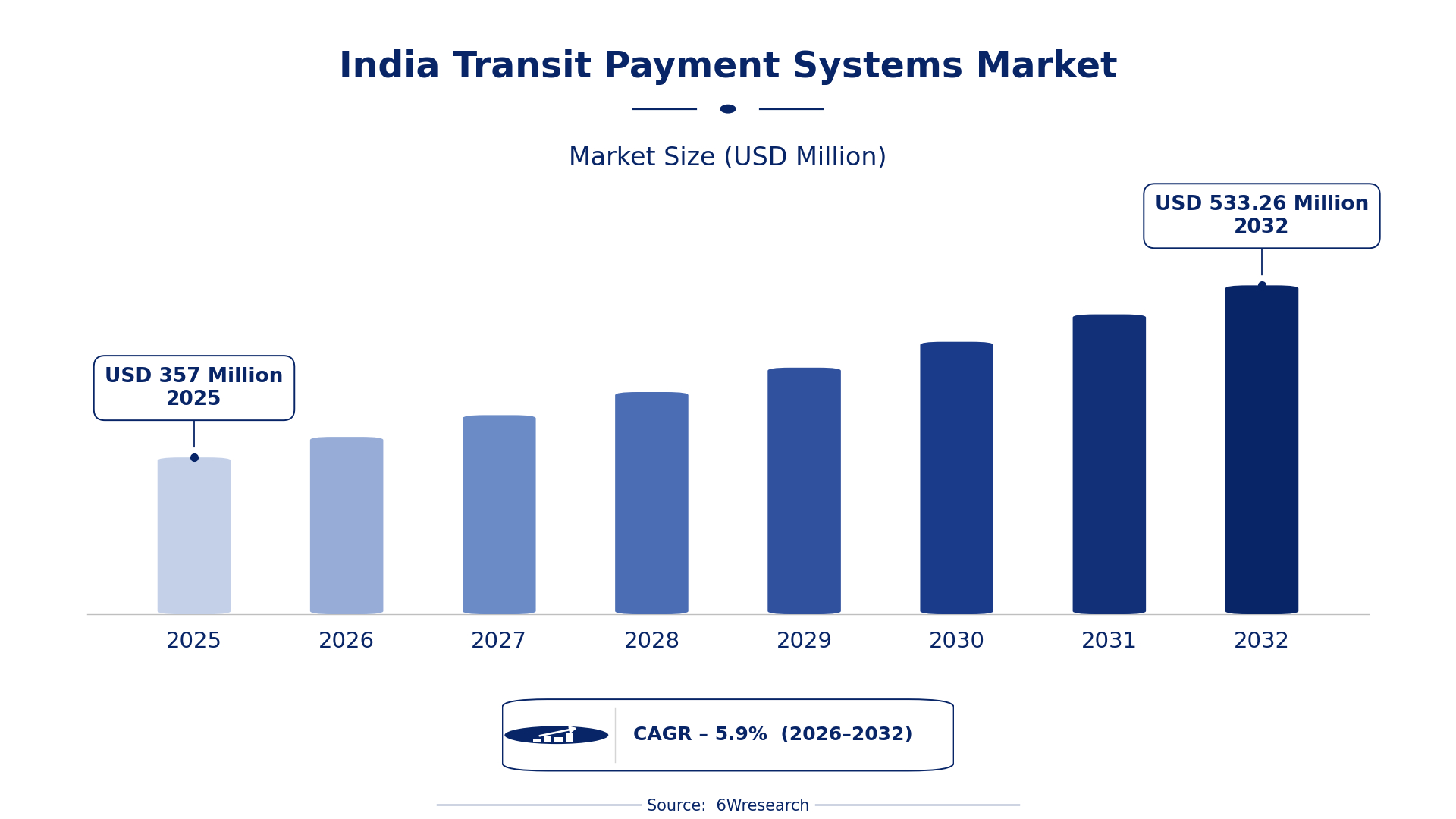
According to 6Wresearch internal database and industry insights, the India Transit Payment Systems Market was valued at USD 357.0 million in 2025 and is projected to reach USD 533.26 million by 2032, growing at a CAGR of approximately 5.9% during 2026–2032.
India Transit Payment Systems Market Highlights
| Report Metric | Details |
| Report Name | India Transit Payment Systems Market |
| Market Size 2025 | USD 357.0 million |
| Market Size 2032 | USD 533.26 million |
| Absolute Growth 2025–2032 | USD 176.26 million |
| CAGR 2026–2032 | 5.9% |
| Peak Annual Growth | 7.5% in 2027 |
| Forecast Period | 2026–2032 |
| Historical Data | 2022–2025 |
| Base Year | 2025 |
| Leading Payment Mode, 2025 | Smart Card Systems (46% share) |
| Leading Technology Used, 2025 | NFC/Contactless (54% share) |
| Leading Transit Medium, 2025 | Metro/Rail (43% share) |
| Leading End User, 2025 | Urban Transport Users (40% share) |
| Fastest-Growing Payment Mode | Mobile Wallets (7.2% CAGR) |
| Fastest-Growing Transit Medium | Bus Networks (8.5% CAGR) |
| Fastest-Growing End User | Commuters (8.0% CAGR) |
| Growing Sector | Urban Transport |
| Key End Users | Urban Transport Users, Commuters, Daily Passengers |
India Transit Payment Systems Market Year-wise Growth Rate and Key Drivers (2022–2032)
This graph illustrates the annual growth rates of the market from 2022 to 2032, highlighting a steady upward trajectory and projected market expansion over the forecast period.
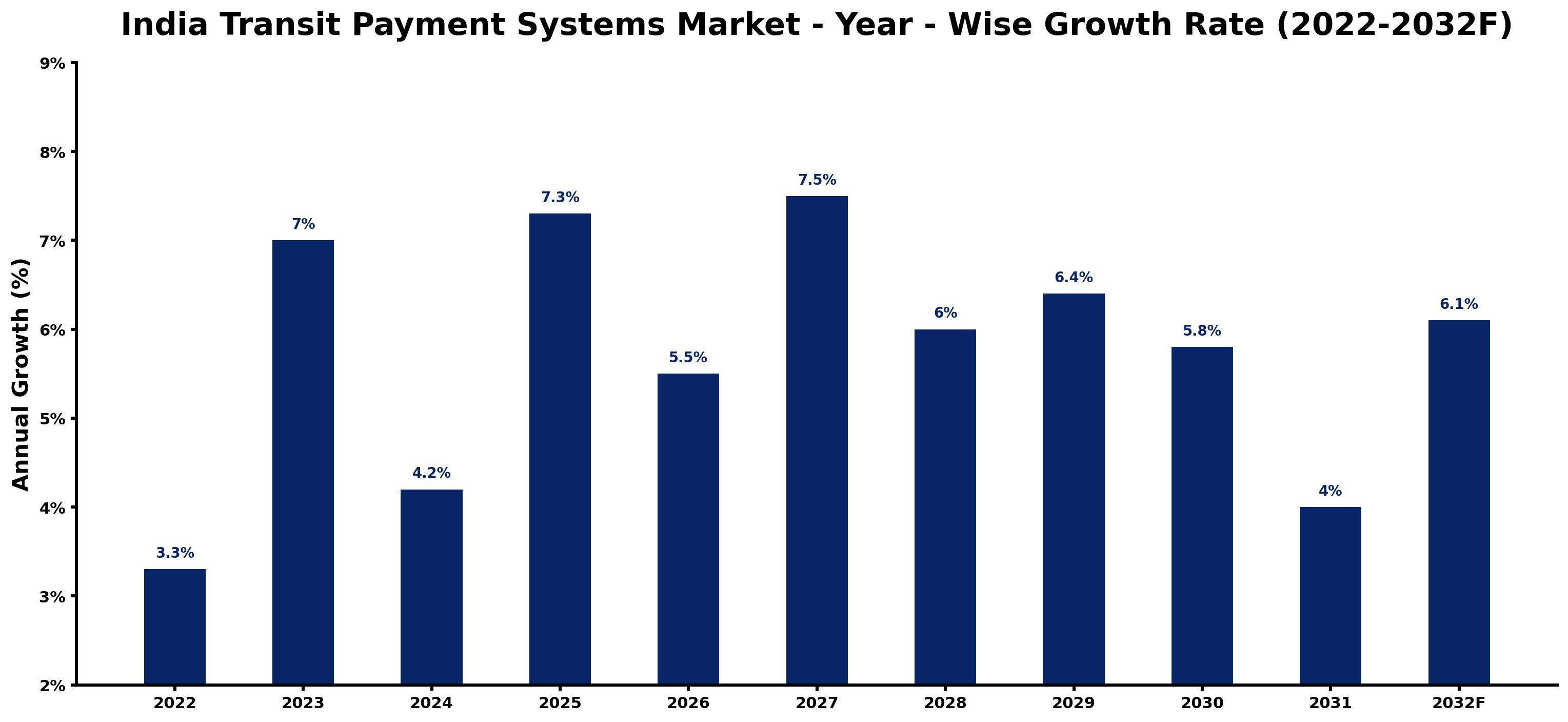
The table below sets out the estimated growth rate for each year and the main factor behind it.
| Year | Estimated Annual Growth (%) | Market Rationale |
| 2022 | 3.3 | The market experienced steady growth due to increasing urbanisation and public transport usage. |
| 2023 | 7.0 | Growth accelerated as urban transport users embraced digital payment solutions. |
| 2024 | 4.2 | The market saw a slowdown as adoption rates stabilised after rapid growth. |
| 2025 | 7.3 | Demand surged again, driven by government initiatives promoting smart payment systems. |
| 2026 | 5.5 | Growth slowed as market maturity began to set in, reflecting earlier rapid expansions. |
| 2027 | 7.5 | The market peaked as NFC/contactless payments gained widespread acceptance among users. |
| 2028 | 6.0 | A slight slowdown occurred as the market adjusted to the peak growth rate. |
| 2029 | 6.4 | Growth resumed as bus networks increasingly adopted modern payment solutions. |
| 2030 | 5.8 | A slowdown followed as market dynamics began to normalise after previous peaks. |
| 2031 | 4.0 | The market continued to grow, albeit at a slower pace, reflecting established trends. |
| 2032 | 6.1 | Growth picked up again as urban transport users increasingly favoured mobile wallets. |
Note: Market size estimations and growth projections presented in this report are based on 6Wresearch's proprietary forecasting methodology, utilizing the latest available industry data, government publications, and primary research inputs.
India Transit Payment Systems Market Synopsis
Transit Payment Systems in India include technologies that facilitate fare collection for public transportation. They simplify fare payments and improve user convenience, primarily through smart card systems and mobile wallets. The India Transit Payment Systems Market is growing due to over 500 million urban transport users and substantial government investment in modernisation. Initiatives such as the National Urban Transport Policy and the Smart Cities Mission are accelerating the adoption of these systems, resulting in increased demand and technological integration.
Market Dynamics Impact Analysis (2026–2032)
| Factor | Type | Impact | Primary Segment Affected |
| Government initiatives promoting smart payment solutions drive adoption. | Driver | High | Smart Card Systems |
| Rapid urbanisation increases the number of urban transport users. | Driver | High | Mobile Wallets |
| The push for cashless transactions creates opportunities for mobile payment solutions. | Opportunity | High | Mobile Wallets |
| Integration of smart payment systems in urban transport presents investment opportunities. | Opportunity | High | Bus Networks |
| Market maturity may slow down growth as adoption stabilises. | Restraint | Medium | NFC/Contactless |
| Regulatory challenges can delay the implementation of new payment technologies. | Restraint | Medium | Smart Card Systems |
| Supply chain disruptions can affect the availability of payment hardware. | Challenge | High | App-Integrated |
| Technological integration challenges may hinder the rollout of new systems. | Challenge | Medium | QR-Based Payments |
Evaluation of Drivers in India Transit Payment Systems Market (2026–2032)
The factors lifting demand, and the evidence behind each, are summarised below.
| Drivers | Primary Segment Affected | Why It Matters (Evidence) |
| Government initiatives like the National Urban Transport Policy promote smart payment solutions. | Smart Card Systems | This policy encourages urban transport authorities to adopt efficient fare collection methods. |
| The increasing number of urban transport users drives demand for convenient payment options. | Mobile Wallets | With over 500 million users, the need for efficient payment systems is paramount. |
| The rise of cashless transactions boosts the appeal of mobile payment systems. | NFC/Contactless | This trend supports the growth of contactless payment technologies in busy transit hubs. |
| Growing bus networks are adopting modern payment solutions to streamline operations. | Bus Networks | Over 1,000 bus routes are now utilising prepaid fare systems, enhancing user convenience. |
| The integration of technology in urban transport systems increases demand for payment solutions. | App-Integrated | Mobile applications improve user experience, driving further adoption of these systems. |
With over 500 million urban transport users, the demand for efficient payment options is substantial. Mobile wallets accounted for 30% of transit payments in 2022, reflecting a shift towards digital transactions. The integration of technology in urban transport systems drives demand for app-integrated solutions, increasing user convenience and satisfaction.
Evaluation of Restraints in India Transit Payment Systems Market
The table below lists the restraints and the evidence behind each.
| Market Restraint | Primary Segment Affected | Why It Matters (Evidence) |
| Market maturity may slow down growth as adoption stabilises. | NFC/Contactless | As users become accustomed to existing technologies, the pace of new adoption may decrease. |
| Regulatory challenges can delay the implementation of new payment technologies. | Smart Card Systems | Complex approval processes can hinder timely deployment of advanced payment solutions. |
| Supply chain disruptions can affect the availability of payment hardware. | App-Integrated | Dependence on specific components may lead to delays in system rollouts. |
| Technological integration challenges may hinder the rollout of new systems. | QR-Based Payments | Compatibility issues with existing infrastructure can slow down adoption rates. |
| User resistance to change can limit the uptake of new payment methods. | Mobile Wallets | Some users prefer traditional payment methods, impacting overall market growth. |
India Transit Payment Systems Market Challenges
India's transit payment systems market faces regulatory challenges, as compliance with ISO 24014 standards can delay system implementations for up to six months, hindering producers' ability to introduce new technologies. Financial constraints arise from the substantial investment required for infrastructure, with urban transport modernisation needing INR 1,000 crores, which places a burden on local governments and slows project rollouts. Supply chain issues persist due to the limited availability of integrated solutions, causing delays for distributors who must navigate fragmented offerings across various cities. Technology adoption remains slow, with only 30% of transit payments made through mobile wallets in 2022, limiting convenience for users and restricting broader usage.
Trends in the India Transit Payment Systems Market
Four trends stand out in the India Transit Payment Systems Market.
- Shift towards Mobile Wallets: The adoption of mobile wallets is on the rise, with 30% of transit payments in 2022 attributed to this method. This trend highlights a growing preference for convenience among urban transport users.
- Integration of Smart Payment Systems in Bus Networks: Maharashtra's smart city project is focused on integrating payment systems in bus networks, with over 1,000 routes implementing prepaid fare systems. This initiative enhances user experience and operational efficiency.
- Rise of NFC/Contactless Payments: NFC/contactless payments are projected to grow by 25% in the next five years, driven by user demand for quicker transactions. This trend is evident in major metropolitan areas across India.
- Government Support for Digital Payments: The Digital India initiative promotes cashless transactions in public transport, improving user convenience. This programme is expected to significantly boost the adoption of digital payment methods.
Investment Opportunities in the India Transit Payment Systems Market
Investors looking at the India Transit Payment Systems Market should consider the following areas.
- Investment in Mobile Payment Solutions: With mobile wallets accounting for 30% of transit payments, there exists a strong opportunity for investment in this sector. Urban transport authorities are increasingly pursuing modern payment solutions.
- Expansion of Smart Card Systems: As smart card systems are widely adopted, there is an opportunity to improve these technologies. Urban transport users are seeking more efficient fare collection methods, especially in metropolitan areas.
- Development of Integrated Payment Platforms: The ongoing integration of smart payment systems reveals a gap in the market. Urban transport authorities are eager to adopt comprehensive solutions that streamline fare collection.
- Partnerships for Technology Adoption: The current market climate encourages partnerships for technology adoption. Collaborating with local authorities can facilitate entry into the expanding transit payment systems market.
Government Initiatives in the India Transit Payment Systems Market
The National Urban Transport Policy 2020, introduced by the Ministry of Housing and Urban Affairs, aims to improve urban mobility through smart technologies and sustainable practices. This policy encourages the adoption of integrated transit payment systems, facilitating cashless transactions in public transport. The Smart Cities Mission, initiated in 2015, focuses on developing urban areas with advanced infrastructure, including payment systems. By 2025, the mission aims to improve urban mobility through technology, further promoting the adoption of smart payment solutions.
The Ministry of Housing and Urban Affairs oversees urban transport initiatives, funding projects that integrate smart payment systems. The Digital India initiative promotes cashless transactions, improving user convenience in public transport. The Ministry of Railways is also involved, launching the National Rail Plan 2020 to improve passenger services, including payment systems by 2030. These agencies work together to streamline the implementation of modern payment technologies in urban transport.
Future Insight of the India Transit Payment Systems Market
The transit payment systems market in India is set for transformation by 2032, driven by government initiatives like the National Smart Cities Mission, which aims to improve urban mobility through technology. The expected growth of NFC/contactless payments by 25% over the next five years will facilitate faster transactions for users. Increased integration of smart card systems will simplify fare collection, as demonstrated by over 10 million cards issued in Delhi Metro. Ongoing smart city projects in Maharashtra will further modernise urban transport payment solutions.
Market Segmentation Analysis
The report offers a comprehensive study of the following market segments and their leading categories in the market.
By Payment Mode – Smart Card Systems Dominated, Mobile Wallets Expected to Grow Fastest
According to Vasudha, AM at 6Wresearch, with a 46% revenue share in 2025, Smart Card Systems was the largest payment mode category. Smart card systems dominate the market due to their extensive use in metro and rail services, with over 10 million cards issued in Delhi Metro alone. This widespread adoption provides a robust infrastructure that supports their leading market share in India. Mobile Wallets are set to record the highest CAGR in this split, 7.2% over 2026–2032. Mobile wallets are experiencing remarkable growth, accounting for 30% of transit payments in 2022, as users increasingly favour the convenience of digital transactions. This shift towards mobile payments is expected to further enhance their market position in the coming years. Suppliers should focus on developing mobile wallet solutions to meet the rising demand for digital payment options among urban transport users.
By Technology Used – NFC/Contactless Dominated and Is Expected to Record the Fastest Growth
NFC/Contactless held a 54% share of the India Transit Payment Systems Market by technology used in 2025. NFC/contactless technology holds the largest market share as it facilitates fast transactions in busy transit hubs, making it ideal for urban transport systems. Its widespread adoption in various transit modes underscores its importance in the market. The same category is also set to grow fastest, at a CAGR of 7.8% during 2026–2032. NFC/contactless technology is also the fastest-growing segment, with an expected growth rate of 25% in the next five years, as users increasingly seek efficient payment methods. This dual role will likely strengthen its market position further. Suppliers must invest in NFC/contactless solutions to meet the rising demand for efficient transit payment technologies.
By Transit Medium – Metro/Rail Dominated, Bus Networks Expected to Grow Fastest
In 2025, Metro/Rail led the transit medium split with a 43% share. Metro and rail systems lead the market as the primary modes of transport using transit payment systems, catering to a vast number of urban commuters. Their established infrastructure and significant user base ensure a consistent demand for effective payment solutions. The quickest growth will come from Bus Networks, forecast to expand at a CAGR of 8.5% between 2026 and 2032. Bus networks are rapidly adopting modern payment technologies, reflecting a notable shift towards improved fare collection methods in public transport. This growth is driven by government initiatives aimed at enhancing urban mobility through integrated solutions. Suppliers should target bus networks to capitalise on the ongoing transformation in transit payment systems and expand their market presence.
By End User – Urban Transport Users Dominated, Commuters Expected to Grow Fastest
Urban Transport Users accounted for a 40% market share by end user in 2025. Urban transport users represent the largest demographic benefiting from transit payment systems, with over 500 million users in India as of 2023. Their daily reliance on these systems for commuting solidifies their substantial market share. Over 2026–2032, Commuters are expected to post the fastest growth, at a CAGR of 8.0%. Commuters are the fastest-growing segment, indicating a rising demand for efficient fare collection methods in public transport. This trend underscores the need for more streamlined and user-friendly payment solutions to cater to their needs. Suppliers should tailor their offerings to specifically address the requirements of commuters, enhancing user satisfaction and improving market penetration.
Key Attractiveness of the Report
- 10 Years of Market Numbers
- Historical Data Starting from 2022 to 2025
- Base Year 2025
- Forecast Data until 2032
- Key Performance Indicators Impacting the Market
- Major Upcoming Developments and Projects
Key Highlights of the Report:
- India Transit Payment Systems Market Outlook
- Market Size of India Transit Payment Systems Market, 2025
- Forecast of India Transit Payment Systems Market, 2032
- Historical Data and Forecast of India Transit Payment Systems Revenues & Volume for the Period 2022 - 2032F
- India Transit Payment Systems Market Trend Evolution
- India Transit Payment Systems Market Drivers and Challenges
- India Transit Payment Systems Price Trends
- India Transit Payment Systems Porter's Five Forces
- India Transit Payment Systems Industry Life Cycle
- Historical Data and Forecast of India Transit Payment Systems Market Revenues & Volume By Payment Mode for the Period 2022 - 2032F
- Historical Data and Forecast of India Transit Payment Systems Market Revenues & Volume By Smart Card Systems for the Period 2022 - 2032F
- Historical Data and Forecast of India Transit Payment Systems Market Revenues & Volume By Mobile Wallets for the Period 2022 - 2032F
- Historical Data and Forecast of India Transit Payment Systems Market Revenues & Volume By QR-Based Payments for the Period 2022 - 2032F
- Historical Data and Forecast of India Transit Payment Systems Market Revenues & Volume By Prepaid Fare Systems for the Period 2022 - 2032F
- Historical Data and Forecast of India Transit Payment Systems Market Revenues & Volume By Technology Used for the Period 2022 - 2032F
- Historical Data and Forecast of India Transit Payment Systems Market Revenues & Volume By NFC/Contactless for the Period 2022 - 2032F
- Historical Data and Forecast of India Transit Payment Systems Market Revenues & Volume By App-Integrated for the Period 2022 - 2032F
- Historical Data and Forecast of India Transit Payment Systems Market Revenues & Volume By Optical Scanning for the Period 2022 - 2032F
- Historical Data and Forecast of India Transit Payment Systems Market Revenues & Volume By Stored Value Cards for the Period 2022 - 2032F
- Historical Data and Forecast of India Transit Payment Systems Market Revenues & Volume By Transit Medium for the Period 2022 - 2032F
- Historical Data and Forecast of India Transit Payment Systems Market Revenues & Volume By Metro/Rail for the Period 2022 - 2032F
- Historical Data and Forecast of India Transit Payment Systems Market Revenues & Volume By Bus Networks for the Period 2022 - 2032F
- Historical Data and Forecast of India Transit Payment Systems Market Revenues & Volume By Shared Mobility for the Period 2022 - 2032F
- Historical Data and Forecast of India Transit Payment Systems Market Revenues & Volume By Suburban Rail for the Period 2022 - 2032F
- Historical Data and Forecast of India Transit Payment Systems Market Revenues & Volume By End User for the Period 2022 - 2032F
- Historical Data and Forecast of India Transit Payment Systems Market Revenues & Volume By Urban Transport Users for the Period 2022 - 2032F
- Historical Data and Forecast of India Transit Payment Systems Market Revenues & Volume By Commuters for the Period 2022 - 2032F
- Historical Data and Forecast of India Transit Payment Systems Market Revenues & Volume By Taxi Riders for the Period 2022 - 2032F
- Historical Data and Forecast of India Transit Payment Systems Market Revenues & Volume By Daily Passengers for the Period 2022 - 2032F
- India Transit Payment Systems Import Export Trade Statistics
- Market Opportunity Assessment By Payment Mode
- Market Opportunity Assessment By Technology Used
- Market Opportunity Assessment By Transit Medium
- Market Opportunity Assessment By End User
- India Transit Payment Systems Top Companies Market Share
- India Transit Payment Systems Competitive Benchmarking By Technical and Operational Parameters
- India Transit Payment Systems Company Profiles
- India Transit Payment Systems Key Strategic Recommendations
Market Covered
This report examines the market across the segments below.
By Payment Mode
- Smart Card Systems
- Mobile Wallets
- QR-Based Payments
- Prepaid Fare Systems
By Technology Used
- NFC/Contactless
- App-Integrated
- Optical Scanning
- Stored Value Cards
By Transit Medium
- Metro/Rail
- Bus Networks
- Shared Mobility
- Suburban Rail
By End User
- Urban Transport Users
- Commuters
- Taxi Riders
- Daily Passengers































