India Tropical Disease Market Size & Growth Rate
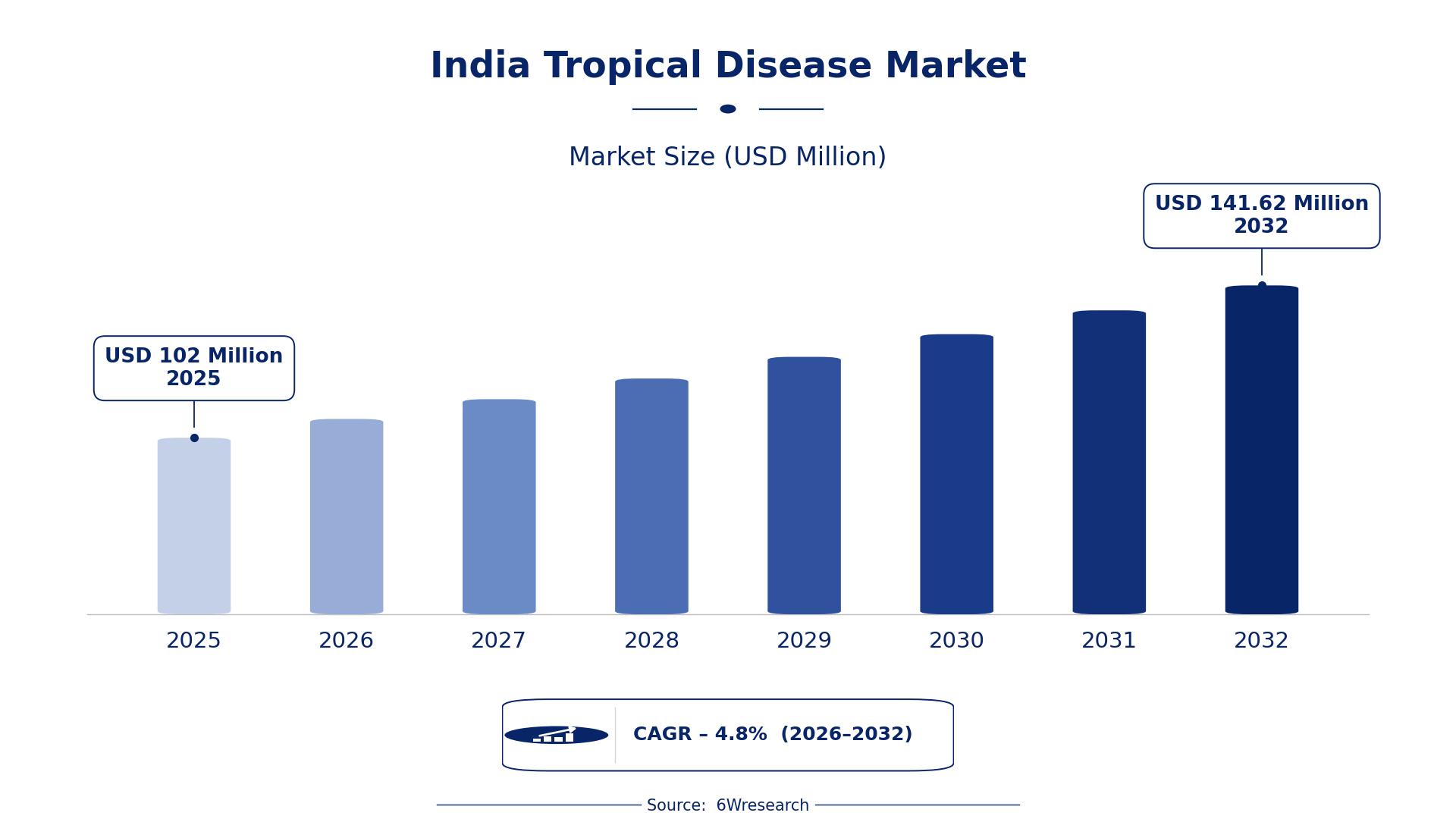
According to 6Wresearch internal database and industry insights, the India Tropical Disease Market was valued at USD 102.0 million in 2025 and is projected to reach USD 141.62 million by 2032, growing at a CAGR of approximately 4.8% during 2026–2032.
India Tropical Disease Market Highlights
| Report Metric | Details |
| Report Name | India Tropical Disease Market |
| Market Size 2025 | USD 102.0 million |
| Market Size 2032 | USD 141.62 million |
| Absolute Growth 2025–2032 | USD 39.62 million |
| CAGR 2026–2032 | 4.8% |
| Peak Annual Growth | 7.3% in 2029 |
| Forecast Period | 2026–2032 |
| Historical Data | 2022–2025 |
| Base Year | 2025 |
| Leading Disease Category, 2025 | Neglected Tropical Diseases (44% share) |
| Leading Transmission Mode, 2025 | Vector-Borne (Mosquito) (36% share) |
| Leading Risk Geography, 2025 | South Asia (41% share) |
| Leading End User, 2025 | National Health Bodies (38% share) |
| Fastest-Growing Transmission Mode | Contact/Waterborne (6.0% CAGR) |
| Fastest-Growing Risk Geography | Tropics & Equator Zones (6.4% CAGR) |
| Fastest-Growing End User | WHO & NGOs (6.0% CAGR) |
| Growing Sector | Public Health Initiatives |
| Key End Users | National Health Bodies, WHO & NGOs, Hospitals, UN Health Programs |
India Tropical Disease Market Year-wise Growth Rate and Key Drivers (2022–2032)
This graph illustrates the annual growth rates of the market from 2022 to 2032, highlighting a steady upward trajectory and projected market expansion over the forecast period.
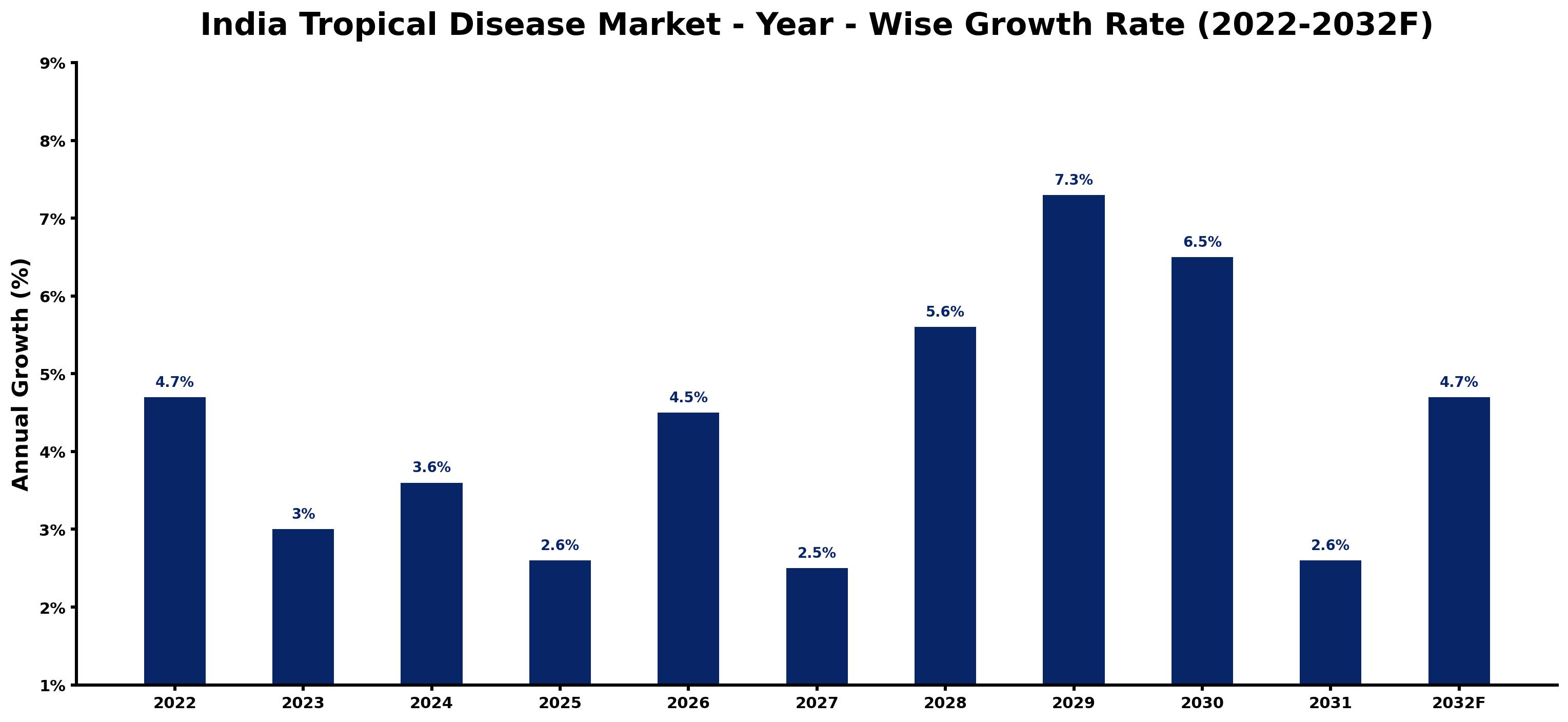
The table below sets out the estimated growth rate for each year and the main factor behind it.
| Year | Estimated Annual Growth (%) | Market Rationale |
| 2022 | 4.7 | The market showed strong activity, driven by the National Health Mission's focus on disease management programs. |
| 2023 | 3.0 | Growth slowed due to a temporary decrease in funding from the National Vector Borne Disease Control Programme. |
| 2024 | 3.6 | Increased public health campaigns led to a rise in disease management efforts and spending. |
| 2025 | 2.6 | A reduction in growth occurred as health resources were reallocated to other priorities. |
| 2026 | 4.5 | Improved disease surveillance systems are expected to boost market growth through the Integrated Disease Surveillance Programme. |
| 2027 | 2.5 | Funding limitations for health programs will lead to a slowdown in growth rates. |
| 2028 | 5.6 | A resurgence in public health efforts is projected to result in increased investments in disease management through the National Health Mission. |
| 2029 | 7.3 | The peak growth year will be driven by the successful implementation of health initiatives under the National Vector Borne Disease Control Programme. |
| 2030 | 6.5 | Growth is expected to slow as the market begins to stabilise after peak investment years in disease control. |
| 2031 | 2.6 | A further slowdown is projected due to resource constraints in health management from national health bodies. |
| 2032 | 4.7 | Growth will pick up again as new initiatives are launched to combat tropical diseases through the Indian Council of Medical Research. |
Note: Market size estimations and growth projections presented in this report are based on 6Wresearch's proprietary forecasting methodology, utilizing the latest available industry data, government publications, and primary research inputs.
India Tropical Disease Market Synopsis
The Tropical Disease Market in India includes illnesses caused by pathogens such as parasites and viruses, primarily transmitted through vectors. The market is set to expand as the National Health Mission targets a 30% reduction in the burden of tropical diseases by 2025. The emphasis on neglected tropical diseases and vector control initiatives propels further growth.
Market Dynamics Impact Analysis (2026–2032)
| Factor | Type | Impact | Primary Segment Affected |
| Increased funding for disease control initiatives | Driver | High | National Health Bodies |
| Rising public health campaigns | Driver | High | WHO & NGOs |
| Growing need for disease management services | Opportunity | High | Hospitals |
| Investment in vector control technologies | Opportunity | Medium | National Health Bodies |
| Limited healthcare access in rural areas | Restraint | High | Parasitic Infections |
| Inadequate water supply affecting disease spread | Restraint | Medium | Contact/Waterborne |
| Resource constraints in health management | Challenge | High | National Health Bodies |
| Slow adoption of new treatment protocols | Challenge | Medium | Hospitals |
Evaluation of Drivers in India Tropical Disease Market (2026–2032)
The table below links each growth driver to the segment it affects and the evidence for it.
| Drivers | Primary Segment Affected | Why It Matters (Evidence) |
| Increased funding for disease control initiatives | National Health Bodies | The National Health Mission allocated ₹1,000 crores to combat tropical diseases, boosting treatment and prevention efforts. |
| Rising public health campaigns | WHO & NGOs | Public health campaigns have increased awareness and access to treatment, leading to higher demand for disease management services. |
| Investment in vector control technologies | National Health Bodies | The National Vector Borne Disease Control Programme's budget supports advanced vector control measures, driving purchases of related technologies. |
| Growing need for disease management services | Hospitals | With over 300 million people at risk of lymphatic filariasis, hospitals are expanding their services to meet the rising demand for tropical disease treatment. |
| Enhanced disease surveillance systems | Neglected Tropical Diseases | The Integrated Disease Surveillance Programme improves monitoring, prompting increased investments in disease management. |
The National Health Mission allocated ₹1,000 crores to combat malaria and dengue, boosting treatment and prevention efforts. Public health campaigns have raised awareness, resulting in a surge in demand for disease management services. With over 300 million people at risk of lymphatic filariasis, hospitals are expanding their offerings to cater to their needs.
Evaluation of Restraints in India Tropical Disease Market
The following restraints limit how fast demand can grow.
| Market Restraint | Primary Segment Affected | Why It Matters (Evidence) |
| Limited healthcare access in rural areas | Parasitic Infections | Many rural populations lack access to healthcare facilities, hindering effective disease management and treatment. |
| Inadequate water supply affecting disease spread | Contact/Waterborne | Poor water supply in certain regions contributes to the spread of tropical diseases, complicating prevention efforts. |
| Resource constraints in health management | National Health Bodies | Limited funding and resources restrict the ability of national health bodies to implement effective disease control measures. |
| Slow adoption of new treatment protocols | Hospitals | Hospitals face challenges in adopting new treatment protocols due to training and resource limitations. |
| Insufficient public awareness programs | Viral Infections | Lack of awareness programs hinders early detection and treatment of viral infections, affecting overall disease management. |
India Tropical Disease Market Challenges
Malaria management in the India Tropical Disease Market faces a notable cost issue, with 1.5 million reported cases in 2021 straining healthcare budgets for public health officials. Limited technological advancements in disease surveillance hinder timely responses, delaying effective control measures for healthcare providers. Buyers managing the risk of lymphatic filariasis, which affects over 300 million individuals, encounter challenges in resource allocation, increasing pressure on health systems. Supply chain disruptions complicate access to essential treatments, as the Indian government aims for kala-azar elimination by 2025, creating urgency for timely access to medications.
Trends in the India Tropical Disease Market
Buyers and suppliers in the India Tropical Disease Market are adjusting to the following trends.
- Shift towards Integrated Disease Surveillance: India is adopting a more integrated approach to disease surveillance, which enhances response capabilities. The Integrated Disease Surveillance Programme, launched in 2022, aims to improve monitoring across states with a budget of ₹500 crores.
- Increased focus on Vector Control Technologies: National Health Bodies are prioritising investments in vector control technologies to address diseases like malaria. The National Vector Borne Disease Control Programme reported a 40% reduction in dengue cases in 2022, demonstrating the effectiveness of these technologies.
- Expansion of Public Health Campaigns: Public health campaigns have grown significantly, focusing on tropical disease awareness and prevention. The National Health Mission aims to reduce tropical disease incidence by 30% by 2025, reflecting a commitment to improving public health.
- Growing Collaboration with International Health Organisations: India is increasingly partnering with WHO and NGOs for tropical disease management. The WHO's Global Programme to Eliminate Lymphatic Filariasis receives active support, benefiting millions at risk.
Investment Opportunities in the India Tropical Disease Market
Below are the investment opportunities with the strongest case in the India Tropical Disease Market.
- Investment in Vector Control Technologies: There is a gap in vector control technologies, with the National Vector Borne Disease Control Programme allocating ₹1,000 crores for malaria and dengue elimination. Suppliers can enter through partnerships with local health bodies.
- Expansion of Disease Management Services: With over 300 million individuals at risk, hospitals need to broaden their disease management services. Collaborating with national health bodies can facilitate this expansion and improve patient outcomes.
- Development of Public Health Campaigns: The National Health Mission's target to reduce tropical disease incidence by 30% by 2025 presents an opportunity for organisations to create public health campaigns. Local partnerships can enhance outreach and effectiveness.
- Research and Development in Tropical Disease Treatments: The Indian Council of Medical Research is actively engaged in tropical disease research, highlighting a need for new treatments. Investing in R&D can lead to breakthroughs in disease management.
Government Initiatives in the India Tropical Disease Market
The Ministry of Health and Family Welfare oversees the implementation of various health initiatives, including the Integrated Disease Surveillance Programme, which improves disease monitoring and response capabilities. This programme funds state-level initiatives to enhance disease tracking and management, ensuring timely interventions and resource allocation. The National Centre for Disease Control plays a critical role in outbreak response, approving funding for emergency health measures and supporting local health bodies in managing disease outbreaks.
The National Health Mission, launched in 2020, aims to reduce tropical disease incidence by 30% by 2025 through improved surveillance and treatment programs. This initiative focuses on enhancing healthcare access and resource allocation, benefiting populations at risk. The Ministry of Health and Family Welfare collaborates with various agencies to implement these measures, ensuring effective management of tropical diseases.
Future Insight of the India Tropical Disease Market
By 2032, buyers and suppliers in the India Tropical Disease Market can anticipate substantial improvements in disease management, driven by enhanced surveillance technologies and targeted government health initiatives. The National Health Mission's commitment to reducing the tropical disease burden will lead to increased funding for research and treatment programs. Collaboration with international health organisations will streamline efforts to eliminate lymphatic filariasis. The Indian government's goal to eradicate malaria by 2030 will promote advancements in vector control, improving treatment accessibility for affected populations.
Market Segmentation Analysis
The analysis below covers each segmentation, its leading category in 2025 and its fastest-growing category through 2032.
By Disease Category – Neglected Tropical Diseases Dominated and Is Expected to Record the Fastest Growth
According to Vasudha, AM at 6Wresearch, in 2025, Neglected Tropical Diseases led the disease category split with a 44% share. Neglected tropical diseases hold the largest share due to their significant impact on populations with limited healthcare access, particularly in rural areas. The National Health Mission's initiatives aim to reduce the burden of these diseases by 30% by 2025, highlighting their importance in public health. Its lead should widen, with a projected CAGR of 6.7% during 2026–2032, the highest in this split. The growth of neglected tropical diseases is propelled by increasing awareness and targeted health initiatives, as evidenced by the Indian government's commitment to eliminate diseases like kala-azar by 2025. This focus on neglected diseases ensures that their lead in market share will continue to widen. Suppliers should align their strategies with government health initiatives to effectively address the growing demand for tropical disease management.
By Transmission Mode – Vector-Borne (Mosquito) Dominated, Contact/Waterborne Expected to Grow Fastest
Vector-Borne (Mosquito) took a 36% share of transmission mode in 2025, more than any other category. Vector-borne (mosquito) diseases dominate the market share as they are the primary transmission mode for illnesses such as malaria and dengue, which are prevalent in India. The National Vector Borne Disease Control Programme's efforts have significantly reduced dengue cases, underscoring the importance of this transmission mode. The quickest growth will come from Contact/Waterborne, forecast to expand at a CAGR of 6.0% between 2026 and 2032. Contact/waterborne diseases are experiencing rapid growth due to inadequate water supply in many regions, which exacerbates the spread of these illnesses. This segment's expansion indicates a need for improved water management and sanitation solutions. Buyers must prioritise investments in water management solutions to mitigate the rising threat of contact and waterborne diseases.
By Risk Geography – South Asia Dominated, Tropics & Equator Zones Expected to Grow Fastest
South Asia accounted for a 41% market share by risk geography in 2025. South Asia leads in market share as it encompasses India and neighbouring countries facing similar tropical disease challenges, with a large population at risk. The region's health initiatives are crucial in addressing these widespread health issues. Over 2026–2032, Tropics & Equator Zones are expected to post the fastest growth, at a CAGR of 6.4%. Tropics and equator zones are witnessing the fastest growth due to their high prevalence of tropical diseases, driven by environmental factors and population density. This growth reflects the urgent need for targeted health interventions in these areas. Suppliers should focus on expanding their reach in tropical and equatorial regions to capitalise on the growing demand for disease management solutions.
By End User – National Health Bodies Dominated, WHO & NGOs Expected to Grow Fastest
National Health Bodies held a 38% share of the India Tropical Disease Market by end user in 2025. National health bodies command the largest market share as they are responsible for implementing health policies and managing disease control programs across the country. Their central role in public health initiatives ensures a steady demand for tropical disease management solutions. WHO & NGOs are set to record the highest CAGR in this split, 6.0% over 2026–2032. WHO and NGOs are the fastest-growing end users, actively involved in funding and managing disease control initiatives, particularly in underserved areas. Their increasing engagement indicates a shift towards collaborative efforts in tackling tropical diseases. Suppliers should consider partnerships with WHO and NGOs to enhance their market presence and align with global health priorities.
Key Attractiveness of the Report
- 10 Years of Market Numbers
- Historical Data Starting from 2022 to 2025
- Base Year 2025
- Forecast Data until 2032
- Key Performance Indicators Impacting the Market
- Major Upcoming Developments and Projects
Key Highlights of the Report:
- India Tropical Disease Market Outlook
- Market Size of India Tropical Disease Market, 2025
- Forecast of India Tropical Disease Market, 2032
- Historical Data and Forecast of India Tropical Disease Revenues & Volume for the Period 2022 - 2032F
- India Tropical Disease Market Trend Evolution
- India Tropical Disease Market Drivers and Challenges
- India Tropical Disease Price Trends
- India Tropical Disease Porter's Five Forces
- India Tropical Disease Industry Life Cycle
- Historical Data and Forecast of India Tropical Disease Market Revenues & Volume By Disease Category for the Period 2022 - 2032F
- Historical Data and Forecast of India Tropical Disease Market Revenues & Volume By Parasitic Infections for the Period 2022 - 2032F
- Historical Data and Forecast of India Tropical Disease Market Revenues & Volume By Viral Infections for the Period 2022 - 2032F
- Historical Data and Forecast of India Tropical Disease Market Revenues & Volume By Bacterial Infections for the Period 2022 - 2032F
- Historical Data and Forecast of India Tropical Disease Market Revenues & Volume By Neglected Tropical Diseases for the Period 2022 - 2032F
- Historical Data and Forecast of India Tropical Disease Market Revenues & Volume By Transmission Mode for the Period 2022 - 2032F
- Historical Data and Forecast of India Tropical Disease Market Revenues & Volume By Vector-Borne (Mosquito) for the Period 2022 - 2032F
- Historical Data and Forecast of India Tropical Disease Market Revenues & Volume By Contact/Waterborne for the Period 2022 - 2032F
- Historical Data and Forecast of India Tropical Disease Market Revenues & Volume By Contaminated Water for the Period 2022 - 2032F
- Historical Data and Forecast of India Tropical Disease Market Revenues & Volume By Multi-Pathogen for the Period 2022 - 2032F
- Historical Data and Forecast of India Tropical Disease Market Revenues & Volume By Risk Geography for the Period 2022 - 2032F
- Historical Data and Forecast of India Tropical Disease Market Revenues & Volume By Africa, South Asia for the Period 2022 - 2032F
- Historical Data and Forecast of India Tropical Disease Market Revenues & Volume By Tropics & Equator Zones for the Period 2022 - 2032F
- Historical Data and Forecast of India Tropical Disease Market Revenues & Volume By Coastal Regions for the Period 2022 - 2032F
- Historical Data and Forecast of India Tropical Disease Market Revenues & Volume By Poor Infrastructure Zones for the Period 2022 - 2032F
- Historical Data and Forecast of India Tropical Disease Market Revenues & Volume By End User for the Period 2022 - 2032F
- Historical Data and Forecast of India Tropical Disease Market Revenues & Volume By WHO & NGOs for the Period 2022 - 2032F
- Historical Data and Forecast of India Tropical Disease Market Revenues & Volume By National Health Bodies for the Period 2022 - 2032F
- Historical Data and Forecast of India Tropical Disease Market Revenues & Volume By Hospitals for the Period 2022 - 2032F
- Historical Data and Forecast of India Tropical Disease Market Revenues & Volume By UN Health Programs for the Period 2022 - 2032F
- India Tropical Disease Import Export Trade Statistics
- Market Opportunity Assessment By Disease Category
- Market Opportunity Assessment By Transmission Mode
- Market Opportunity Assessment By Risk Geography
- Market Opportunity Assessment By End User
- India Tropical Disease Top Companies Market Share
- India Tropical Disease Competitive Benchmarking By Technical and Operational Parameters
- India Tropical Disease Company Profiles
- India Tropical Disease Key Strategic Recommendations
Market Covered
This report examines the market across the segments below.
By Disease Category
- Parasitic Infections
- Viral Infections
- Bacterial Infections
- Neglected Tropical Diseases
By Transmission Mode
- Vector-Borne (Mosquito)
- Contact/Waterborne
- Contaminated Water
- Multi-Pathogen
By Risk Geography
- Africa
- South Asia
- Tropics & Equator Zones
- Coastal Regions
- Poor Infrastructure Zones
By End User
- WHO & NGOs
- National Health Bodies
- Hospitals
- UN Health Programs































