India UAV Avionics Market Size & Growth Rate
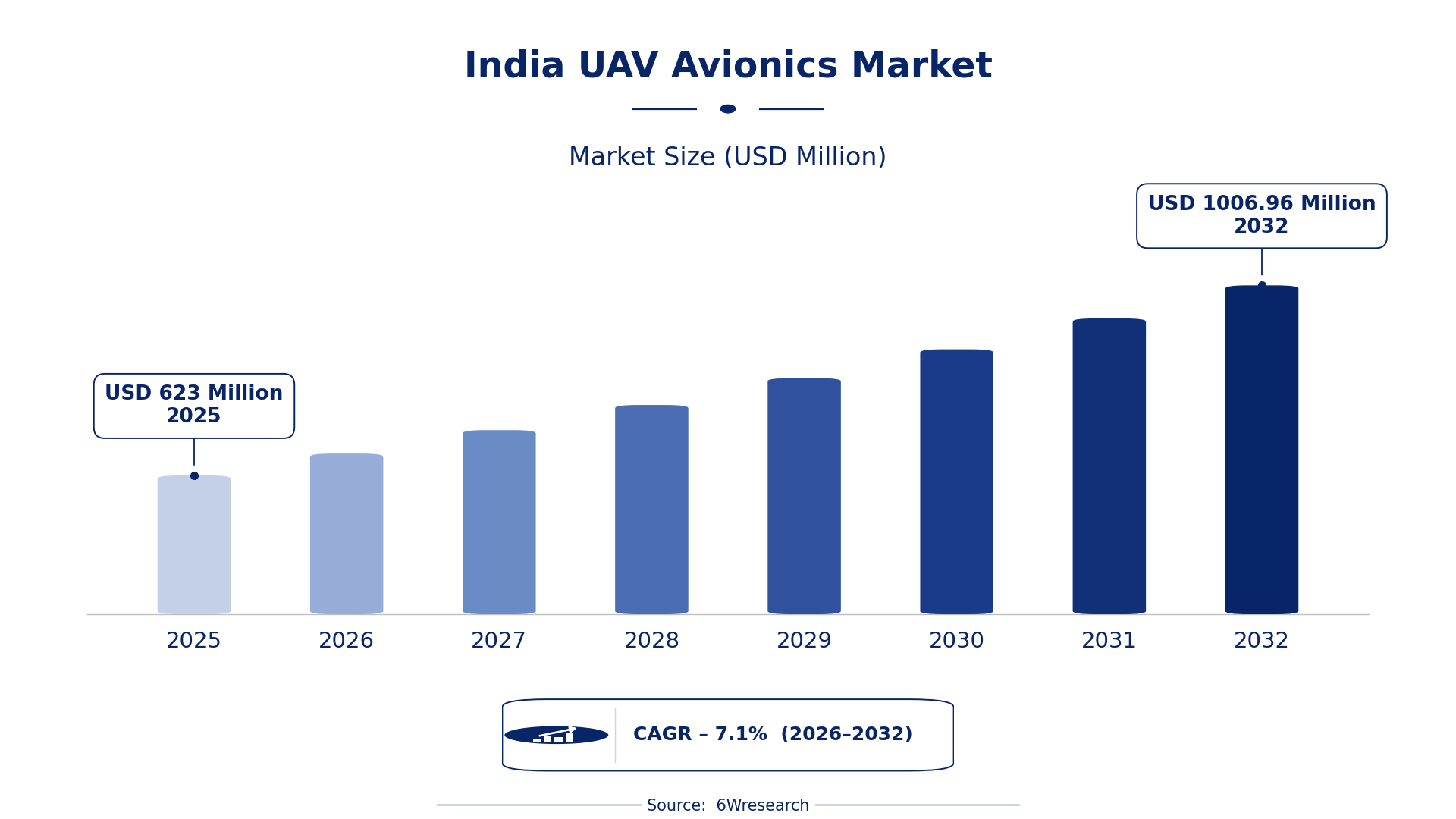
According to 6Wresearch internal database and industry insights, the India UAV Avionics Market was valued at USD 623.0 million in 2025 and is projected to reach USD 1,006.96 million by 2032, growing at a CAGR of approximately 7.1% during 2026–2032.
India UAV Avionics Market Highlights
| Report Metric | Details |
| Report Name | India UAV Avionics Market |
| Market Size 2025 | USD 623.0 million |
| Market Size 2032 | USD 1,006.96 million |
| Absolute Growth 2025–2032 | USD 383.96 million |
| CAGR 2026–2032 | 7.1% |
| Peak Annual Growth | 9.1% in 2029 |
| Forecast Period | 2026–2032 |
| Historical Data | 2022–2025 |
| Base Year | 2025 |
| Leading Avionics Type, 2025 | Flight Control Computers (50% share) |
| Leading UAV Type, 2025 | Medium-Large UAVs (43% share) |
| Leading Functionality, 2025 | Data Link & Control (39% share) |
| Leading End User, 2025 | Military Users (42% share) |
| Fastest-Growing Avionics Type | Navigation Systems (9.7% CAGR) |
| Fastest-Growing UAV Type | ISR UAVs (9.5% CAGR) |
| Fastest-Growing Functionality | Sensor Coordination (8.9% CAGR) |
| Fastest-Growing End User | UAV OEMs (9.4% CAGR) |
| Growing Sector | UAV OEMs |
| Key End Users | Military Users, UAV OEMs, Defense Contractors, Avionics Integrators |
India UAV Avionics Market Year-wise Growth Rate and Key Drivers (2022–2032)
This graph illustrates the annual growth rates of the market from 2022 to 2032, highlighting a steady upward trajectory and projected market expansion over the forecast period.
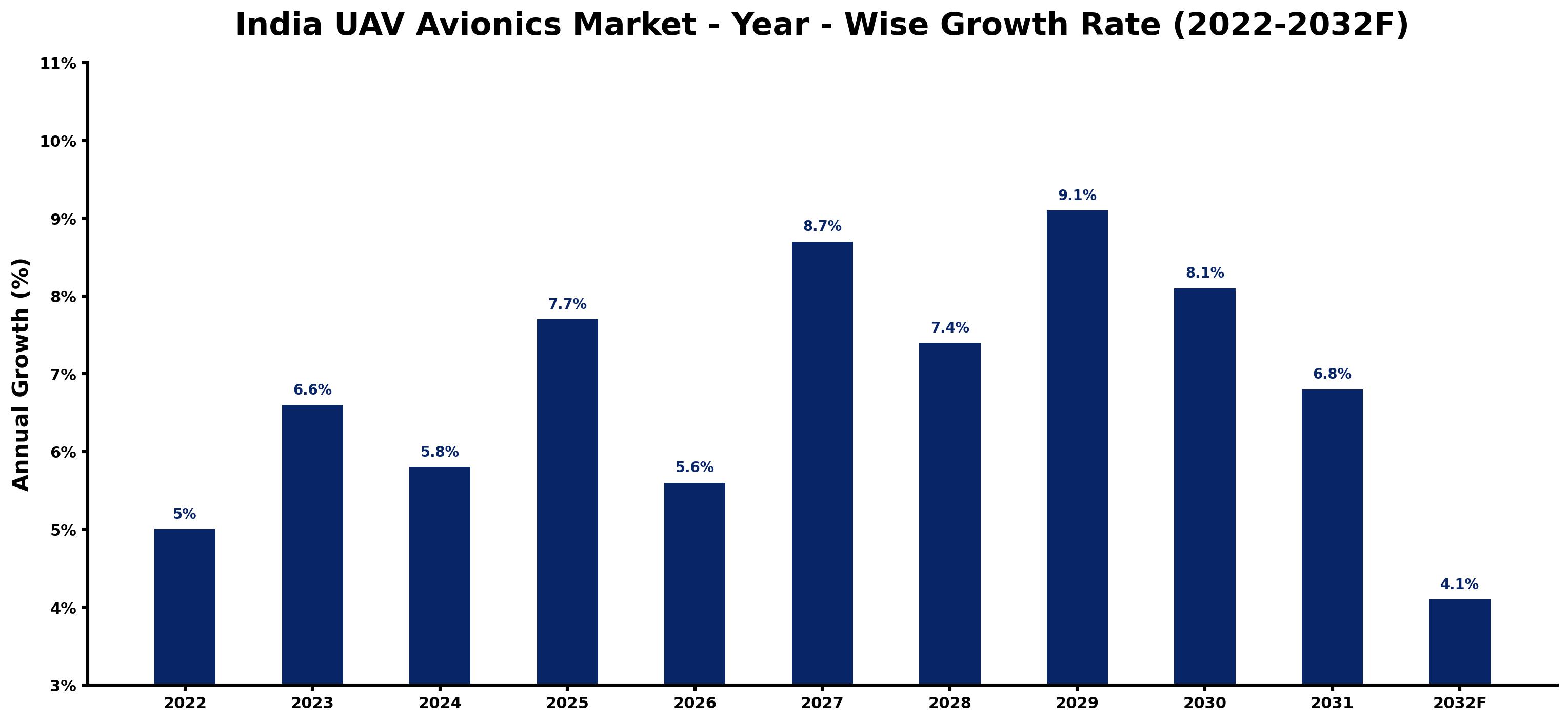
The table below sets out the estimated growth rate for each year and the main factor behind it.
| Year | Estimated Annual Growth (%) | Market Rationale |
| 2022 | 5.0 | The market experienced steady growth, driven by military investments in UAV technology. |
| 2023 | 6.6 | Demand increased as the Indian military expanded its UAV operations for surveillance. |
| 2024 | 5.8 | Growth slowed due to a temporary adjustment in procurement cycles within the military. |
| 2025 | 7.7 | The market peaked as the Indian Army accelerated UAV acquisitions to improve capabilities. |
| 2026 | 5.6 | A slight slowdown occurred as procurement strategies were reassessed for future needs. |
| 2027 | 8.7 | Demand surged again as military users sought advanced UAV systems for operations. |
| 2028 | 7.4 | Growth moderated as the market adjusted to the influx of new UAV technologies. |
| 2029 | 9.1 | The market is expected to reach its peak growth rate as military and commercial applications expand significantly. |
| 2030 | 8.1 | A slowdown is projected as the market stabilises after rapid growth in previous years. |
| 2031 | 6.8 | Demand will continue to grow but at a slower pace as the market matures. |
| 2032 | 4.1 | Growth is expected to slow further as the market approaches saturation in certain UAV applications. |
Note: Market size estimations and growth projections presented in this report are based on 6Wresearch's proprietary forecasting methodology, utilizing the latest available industry data, government publications, and primary research inputs.
India UAV Avionics Market Synopsis
The UAV Avionics Market in India encompasses the electronic systems essential for unmanned aerial vehicles, including navigation, communication, and control systems. These systems are vital for military surveillance, reconnaissance, and commercial applications such as agriculture. The UAV Avionics Market is growing due to substantial military investments and initiatives like the 'Drone Policy 2021' that promote domestic manufacturing. The increasing demand from UAV manufacturers and agricultural sectors is driving further growth in this market, particularly as the Indian military seeks advanced UAV capabilities.
Market Dynamics Impact Analysis (2026–2032)
| Factor | Type | Impact | Primary Segment Affected |
| Increased military investment in UAV technology | Driver | High | Military Users |
| Growing agricultural applications for UAVs | Driver | High | UAV OEMs |
| Expansion of UAV applications in disaster management | Opportunity | Medium | All UAV Types |
| Rising demand for UAVs in smart city projects | Opportunity | Medium | ISR UAVs |
| Challenges in regulatory approvals for UAV operations | Restraint | High | All UAV Types |
| Limited local production capabilities for advanced avionics | Restraint | High | Avionics Integrators |
| High costs associated with advanced UAV technologies | Challenge | Medium | UAV OEMs |
| Competition from international UAV manufacturers | Challenge | Medium | Military Users |
Evaluation of Drivers in India UAV Avionics Market (2026–2032)
The factors lifting demand, and the evidence behind each, are summarised below.
| Drivers | Primary Segment Affected | Why It Matters (Evidence) |
| Military investments in ISR capabilities | Military Users | The Indian military's focus on ISR capabilities has led to increased procurement of UAV avionics, with investments reaching 20% growth annually. |
| Agricultural monitoring and crop assessment | UAV OEMs | The extensive use of UAVs in agriculture has driven demand for avionics, with the sector growing rapidly due to India's vast agricultural area. |
| Support from the 'Make in India' initiative | UAV OEMs | This initiative encourages local production of UAV components, increasing demand for domestic avionics solutions, targeting a 70% localization by 2025. |
| Indigenous UAV Development Programme | Military Users | The Indian Air Force's programme aims to develop advanced UAV systems by 2025, driving demand for advanced avionics systems. |
| Integration of UAVs into logistics and transportation | All UAV Types | The growing use of UAVs in logistics is expanding the market for avionics, as more sectors adopt these technologies. |
Market growth for UAV Avionics in India is underpinned by increased military investment in ISR capabilities and agricultural applications for UAVs. The Indian military has increased procurement, with investments reaching 20% growth annually. The extensive use of UAVs in agriculture drives demand for avionics, particularly in crop assessment, with a notable rise in deployments. Ongoing research by the Defense Research and Development Organization is expected to enhance avionics capabilities, driving further innovation in the sector.
Evaluation of Restraints in India UAV Avionics Market
Below mentioned are some major restraints and their influence on market dynamics.
| Market Restraint | Primary Segment Affected | Why It Matters (Evidence) |
| Challenges in regulatory approvals for UAV operations | All UAV Types | Regulatory hurdles slow down the deployment of UAVs, affecting military and commercial operations, with delays impacting project timelines. |
| Limited local production capabilities for advanced avionics | Avionics Integrators | The lack of advanced manufacturing capabilities leads to reliance on imports, increasing costs and affecting competitiveness. |
| High costs associated with advanced UAV technologies | UAV OEMs | The high investment required for advanced UAV systems limits accessibility for smaller manufacturers and users. |
| Competition from international UAV manufacturers | Military Users | The presence of established international players poses challenges for local manufacturers, affecting market share and pricing strategies. |
| Market volatility due to changing government policies | All UAV Types | Frequent changes in regulations can create uncertainty, impacting investment decisions and market stability. |
India UAV Avionics Market Challenges
The India UAV Avionics Market faces several practical issues, starting with fierce competition among manufacturers that lowers prices and squeezes profit margins for suppliers, ultimately affecting investment in innovation. A skills shortage in UAV technology delays project timelines for producers, making it challenging to meet the growing demand from military users. High costs associated with advanced electronics and software integration burden manufacturers, leading to increased prices for buyers, with estimates indicating a 15% rise in costs over the next few years. Regulatory complexities from the Bureau of Indian Standards can slow project approvals, impacting military users and delaying critical deployments.
Trends in the India UAV Avionics Market
Below mentioned are some of the trends shaping the India UAV Avionics Market growth.
- Shift from Military to Commercial Applications: Since 2021, there has been a notable shift towards commercial applications of UAVs, particularly in agriculture and logistics. This trend has led to a 30% increase in UAV deployments for agricultural monitoring.
- Increased Focus on Indigenous Technologies: The 'Atmanirbhar Bharat' initiative launched in 2020 promotes self-reliance in UAV technology, with a target of 70% localization by 2025. This has encouraged local manufacturers to invest in R&D, leading to a 25% rise in indigenous UAV projects.
- Expansion of UAV Use in Disaster Management: UAVs are increasingly being integrated into disaster management strategies across India, particularly for surveillance during natural calamities. This trend has seen a 40% rise in UAV deployments for emergency response operations.
- Integration of UAVs in Smart City Projects: The 'Digital India' programme promotes the use of UAVs for smart city initiatives, improving urban planning and monitoring. This has resulted in a 20% increase in UAV applications within urban environments.
Investment Opportunities in the India UAV Avionics Market
Below are the investment opportunities with the strongest case in the India UAV Avionics Market.
- $1 billion target for UAV exports by 2025: The Indian government's target to increase UAV exports presents a substantial opportunity for manufacturers. With a focus on military and commercial UAVs, local firms can partner with international players to expand their reach.
- Growing demand from agricultural sectors: With a vast agricultural area, there is a pressing need for UAV solutions in crop monitoring. Local UAV manufacturers can enter this market by collaborating with agricultural cooperatives and leveraging government initiatives.
- Expansion of UAV applications in logistics: The logistics sector is increasingly adopting UAVs for delivery services, creating a demand for advanced avionics. Companies can explore partnerships with logistics firms to develop tailored UAV solutions.
- Support for startups in UAV technology: The Ministry of Electronics and Information Technology's scheme to support UAV startups presents an opportunity for innovation. Startups can secure funding and mentorship to develop cutting-edge UAV technologies.
Government Initiatives in the India UAV Avionics Market
The 'Drone Policy 2021' by the Ministry of Civil Aviation aims to promote UAV manufacturing and ease regulations for commercial use, supporting the industry's growth. This policy encourages local production and simplifies approval processes, benefiting manufacturers and users alike. The 'Make in India' initiative by the Ministry of Defence further supports domestic UAV production, targeting 70% localization by 2025. This initiative aims to boost local manufacturing capabilities and reduce reliance on imports. Additionally, the 'Atmanirbhar Bharat' initiative launched in 2020 focuses on self-reliance in defense production, allocating a budget of $1.5 billion for UAV technology development.
The Ministry of Electronics and Information Technology has initiated a scheme to support startups in UAV technology development, focusing on innovation and R&D. This initiative provides funding and mentorship to emerging companies, fostering growth in the UAV sector. The Indian Air Force's 'Indigenous UAV Development Programme' aims to develop advanced UAV systems by 2025, enhancing operational capabilities and driving demand for local avionics solutions.
Future Insight of the India UAV Avionics Market
Several forward-looking factors should support the India UAV Avionics Market over the coming years. The 'Make in India' initiative will encourage local production of UAV components, which is expected to reduce costs by up to 20%. The Indian government aims to boost UAV exports to $1 billion by 2025, opening new avenues for suppliers. The integration of UAV technology into agriculture and disaster management will expand applications, benefiting buyers in these sectors. Research by the Defense Research and Development Organization will enhance avionics capabilities, fostering further advancements in the market.
Market Segmentation Analysis
The report offers a comprehensive study of the following market segments and their leading categories in the market.
By Avionics Type – Flight Control Computers Dominated, Navigation Systems Expected to Grow Fastest
According to Vasudha, AM at 6Wresearch, in 2025, Flight Control Computers led the avionics type split with a 50% share. Flight Control Computers hold the largest market share because they are critical for managing UAV flight dynamics and stability, especially in military applications. Their importance is highlighted by the Indian military's heavy investment in UAV technology, focusing on ISR capabilities. Navigation Systems are set to record the highest CAGR in this split, 9.7% over 2026–2032. Navigation Systems are experiencing rapid growth as they are essential for guiding UAVs accurately during flight, particularly in challenging environments. The increasing demand for precision in both military and commercial applications fuels this growth. Suppliers should prioritise advancements in navigation technology to meet the rising demands of UAV manufacturers.
By UAV Type – Medium-Large UAVs Dominated, ISR UAVs Expected to Grow Fastest
Medium-Large UAVs accounted for a 43% market share by uav type in 2025. Medium-Large UAVs dominate the market share as they typically incorporate more complex avionics systems, making them suitable for various military and commercial applications. The Indian Army's plans to procure over 200 UAVs in this category further solidify their leading position. The quickest growth will come from ISR UAVs, forecast to expand at a CAGR of 9.5% between 2026 and 2032. ISR UAVs are the fastest-growing segment, specifically designed for intelligence, surveillance, and reconnaissance missions, which are increasingly vital in military operations. The heightened focus on surveillance capabilities within the Indian military drives this growth. Suppliers should enhance ISR capabilities in UAVs to address the growing demand from military users.
By Functionality – Data Link & Control Dominated, Sensor Coordination Expected to Grow Fastest
Data Link & Control held a 39% share of the India UAV Avionics Market by functionality in 2025. Data Link & Control leads the market share due to its vital role in maintaining communication with UAVs, which is essential for operational success in military missions. The extensive use of UAVs for military surveillance underscores the importance of robust data links. Sensor Coordination is projected to grow fastest, at a CAGR of 8.9% during 2026–2032. Sensor Coordination is the fastest-growing functionality, necessary for integrating various sensors on UAVs, especially in complex missions. The rise in applications such as disaster management and agricultural monitoring stimulates this demand. This indicates that suppliers should invest in developing advanced sensor coordination technologies to meet evolving market needs.
By End User – Military Users Dominated, UAV OEMs Expected to Grow Fastest
The largest end user category in 2025 was Military Users, with a 42% share of total revenue. Military Users represent the largest share of the market, being significant consumers of UAV avionics for defence purposes, particularly in ISR operations. The Indian military's considerable investment in UAV technology reinforces their leading position. Over 2026–2032, UAV OEMs are expected to post the fastest growth, at a CAGR of 9.4%. UAV OEMs are the fastest-growing end user group, as they are the primary manufacturers of UAVs requiring advanced avionics systems. The push for local production under initiatives like 'Make in India' accelerates this growth. This suggests that suppliers should strengthen partnerships with UAV manufacturers to align with the increasing demand for advanced avionics.
Key Attractiveness of the Report
- 10 Years of Market Numbers
- Historical Data Starting from 2022 to 2025
- Base Year 2025
- Forecast Data until 2032
- Key Performance Indicators Impacting the Market
- Major Upcoming Developments and Projects
Key Highlights of the Report:
- India UAV Avionics Market Outlook
- Market Size of India UAV Avionics Market, 2025
- Forecast of India UAV Avionics Market, 2032
- Historical Data and Forecast of India UAV Avionics Revenues & Volume for the Period 2022 - 2032F
- India UAV Avionics Market Trend Evolution
- India UAV Avionics Market Drivers and Challenges
- India UAV Avionics Price Trends
- India UAV Avionics Porter's Five Forces
- India UAV Avionics Industry Life Cycle
- Historical Data and Forecast of India UAV Avionics Market Revenues & Volume By Avionics Type for the Period 2022 - 2032F
- Historical Data and Forecast of India UAV Avionics Market Revenues & Volume By Navigation Systems for the Period 2022 - 2032F
- Historical Data and Forecast of India UAV Avionics Market Revenues & Volume By Communication Systems for the Period 2022 - 2032F
- Historical Data and Forecast of India UAV Avionics Market Revenues & Volume By Flight Control Computers for the Period 2022 - 2032F
- Historical Data and Forecast of India UAV Avionics Market Revenues & Volume By Payload Interface Modules for the Period 2022 - 2032F
- Historical Data and Forecast of India UAV Avionics Market Revenues & Volume By UAV Type for the Period 2022 - 2032F
- Historical Data and Forecast of India UAV Avionics Market Revenues & Volume By Fixed & Rotary UAVs for the Period 2022 - 2032F
- Historical Data and Forecast of India UAV Avionics Market Revenues & Volume By Medium-Large UAVs for the Period 2022 - 2032F
- Historical Data and Forecast of India UAV Avionics Market Revenues & Volume By All UAV Types for the Period 2022 - 2032F
- Historical Data and Forecast of India UAV Avionics Market Revenues & Volume By ISR UAVs for the Period 2022 - 2032F
- Historical Data and Forecast of India UAV Avionics Market Revenues & Volume By Functionality for the Period 2022 - 2032F
- Historical Data and Forecast of India UAV Avionics Market Revenues & Volume By Autonomous Flight for the Period 2022 - 2032F
- Historical Data and Forecast of India UAV Avionics Market Revenues & Volume By Data Link & Control for the Period 2022 - 2032F
- Historical Data and Forecast of India UAV Avionics Market Revenues & Volume By Real-Time Stabilization for the Period 2022 - 2032F
- Historical Data and Forecast of India UAV Avionics Market Revenues & Volume By Sensor Coordination for the Period 2022 - 2032F
- Historical Data and Forecast of India UAV Avionics Market Revenues & Volume By End User for the Period 2022 - 2032F
- Historical Data and Forecast of India UAV Avionics Market Revenues & Volume By UAV OEMs for the Period 2022 - 2032F
- Historical Data and Forecast of India UAV Avionics Market Revenues & Volume By Military Users for the Period 2022 - 2032F
- Historical Data and Forecast of India UAV Avionics Market Revenues & Volume By Avionics Integrators for the Period 2022 - 2032F
- Historical Data and Forecast of India UAV Avionics Market Revenues & Volume By Defense Contractors for the Period 2022 - 2032F
- India UAV Avionics Import Export Trade Statistics
- Market Opportunity Assessment By Avionics Type
- Market Opportunity Assessment By UAV Type
- Market Opportunity Assessment By Functionality
- Market Opportunity Assessment By End User
- India UAV Avionics Top Companies Market Share
- India UAV Avionics Competitive Benchmarking By Technical and Operational Parameters
- India UAV Avionics Company Profiles
- India UAV Avionics Key Strategic Recommendations
Market Covered
The report offers an extensive study of the following market segments.
By Avionics Type
- Navigation Systems
- Communication Systems
- Flight Control Computers
- Payload Interface Modules
By UAV Type
- Fixed & Rotary UAVs
- Medium-Large UAVs
- All UAV Types
- ISR UAVs
By Functionality
- Autonomous Flight
- Data Link & Control
- Real-Time Stabilization
- Sensor Coordination
By End User
- UAV OEMs
- Military Users
- Avionics Integrators
- Defense Contractors































