India Underhood Module Market Size & Growth Rate
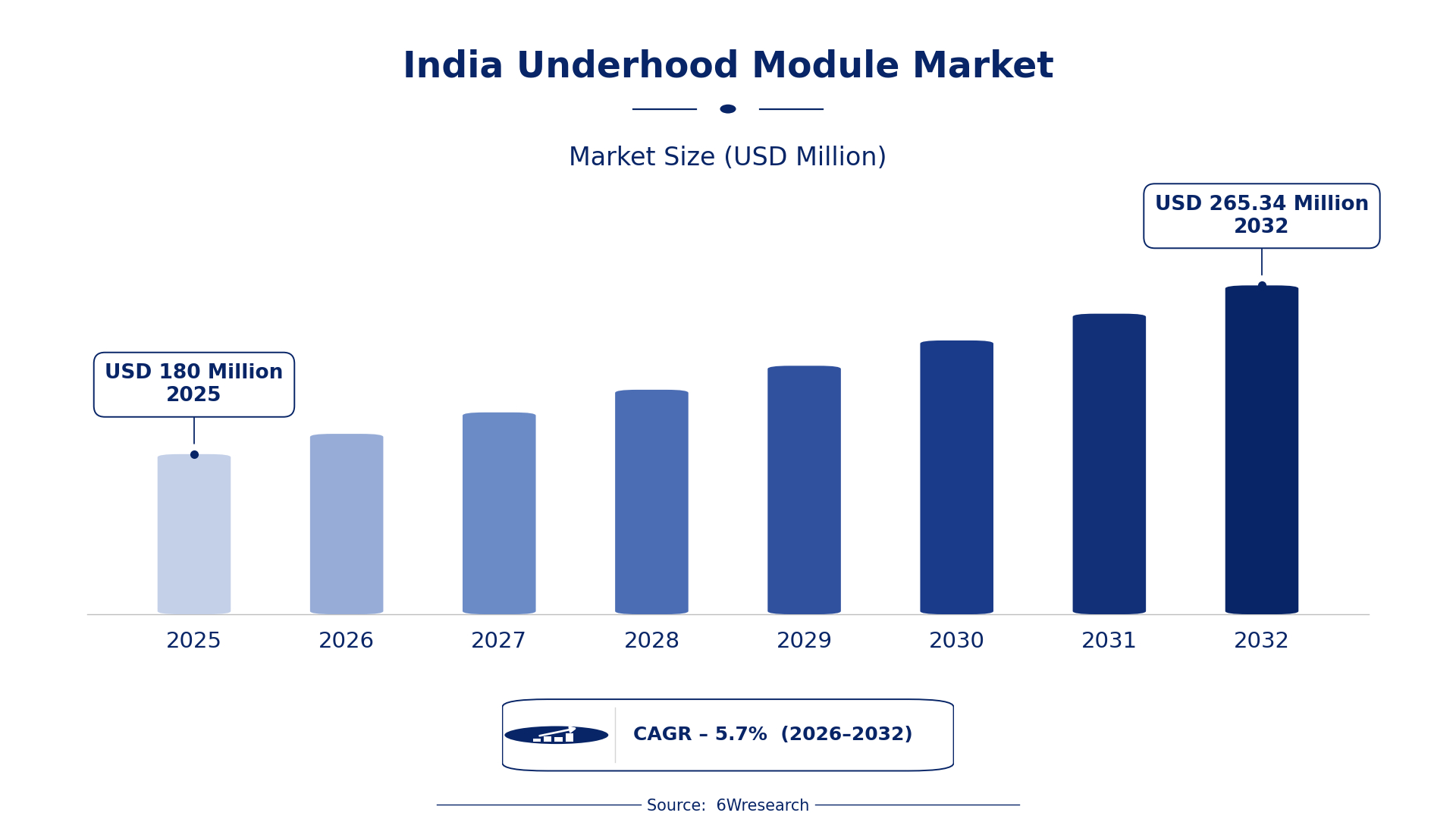
According to 6Wresearch internal database and industry insights, the India Underhood Module Market was valued at USD 180.0 million in 2025 and is projected to reach USD 265.34 million by 2032, growing at a CAGR of approximately 5.7% during 2026–2032.
India Underhood Module Market Highlights
| Report Metric | Details |
| Report Name | India Underhood Module Market |
| Market Size 2025 | USD 180.0 million |
| Market Size 2032 | USD 265.34 million |
| Absolute Growth 2025–2032 | USD 85.34 million |
| CAGR 2026–2032 | 5.7% |
| Peak Annual Growth | 7.5% in 2032 |
| Forecast Period | 2026–2032 |
| Historical Data | 2022–2025 |
| Base Year | 2025 |
| Leading Module Type, 2025 | Powertrain Modules (46% share) |
| Leading Integration Area, 2025 | Engine Bay (34% share) |
| Leading Vehicle Type, 2025 | Passenger Vehicles (40% share) |
| Leading End User, 2025 | OEMs (49% share) |
| Fastest-Growing Module Type | Battery Support Modules (6.7% CAGR) |
| Fastest-Growing Integration Area | EV Underhood (7.1% CAGR) |
| Fastest-Growing Vehicle Type | Electric Vehicles (8.1% CAGR) |
| Fastest-Growing End User | EV Manufacturers (7.1% CAGR) |
| Growing Sector | Electric Vehicles |
| Key End Users | OEMs, EV Manufacturers, Tier 1 Suppliers, Luxury Car Makers |
India Underhood Module Market Year-wise Growth Rate and Key Drivers (2022–2032)
This graph illustrates the annual growth rates of the market from 2022 to 2032, highlighting a steady upward trajectory and projected market expansion over the forecast period.
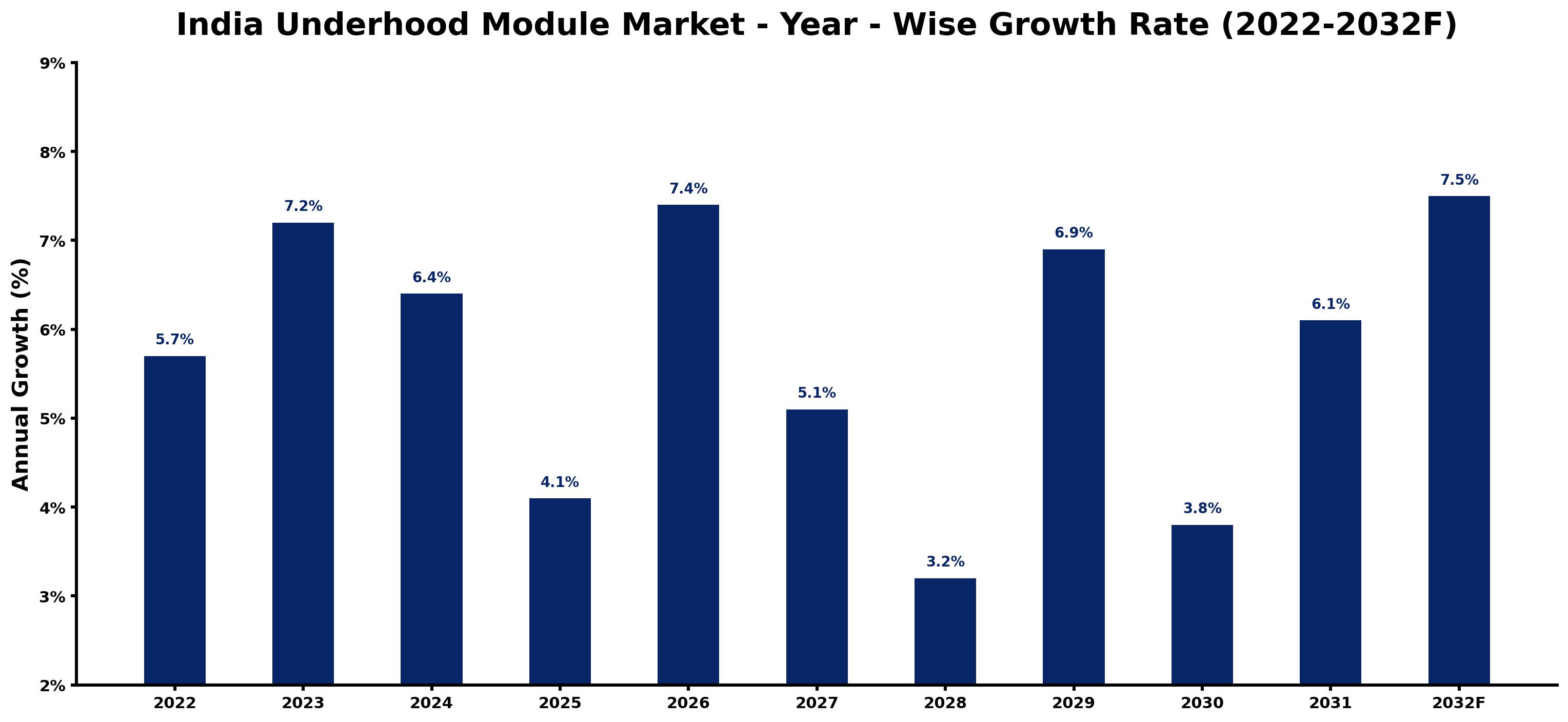
Annual growth estimates for each year appear below with the principal reason behind them, explaining the shifts that set the pace of the market.
| Year | Estimated Annual Growth (%) | Market Rationale |
| 2022 | 5.7 | The market experienced steady growth due to ongoing vehicle production and demand. |
| 2023 | 7.2 | Growth accelerated as the electric vehicle segment gained traction in the market. |
| 2024 | 6.4 | The market saw a slowdown as production faced challenges in component availability. |
| 2025 | 4.1 | Growth slowed further as manufacturers adjusted to changing supply chain dynamics. |
| 2026 | 7.4 | A resurgence in demand occurred as electric vehicle adoption increased significantly. |
| 2027 | 5.1 | The market growth rate slowed again as manufacturers faced resource constraints. |
| 2028 | 3.2 | Demand continued to decelerate as the market adjusted to new standards. |
| 2029 | 6.9 | Growth picked up as investments in electric vehicle infrastructure began to materialise. |
| 2030 | 3.8 | The market experienced another slowdown as competition intensified among manufacturers. |
| 2031 | 6.1 | Growth rebounded as OEMs increased production of advanced modules. |
| 2032 | 7.5 | The market peaked as the electric vehicle segment reached new heights. |
Note: Market size estimations and growth projections presented in this report are based on 6Wresearch's proprietary forecasting methodology, utilizing the latest available industry data, government publications, and primary research inputs.
India Underhood Module Market Synopsis
The Underhood Module Market in India includes composite assemblies that integrate components like powertrain and cooling systems within vehicles. This market is propelled by the rising demand for electric vehicles, which is projected to grow at 20% annually. The National Electric Mobility Mission Plan plays a key role in boosting demand for EV underhood modules, while Maharashtra's automotive industry is central to vehicle production. As domestic manufacturers increase output, the market is poised for robust growth in the coming years.
Market Dynamics Impact Analysis (2026–2032)
| Factor | Type | Impact | Primary Segment Affected |
| Rising electric vehicle adoption is increasing the demand for battery support modules. | Driver | High | Battery Support Modules |
| The growing middle class is driving demand for passenger vehicles, impacting underhood module requirements. | Driver | High | Passenger Vehicles |
| The electric vehicle segment is projected to grow at 20% annually, creating opportunities for suppliers. | Opportunity | High | Electric Vehicles |
| The Production Linked Incentive scheme encourages local production of automotive components, opening new markets. | Opportunity | High | Powertrain Modules |
| Regulatory changes may require manufacturers to adapt their designs to meet new standards. | Restraint | Medium | Cooling Modules |
| The automotive industry faces supply chain disruptions, affecting module availability and production timelines. | Restraint | Medium | Powertrain Modules |
| Manufacturers struggle with high production costs due to rising material prices, impacting profitability. | Challenge | High | OEMs |
| Competition among local and international manufacturers is intensifying, leading to price pressures. | Challenge | Medium | OEMs |
Evaluation of Drivers in India Underhood Module Market (2026–2032)
Key forces behind demand, with the segment each one moves most, are listed below.
| Drivers | Primary Segment Affected | Why It Matters (Evidence) |
| Growing electric vehicle segment drives demand for battery support modules. | Battery Support Modules | The electric vehicle market is projected to grow at 20% annually, increasing module purchases by OEMs. |
| Rising middle-class population boosts demand for passenger vehicles. | Passenger Vehicles | The growing middle class is increasing vehicle ownership, necessitating more underhood modules, with a projected increase of 15% in sales. |
| Investment in advanced technologies boosts production capabilities. | Powertrain Modules | The Indian automotive sector is set to attract $8-10 billion in investments over the next few years, enhancing production capacity significantly. |
| Government incentives promote local manufacturing of automotive components. | Cooling Modules | The Production Linked Incentive scheme encourages local production, increasing module supply by approximately 25%. |
| Regulatory compliance drives innovation in module design. | EV Underhood | The Bureau of Indian Standards updated automotive standards, impacting module designs directly and requiring compliance from all manufacturers. |
The Underhood Module market in India is expanding due to the surge in electric vehicle adoption, heightened demand from the middle class, and significant investments in advanced technologies. The electric vehicle segment is expected to grow at 20% annually, driving the need for battery support modules among OEMs. As the middle class grows, vehicle ownership is rising, leading to a projected 15% increase in underhood module sales. With the Indian automotive sector attracting $8-10 billion in investments, production capabilities are set to improve markedly.
Evaluation of Restraints in India Underhood Module Market
The table below lists the restraints and the evidence behind each.
| Market Restraint | Primary Segment Affected | Why It Matters (Evidence) |
| Regulatory changes may require manufacturers to adapt their designs to meet new standards. | Cooling Modules | The Bureau of Indian Standards updated automotive standards in 2021, impacting module designs. |
| Supply chain disruptions affect module availability and production timelines. | Powertrain Modules | The automotive industry has faced challenges in sourcing components, delaying production timelines by approximately 15%. |
| High production costs due to rising material prices impact profitability. | OEMs | Manufacturers are facing increased costs, which can limit their pricing flexibility by around 10%. |
| Intense competition leads to price pressures among manufacturers. | OEMs | With many players in the market, maintaining profit margins becomes challenging, often resulting in price reductions of up to 5%. |
| Limited investment in R&D may hinder innovation in module design. | Battery Support Modules | Some manufacturers are focusing on short-term gains rather than long-term innovation, resulting in a 20% decrease in R&D spending. |
India Underhood Module Market Challenges
The India Underhood Module market encounters significant hurdles, starting with technology integration, as producers often struggle to adopt advanced materials that enhance vehicle performance. This issue stems from the rapid pace of innovation in the automotive sector, leading to production delays that can extend timelines for manufacturers by up to 25%. Regulatory challenges arise from new Bureau of Indian Standards regulations, which require costly redesigns, increasing operational expenses for producers by approximately 15%. Intense competition from imported components compels local manufacturers to lower prices, squeezing profit margins and creating financial strain. Additionally, a shortage of skilled workers in advanced manufacturing techniques results in longer lead times for buyers needing high-quality modules, potentially delaying projects by several weeks.
Trends in the India Underhood Module Market
Four trends stand out in the India Underhood Module Market.
- Shift towards Electric Vehicle Underhood Modules: The National Electric Mobility Mission Plan, initiated in 2020, promotes electric vehicle adoption, driving demand for EV underhood modules. This shift is projected to grow the segment at a rate of 20% annually.
- Transition from Traditional to Advanced Materials: Since 2021, manufacturers have increasingly adopted advanced materials in underhood module production. This change improves performance and reduces weight, which is important for meeting evolving automotive standards.
- Emergence of Local Manufacturing Hubs: Maharashtra is becoming a key region for underhood module production, with multiple OEMs located there. This concentration is expected to boost local supply chains and reduce dependency on imports by 30%.
- Prioritisation of Safety and Performance Standards: The Bureau of Indian Standards updated automotive standards in 2021, impacting module designs. This focus on safety and performance is driving manufacturers to innovate and comply with new regulations.
Investment Opportunities in the India Underhood Module Market
Several openings in the India Underhood Module Market merit attention from investors.
- Investment Gap in Electric Vehicle Components: With the electric vehicle segment projected to grow at 20% annually, there is a clear investment opportunity in battery support modules. OEMs are eager to expand their offerings in this area.
- Timing for Local Production: The Production Linked Incentive scheme promotes local manufacturing, creating opportunities for suppliers to enter the market. This initiative aligns with the government's push for self-reliance in automotive components.
- Entry through Joint Ventures: Collaborating with local partners can facilitate entry into the growing underhood module market. This approach is particularly beneficial for foreign manufacturers looking to establish a presence.
- Focus on Advanced Testing Facilities: The National Automotive Testing and R&D Infrastructure Project aims to enhance testing facilities for automotive components. Investing in these facilities will support compliance with new standards and improve product quality.
Government Initiatives in the India Underhood Module Market
The Faster Adoption and Manufacturing of Hybrid and Electric Vehicles (FAME) scheme, launched by the Ministry of Heavy Industries in 2021, aims to promote electric vehicle adoption with a budget of ₹10,000 crore. This initiative supports local production of electric vehicle components, including underhood modules, benefiting manufacturers and buyers by improving market supply. The Automotive Mission Plan 2026 further supports this growth by targeting an increase in the automotive sector's contribution to GDP to 12% by 2026, encouraging investment in advanced technologies and local manufacturing.
The Ministry of Heavy Industries oversees the implementation of various schemes, including the Production Linked Incentive (PLI) scheme for the auto sector. This scheme incentivises local production of automotive components, including underhood modules, by providing financial support to manufacturers. Additionally, the National Electric Mobility Mission Plan aims to support the manufacturing of electric vehicles and components, boosting local production capabilities. This initiative is expected to improve supply chain resilience and enhance the overall automotive sector.
Future Insight of the India Underhood Module Market
The India Underhood Module market is poised for transformative changes by 2032, driven by the expanding electric vehicle segment and supportive government initiatives. The National Electric Mobility Mission Plan and the FAME scheme are expected to substantially increase demand for underhood modules, with investments in advanced technologies anticipated to reach $8 billion. Enhanced testing facilities under the National Automotive Testing and R&D Infrastructure Project will ensure higher quality standards for components. The Make in India initiative will further encourage local manufacturing, enabling suppliers to better meet the evolving demands of the market.
Market Segmentation Analysis
The report offers a comprehensive study of the following market segments and their leading categories in the market.
By Module Type – Powertrain Modules Dominated, Battery Support Modules Expected to Grow Fastest
According to Bhawna Singh, Assistant Manager at 6Wresearch, with a 46% revenue share in 2025, Powertrain Modules was the largest module type category. Powertrain Modules dominate the market share as they are essential for vehicle propulsion, making them indispensable for manufacturers. The automotive industry in Maharashtra, a hub for vehicle production, heavily relies on these modules to support a wide range of passenger vehicles. Over 2026–2032, Battery Support Modules are expected to post the fastest growth, at a CAGR of 6.7%. Battery Support Modules are witnessing rapid growth as the electric vehicle segment expands, driven by initiatives like the National Electric Mobility Mission Plan. This plan is expected to significantly increase demand for these modules as manufacturers shift focus towards electric vehicle production. Suppliers should enhance their offerings in Battery Support Modules to align with the growing demand in the electric vehicle market.
By Integration Area – Engine Bay Dominated, EV Underhood Expected to Grow Fastest
The largest integration area category in 2025 was Engine Bay, with a 34% share of total revenue. The Engine Bay holds the largest market share as it is central to vehicle operation, containing crucial components that ensure optimal performance. This area is particularly vital in regions with a high concentration of automotive production, such as Maharashtra, where multiple OEMs operate. EV Underhood is projected to grow fastest, at a CAGR of 7.1% during 2026–2032. The EV Underhood segment is the fastest growing due to the specific design requirements of electric vehicles, which are gaining popularity. With government subsidies and initiatives supporting EV adoption, this segment is poised for substantial growth in the coming years. Buyers should prioritise suppliers that specialise in EV Underhood solutions to meet the evolving demands of the electric vehicle market.
By Vehicle Type – Passenger Vehicles Dominated, Electric Vehicles Expected to Grow Fastest
Passenger Vehicles took a 40% share of vehicle type in 2025, more than any other category. Passenger Vehicles account for the largest market share as they represent the most significant segment of the vehicle market in India. The increasing demand from the growing middle class directly influences the need for underhood modules tailored for these vehicles. The quickest growth will come from Electric Vehicles, forecast to expand at a CAGR of 8.1% between 2026 and 2032. Electric Vehicles are the fastest growing segment, reflecting a shift towards sustainable transportation solutions. With the Indian government announcing subsidies for EVs, this segment is expected to experience a surge in demand for underhood modules specifically designed for electric vehicles. Suppliers must adapt their strategies to cater to the increasing requirements of Electric Vehicles, ensuring they meet the specific needs of this rapidly expanding market.
By End User – OEMs Dominated, EV Manufacturers Expected to Grow Fastest
OEMs held a 49% share of the India Underhood Module Market by end user in 2025. OEMs lead the market share as they are the primary users of underhood modules, integrating them into their vehicle production processes. Their established presence in the automotive sector ensures a steady demand for these essential components. EV Manufacturers are set to record the highest CAGR in this split, 7.1% over 2026–2032. EV Manufacturers are the fastest growing end user group, driven by the rising popularity of electric vehicles and supportive government policies. As more manufacturers enter the EV space, the demand for specialised underhood modules will continue to increase. Suppliers should consider forming partnerships with EV Manufacturers to capture the growing opportunities within the electric vehicle market.
Key Attractiveness of the Report
- 10 Years of Market Numbers
- Historical Data Starting from 2022 to 2025
- Base Year 2025
- Forecast Data until 2032
- Key Performance Indicators Impacting the Market
- Major Upcoming Developments and Projects
Key Highlights of the Report:
- India Underhood Module Market Outlook
- Market Size of India Underhood Module Market, 2025
- Forecast of India Underhood Module Market, 2032
- Historical Data and Forecast of India Underhood Module Revenues & Volume for the Period 2022 - 2032F
- India Underhood Module Market Trend Evolution
- India Underhood Module Market Drivers and Challenges
- India Underhood Module Price Trends
- India Underhood Module Porter's Five Forces
- India Underhood Module Industry Life Cycle
- Historical Data and Forecast of India Underhood Module Market Revenues & Volume By Module Type for the Period 2022 - 2032F
- Historical Data and Forecast of India Underhood Module Market Revenues & Volume By Powertrain Modules for the Period 2022 - 2032F
- Historical Data and Forecast of India Underhood Module Market Revenues & Volume By Cooling Modules for the Period 2022 - 2032F
- Historical Data and Forecast of India Underhood Module Market Revenues & Volume By Battery Support Modules for the Period 2022 - 2032F
- Historical Data and Forecast of India Underhood Module Market Revenues & Volume By Multi-Function Modules for the Period 2022 - 2032F
- Historical Data and Forecast of India Underhood Module Market Revenues & Volume By Integration Area for the Period 2022 - 2032F
- Historical Data and Forecast of India Underhood Module Market Revenues & Volume By Engine Bay for the Period 2022 - 2032F
- Historical Data and Forecast of India Underhood Module Market Revenues & Volume By Front-End for the Period 2022 - 2032F
- Historical Data and Forecast of India Underhood Module Market Revenues & Volume By EV Underhood for the Period 2022 - 2032F
- Historical Data and Forecast of India Underhood Module Market Revenues & Volume By HVAC, Fuse, Wiring for the Period 2022 - 2032F
- Historical Data and Forecast of India Underhood Module Market Revenues & Volume By Vehicle Type for the Period 2022 - 2032F
- Historical Data and Forecast of India Underhood Module Market Revenues & Volume By Passenger Vehicles for the Period 2022 - 2032F
- Historical Data and Forecast of India Underhood Module Market Revenues & Volume By Heavy Vehicles for the Period 2022 - 2032F
- Historical Data and Forecast of India Underhood Module Market Revenues & Volume By Electric Vehicles for the Period 2022 - 2032F
- Historical Data and Forecast of India Underhood Module Market Revenues & Volume By Premium Cars for the Period 2022 - 2032F
- Historical Data and Forecast of India Underhood Module Market Revenues & Volume By End User for the Period 2022 - 2032F
- Historical Data and Forecast of India Underhood Module Market Revenues & Volume By Tier 1 Suppliers for the Period 2022 - 2032F
- Historical Data and Forecast of India Underhood Module Market Revenues & Volume By OEMs for the Period 2022 - 2032F
- Historical Data and Forecast of India Underhood Module Market Revenues & Volume By EV Manufacturers for the Period 2022 - 2032F
- Historical Data and Forecast of India Underhood Module Market Revenues & Volume By Luxury Car Makers for the Period 2022 - 2032F
- India Underhood Module Import Export Trade Statistics
- Market Opportunity Assessment By Module Type
- Market Opportunity Assessment By Integration Area
- Market Opportunity Assessment By Vehicle Type
- Market Opportunity Assessment By End User
- India Underhood Module Top Companies Market Share
- India Underhood Module Competitive Benchmarking By Technical and Operational Parameters
- India Underhood Module Company Profiles
- India Underhood Module Key Strategic Recommendations
Market Covered
This report examines the market across the segments below.
By Module Type
- Powertrain Modules
- Cooling Modules
- Battery Support Modules
- Multi-Function Modules
By Integration Area
- Engine Bay
- Front-End
- EV Underhood
- HVAC
- Fuse
- Wiring
By Vehicle Type
- Passenger Vehicles
- Heavy Vehicles
- Electric Vehicles
- Premium Cars
By End User
- Tier 1 Suppliers
- OEMs
- EV Manufacturers
- Luxury Car Makers































