India Underwater Propulsion Technology Market Size & Growth Rate
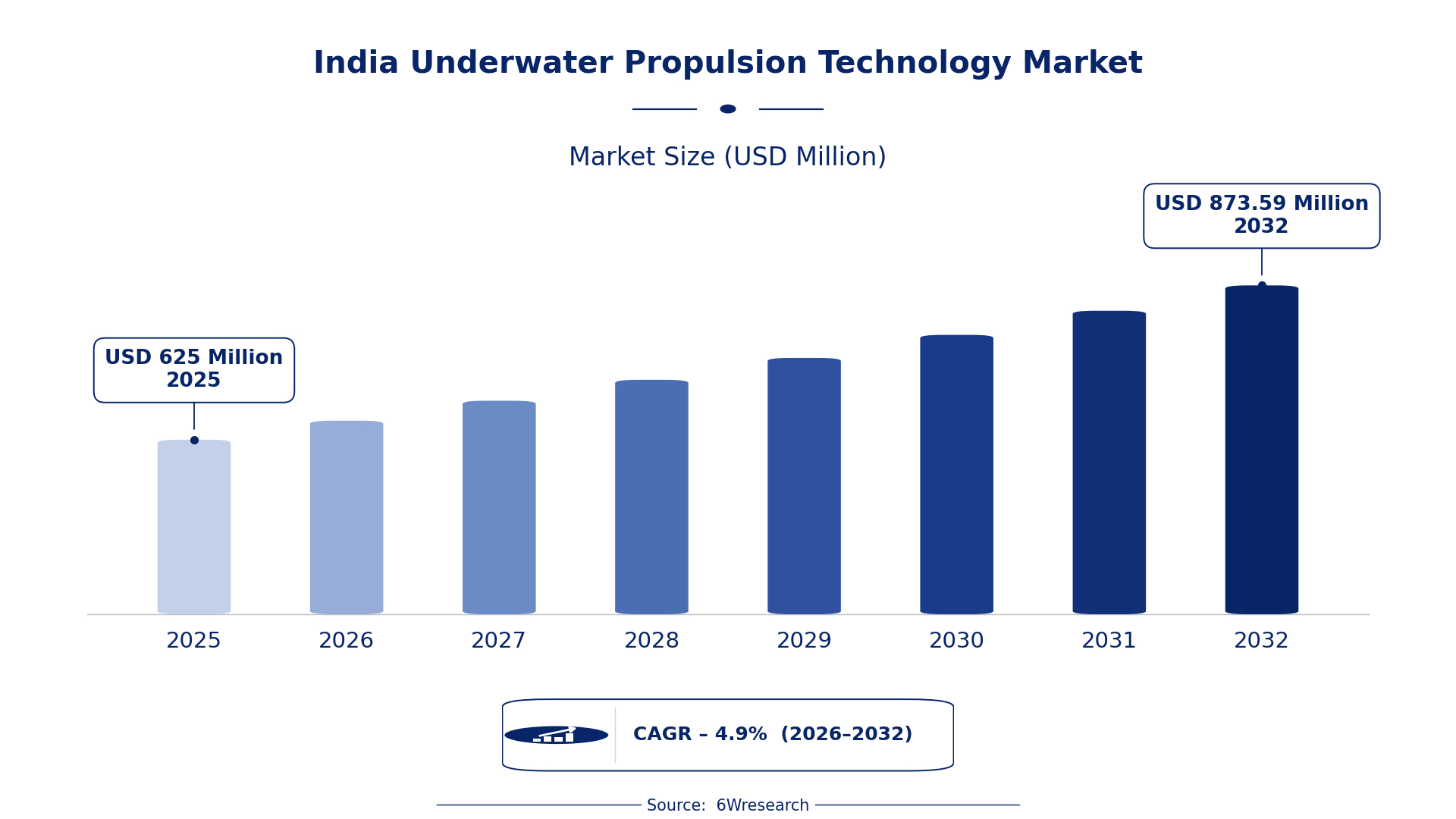
According to 6Wresearch internal database and industry insights, the India Underwater Propulsion Technology Market was valued at USD 625.0 million in 2025 and is projected to reach USD 873.59 million by 2032, growing at a CAGR of approximately 4.9% during 2026–2032.
India Underwater Propulsion Technology Market Highlights
| Report Metric | Details |
| Report Name | India Underwater Propulsion Technology Market |
| Market Size 2025 | USD 625.0 million |
| Market Size 2032 | USD 873.59 million |
| Absolute Growth 2025–2032 | USD 248.59 million |
| CAGR 2026–2032 | 4.9% |
| Peak Annual Growth | 6.9% in 2030 |
| Forecast Period | 2026–2032 |
| Historical Data | 2022–2025 |
| Base Year | 2025 |
| Leading Propulsion Type, 2025 | Thruster Systems (41% share) |
| Leading Power Source, 2025 | Electric (50% share) |
| Leading Application Sector, 2025 | Submarines (40% share) |
| Leading End User, 2025 | Defense Navy (38% share) |
| Fastest-Growing Propulsion Type | Bio-Inspired Systems (6.7% CAGR) |
| Fastest-Growing Power Source | Hybrid Systems (7.2% CAGR) |
| Fastest-Growing Application Sector | Marine Robotics (6.4% CAGR) |
| Fastest-Growing End User | Marine Tech Startups (7.0% CAGR) |
| Growing Sector | Defense Navy |
| Key End Users | Defense Navy, a leading supplier Forces, Research Institutions, Marine Tech Startups. |
India Underwater Propulsion Technology Market Year-wise Growth Rate and Key Drivers (2022–2032)
This graph illustrates the annual growth rates of the market from 2022 to 2032, highlighting a steady upward trajectory and projected market expansion over the forecast period.
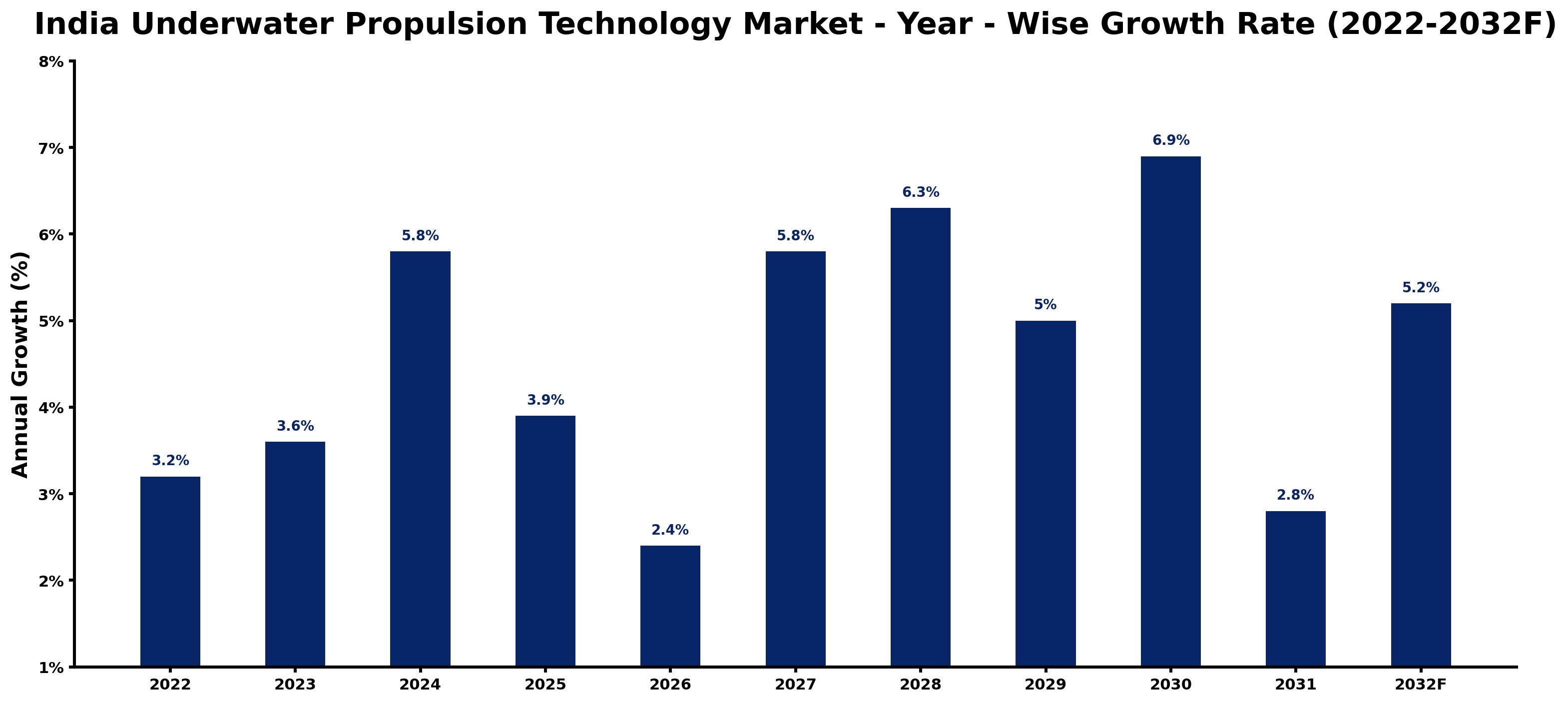
Year by year, the estimates below pair each growth rate with the development that shaped it.
| Year | Estimated Annual Growth (%) | Market Rationale |
| 2022 | 3.2 | The defense budget focused on enhancing naval capabilities, supporting growth in the sector. |
| 2023 | 3.6 | Increased investments in submarine technology led to a rise in demand for propulsion systems. |
| 2024 | 5.8 | The Indian Navy's expansion plans drove substantial growth in underwater technologies. |
| 2025 | 3.9 | A temporary slowdown occurred as budget allocations were realigned for new projects. |
| 2026 | 2.4 | The market experienced slower growth as focus shifted to indigenization efforts. |
| 2027 | 5.8 | Rising demand for marine robotics revitalized interest in propulsion technologies. |
| 2028 | 6.3 | The introduction of advanced underwater drones spurred growth in the sector. |
| 2029 | 5.0 | A slight slowdown occurred as the market adjusted to new technological standards. |
| 2030 | 6.9 | The peak growth was driven by increased naval operations in the Indian Ocean region. |
| 2031 | 2.8 | Growth slowed as the market matured and competition intensified. |
| 2032 | 5.2 | A resurgence in demand for autonomous vehicles revitalized the underwater propulsion market. |
Note: Market size estimations and growth projections presented in this report are based on 6Wresearch's proprietary forecasting methodology, utilizing the latest available industry data, government publications, and primary research inputs.
India Underwater Propulsion Technology Market Synopsis
Underwater Propulsion Technology in India encompasses systems that facilitate movement beneath the surface, including thrusters and bio-inspired designs. These technologies are crucial for military applications, particularly in submarines and naval forces. The market is expanding due to substantial investments in naval capabilities and ongoing research initiatives. The defense sector remains the primary buyer, bolstered by government programs like 'Make in India' aimed at promoting domestic manufacturing. As of 2023, India's defense budget stands at approximately ₹5.25 lakh crore, underscoring a strong commitment to advancing naval technology.
Market Dynamics Impact Analysis (2026–2032)
| Factor | Type | Impact | Primary Segment Affected |
| Growing defense budget and naval expansion plans drive demand for advanced propulsion systems. | Driver | High | Thruster Systems |
| Increased focus on marine robotics and autonomous vehicles creates new opportunities for propulsion technology. | Driver | High | Marine Robotics |
| The push for indigenization in defense manufacturing opens avenues for local suppliers. | Opportunity | High | Electric |
| Research institutions are increasingly adopting underwater drones for oceanographic studies, boosting demand. | Opportunity | High | Autonomous Drones |
| Limited availability of skilled workforce in advanced manufacturing hampers production capabilities. | Restraint | High | Pump-Jet Propulsion |
| High R&D costs for developing new propulsion technologies can deter investment. | Restraint | Medium | Bio-Inspired Systems |
| Underwater Propulsion Technology in India faces challenges related to regulatory compliance and certification processes. | Challenge | Medium | Thruster Systems |
| Competition from international suppliers can impact pricing strategies and market share. | Challenge | Medium | Marine Robotics |
Evaluation of Drivers in India Underwater Propulsion Technology Market (2026–2032)
The main growth drivers and the segments they affect most are set out below.
| Drivers | Primary Segment Affected | Why It Matters (Evidence) |
| Increased defense spending on naval capabilities drives demand for advanced thruster systems. | Thruster Systems | India's defense budget for 2023 is approximately ₹5.25 lakh crore, promoting naval technology advancements. |
| The rise of marine robotics necessitates efficient propulsion systems for underwater vehicles. | Marine Robotics | As of 2023, research institutions are adopting underwater drones, leading to increased demand for propulsion technology. |
| Government initiatives like 'Make in India' promote local manufacturing of electric propulsion systems. | Electric | The initiative aims to boost domestic production, impacting underwater propulsion technologies. |
| Expansion of the Indian Navy's submarine fleet increases the need for advanced propulsion systems. | Submarines | The Indian Navy operates over 15 submarines equipped with advanced underwater propulsion systems. |
| Growing interest in autonomous drones drives demand for innovative propulsion solutions. | Autonomous Drones | The Indian Navy plans to increase its fleet of autonomous underwater vehicles by 2025. |
Market growth for Underwater Propulsion Technology in India is driven by increasing demand from the defense sector and a responsive supply from local manufacturers. The Indian defense budget for 2023, approximately ₹5.25 lakh crore, fuels investments in naval capabilities. At the same time, the rise of underwater drones for oceanographic research by various institutions boosts demand for advanced propulsion systems. The promotion of local manufacturing of electric propulsion technology further supports market expansion. Plans to upgrade the submarine fleet will heighten the need for efficient thruster systems, creating opportunities for suppliers.
Evaluation of Restraints in India Underwater Propulsion Technology Market
The main factors holding the market back are set out below.
| Market Restraint | Primary Segment Affected | Why It Matters (Evidence) |
| Limited skilled workforce hampers production capabilities for advanced propulsion systems. | Pump-Jet Propulsion | The shortage of skilled technicians affects the efficiency of manufacturing processes. |
| High research and development costs deter investment in new propulsion technologies. | Bio-Inspired Systems | The financial burden of R&D can limit the entry of new players in the market. |
| Regulatory compliance and certification processes can delay product launches in the market. | Thruster Systems | Stringent standards require extensive testing, impacting time-to-market for new technologies. |
| Competition from international suppliers can pressure local manufacturers on pricing. | Marine Robotics | Global players often offer advanced solutions at competitive prices, affecting local manufacturers. |
| Market maturity leads to slower growth rates as opportunities become saturated. | Submarines | As the market stabilizes, new entrants may find it challenging to gain traction. |
India Underwater Propulsion Technology Market Challenges
The India Underwater Propulsion Technology Market faces a few practical problems, starting with supply chain disruptions that can delay production timelines for defense buyers. These disruptions arise from a reliance on imported components, which can lead to budget overruns of up to ₹1,000 crore for major defense projects. Buyers also face high costs for advanced technology integration, sometimes exceeding ₹50 crore for naval upgrades, limiting their modernization efforts. Suppliers encounter the challenge of keeping pace with rapid technological advancements, which can inflate operational expenses by around 15%, straining their financial resources. Intense competition from global markets compels local suppliers to cut prices, jeopardising quality and innovation.
Trends in the India Underwater Propulsion Technology Market
Several trends are reshaping the India Underwater Propulsion Technology Market; the most important are set out below.
- Shift from Traditional to Autonomous Underwater Vehicles: Since 2021, the Indian Navy has increasingly embraced autonomous underwater vehicles for surveillance. This shift is clear as the Navy aims to expand its fleet, targeting an increase in autonomous vehicles by 2025.
- Emergence of Marine Robotics in Research: Research institutions are progressively integrating marine robotics into their studies, with underwater drones becoming commonplace. As of 2023, a growing number of research institutions are adopting these technologies for oceanographic research.
- Focus on Sustainable Marine Technology: The National Marine Spatial Planning Framework, introduced in 2021, stresses the sustainable use of ocean resources. This framework shapes the development of propulsion technologies that comply with environmental standards.
- Rise of Bio-Inspired Propulsion Systems: Beginning in 2023, bio-inspired propulsion systems are gaining traction for their efficiency. This trend is supported by ongoing research and development efforts, with a projected CAGR of 6.7%.
Investment Opportunities in the India Underwater Propulsion Technology Market
Investors looking at the India Underwater Propulsion Technology Market should consider the following areas.
- Supply of Advanced Thruster Systems: With the Indian Navy's focus on its submarine fleet, there is a growing need for advanced thruster systems. This presents an opportunity for local manufacturers to meet the demand for efficient propulsion solutions.
- Investment in Marine Robotics: Now is an opportune time to invest in marine robotics, as research institutions increasingly adopt underwater drones. This trend is driven by the need for advanced technology in oceanographic studies, with a growing number of institutions involved.
- Development of Electric Propulsion Systems: The push for indigenization in defense manufacturing creates opportunities for electric propulsion systems. Local suppliers can benefit from government initiatives like 'Make in India' to enhance production capabilities.
- Expansion of Autonomous Drone Market: The Indian Navy's plans to increase its fleet of autonomous underwater vehicles create a demand for innovative propulsion solutions. Suppliers can enter this market by partnering with research institutions and defense agencies.
Government Initiatives in the India Underwater Propulsion Technology Market
The 'Make in India' initiative, launched by the Ministry of Commerce and Industry in 2014, aims to strengthen local manufacturing in defense, including underwater technologies. This initiative promotes domestic production and innovation, influencing the development of underwater propulsion systems. Additionally, the 'Atmanirbhar Bharat' program, initiated in 2020, focuses on self-reliance in defense production, encouraging local suppliers and reducing reliance on imports. This program is anticipated to impact the underwater propulsion technology market by bolstering local capabilities.
The Defence Production Policy 2018 aims for a turnover of ₹1.75 lakh crore in defense manufacturing by 2025, promoting the development of underwater systems and encouraging investment in advanced technologies. Furthermore, the National Marine Spatial Planning Framework, introduced by the Ministry of Earth Sciences in 2021, seeks to manage marine resources sustainably, influencing the development of propulsion technologies in line with environmental standards.
Future Insight of the India Underwater Propulsion Technology Market
Several forward-looking factors should support the India Underwater Propulsion Technology Market in the coming years. The 'Make in India' initiative will strengthen domestic manufacturing capabilities, reducing reliance on imports and encouraging growth. Research institutions are increasingly adopting underwater drones, driving demand for advanced propulsion systems. The Indian Navy's strategy to expand its fleet of autonomous underwater vehicles by 2025 will further stimulate market activity. The Bureau of Indian Standards is also developing regulations for propulsion systems, ensuring quality and safety, which will benefit both buyers and suppliers.
Market Segmentation Analysis
The analysis below covers each segmentation, its leading category in 2025 and its fastest-growing category through 2032.
By Propulsion Type – Thruster Systems Dominated, Bio-Inspired Systems Expected to Grow Fastest
According to Bhawna Singh, Assistant Manager at 6Wresearch, in 2025, Thruster Systems led the propulsion type split with a 41% share. Thruster systems command the largest market share in India as they are crucial for the effective maneuvering of underwater vehicles, especially in military contexts. The operational capabilities of the Indian Navy's submarines, which rely heavily on these systems, underscore their importance in national defense. Bio-Inspired Systems are projected to grow fastest, at a CAGR of 6.7% during 2026–2032. Bio-inspired systems are experiencing rapid growth due to their potential to offer novel solutions for underwater movement, with research institutions actively exploring their applications. The National Institute of Ocean Technology's ongoing projects highlight the increasing interest in these experimental technologies. Suppliers should invest in bio-inspired technologies to capitalise on the growing interest in innovative underwater propulsion solutions.
By Power Source – Electric Dominated, Hybrid Systems Expected to Grow Fastest
Electric accounted for a 50% market share by power source in 2025. Electric power sources hold the largest market share as they are the most widely used for underwater vehicles, ensuring reliable and efficient operation. Their prevalence in the Indian Navy's submarines underscores their importance in naval capabilities. Over 2026–2032, Hybrid Systems are expected to post the fastest growth, at a CAGR of 7.2%. Hybrid systems are gaining traction due to their versatility in specialized applications, with increasing interest from the defense sector. This growth is supported by the Indian government's push for indigenization of defense technologies, aiming for 70% local production by 2025. Buyers should consider hybrid systems for future-proofing their underwater propulsion capabilities as demand for advanced solutions rises.
By Application Sector – Submarines Dominated, Marine Robotics Expected to Grow Fastest
With a 40% revenue share in 2025, Submarines was the largest application sector category. Submarines lead the application sector, primarily due to the Indian Navy's significant reliance on advanced underwater propulsion systems for both defensive and research operations. The ongoing enhancement of naval capabilities further solidifies this segment's dominant market position. Marine Robotics are set to record the highest CAGR in this split, 6.4% over 2026–2032. Marine robotics is emerging as the fastest-growing application sector, driven by a surge in the use of underwater drones for oceanographic research. The rising number of research institutions adopting these technologies indicates a promising trend for this segment. Suppliers should target the marine robotics sector to meet the increasing demand for advanced underwater applications.
By End User – Defense Navy Dominated, Marine Tech Startups Expected to Grow Fastest
Defense Navy took a 38% share of end user in 2025, more than any other category. The defense navy is the predominant end user of underwater propulsion technology, utilising these systems extensively for national security and maritime operations. This strong demand is supported by India's substantial defense budget, which prioritises advancements in naval capabilities. The quickest growth will come from Marine Tech Startups, forecast to expand at a CAGR of 7.0% between 2026 and 2032. Marine tech startups are rapidly becoming a significant end user segment, fuelled by innovation and the need for advanced solutions in underwater applications. Their growth reflects a shift towards more diverse and creative uses of propulsion technology. Suppliers must engage with marine tech startups to unlock new market opportunities and drive innovation in underwater propulsion.
Key Attractiveness of the Report
- 10 Years of Market Numbers
- Historical Data Starting from 2022 to 2025
- Base Year 2025
- Forecast Data until 2032
- Key Performance Indicators Impacting the Market
- Major Upcoming Developments and Projects
Key Highlights of the Report:
- India Underwater Propulsion Technology Market Outlook
- Market Size of India Underwater Propulsion Technology Market, 2025
- Forecast of India Underwater Propulsion Technology Market, 2032
- Historical Data and Forecast of India Underwater Propulsion Technology Revenues & Volume for the Period 2022 - 2032F
- India Underwater Propulsion Technology Market Trend Evolution
- India Underwater Propulsion Technology Market Drivers and Challenges
- India Underwater Propulsion Technology Price Trends
- India Underwater Propulsion Technology Porter's Five Forces
- India Underwater Propulsion Technology Industry Life Cycle
- Historical Data and Forecast of India Underwater Propulsion Technology Market Revenues & Volume By Propulsion Type for the Period 2022 - 2032F
- Historical Data and Forecast of India Underwater Propulsion Technology Market Revenues & Volume By Thruster Systems for the Period 2022 - 2032F
- Historical Data and Forecast of India Underwater Propulsion Technology Market Revenues & Volume By Magnetohydrodynamic for the Period 2022 - 2032F
- Historical Data and Forecast of India Underwater Propulsion Technology Market Revenues & Volume By Pump-Jet Propulsion for the Period 2022 - 2032F
- Historical Data and Forecast of India Underwater Propulsion Technology Market Revenues & Volume By Bio-Inspired Systems for the Period 2022 - 2032F
- Historical Data and Forecast of India Underwater Propulsion Technology Market Revenues & Volume By Power Source for the Period 2022 - 2032F
- Historical Data and Forecast of India Underwater Propulsion Technology Market Revenues & Volume By Electric for the Period 2022 - 2032F
- Historical Data and Forecast of India Underwater Propulsion Technology Market Revenues & Volume By Battery-Powered for the Period 2022 - 2032F
- Historical Data and Forecast of India Underwater Propulsion Technology Market Revenues & Volume By Hybrid Systems for the Period 2022 - 2032F
- Historical Data and Forecast of India Underwater Propulsion Technology Market Revenues & Volume By Solar/Electric for the Period 2022 - 2032F
- Historical Data and Forecast of India Underwater Propulsion Technology Market Revenues & Volume By Application Sector for the Period 2022 - 2032F
- Historical Data and Forecast of India Underwater Propulsion Technology Market Revenues & Volume By Marine Robotics for the Period 2022 - 2032F
- Historical Data and Forecast of India Underwater Propulsion Technology Market Revenues & Volume By Submarines for the Period 2022 - 2032F
- Historical Data and Forecast of India Underwater Propulsion Technology Market Revenues & Volume By Deep Sea Vessels for the Period 2022 - 2032F
- Historical Data and Forecast of India Underwater Propulsion Technology Market Revenues & Volume By Autonomous Drones for the Period 2022 - 2032F
- Historical Data and Forecast of India Underwater Propulsion Technology Market Revenues & Volume By End User for the Period 2022 - 2032F
- Historical Data and Forecast of India Underwater Propulsion Technology Market Revenues & Volume By Defense Navy for the Period 2022 - 2032F
- Historical Data and Forecast of India Underwater Propulsion Technology Market Revenues & Volume By Naval Forces for the Period 2022 - 2032F
- Historical Data and Forecast of India Underwater Propulsion Technology Market Revenues & Volume By Ocean Research Labs for the Period 2022 - 2032F
- Historical Data and Forecast of India Underwater Propulsion Technology Market Revenues & Volume By Marine Tech Startups for the Period 2022 - 2032F
- India Underwater Propulsion Technology Import Export Trade Statistics
- Market Opportunity Assessment By Propulsion Type
- Market Opportunity Assessment By Power Source
- Market Opportunity Assessment By Application Sector
- Market Opportunity Assessment By End User
- India Underwater Propulsion Technology Top Companies Market Share
- India Underwater Propulsion Technology Competitive Benchmarking By Technical and Operational Parameters
- India Underwater Propulsion Technology Company Profiles
- India Underwater Propulsion Technology Key Strategic Recommendations
Market Covered
Segments analysed in this report are listed below.
By Propulsion Type
- Thruster Systems
- Magnetohydrodynamic
- Pump-Jet Propulsion
- Bio-Inspired Systems
By Power Source
- Electric
- Battery-Powered
- Hybrid Systems
- Solar/Electric
By Application Sector
- Marine Robotics
- Submarines
- Deep Sea Vessels
- Autonomous Drones
By End User
- Defense Navy
- Naval Forces
- Ocean Research Labs
- Marine Tech Startups































