India Urban Skincare Market Size & Growth Rate
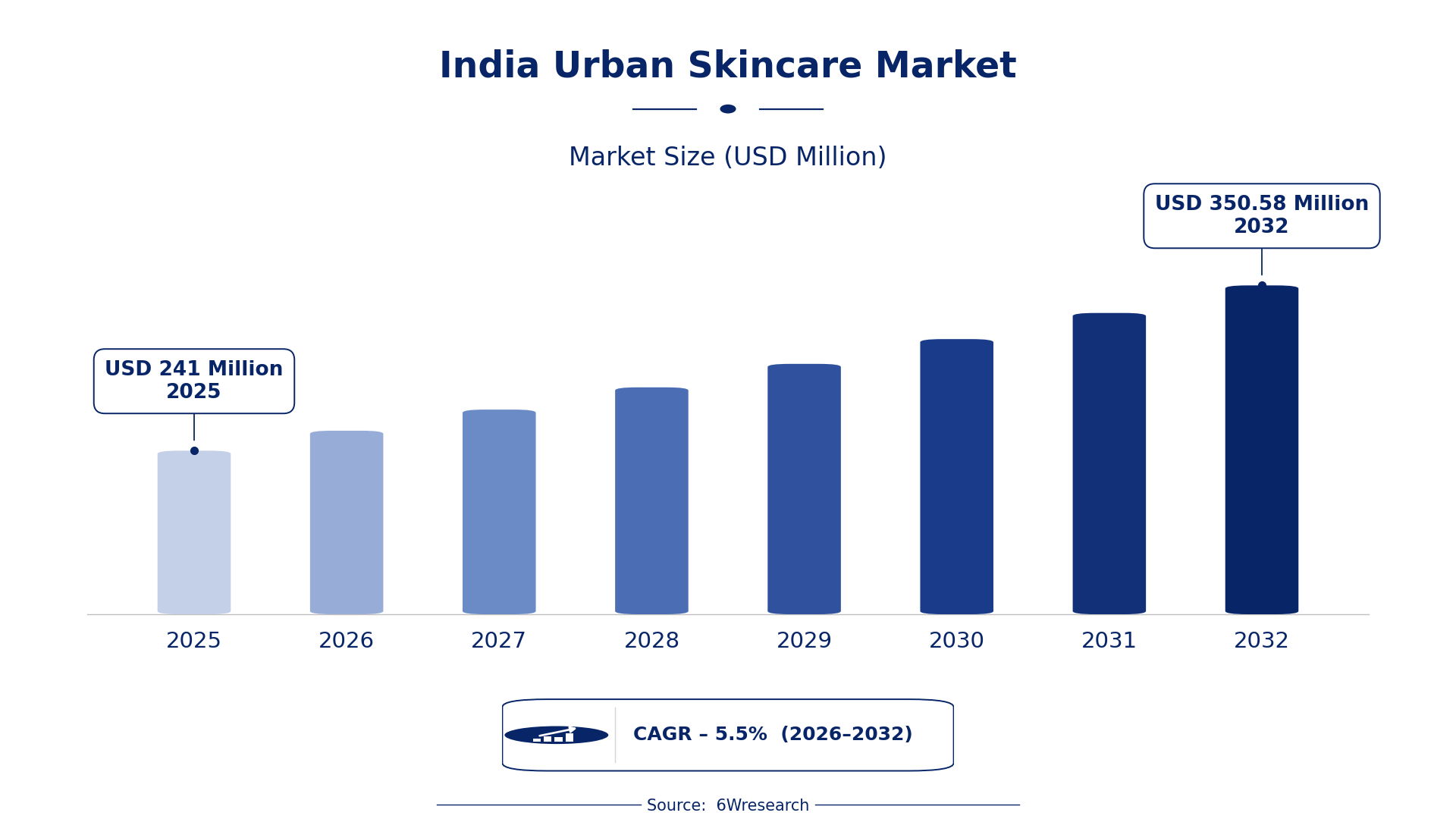
According to 6Wresearch internal database and industry insights, the India Urban Skincare Market was valued at USD 241.0 million in 2025 and is projected to reach USD 350.58 million by 2032, growing at a CAGR of approximately 5.5% during 2026–2032.
India Urban Skincare Market Highlights
| Report Metric | Details |
| Report Name | India Urban Skincare Market |
| Market Size 2025 | USD 241.0 million |
| Market Size 2032 | USD 350.58 million |
| Absolute Growth 2025–2032 | USD 109.58 million |
| CAGR 2026–2032 | 5.5% |
| Peak Annual Growth | 8.1% in 2032 |
| Forecast Period | 2026–2032 |
| Historical Data | 2022–2025 |
| Base Year | 2025 |
| Leading Product Type, 2025 | Anti-Pollution Creams (38% share) |
| Leading Target Skin Concern, 2025 | Dust & UV Protection (45% share) |
| Leading Ingredient Type, 2025 | Vitamin C (29% share) |
| Leading End User, 2025 | Urban Professionals (44% share) |
| Fastest-Growing Product Type | Hydrating Serums (7.0% CAGR) |
| Fastest-Growing Target Skin Concern | Dryness & Irritation (6.7% CAGR) |
| Fastest-Growing Ingredient Type | SPF (7.5% CAGR) |
| Fastest-Growing End User | Commuters (8.0% CAGR) |
| Growing Sector | Skincare |
| Key End Users | Urban Professionals, Commuters, Skincare Enthusiasts |
India Urban Skincare Market Year-wise Growth Rate and Key Drivers (2022–2032)
This graph illustrates the annual growth rates of the market from 2022 to 2032, highlighting a steady upward trajectory and projected market expansion over the forecast period.
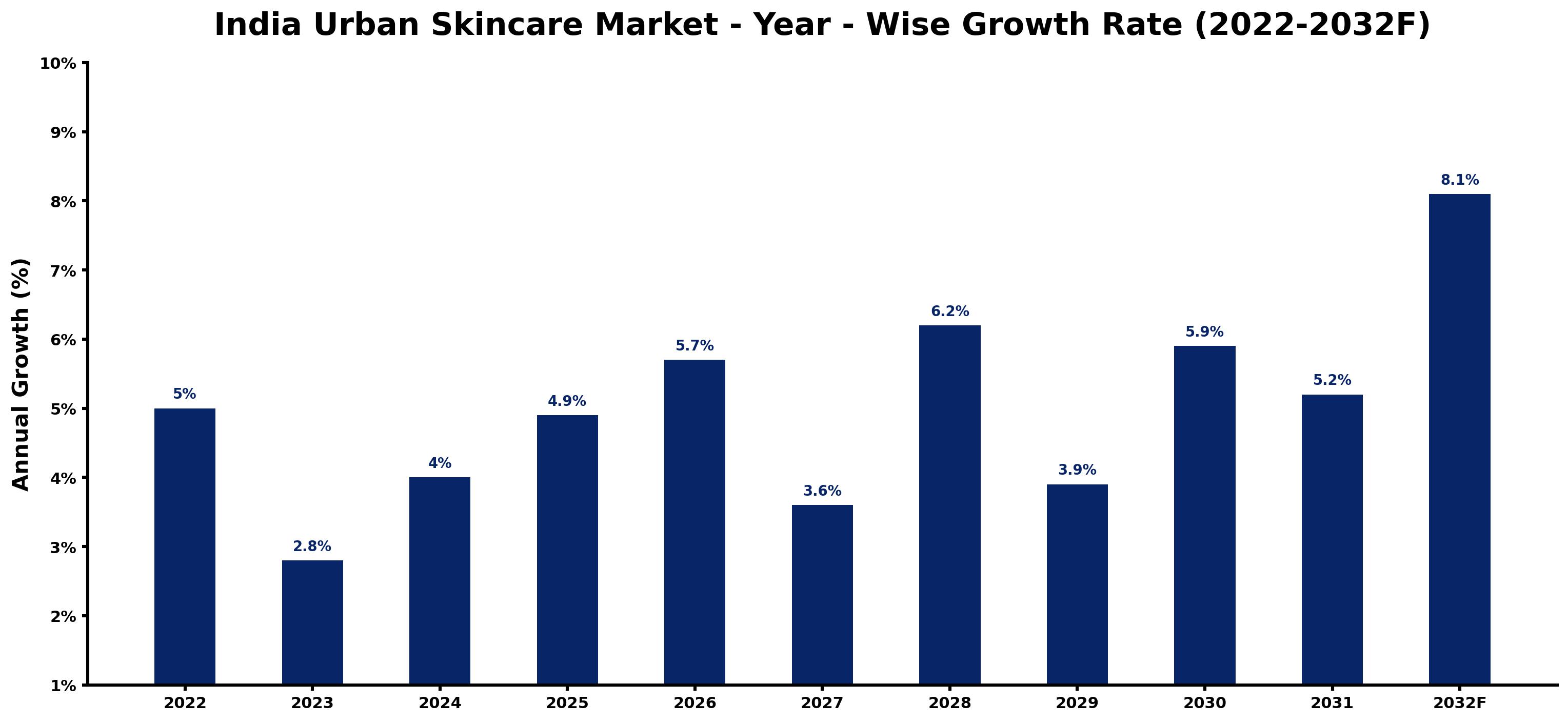
The following table presents the estimated annual growth rate for each year together with the principal factor influencing market performance.
| Year | Estimated Annual Growth (%) | Market Rationale |
| 2022 | 5.0 | The market experienced steady demand due to increasing urbanisation and skincare awareness. |
| 2023 | 2.8 | Growth slowed as consumers adjusted to rising prices of urban skincare products. |
| 2024 | 4.0 | Demand increased as consumers sought effective solutions for urban pollution effects. |
| 2025 | 4.9 | The market expanded with a focus on anti-aging products and urban skincare solutions. |
| 2026 | 5.7 | Investment in local production is expected to boost availability and affordability of skincare products. |
| 2027 | 3.6 | Growth is projected to slow as competition intensifies among local skincare brands. |
| 2028 | 6.2 | The introduction of new product lines will spur demand for effective skincare solutions. |
| 2029 | 3.9 | Consumer interest in eco-friendly products is expected to lead to a slight slowdown in growth. |
| 2030 | 5.9 | Demand is projected to rise as urban professionals increasingly prioritise skincare in their routines. |
| 2031 | 5.2 | Growth is expected to slow as the 'Atmanirbhar Bharat' initiative impacts new product introductions. |
| 2032 | 8.1 | The market is projected to peak with rising demand for anti-aging and UV protection products. |
Note: Market size estimations and growth projections presented in this report are based on 6Wresearch's proprietary forecasting methodology, utilizing the latest available industry data, government publications, and primary research inputs.
India Urban Skincare Market Synopsis
Urban Skincare in India includes products designed to protect and rejuvenate skin exposed to city environments. These products target urban pollutants and skin damage, offering hydration and anti-aging benefits. The India Urban Skincare Market is growing due to a rapidly urbanising population and increased awareness of skincare among consumers. With 600 million people living in urban areas, the demand for effective skincare solutions is rising. Initiatives like the 'Swachh Bharat Mission' are further driving interest in urban skincare products.
Market Dynamics Impact Analysis (2026–2032)
| Factor | Type | Impact | Primary Segment Affected |
| Increasing urban population driving demand for skincare solutions | Driver | High | Anti-Pollution Creams |
| Rising consumer awareness about the effects of pollution on skin | Driver | High | Hydrating Serums |
| Growing interest in sustainable skincare products | Opportunity | Medium | Detox Face Masks |
| Expansion of local production capabilities for skincare ingredients | Opportunity | Medium | Anti-Aging Lotions |
| High competition among local brands limiting market growth | Restraint | High | Anti-Pollution Creams |
| Consumer hesitation due to higher prices of premium skincare products | Restraint | Medium | Hydrating Serums |
| Supply chain disruptions affecting ingredient availability | Challenge | High | Detox Face Masks |
| Regulatory hurdles delaying product approvals for new entrants | Challenge | Medium | Anti-Aging Lotions |
Evaluation of Drivers in India Urban Skincare Market (2026–2032)
The table below links each growth driver to the segment it affects and the evidence for it.
| Drivers | Primary Segment Affected | Why It Matters (Evidence) |
| Increased investment in local production of skincare ingredients | Anti-Pollution Creams | This investment allows for better pricing and availability, encouraging more purchases from urban consumers. |
| Growing awareness of pollution-related skin damage | Hydrating Serums | Consumers are increasingly seeking hydration solutions, leading to higher sales of these products. |
| Rising demand for anti-aging products among urban populations | Anti-Aging Lotions | As urban stressors contribute to premature aging, consumers are prioritising these products in their skincare routines. |
| Focus on sustainable and eco-friendly skincare solutions | Detox Face Masks | Consumers are willing to pay a premium for products that align with their values, boosting sales. |
| High UV index in urban areas driving SPF product sales | Hydrating Serums | With increasing awareness of UV damage, consumers are purchasing more products containing SPF. |
Growth in the Urban Skincare market in India stems from increased investment in local production and rising end-use demand for effective skincare solutions. The urban population reached 600 million in 2023, boosting demand for products that combat pollution effects. Awareness of skin damage caused by environmental factors has led to a surge in demand for hydrating serums, with sales increasing as consumers seek effective hydration. The popularity of anti-aging products is also on the rise, with growth projected in this segment by 2025. The focus on sustainable skincare practices encourages consumers to invest in eco-friendly products, supporting overall market growth.
Evaluation of Restraints in India Urban Skincare Market
Below mentioned are some major restraints and their influence on market dynamics.
| Market Restraint | Primary Segment Affected | Why It Matters (Evidence) |
| High competition among local brands leading to price wars | Anti-Pollution Creams | This competition can reduce profit margins for producers, making it challenging to sustain growth. |
| Consumer reluctance to switch from established brands | Hydrating Serums | Brand loyalty can hinder new entrants from gaining market share, impacting overall sales. |
| Supply chain disruptions affecting ingredient availability | Detox Face Masks | These disruptions can delay product launches and limit the variety of products available to consumers. |
| Regulatory hurdles delaying product approvals for new entrants | Anti-Aging Lotions | This can slow down market entry for new products, affecting competition and consumer choice. |
| Higher prices of premium skincare products limiting access | Hydrating Serums | This can deter price-sensitive consumers from purchasing these products, impacting overall sales. |
India Urban Skincare Market Challenges
Producers in the India Urban Skincare Market struggle with stringent regulations from the Bureau of Indian Standards, causing product approvals to take up to six months, which delays market entry. Distributors face supply challenges due to the 'Atmanirbhar Bharat' initiative, which prioritises local sourcing, potentially leading to a 20% shortage of imported ingredients and affecting product diversity. Buyers encounter rising prices as demand for premium urban skincare escalates, with costs expected to increase by 15% by 2025, impacting their purchasing power. A scarcity of skilled professionals in formulation hampers innovation, making it difficult for producers to align with evolving consumer preferences for advanced skincare solutions.
Trends in the India Urban Skincare Market
Buyers and suppliers in the India Urban Skincare Market are adjusting to the following trends.
- Shift Towards Eco-Friendly Skincare: The trend towards sustainable skincare is growing, with initiatives like the National Institute of Fashion Technology promoting sustainable practices. In 2023, 30% of consumers reported a preference for eco-friendly products.
- Increase in SPF Product Popularity: Urban areas are seeing a rise in SPF product sales as consumers become more aware of UV damage. In 2022, SPF products accounted for 25% of all skincare sales in urban India.
- Focus on Anti-Aging Solutions: The demand for anti-aging products has surged, particularly among urban professionals. By 2025, the anti-aging segment is projected to capture 40% of the market share.
- Rise of Vitamin C Products: Vitamin C serums are becoming increasingly popular due to their antioxidant properties. In 2023, they represented 29% of the total skincare sales in urban India.
Investment Opportunities in the India Urban Skincare Market
The following opportunities in the India Urban Skincare Market pair current demand with a clear way in.
- Investment in Eco-Friendly Skincare Products: With rising consumer interest in sustainable solutions, there is an opportunity to invest in eco-friendly skincare lines. Urban professionals are particularly inclined to purchase these products, driving demand.
- Expansion of Local Production Facilities: Investing in local production capabilities can meet the growing demand for skincare products. The 'Atmanirbhar Bharat' initiative encourages local production, making it an ideal time to enter the market.
- Development of Anti-Aging Products: The increasing awareness of aging effects presents an opportunity to develop effective anti-aging solutions. Urban women aged 30-50 are a key target market for these products.
- Launch of SPF-Enriched Skincare Lines: The high UV index in urban areas creates a demand for SPF-enriched skincare products. Collaborating with local manufacturers can facilitate entry into this growing segment.
Government Initiatives in the India Urban Skincare Market
The Bureau of Indian Standards has established guidelines for skincare product safety, ensuring quality and safety in production. This measure complements existing regulations, such as the ISO 22716:2007 standard for good manufacturing practices in cosmetics, which builds consumer trust in products. In 2022, the Indian government launched the 'Swachh Bharat Mission' focusing on urban cleanliness, impacting skincare product use. These measures collectively enhance the regulatory framework for skincare producers and buyers, ensuring safer products in the market.
The Cosmetic Export Promotion Council of India supports local skincare brands in international markets by providing funding and resources for export initiatives. This support helps local producers expand their reach and improve product visibility globally, with 50% of local brands benefiting from these initiatives. Additionally, the council assists in compliance with international standards, making it easier for producers to enter foreign markets and enhancing their competitiveness.
Future Insight of the India Urban Skincare Market
The India Urban Skincare Market is set to transform by 2032, driven by a rapidly growing urban population that demands effective skincare solutions. The emphasis on sustainable practices by the National Institute of Fashion Technology will promote eco-friendly product development, appealing to environmentally conscious consumers. The anti-aging segment will see considerable growth, prompting increased investment in research and development for innovative formulations. Adherence to ISO standards will improve manufacturing practices, ensuring higher quality and safety for consumers.
Market Segmentation Analysis
The analysis below covers each segmentation, its leading category in 2025 and its fastest-growing category through 2032.
By Product Type – Anti-Pollution Creams Dominated, Hydrating Serums Expected to Grow Fastest
According to Bhawna Singh, Assistant Manager at 6Wresearch, Anti-Pollution Creams accounted for a 38% market share by product type in 2025. Anti-Pollution Creams command the largest market share due to their essential role in protecting urban skin from environmental pollutants. With India's urban population hitting 600 million, these creams have become a staple in daily skincare routines, especially in heavily polluted cities. Hydrating Serums are set to record the highest CAGR in this split, 7.0% over 2026–2032. Hydrating Serums are experiencing rapid growth as consumers increasingly recognise the importance of moisture in combating urban skin challenges. The demand for these serums has surged, driven by the need to alleviate dryness caused by harsh environmental conditions. Suppliers should focus on developing hydrating products to meet the rising demand from consumers in polluted urban settings.
By Target Skin Concern – Dust & UV Protection Dominated, Dryness & Irritation Expected to Grow Fastest
The largest target skin concern category in 2025 was Dust & UV Protection, with a 45% share of total revenue. Dust & UV Protection leads the market share as these products are crucial for shielding skin from harmful urban dust and UV exposure. Growing awareness of skin health has prompted consumers to prioritise protection against these environmental threats. The quickest growth will come from Dryness & Irritation, forecast to expand at a CAGR of 6.7% between 2026 and 2032. Dryness & Irritation is the fastest-growing concern as urban living conditions contribute significantly to skin issues. The increasing prevalence of pollution and environmental stressors has intensified consumer focus on products that specifically address these concerns. This trend indicates that suppliers should expand their product lines to include targeted solutions for dryness and irritation, catering to the needs of urban consumers.
By Ingredient Type – Vitamin C Dominated, SPF Expected to Grow Fastest
In 2025, Vitamin C led the ingredient type split with a 29% share. Vitamin C leads the market share due to its well-known antioxidant properties that are highly valued by consumers seeking effective skincare solutions. Its popularity is driven by the increasing awareness of its benefits in combating urban skin damage and promoting a healthy complexion. SPF is projected to grow fastest, at a CAGR of 7.5% during 2026–2032. SPF is the fastest-growing ingredient as consumers become more conscious of the need for sun protection in urban settings. The high UV index in cities has led to a surge in demand for products that incorporate SPF for daily use. This indicates that suppliers should focus on integrating SPF into their products, meeting the rising demand for sun protection among urban consumers.
By End User – Urban Professionals Dominated, Commuters Expected to Grow Fastest
Urban Professionals took a 44% share of end user in 2025, more than any other category. Urban Professionals represent the largest market share as they actively seek skincare solutions tailored to the challenges of city living. This demographic prioritises effective products that fit their busy lifestyles, making them key consumers in the urban skincare market. Over 2026–2032, Commuters are expected to post the fastest growth, at a CAGR of 8.0%. Commuters are the fastest-growing segment as their daily exposure to pollution heightens the need for effective skincare. The increasing number of individuals commuting in urban areas has led to a surge in demand for products that address their specific skincare needs. This suggests that suppliers should target commuter-friendly skincare solutions, catering to the unique challenges faced by this growing consumer group.
Key Attractiveness of the Report
- 10 Years of Market Numbers
- Historical Data Starting from 2022 to 2025
- Base Year 2025
- Forecast Data until 2032
- Key Performance Indicators Impacting the Market
- Major Upcoming Developments and Projects
Key Highlights of the Report:
- India Urban Skincare Market Outlook
- Market Size of India Urban Skincare Market, 2025
- Forecast of India Urban Skincare Market, 2032
- Historical Data and Forecast of India Urban Skincare Revenues & Volume for the Period 2022 - 2032F
- India Urban Skincare Market Trend Evolution
- India Urban Skincare Market Drivers and Challenges
- India Urban Skincare Price Trends
- India Urban Skincare Porter's Five Forces
- India Urban Skincare Industry Life Cycle
- Historical Data and Forecast of India Urban Skincare Market Revenues & Volume By Product Type for the Period 2022 - 2032F
- Historical Data and Forecast of India Urban Skincare Market Revenues & Volume By Anti-Pollution Creams for the Period 2022 - 2032F
- Historical Data and Forecast of India Urban Skincare Market Revenues & Volume By Hydrating Serums for the Period 2022 - 2032F
- Historical Data and Forecast of India Urban Skincare Market Revenues & Volume By Detox Face Masks for the Period 2022 - 2032F
- Historical Data and Forecast of India Urban Skincare Market Revenues & Volume By Anti-Aging Lotions for the Period 2022 - 2032F
- Historical Data and Forecast of India Urban Skincare Market Revenues & Volume By Target Skin Concern for the Period 2022 - 2032F
- Historical Data and Forecast of India Urban Skincare Market Revenues & Volume By Dust & UV Protection for the Period 2022 - 2032F
- Historical Data and Forecast of India Urban Skincare Market Revenues & Volume By Dryness & Irritation for the Period 2022 - 2032F
- Historical Data and Forecast of India Urban Skincare Market Revenues & Volume By Pollution Build-up for the Period 2022 - 2032F
- Historical Data and Forecast of India Urban Skincare Market Revenues & Volume By Premature Aging for the Period 2022 - 2032F
- Historical Data and Forecast of India Urban Skincare Market Revenues & Volume By Ingredient Type for the Period 2022 - 2032F
- Historical Data and Forecast of India Urban Skincare Market Revenues & Volume By Vitamin C, SPF for the Period 2022 - 2032F
- Historical Data and Forecast of India Urban Skincare Market Revenues & Volume By Hyaluronic Acid, Aloe for the Period 2022 - 2032F
- Historical Data and Forecast of India Urban Skincare Market Revenues & Volume By Charcoal, Clay for the Period 2022 - 2032F
- Historical Data and Forecast of India Urban Skincare Market Revenues & Volume By Peptides, Antioxidants for the Period 2022 - 2032F
- Historical Data and Forecast of India Urban Skincare Market Revenues & Volume By End User for the Period 2022 - 2032F
- Historical Data and Forecast of India Urban Skincare Market Revenues & Volume By Urban Professionals for the Period 2022 - 2032F
- Historical Data and Forecast of India Urban Skincare Market Revenues & Volume By Commuters for the Period 2022 - 2032F
- Historical Data and Forecast of India Urban Skincare Market Revenues & Volume By Skincare Enthusiasts for the Period 2022 - 2032F
- Historical Data and Forecast of India Urban Skincare Market Revenues & Volume By Women (30 50) for the Period 2022 - 2032F
- India Urban Skincare Import Export Trade Statistics
- Market Opportunity Assessment By Product Type
- Market Opportunity Assessment By Target Skin Concern
- Market Opportunity Assessment By Ingredient Type
- Market Opportunity Assessment By End User
- India Urban Skincare Top Companies Market Share
- India Urban Skincare Competitive Benchmarking By Technical and Operational Parameters
- India Urban Skincare Company Profiles
- India Urban Skincare Key Strategic Recommendations
Market Covered
Segments analysed in this report are listed below.
By Product Type
- Anti-Pollution Creams
- Hydrating Serums
- Detox Face Masks
- Anti-Aging Lotions
By Target Skin Concern
- Dust & UV Protection
- Dryness & Irritation
- Pollution Build-up
- Premature Aging
By Ingredient Type
- Vitamin C
- SPF
- Hyaluronic Acid
- Aloe
- Charcoal
- Clay
- Peptides
- Antioxidants
By End User
- Urban Professionals
- Commuters
- Skincare Enthusiasts
- Women (30–50)































