India Utility-Scale Energy Storage Market Size & Growth Rate
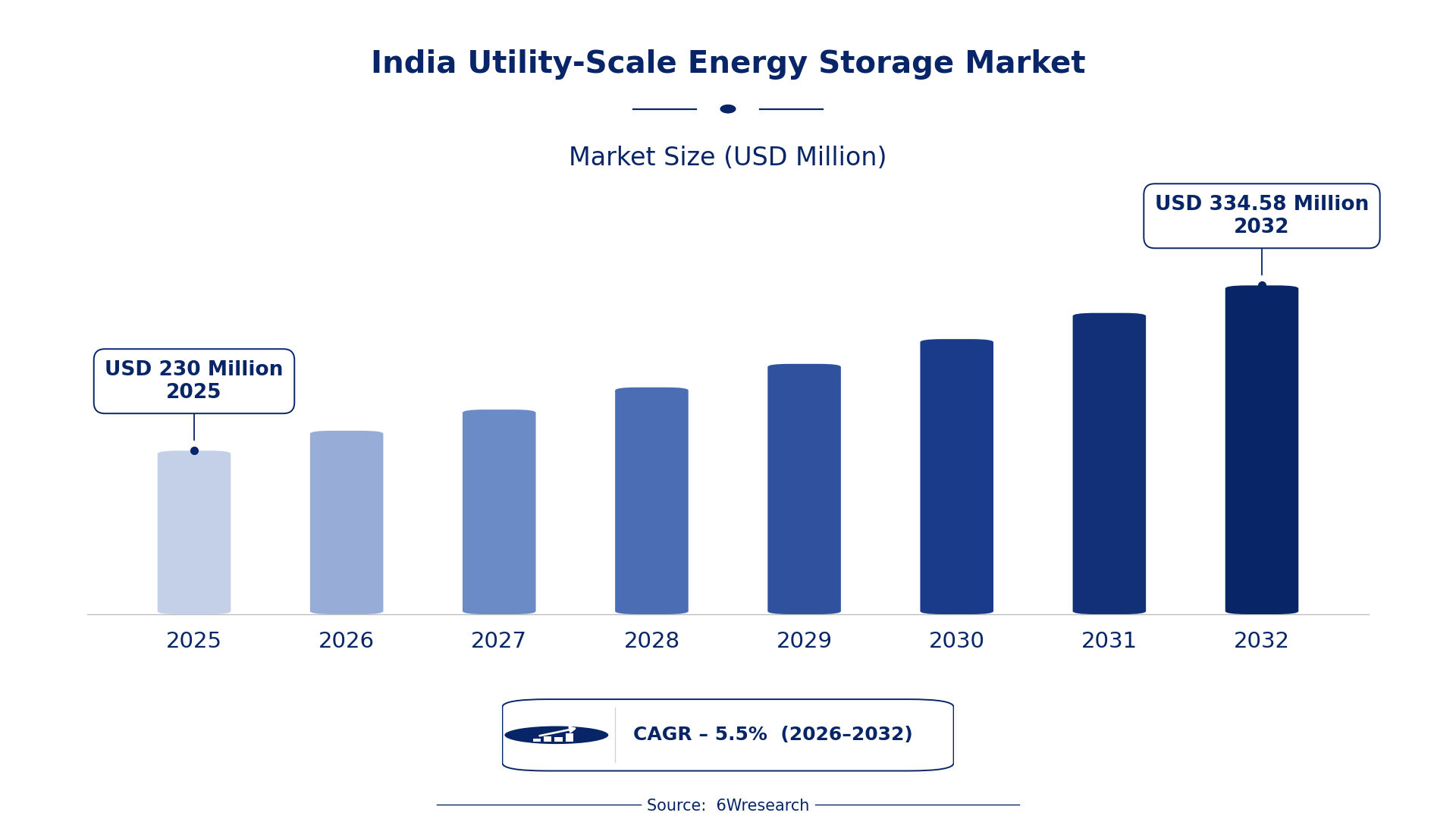
According to 6Wresearch internal database and industry insights, the India Utility-Scale Energy Storage Market was valued at USD 230.0 million in 2025 and is projected to reach USD 334.58 million by 2032, growing at a CAGR of approximately 5.5% during 2026–2032.
India Utility-Scale Energy Storage Market Highlights
| Report Metric | Details |
| Report Name | India Utility-Scale Energy Storage Market |
| Market Size 2025 | USD 230.0 million |
| Market Size 2032 | USD 334.58 million |
| Absolute Growth 2025–2032 | USD 104.58 million |
| CAGR 2026–2032 | 5.5% |
| Peak Annual Growth | 8.0% in 2027 |
| Forecast Period | 2026–2032 |
| Historical Data | 2022–2025 |
| Base Year | 2025 |
| Leading Storage Type, 2025 | Battery Storage (48% share) |
| Leading Technology Used, 2025 | Lithium-Ion (38% share) |
| Leading Discharge Duration, 2025 | Long-Term (Days) (47% share) |
| Leading End User, 2025 | Grid Operators (46% share) |
| Fastest-Growing Storage Type | Flow Batteries (7.7% CAGR) |
| Fastest-Growing Technology Used | Vanadium Redox (7.2% CAGR) |
| Fastest-Growing Discharge Duration | Medium-Term (Hours–Days) (8.1% CAGR) |
| Fastest-Growing End User | Renewable Firms (7.2% CAGR) |
| Growing Sector | Renewable Energy |
| Key End Users | Grid Operators, Renewable Firms, Energy Utilities, Solar Plant Owners |
India Utility-Scale Energy Storage Market Year-wise Growth Rate and Key Drivers (2022–2032)
This graph illustrates the annual growth rates of the market from 2022 to 2032, highlighting a steady upward trajectory and projected market expansion over the forecast period.
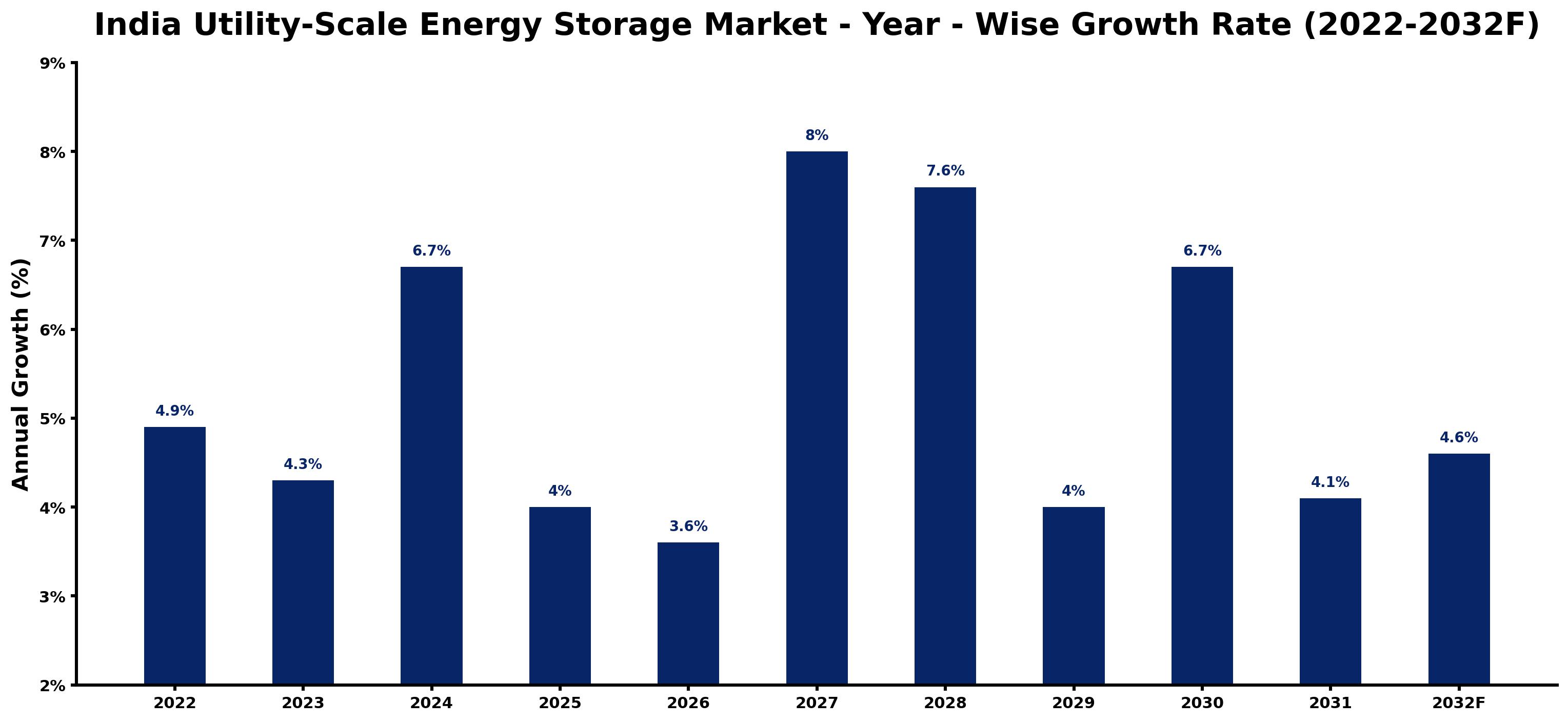
Each row of the following table gives one year's estimated growth and the event or demand shift that explains it.
| Year | Estimated Annual Growth (%) | Market Rationale |
| 2022 | 4.9 | The market experienced steady growth due to increasing demand from renewable energy projects. |
| 2023 | 4.3 | Growth slowed as the market adjusted to supply chain challenges affecting energy storage components. |
| 2024 | 6.7 | Demand surged as grid operators expanded their energy storage capabilities for reliability. |
| 2025 | 4.0 | Growth slowed again as the market stabilised after rapid expansions in previous years. |
| 2026 | 3.6 | A further slowdown occurred as market participants shifted focus towards long-term energy solutions. |
| 2027 | 8.0 | The market rebounded sharply with a surge in investments in energy storage technologies. |
| 2028 | 7.6 | Growth slowed again as the focus shifted to optimising existing energy storage systems. |
| 2029 | 4.0 | Demand growth slowed as market participants adjusted to new regulatory frameworks. |
| 2030 | 6.7 | Growth accelerated as India achieved significant milestones in renewable energy capacity. |
| 2031 | 4.1 | A slowdown occurred as the market stabilised following rapid expansions in previous years. |
| 2032 | 4.6 | Growth picked up again as new technologies and projects were initiated. |
Note: Market size estimations and growth projections presented in this report are based on 6Wresearch's proprietary forecasting methodology, utilizing the latest available industry data, government publications, and primary research inputs.
India Utility-Scale Energy Storage Market Synopsis
Utility-Scale Energy Storage in India encompasses technologies designed for large-scale energy storage, including battery storage and pumped hydro storage. The India Utility-Scale Energy Storage Market is growing due to heightened demand from grid operators and renewable energy initiatives. The National Energy Storage Mission aims for 30 GW of energy storage capacity by 2030, which is driving investments in this sector. With India's renewable energy capacity projected to reach 500 GW by 2030, the necessity for dependable energy storage solutions is increasingly pressing.
Market Dynamics Impact Analysis (2026–2032)
| Factor | Type | Impact | Primary Segment Affected |
| Growing investments in renewable energy projects drive demand for energy storage solutions. | Driver | High | Battery Storage |
| The increasing need for grid stability and reliability fuels demand for pumped hydro storage. | Driver | High | Pumped Hydro Storage |
| Investment opportunities exist in advanced energy storage technologies for grid operators. | Opportunity | High | Grid Operators |
| The rise in renewable energy capacity creates a demand for energy storage solutions in solar plants. | Opportunity | High | Solar Plant Owners |
| Supply chain challenges hinder the availability of critical components for energy storage systems. | Restraint | High | Battery Storage |
| High initial investment costs for energy storage systems limit market entry for new players. | Restraint | Medium | Pumped Hydro Storage |
| Regulatory uncertainties can delay project approvals and hinder market growth. | Challenge | High | Energy Utilities |
| Technological advancements require continuous investment, posing a challenge for suppliers. | Challenge | Medium | Renewable Firms |
Evaluation of Drivers in India Utility-Scale Energy Storage Market (2026–2032)
Below mentioned are some major drivers and their influence on market dynamics.
| Drivers | Primary Segment Affected | Why It Matters (Evidence) |
| Increasing renewable energy capacity necessitates energy storage solutions for grid stability. | Battery Storage | India's renewable energy capacity is projected to reach 500 GW by 2030, leading to higher storage demand. |
| Government initiatives promote the adoption of energy storage technologies across the country. | Pumped Hydro Storage | The National Energy Storage Mission aims for 30 GW of energy storage capacity by 2030, boosting investments. |
| Grid operators seek energy storage to improve operational efficiency and reliability. | Grid Operators | In 2023, the Indian government allocated ₹1,000 crore for energy storage projects under the Atmanirbhar Bharat initiative. |
| Technological advancements in battery technology are driving market growth. | Lithium-Ion | Lithium-ion batteries dominate the market, accounting for over 70% of energy storage installations. |
| Research and development in advanced storage technologies is gaining traction. | Flow Batteries | The Ministry of New and Renewable Energy launched a scheme in 2023 to promote research in energy storage. |
India's renewable energy capacity is set to reach 500 GW by 2030, creating a need for dependable energy storage solutions. The National Energy Storage Mission targets 30 GW of energy storage capacity by 2030, encouraging investments in this sector. The prevalence of lithium-ion batteries, which constitute over 70% of installations, highlights the shift towards advanced storage technologies.
Evaluation of Restraints in India Utility-Scale Energy Storage Market
The following restraints limit how fast demand can grow.
| Market Restraint | Primary Segment Affected | Why It Matters (Evidence) |
| Supply chain disruptions affect the availability of essential components for energy storage systems. | Battery Storage | India's energy storage market is impacted by global supply chain issues, delaying project timelines. |
| High initial investment costs deter new entrants in the energy storage market. | Pumped Hydro Storage | The capital-intensive nature of pumped hydro storage projects limits participation from smaller firms. |
| Regulatory uncertainties can create delays in project approvals for energy storage initiatives. | Energy Utilities | Unclear regulatory frameworks lead to hesitance among investors and project developers. |
| Limited awareness of energy storage benefits among potential users hinders market growth. | Renewable Firms | Many renewable firms are still unfamiliar with the advantages of integrating energy storage solutions. |
| Technological limitations in existing storage solutions restrict their widespread adoption. | Flow Batteries | Flow batteries, while promising, have not yet achieved significant market penetration due to performance issues. |
India Utility-Scale Energy Storage Market Challenges
In the India Utility-Scale Energy Storage market, only 1.5 GW of installed battery storage capacity in 2023 hampers the ability of grid operators to maintain stability. A shortage of skilled professionals delays the deployment of advanced energy storage technologies for suppliers, resulting in slower project rollouts. Supply chain disruptions arise from reliance on imported components, which can extend project timelines for producers and increase costs. Buyers face rising expenses as achieving the target of 30 GW of energy storage by 2030 necessitates significant investment, straining budgets for renewable energy projects.
Trends in the India Utility-Scale Energy Storage Market
The trends below show where the India Utility-Scale Energy Storage Market is heading.
- Shift from Conventional to Advanced Energy Storage Technologies: India is moving away from conventional energy storage methods towards advanced technologies like lithium-ion and flow batteries. The Ministry of New and Renewable Energy's 2023 scheme encourages research in these areas, reflecting this transition.
- Increasing Focus on Long-Duration Energy Storage Solutions: The market is gravitating towards long-duration energy storage solutions to address seasonal energy demands. The National Energy Storage Mission, launched in 2021, aims for 30 GW of energy storage capacity by 2030, supporting this shift.
- Growing Integration of Energy Storage in Renewable Projects: Renewable firms are increasingly incorporating energy storage systems to boost reliability. The Ministry of New and Renewable Energy's initiatives are driving the demand for efficient storage solutions, with a target of 500 GW renewable capacity by 2030.
- Rising Demand for Grid Balancing Solutions: Grid operators are prioritising energy storage for effective grid balancing. The Central Electricity Authority's updated guidelines in 2022 facilitate the integration of energy storage systems into the national grid, improving reliability.
Investment Opportunities in the India Utility-Scale Energy Storage Market
Several openings in the India Utility-Scale Energy Storage Market merit attention from investors.
- Investment in Lithium-Ion Battery Manufacturing: With lithium-ion batteries accounting for over 70% of installations, there is a strong opportunity for investment in local manufacturing. The Atmanirbhar Bharat initiative supports domestic production, with a budget of ₹1,000 crore.
- Development of Flow Battery Technologies: The growing interest in flow batteries presents an opportunity for innovation and investment. The Ministry of New and Renewable Energy's 2023 scheme promotes research in this area, encouraging new entrants.
- Expansion of Pumped Hydro Storage Facilities: The dominance of pumped hydro storage, accounting for approximately 95% of total capacity, indicates a need for facility expansion. Collaborating with local governments can facilitate new project approvals.
- Improving Grid Integration Solutions: As grid operators seek reliable energy storage solutions, there is a demand for advanced integration technologies. Partnering with the Central Electricity Authority can streamline project implementation.
Government Initiatives in the India Utility-Scale Energy Storage Market
The National Energy Storage Mission, initiated by the Ministry of Power in 2021, aims to boost energy storage capacity and technology development, targeting 30 GW by 2030. This initiative encourages investments in energy storage technologies and infrastructure. Additionally, the Atmanirbhar Bharat initiative, launched in 2021, includes a ₹1,000 crore budget for promoting domestic manufacturing of energy storage systems, further supporting the market.
The Central Electricity Authority is tasked with integrating energy storage systems into the national grid, enhancing reliability and stability. The Ministry of New and Renewable Energy promotes research and development in advanced energy storage technologies through a scheme launched in 2023, focusing on lithium-ion and flow batteries. This initiative encourages innovation in the sector, benefiting both producers and buyers.
Future Insight of the India Utility-Scale Energy Storage Market
Several forward-looking factors should support the India Utility-Scale Energy Storage market by 2032. The National Energy Storage Mission will drive technology adoption, while the ₹1,000 crore allocated for energy storage projects under the Atmanirbhar Bharat initiative will stimulate growth. Research into new storage technologies will improve system capabilities. The Central Electricity Authority's focus on grid integration will enhance the reliability of energy storage solutions, benefiting both buyers and suppliers.
Market Segmentation Analysis
The analysis below covers each segmentation, its leading category in 2025 and its fastest-growing category through 2032.
By Storage Type – Battery Storage Dominated, Flow Batteries Expected to Grow Fastest
According to Bhawna Singh, Assistant Manager at 6Wresearch, with a 48% revenue share in 2025, Battery Storage was the largest storage type category. Battery storage holds the largest market share in India due to its widespread application in energy storage and grid services. With an installed capacity of 1.5 GW in 2023, it is a preferred choice for balancing supply and demand. Flow Batteries are set to record the highest CAGR in this split, 7.7% over 2026–2032. Flow batteries are experiencing rapid growth as they offer potential for long-duration energy storage applications. Their increasing exploration and pilot projects indicate a shift towards more versatile energy storage solutions. Suppliers should focus on developing flow battery technologies to capture emerging opportunities in the energy storage market.
By Technology Used – Lithium-Ion Dominated, Vanadium Redox Expected to Grow Fastest
Lithium-Ion accounted for a 38% market share by technology used in 2025. Lithium-ion technology dominates the Indian energy storage market, accounting for over 70% of installations due to its efficiency and reliability. This widespread adoption is driven by the need for effective energy storage solutions in renewable integration. Over 2026–2032, Vanadium Redox is expected to post the fastest growth, at a CAGR of 7.2%. Vanadium redox technology is gaining traction as it presents unique advantages for specific applications, despite its current limited market penetration. The growing interest in this technology suggests a potential shift in energy storage strategies. Buyers may benefit from diversifying their energy storage technologies to include emerging solutions like vanadium redox.
By Discharge Duration – Long-Term (Days) Dominated, Medium-Term (Hours–Days) Expected to Grow Fastest
The largest discharge duration category in 2025 was Long-Term (Days), with a 47% share of total revenue. Long-term energy storage solutions are critical for addressing seasonal energy demands, making this segment the largest in the market. Their importance is underscored by the need to support India's ambitious renewable energy targets. Medium-Term (Hours–Days) is projected to grow fastest, at a CAGR of 8.1% during 2026–2032. Medium-term storage is rapidly growing as it effectively bridges short-term gaps in energy supply, making it increasingly relevant for grid operators. This segment's growth reflects the immediate needs of the energy market. Suppliers should prioritise medium-term storage solutions to meet the evolving demands of grid operators and renewable firms.
By End User – Grid Operators Dominated, Renewable Firms Expected to Grow Fastest
Grid Operators took a 46% share of end user in 2025, more than any other category. Grid operators are essential in the utility-scale energy storage market, as they depend on these solutions for effective grid management and stability. Their significant role ensures a steady demand for energy storage technologies, particularly for balancing supply and demand. The quickest growth will come from Renewable Firms, forecast to expand at a CAGR of 7.2% between 2026 and 2032. Renewable firms are increasingly integrating energy storage to optimise their generation capabilities, driving rapid growth in this segment. This trend highlights the critical need for storage solutions to complement renewable energy production and meet future energy requirements. Suppliers must focus on creating customised solutions that cater to the distinct needs of renewable firms to seize opportunities in the growing energy storage market.
Key Attractiveness of the Report
- 10 Years of Market Numbers
- Historical Data Starting from 2022 to 2025
- Base Year 2025
- Forecast Data until 2032
- Key Performance Indicators Impacting the Market
- Major Upcoming Developments and Projects
Key Highlights of the Report:
- India Utility-Scale Energy Storage Market Outlook
- Market Size of India Utility-Scale Energy Storage Market, 2025
- Forecast of India Utility-Scale Energy Storage Market, 2032
- Historical Data and Forecast of India Utility-Scale Energy Storage Revenues & Volume for the Period 2022 - 2032F
- India Utility-Scale Energy Storage Market Trend Evolution
- India Utility-Scale Energy Storage Market Drivers and Challenges
- India Utility-Scale Energy Storage Price Trends
- India Utility-Scale Energy Storage Porter's Five Forces
- India Utility-Scale Energy Storage Industry Life Cycle
- Historical Data and Forecast of India Utility-Scale Energy Storage Market Revenues & Volume By Storage Type for the Period 2022 - 2032F
- Historical Data and Forecast of India Utility-Scale Energy Storage Market Revenues & Volume By Battery Storage for the Period 2022 - 2032F
- Historical Data and Forecast of India Utility-Scale Energy Storage Market Revenues & Volume By Pumped Hydro Storage for the Period 2022 - 2032F
- Historical Data and Forecast of India Utility-Scale Energy Storage Market Revenues & Volume By Flow Batteries for the Period 2022 - 2032F
- Historical Data and Forecast of India Utility-Scale Energy Storage Market Revenues & Volume By Thermal Storage for the Period 2022 - 2032F
- Historical Data and Forecast of India Utility-Scale Energy Storage Market Revenues & Volume By Technology Used for the Period 2022 - 2032F
- Historical Data and Forecast of India Utility-Scale Energy Storage Market Revenues & Volume By Lithium-Ion for the Period 2022 - 2032F
- Historical Data and Forecast of India Utility-Scale Energy Storage Market Revenues & Volume By Gravity-Based for the Period 2022 - 2032F
- Historical Data and Forecast of India Utility-Scale Energy Storage Market Revenues & Volume By Vanadium Redox for the Period 2022 - 2032F
- Historical Data and Forecast of India Utility-Scale Energy Storage Market Revenues & Volume By Molten Salt for the Period 2022 - 2032F
- Historical Data and Forecast of India Utility-Scale Energy Storage Market Revenues & Volume By Discharge Duration for the Period 2022 - 2032F
- Historical Data and Forecast of India Utility-Scale Energy Storage Market Revenues & Volume By Short-Term (Hours) for the Period 2022 - 2032F
- Historical Data and Forecast of India Utility-Scale Energy Storage Market Revenues & Volume By Long-Term (Days) for the Period 2022 - 2032F
- Historical Data and Forecast of India Utility-Scale Energy Storage Market Revenues & Volume By Medium-Term (Hours Days) for the Period 2022 - 2032F
- Historical Data and Forecast of India Utility-Scale Energy Storage Market Revenues & Volume By Grid Balancing for the Period 2022 - 2032F
- Historical Data and Forecast of India Utility-Scale Energy Storage Market Revenues & Volume By End User for the Period 2022 - 2032F
- Historical Data and Forecast of India Utility-Scale Energy Storage Market Revenues & Volume By Grid Operators for the Period 2022 - 2032F
- Historical Data and Forecast of India Utility-Scale Energy Storage Market Revenues & Volume By Energy Utilities for the Period 2022 - 2032F
- Historical Data and Forecast of India Utility-Scale Energy Storage Market Revenues & Volume By Renewable Firms for the Period 2022 - 2032F
- Historical Data and Forecast of India Utility-Scale Energy Storage Market Revenues & Volume By Solar Plant Owners for the Period 2022 - 2032F
- India Utility-Scale Energy Storage Import Export Trade Statistics
- Market Opportunity Assessment By Storage Type
- Market Opportunity Assessment By Technology Used
- Market Opportunity Assessment By Discharge Duration
- Market Opportunity Assessment By End User
- India Utility-Scale Energy Storage Top Companies Market Share
- India Utility-Scale Energy Storage Competitive Benchmarking By Technical and Operational Parameters
- India Utility-Scale Energy Storage Company Profiles
- India Utility-Scale Energy Storage Key Strategic Recommendations
Market Covered
The report offers an extensive study of the following market segments.
By Storage Type
- Battery Storage
- Pumped Hydro Storage
- Flow Batteries
- Thermal Storage
By Technology Used
- Lithium-Ion
- Gravity-Based
- Vanadium Redox
- Molten Salt
By Discharge Duration
- Short-Term (Hours)
- Long-Term (Days)
- Medium-Term (Hours–Days)
- Grid Balancing
By End User
- Grid Operators
- Energy Utilities
- Renewable Firms
- Solar Plant Owners































