India Vacuum-Assisted Brake Systems Market Size & Growth Rate
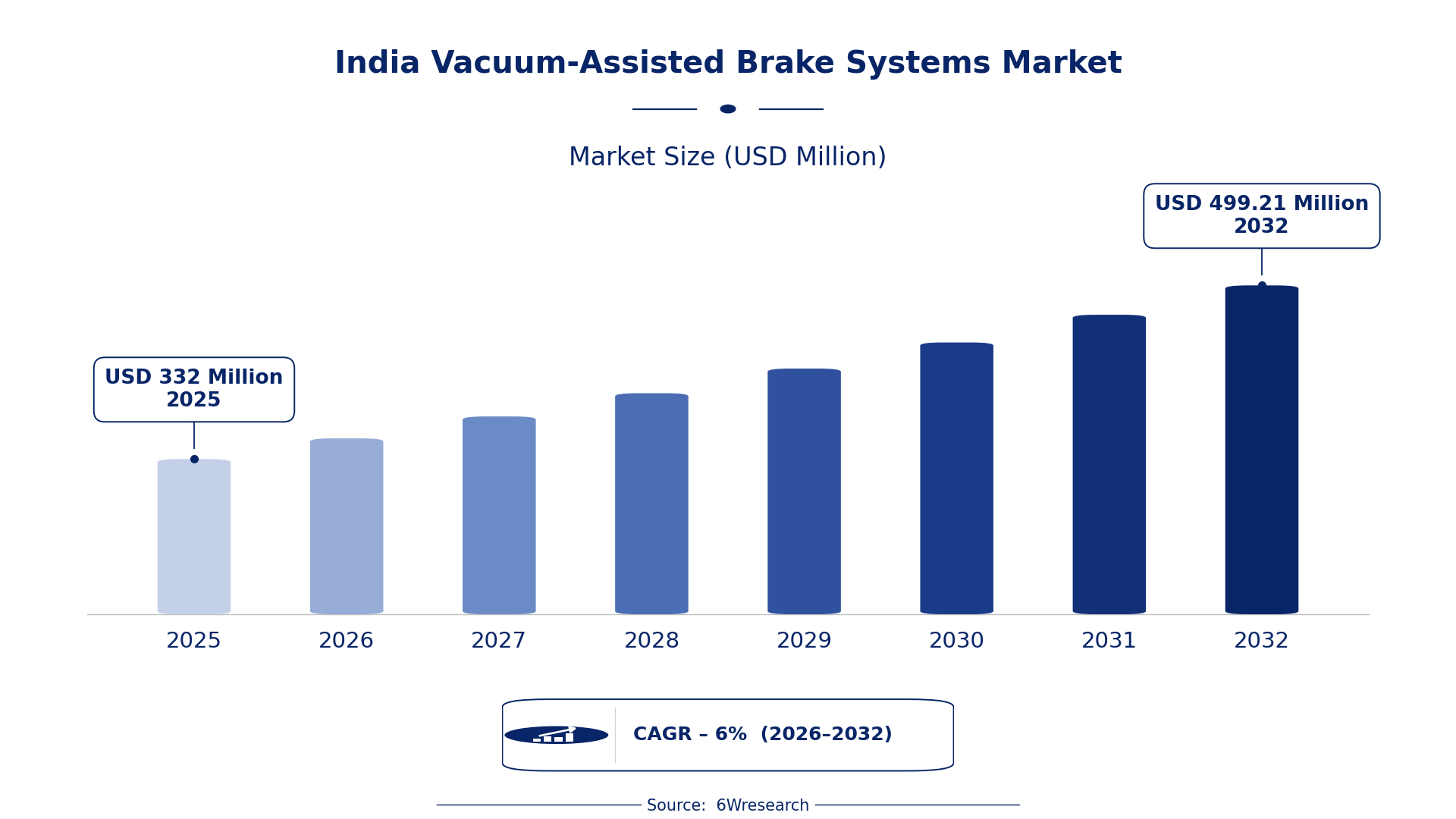
According to 6Wresearch internal database and industry insights, the India Vacuum-Assisted Brake Systems Market was valued at USD 332.0 million in 2025 and is projected to reach USD 499.21 million by 2032, growing at a CAGR of approximately 6% during 2026–2032.
India Vacuum-Assisted Brake Systems Market Highlights
| Report Metric | Details |
| Report Name | India Vacuum-Assisted Brake Systems Market |
| Market Size 2025 | USD 332.0 million |
| Market Size 2032 | USD 499.21 million |
| Absolute Growth 2025–2032 | USD 167.21 million |
| CAGR 2026–2032 | 6% |
| Peak Annual Growth | 8.6% in 2031 |
| Forecast Period | 2026–2032 |
| Historical Data | 2022–2025 |
| Base Year | 2025 |
| Leading Brake Type, 2025 | Hydraulic Vacuum Brakes (47% share) |
| Leading Vehicle Type, 2025 | Passenger Cars (44% share) |
| Leading Booster Type, 2025 | Single Diaphragm (50% share) |
| Leading End User, 2025 | OEM Manufacturers (42% share) |
| Fastest-Growing Brake Type | Electric Vacuum Brakes (7.2% CAGR) |
| Fastest-Growing Vehicle Type | EVs & Hybrids (7.9% CAGR) |
| Fastest-Growing Booster Type | Electric Pump Based (7.1% CAGR) |
| Growing Sector | Electric Vehicles |
| Key End Users | OEM Manufacturers, Auto Assemblers, Tier-1 Suppliers, Repair Garages |
India Vacuum-Assisted Brake Systems Market Year-wise Growth Rate and Key Drivers (2022–2032)
This graph illustrates the annual growth rates of the market from 2022 to 2032, highlighting a steady upward trajectory and projected market expansion over the forecast period.
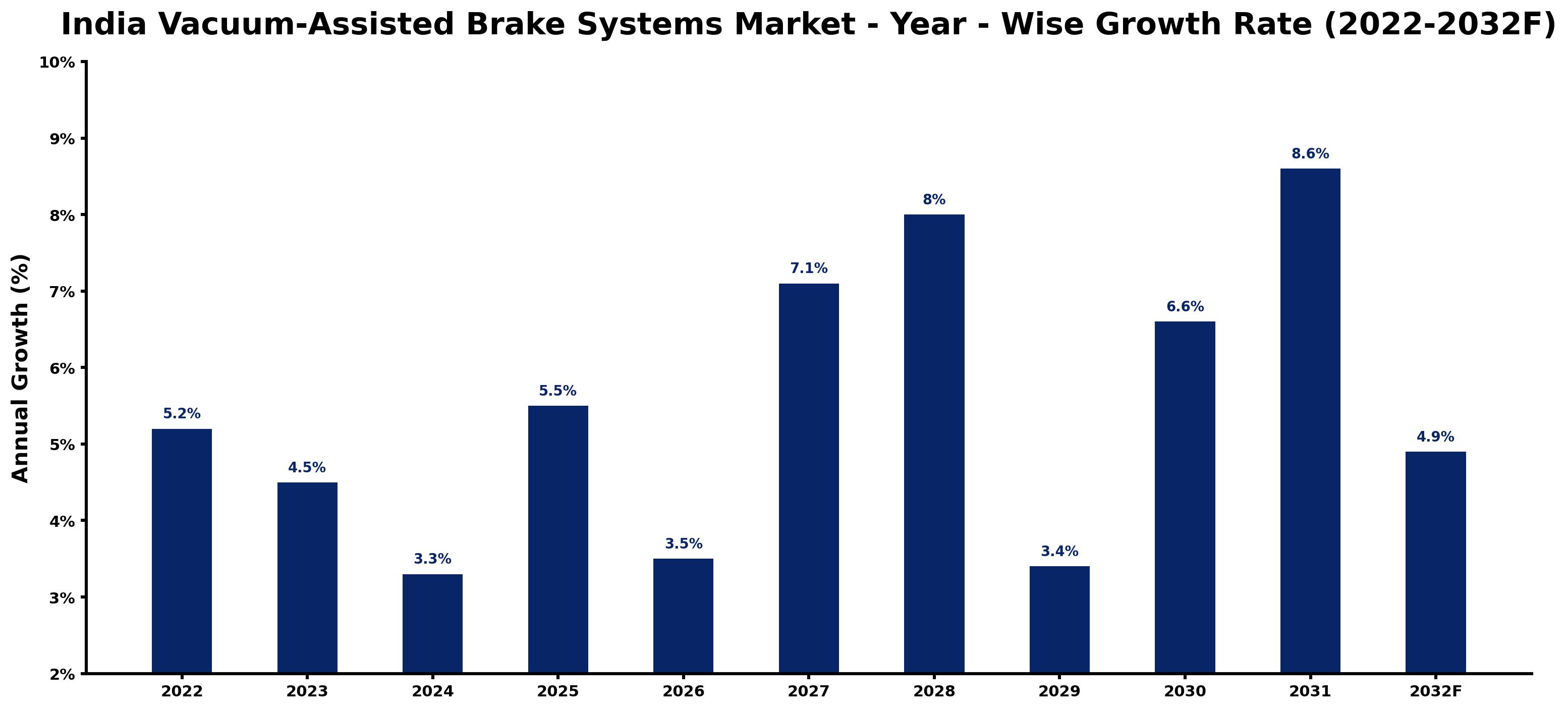
Each row of the following table gives one year's estimated growth and the event or demand shift that explains it.
| Year | Estimated Annual Growth (%) | Market Rationale |
| 2022 | 5.2 | The market showed steady performance with strong demand from OEM manufacturers and local production. |
| 2023 | 4.5 | Growth slowed due to supply chain disruptions affecting component availability and production schedules. |
| 2024 | 3.3 | Manufacturers faced challenges as they adjusted to changing consumer preferences and market dynamics. |
| 2025 | 5.5 | An increase in vehicle sales and production accelerated growth in the automotive sector. |
| 2026 | 3.5 | The market growth rate is expected to slow again as manufacturers adapt to new safety standards. |
| 2027 | 7.1 | Demand is projected to surge as the adoption of electric vehicles increases, leading to higher requirements for advanced braking systems. |
| 2028 | 8.0 | The market is expected to grow, driven by the rising popularity of electric and hybrid vehicles. |
| 2029 | 3.4 | Growth is projected to moderate as the market adjusts to the saturation of certain vehicle segments. |
| 2030 | 6.6 | An uptick in demand is expected as manufacturers invest in modernising braking technologies and systems. |
| 2031 | 8.6 | Investment in safety and performance improvements is expected to peak, driving market growth. |
| 2032 | 4.9 | Growth is expected to slow as the market stabilises, reflecting a mature automotive sector with established technologies. |
Note: Market size estimations and growth projections presented in this report are based on 6Wresearch's proprietary forecasting methodology, utilizing the latest available industry data, government publications, and primary research inputs.
India Vacuum-Assisted Brake Systems Market Synopsis
Constructed from metal components and rubber diaphragms, these systems improve safety and performance across diverse vehicle types. The India Vacuum-Assisted Brake Systems Market is growing, driven by rising vehicle sales, with over 4.5 million passenger vehicles sold in 2022. Demand is particularly strong from OEM manufacturers and the increasing prevalence of electric vehicles, supported by initiatives like the National Electric Mobility Mission Plan 2020.
Market Dynamics Impact Analysis (2026–2032)
| Factor | Type | Impact | Primary Segment Affected |
| Growing demand for electric vehicles is driving the adoption of advanced braking technologies. | Driver | High | Electric Vacuum Brakes |
| Investment in infrastructure development for electric vehicles is creating demand for modern braking systems. | Driver | High | Hydraulic Vacuum Brakes |
| The increasing number of passenger vehicles sold presents a significant opportunity for suppliers. | Opportunity | High | Passenger Cars |
| The rise of electric vehicle manufacturing in hubs like Maharashtra opens new supply channels. | Opportunity | Medium | EVs & Hybrids |
| Regulatory compliance with updated safety standards may increase production costs for manufacturers. | Restraint | High | Hydraulic Vacuum Brakes |
| Limited awareness among consumers regarding advanced braking systems could hinder market penetration. | Restraint | Medium | Hydraulic Vacuum Brakes |
| Manufacturers face challenges in sourcing high-quality components due to supply chain disruptions. | Challenge | High | Hydraulic Vacuum Brakes |
| Technological advancements require continuous investment, which may strain smaller manufacturers. | Challenge | Medium | Hydraulic Vacuum Brakes |
Evaluation of Drivers in India Vacuum-Assisted Brake Systems Market (2026–2032)
The table below links each growth driver to the segment it affects and the evidence for it.
| Drivers | Primary Segment Affected | Why It Matters (Evidence) |
| Increased electric vehicle adoption is driving demand for Electric Vacuum Brakes. | Electric Vacuum Brakes | The rise of electric vehicles necessitates advanced braking systems for improved efficiency. |
| Growing vehicle sales are boosting the need for Vacuum-Assisted Brake Systems. | Hydraulic Vacuum Brakes | With over 4.5 million passenger vehicles sold in 2022, demand for efficient braking systems is rising. |
| Investment in automotive infrastructure is enhancing the market for advanced braking technologies. | Passenger Cars | Government initiatives are promoting the growth of electric vehicle infrastructure, increasing demand for modern braking systems. |
| The push for improved safety standards is driving innovation in braking technologies. | Hydraulic Vacuum Brakes | The Bureau of Indian Standards sets stringent safety metrics, prompting manufacturers to upgrade their systems. |
| OEM manufacturers are increasingly integrating advanced braking systems into new vehicle models. | OEM Manufacturers | The Automotive Mission Plan 2026 aims to enhance competitiveness, leading to higher adoption of advanced technologies. |
The Vacuum-Assisted Brake Systems market in India is expanding as investment in electric vehicle infrastructure and growing end-use demand drive innovation. With over 4.5 million passenger vehicles sold in 2022, the need for efficient braking systems is rising. The National Electric Mobility Mission Plan 2020 supports this growth by promoting electric vehicle adoption, resulting in increased demand for advanced braking technologies. Stringent safety metrics set by the Bureau of Indian Standards prompt manufacturers to upgrade their systems. As manufacturers integrate these advanced technologies into new models, the market continues to grow.
Evaluation of Restraints in India Vacuum-Assisted Brake Systems Market
The following restraints limit how fast demand can grow.
| Market Restraint | Primary Segment Affected | Why It Matters (Evidence) |
| Regulatory compliance with updated safety standards may increase production costs for manufacturers. | Hydraulic Vacuum Brakes | The Bureau of Indian Standards updated the IS 15900 standard, which may lead to higher manufacturing expenses. |
| Limited awareness among consumers regarding advanced braking systems could hinder market penetration. | Hydraulic Vacuum Brakes | Many consumers are still unfamiliar with the benefits of modern braking technologies, affecting sales. |
| Manufacturers face challenges in sourcing high-quality components due to supply chain disruptions. | Hydraulic Vacuum Brakes | Recent global supply chain issues have made it difficult for manufacturers to obtain necessary materials. |
| Technological advancements require continuous investment, which may strain smaller manufacturers. | Hydraulic Vacuum Brakes | Smaller manufacturers may struggle to keep up with the pace of technological change due to limited resources. |
| Competition from alternative braking technologies could limit market share for vacuum-assisted systems. | Hydraulic Vacuum Brakes | As new technologies emerge, they may attract customers away from traditional vacuum-assisted systems. |
India Vacuum-Assisted Brake Systems Market Challenges
Buyers and suppliers in the India Vacuum-Assisted Brake Systems market encounter a pressing supply issue due to reliance on imported advanced components, potentially delaying production timelines by three months. Producers face technological hurdles as they strive to meet the rigorous safety standards set by the Bureau of Indian Standards, often incurring upgrade costs exceeding ₹5 crore. Intense competition from alternative braking technologies, such as electric vacuum brakes, drives suppliers to innovate rapidly, increasing operational costs by over 15%. Buyers experience unpredictable pricing fluctuations tied to demand surges in the automotive sector, complicating budgeting for vehicle manufacturers and possibly raising costs by 10%.
Trends in the India Vacuum-Assisted Brake Systems Market
Four trends stand out in the India Vacuum-Assisted Brake Systems Market.
- Shift Towards Electric Vehicle Integration: OEM manufacturers are increasingly adopting advanced braking systems for electric vehicles, driven by the National Electric Mobility Mission Plan 2020. In 2022, electric vehicles accounted for a growing share of new registrations, prompting suppliers to innovate.
- Increased Focus on Safety Standards: The Bureau of Indian Standards has updated safety metrics for braking systems, compelling manufacturers to improve their products. By 2023, compliance with these standards has become essential for competitive positioning.
- Transition from Conventional to Advanced Braking Systems: The automotive industry is moving from traditional braking systems to more advanced vacuum-assisted technologies. In 2022, a significant percentage of new vehicles featured these systems, reflecting a shift in consumer preferences.
- Emerging Demand in Commercial Vehicles: Heavy-duty vehicles are increasingly adopting advanced braking technologies to meet safety regulations. In 2023, the demand for vacuum-assisted systems in this segment rose considerably, indicating a trend towards improved safety.
Investment Opportunities in the India Vacuum-Assisted Brake Systems Market
The following opportunities in the India Vacuum-Assisted Brake Systems Market pair current demand with a clear way in.
- Expanding Electric Vehicle Segment: The electric vehicle market is experiencing rapid growth, with a projected growth rate of 7.9% for EVs and hybrids. Suppliers can focus on developing advanced braking systems tailored for this segment, particularly in Maharashtra.
- Government Investment in Infrastructure: The Indian government has allocated ₹10,000 crore for electric vehicle infrastructure development, creating opportunities for suppliers. Collaborating with local manufacturers can facilitate entry into this expanding market.
- Growing Demand for Safety Features: As safety becomes a priority, there is an opportunity for suppliers of advanced braking systems. The Automotive Component Manufacturers Association of India is promoting innovations that enhance safety standards.
- Manufacturing Capability Expansion: The Automotive Mission Plan 2026 aims to position India as a global manufacturing hub. Investing in local production facilities can help suppliers meet the rising demand for vacuum-assisted brake systems.
Government Initiatives in the India Vacuum-Assisted Brake Systems Market
In 2023, the Ministry of Heavy Industries launched the National Electric Mobility Mission Plan 2020, aiming to boost electric vehicle adoption and infrastructure development. This initiative complements earlier measures like the Automotive Mission Plan 2026, which strengthens the competitiveness of the automotive industry. Together, these policies encourage manufacturers to invest in advanced braking technologies, aligning with the increasing demand for electric vehicles. The Faster Adoption and Manufacturing of Hybrid and Electric Vehicles (FAME) India Scheme Phase II also offers incentives for electric vehicle production, further supporting the uptake of advanced braking systems.
The Bureau of Indian Standards oversees the approval of safety standards for automotive braking systems. It has updated the IS 15900 standard, which improves safety and performance metrics for manufacturers. Additionally, the National Automotive Testing and R&D Infrastructure Project (NATRiP) funds automotive innovation, enabling producers to test and certify advanced braking technologies. These initiatives allow manufacturers to comply with updated regulations, ensuring product safety and performance.
Future Insight of the India Vacuum-Assisted Brake Systems Market
The India Vacuum-Assisted Brake Systems market is set for substantial changes by 2032, driven by government initiatives that will reshape the industry. A ₹10,000 crore fund for electric vehicle infrastructure development will stimulate demand for advanced braking systems. The National Automotive Testing and R&D Infrastructure Project will promote innovation, ensuring compliance with ISO 26262 standards. The Automotive Mission Plan 2026 will enhance local production capabilities, positioning India as a key player in the global automotive manufacturing sector.
Market Segmentation Analysis
The report offers a comprehensive study of the following market segments and their leading categories in the market.
By Brake Type – Hydraulic Vacuum Brakes Dominated, Electric Vacuum Brakes Expected to Grow Fastest
According to Bhawna Singh, Assistant Manager at 6Wresearch, in 2025, Hydraulic Vacuum Brakes led the brake type split with a 47% share. Hydraulic Vacuum Brakes dominate the market due to their widespread use in conventional vehicles, ensuring reliable braking performance. Their significant presence in automotive hubs such as Maharashtra and Tamil Nadu reinforces their leading market share in the India Vacuum-Assisted Brake Systems Market. The quickest growth will come from Electric Vacuum Brakes, forecast to expand at a CAGR of 7.2% between 2026 and 2032. Electric Vacuum Brakes are experiencing rapid growth as the adoption of electric vehicles increases, necessitating advanced braking technologies for improved efficiency. The government's ₹10,000 crore fund for electric vehicle infrastructure is likely to further accelerate the demand for electric braking systems. Suppliers should focus on developing electric braking solutions to meet the rising demand from the expanding electric vehicle sector.
By Vehicle Type – Passenger Cars Dominated, EVs & Hybrids Expected to Grow Fastest
Passenger Cars held a 44% share of the India Vacuum-Assisted Brake Systems Market by vehicle type in 2025. Passenger Cars hold the largest share in the market as they represent the majority of vehicles sold in India, with over 4.5 million units sold in 2022. This high volume of passenger vehicles necessitates the use of reliable braking systems, solidifying their market position. EVs & Hybrids are projected to grow fastest, at a CAGR of 7.9% during 2026–2032. EVs & Hybrids are the fastest-growing segment, driven by the increasing consumer preference for electric vehicles and supportive government initiatives like the FAME scheme. This shift towards electrification is expected to boost the demand for advanced braking technologies tailored for these vehicles. Manufacturers should prioritise the development of braking systems specifically designed for electric vehicles to capitalise on this growth opportunity.
By Booster Type – Single Diaphragm Dominated, Electric Pump Based Expected to Grow Fastest
With a 50% revenue share in 2025, Single Diaphragm was the largest booster type category. Single Diaphragm boosters are widely preferred for their simplicity and effectiveness, making them a common choice in many vehicles. Their established role in the automotive industry contributes to their substantial market share in the Vacuum-Assisted Brake Systems sector. Electric Pump Based is set to record the highest CAGR in this split, 7.1% over 2026–2032. Electric Pump Based boosters are gaining traction as modern vehicles increasingly require enhanced performance and efficiency. As manufacturers adopt this technology, its market share is expected to grow rapidly in the near future. Suppliers need to prioritise the advancement of electric pump-based systems to stay competitive in a market leaning towards modern braking technologies.
By End User – OEM Manufacturers Dominated and Is Expected to Record the Fastest Growth
OEM Manufacturers accounted for a 42% market share by end user in 2025. OEM Manufacturers are the primary users of vacuum-assisted systems, accounting for the largest share in the market due to their integral role in vehicle production. Their consistent demand for reliable braking technologies ensures a stable market position for this segment. Its lead should widen, with a projected CAGR of 7.4% during 2026–2032, the highest in this split. OEM Manufacturers also represent the fastest-growing segment as they increasingly incorporate advanced braking systems into new vehicle models. This dual role as both leader and fastest-growing segment highlights their critical importance in shaping the market's future. Suppliers must strengthen partnerships with OEM Manufacturers to align their offerings with the evolving needs of the automotive industry.
Key Attractiveness of the Report
- 10 Years of Market Numbers
- Historical Data Starting from 2022 to 2025
- Base Year 2025
- Forecast Data until 2032
- Key Performance Indicators Impacting the Market
- Major Upcoming Developments and Projects
Key Highlights of the Report:
- India Vacuum-Assisted Brake Systems Market Outlook
- Market Size of India Vacuum-Assisted Brake Systems Market, 2025
- Forecast of India Vacuum-Assisted Brake Systems Market, 2032
- Historical Data and Forecast of India Vacuum-Assisted Brake Systems Revenues & Volume for the Period 2022 - 2032F
- India Vacuum-Assisted Brake Systems Market Trend Evolution
- India Vacuum-Assisted Brake Systems Market Drivers and Challenges
- India Vacuum-Assisted Brake Systems Price Trends
- India Vacuum-Assisted Brake Systems Porter's Five Forces
- India Vacuum-Assisted Brake Systems Industry Life Cycle
- Historical Data and Forecast of India Vacuum-Assisted Brake Systems Market Revenues & Volume By Brake Type for the Period 2022 - 2032F
- Historical Data and Forecast of India Vacuum-Assisted Brake Systems Market Revenues & Volume By Hydraulic Vacuum Brakes for the Period 2022 - 2032F
- Historical Data and Forecast of India Vacuum-Assisted Brake Systems Market Revenues & Volume By Electric Vacuum Brakes for the Period 2022 - 2032F
- Historical Data and Forecast of India Vacuum-Assisted Brake Systems Market Revenues & Volume By Tandem Vacuum Boosters for the Period 2022 - 2032F
- Historical Data and Forecast of India Vacuum-Assisted Brake Systems Market Revenues & Volume By Mechanical Vacuum Brakes for the Period 2022 - 2032F
- Historical Data and Forecast of India Vacuum-Assisted Brake Systems Market Revenues & Volume By Vehicle Type for the Period 2022 - 2032F
- Historical Data and Forecast of India Vacuum-Assisted Brake Systems Market Revenues & Volume By Passenger Cars for the Period 2022 - 2032F
- Historical Data and Forecast of India Vacuum-Assisted Brake Systems Market Revenues & Volume By EVs & Hybrids for the Period 2022 - 2032F
- Historical Data and Forecast of India Vacuum-Assisted Brake Systems Market Revenues & Volume By SUVs for the Period 2022 - 2032F
- Historical Data and Forecast of India Vacuum-Assisted Brake Systems Market Revenues & Volume By LCVs for the Period 2022 - 2032F
- Historical Data and Forecast of India Vacuum-Assisted Brake Systems Market Revenues & Volume By Booster Type for the Period 2022 - 2032F
- Historical Data and Forecast of India Vacuum-Assisted Brake Systems Market Revenues & Volume By Single Diaphragm for the Period 2022 - 2032F
- Historical Data and Forecast of India Vacuum-Assisted Brake Systems Market Revenues & Volume By Electric Pump Based for the Period 2022 - 2032F
- Historical Data and Forecast of India Vacuum-Assisted Brake Systems Market Revenues & Volume By Dual Diaphragm for the Period 2022 - 2032F
- Historical Data and Forecast of India Vacuum-Assisted Brake Systems Market Revenues & Volume By Mechanical Assist for the Period 2022 - 2032F
- Historical Data and Forecast of India Vacuum-Assisted Brake Systems Market Revenues & Volume By End User for the Period 2022 - 2032F
- Historical Data and Forecast of India Vacuum-Assisted Brake Systems Market Revenues & Volume By OEM Manufacturers for the Period 2022 - 2032F
- Historical Data and Forecast of India Vacuum-Assisted Brake Systems Market Revenues & Volume By Auto Assemblers for the Period 2022 - 2032F
- Historical Data and Forecast of India Vacuum-Assisted Brake Systems Market Revenues & Volume By Tier-1 Suppliers for the Period 2022 - 2032F
- Historical Data and Forecast of India Vacuum-Assisted Brake Systems Market Revenues & Volume By Repair Garages for the Period 2022 - 2032F
- India Vacuum-Assisted Brake Systems Import Export Trade Statistics
- Market Opportunity Assessment By Brake Type
- Market Opportunity Assessment By Vehicle Type
- Market Opportunity Assessment By Booster Type
- Market Opportunity Assessment By End User
- India Vacuum-Assisted Brake Systems Top Companies Market Share
- India Vacuum-Assisted Brake Systems Competitive Benchmarking By Technical and Operational Parameters
- India Vacuum-Assisted Brake Systems Company Profiles
- India Vacuum-Assisted Brake Systems Key Strategic Recommendations
Market Covered
Segments analysed in this report are listed below.
By Brake Type
- Hydraulic Vacuum Brakes
- Electric Vacuum Brakes
- Tandem Vacuum Boosters
- Mechanical Vacuum Brakes
By Vehicle Type
- Passenger Cars
- EVs & Hybrids
- SUVs
- LCVs
By Booster Type
- Single Diaphragm
- Electric Pump Based
- Dual Diaphragm
- Mechanical Assist
By End User
- OEM Manufacturers
- Auto Assemblers
- Tier-1 Suppliers
- Repair Garages































