India VDI Market Size & Growth Rate
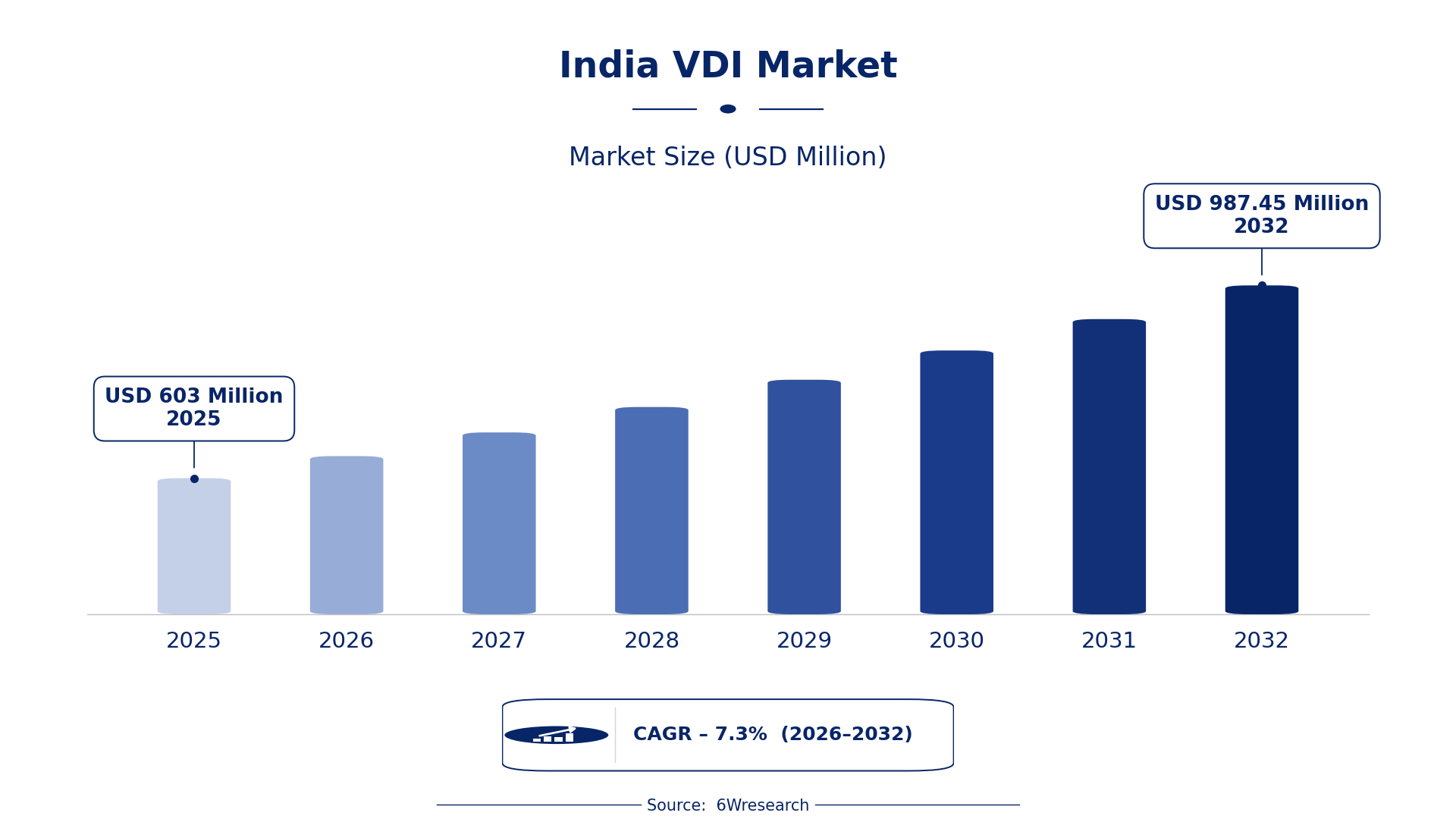
According to 6Wresearch internal database and industry insights, the India VDI Market was valued at USD 603.0 million in 2025 and is projected to reach USD 987.45 million by 2032, growing at a CAGR of approximately 7.3% during 2026–2032.
India VDI Market Highlights
| Report Metric | Details |
| Report Name | India VDI Market |
| Market Size 2025 | USD 603.0 million |
| Market Size 2032 | USD 987.45 million |
| Absolute Growth 2025–2032 | USD 384.45 million |
| CAGR 2026–2032 | 7.3% |
| Peak Annual Growth | 8.6% in 2026 |
| Forecast Period | 2026–2032 |
| Historical Data | 2022–2025 |
| Base Year | 2025 |
| Leading Deployment Model, 2025 | Cloud-Based VDI (36% share) |
| Leading Device Access Type, 2025 | Thin Clients (40% share) |
| Leading Use Case, 2025 | Remote Work (46% share) |
| Leading End User, 2025 | Corporates (51% share) |
| Fastest-Growing Deployment Model | DaaS (Desktop-as-Service) (9.7% CAGR) |
| Fastest-Growing Device Access Type | BYOD Devices (8.7% CAGR) |
| Fastest-Growing Use Case | SMBs (9.6% CAGR) |
| Fastest-Growing End User | Managed Service Providers (8.5% CAGR) |
| Growing Sector | Managed Service Providers |
| Key End Users | 3-4 buyer categories, comma separated, no company names (never empty) |
India VDI Market Year-wise Growth Rate and Key Drivers (2022–2032)
This graph illustrates the annual growth rates of the market from 2022 to 2032, highlighting a steady upward trajectory and projected market expansion over the forecast period.
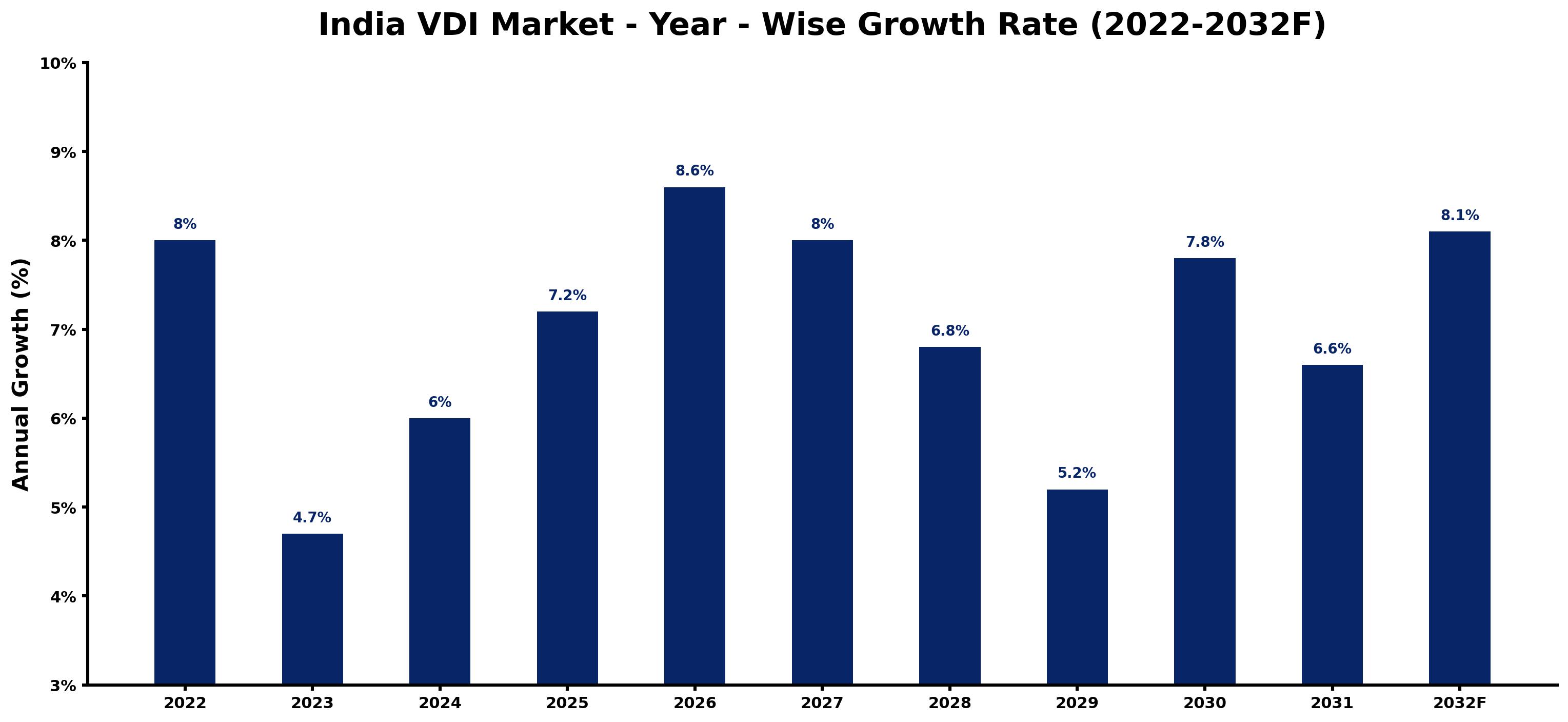
Year by year, the estimates below pair each growth rate with the development that shaped it.
| Year | Estimated Annual Growth (%) | Market Rationale |
| 2022 | 8.0 | The market experienced strong growth due to increased adoption of remote work solutions and cloud technologies. |
| 2023 | 4.7 | Growth slowed as organizations faced high deployment costs, impacting VDI implementation rates. |
| 2024 | 6.0 | A rise in cloud adoption and remote work initiatives spurred faster growth in VDI solutions. |
| 2025 | 7.2 | Demand increased as more corporates recognized the efficiency benefits of VDI for remote work. |
| 2026 | 8.6 | The peak growth year saw significant investment in digital infrastructure, enhancing VDI adoption. |
| 2027 | 8.0 | Growth slowed as market saturation began to affect new VDI implementations among corporates. |
| 2028 | 6.8 | A continued focus on hybrid work models contributed to a further slowdown in growth rates. |
| 2029 | 5.2 | The market experienced slower growth as competition intensified among VDI service providers. |
| 2030 | 7.8 | A resurgence in demand occurred as more organizations upgraded their IT infrastructure for VDI. |
| 2031 | 6.6 | Growth slowed again as companies reassessed their VDI strategies amidst changing market conditions. |
| 2032 | 8.1 | A renewed focus on security and efficiency is expected to drive VDI growth in the coming years. |
Note: Market size estimations and growth projections presented in this report are based on 6Wresearch's proprietary forecasting methodology, utilizing the latest available industry data, government publications, and primary research inputs.
India VDI Market Synopsis
VDI in India refers to Virtual Desktop Infrastructure, allowing users to access desktop environments hosted on centralized servers. This technology enables secure access to corporate resources and facilitates remote work. The India VDI Market is expanding due to increased cloud adoption and a rise in remote workers, with over 70% of corporates implementing VDI solutions. The Digital India programme promotes digital infrastructure, driving demand for VDI technologies.
Market Dynamics Impact Analysis (2026–2032)
| Factor | Type | Impact | Primary Segment Affected |
| Growing remote work culture | Driver | High | Remote Work |
| Increasing cloud adoption rates | Driver | High | Cloud-Based VDI |
| Healthcare sector's need for secure data access | Opportunity | High | Cloud-Based VDI |
| Rising demand from managed service providers | Opportunity | Medium | Managed Service Providers |
| High deployment costs for VDI solutions | Restraint | High | On-Premises VDI |
| Complexity of VDI implementation and maintenance | Restraint | Medium | Hybrid VDI |
| Limited awareness among small businesses | Challenge | High | SMBs |
| Regulatory compliance requirements for data security | Challenge | Medium | Cloud-Based VDI |
Evaluation of Drivers in India VDI Market (2026–2032)
The main growth drivers and the segments they affect most are set out below.
| Drivers | Primary Segment Affected | Why It Matters (Evidence) |
| Increased remote work adoption | Remote Work | The average number of remote workers in India is projected to exceed 50 million by 2025, leading to higher VDI demand. |
| Cloud adoption growth | Cloud-Based VDI | A 20% increase in cloud adoption in India reported by NASSCOM in 2023 drives demand for VDI solutions. |
| Secure access needs in healthcare | Secure Access | VDI solutions are increasingly adopted in the healthcare sector for secure patient data access. |
| Managed service providers expanding offerings | Managed Service Providers | 60% of managed service providers in India reported offering VDI solutions to clients in 2023. |
| Government initiatives promoting digital infrastructure | Cloud-Based VDI | The Digital India programme launched in 2020 boosts VDI adoption. |
The VDI market in India is growing on the back of increasing remote work, cloud adoption, and secure access needs across various sectors. The average number of remote workers is projected to exceed 50 million by 2025, driving demand for VDI solutions. A notable increase in cloud adoption, reported at 20% in 2023, further fuels this market.
Evaluation of Restraints in India VDI Market
Below mentioned are some major restraints and their influence on market dynamics.
| Market Restraint | Primary Segment Affected | Why It Matters (Evidence) |
| High deployment costs for VDI solutions | On-Premises VDI | The average cost of VDI deployment in India was reported at ₹50,000 per user in 2023. |
| Complexity of VDI implementation and maintenance | Hybrid VDI | The average lifespan of a VDI implementation in India is around 3-5 years before upgrades are necessary. |
| Limited knowledge among small businesses | SMBs | Many small businesses lack knowledge about the benefits and implementation of VDI solutions. |
| Regulatory compliance requirements for data security | Cloud-Based VDI | The Cyber Security Strategy emphasizes secure VDI implementations, increasing compliance costs. |
| Dependence on stable internet connectivity | Cloud-Based VDI | Inconsistent internet access can hinder the effectiveness of cloud-based VDI solutions. |
India VDI Market Challenges
High deployment costs hinder VDI adoption for buyers in India, with an average expense of ₹50,000 per user. This financial burden limits the ability of companies to implement remote work solutions, delaying productivity gains. Many organizations encounter technological limitations due to outdated infrastructure, resulting in inefficiencies and increased operational costs. Compliance with regulations like ISO/IEC 27001 complicates VDI rollout, causing delays for healthcare providers who require secure access to patient data. Competition intensifies as 60% of managed service providers offer VDI solutions, compelling others to reduce prices or improve services, which can squeeze profit margins for suppliers.
Trends in the India VDI Market
Four trends stand out in the India VDI Market.
- Shift towards Hybrid Work Models: India is increasingly adopting hybrid work models, with 51% of corporates using VDI solutions as of 2023. This shift is driven by the need for flexibility in work arrangements.
- Growing Adoption of DaaS: DaaS is emerging as a preferred solution, with a projected CAGR of 9.7% from 2026 to 2032. Businesses are opting for DaaS for its scalability and cost-effectiveness.
- Increased Focus on Data Security: The National Cyber Security Policy aims to improve security measures for IT infrastructure, including VDI. This focus is critical as businesses seek to protect sensitive data.
- Rise of BYOD Policies: The trend of Bring Your Own Device (BYOD) is gaining traction, with an expected CAGR of 8.7% for BYOD Devices. This shift allows employees to work on personal devices.
Investment Opportunities in the India VDI Market
Investors looking at the India VDI Market should consider the following areas.
- Corporates seeking efficient solutions: Corporates are increasingly adopting VDI to improve operational efficiency, with over 70% already implementing it. This trend creates a demand for innovative VDI solutions.
- Healthcare facilities requiring secure access: Healthcare facilities are adopting VDI for secure patient data access, with a growing need for compliance with data protection regulations. This presents a significant opportunity for VDI providers.
- Managed service providers expanding their offerings: Managed service providers are looking to diversify their service portfolios with VDI solutions. This trend is supported by the increasing demand for remote work solutions.
- Government initiatives supporting startups: The Atmanirbhar Bharat initiative encourages self-reliance in technology, creating opportunities for startups in the VDI space. This initiative is expected to boost local innovation.
Government Initiatives in the India VDI Market
The National Policy on Software Products, approved by the Ministry of Electronics and Information Technology (MeitY) in 2021, promotes VDI solutions among startups and SMEs. This policy supports the implementation of VDI technologies, improving operational capabilities for these businesses. Additionally, the Cyber Security Strategy, introduced in 2022, emphasizes secure VDI implementations for protecting sensitive data. This focus on security is vital for encouraging wider adoption of VDI technologies across sectors.
The Digital India programme, launched in 2020, aims to improve accessibility and efficiency in technology deployment, including VDI. This initiative has allocated substantial resources to develop IT infrastructure, promoting VDI adoption across sectors. Furthermore, the government encourages startups in the IT sector, indirectly supporting VDI innovation. The Ministry of Electronics and Information Technology (MeitY) oversees various initiatives that fund digital infrastructure development.
Future Insight of the India VDI Market
The India VDI market will undergo significant changes by 2032, influenced by the Digital India programme and the government's allocation of ₹1,000 crores for digital infrastructure. The average number of remote workers is expected to surpass 50 million, significantly boosting demand for VDI solutions. Security improvements from the National Cyber Security Policy will encourage broader adoption of VDI technologies across various sectors. The ongoing enhancement of cloud computing capabilities will streamline VDI implementations, providing advantages for both buyers and suppliers.
Market Segmentation Analysis
The report offers a comprehensive study of the following market segments and their leading categories in the market.
By Deployment Model – Cloud-Based VDI Dominated, DaaS (Desktop-as-Service) Expected to Grow Fastest
According to Bhawna Singh, Assistant Manager at 6Wresearch, Cloud-Based VDI took a 36% share of deployment model in 2025, more than any other category. Cloud-Based VDI holds the largest share due to its ability to provide flexibility and scalability, making it essential for businesses adapting to modern work environments. The Indian corporate sector's shift towards hybrid work models further solidifies its dominance in the VDI market. Over 2026–2032, DaaS (Desktop-as-Service) is expected to post the fastest growth, at a CAGR of 9.7%. DaaS (Desktop-as-Service) is rapidly gaining traction as companies increasingly seek cost-effective solutions that deliver desktop services over the internet. The 20% increase in cloud adoption reported by NASSCOM in 2023 is a significant driver of this segment's growth. Suppliers should focus on enhancing DaaS offerings to align with the rising demand for flexible VDI solutions.
By Device Access Type – Thin Clients Dominated, BYOD Devices Expected to Grow Fastest
In 2025, Thin Clients led the device access type split with a 40% share. Thin Clients dominate the market as they are primarily utilised in corporate settings for secure and efficient VDI access. Their widespread adoption is reflected in their substantial market share, making them a preferred choice for organisations. BYOD Devices are set to record the highest CAGR in this split, 8.7% over 2026–2032. BYOD Devices are witnessing rapid growth as they empower employees to use personal devices for work, aligning with the trend towards hybrid work models. The projected increase in remote workers in India to over 50 million by 2025 will further accelerate this adoption. Buyers should consider implementing BYOD policies to enhance workforce flexibility and overall productivity.
By Use Case – Remote Work Dominated, SMBs Expected to Grow Fastest
With a 46% revenue share in 2025, Remote Work was the largest use case category. Remote Work is the leading use case for VDI, enabling employees to operate from any location, which is crucial in today's corporate environment. The high percentage of corporates implementing VDI highlights its essential role in facilitating remote operations effectively. The quickest growth will come from SMBs, forecast to expand at a CAGR of 9.6% between 2026 and 2032. SMBs are increasingly adopting VDI solutions to improve operational efficiency, reflecting a broader trend of digital transformation among smaller enterprises. Government initiatives aimed at enhancing digital infrastructure also play a role in this rapid uptake. Suppliers should tailor their VDI solutions to meet the specific needs of SMBs to capture this expanding market segment.
By End User – Corporates Dominated, Managed Service Providers Expected to Grow Fastest
Corporates accounted for a 51% market share by end user in 2025. Corporates represent the largest user segment for VDI solutions, driven by the need for secure and efficient remote access to corporate resources. With over 70% of corporates in India implementing VDI, their market share is substantial. Managed Service Providers are projected to grow fastest, at a CAGR of 8.5% during 2026–2032. Managed Service Providers are experiencing the fastest growth as they increasingly offer VDI solutions to their clients, capitalising on the rising demand for managed IT services. The 60% of providers reporting VDI offerings indicates a strong market trend. Suppliers should strengthen partnerships with managed service providers to expand their reach in the VDI market.
Key Attractiveness of the Report
- 10 Years of Market Numbers
- Historical Data Starting from 2022 to 2025
- Base Year 2025
- Forecast Data until 2032
- Key Performance Indicators Impacting the Market
- Major Upcoming Developments and Projects
Key Highlights of the Report:
- India VDI Market Outlook
- Market Size of India VDI Market, 2025
- Forecast of India VDI Market, 2032
- Historical Data and Forecast of India VDI Revenues & Volume for the Period 2022 - 2032F
- India VDI Market Trend Evolution
- India VDI Market Drivers and Challenges
- India VDI Price Trends
- India VDI Porter's Five Forces
- India VDI Industry Life Cycle
- Historical Data and Forecast of India VDI Market Revenues & Volume By Deployment Model for the Period 2022 - 2032F
- Historical Data and Forecast of India VDI Market Revenues & Volume By On-Premises VDI for the Period 2022 - 2032F
- Historical Data and Forecast of India VDI Market Revenues & Volume By Cloud-Based VDI for the Period 2022 - 2032F
- Historical Data and Forecast of India VDI Market Revenues & Volume By Hybrid VDI for the Period 2022 - 2032F
- Historical Data and Forecast of India VDI Market Revenues & Volume By DaaS (Desktop-as-Service) for the Period 2022 - 2032F
- Historical Data and Forecast of India VDI Market Revenues & Volume By Device Access Type for the Period 2022 - 2032F
- Historical Data and Forecast of India VDI Market Revenues & Volume By Thin Clients for the Period 2022 - 2032F
- Historical Data and Forecast of India VDI Market Revenues & Volume By Mobile/Desktop for the Period 2022 - 2032F
- Historical Data and Forecast of India VDI Market Revenues & Volume By BYOD Devices for the Period 2022 - 2032F
- Historical Data and Forecast of India VDI Market Revenues & Volume By Subscription for the Period 2022 - 2032F
- Historical Data and Forecast of India VDI Market Revenues & Volume By Use Case for the Period 2022 - 2032F
- Historical Data and Forecast of India VDI Market Revenues & Volume By Secure Access for the Period 2022 - 2032F
- Historical Data and Forecast of India VDI Market Revenues & Volume By Remote Work for the Period 2022 - 2032F
- Historical Data and Forecast of India VDI Market Revenues & Volume By Disaster Recovery for the Period 2022 - 2032F
- Historical Data and Forecast of India VDI Market Revenues & Volume By SMBs for the Period 2022 - 2032F
- Historical Data and Forecast of India VDI Market Revenues & Volume By End User for the Period 2022 - 2032F
- Historical Data and Forecast of India VDI Market Revenues & Volume By Corporates for the Period 2022 - 2032F
- Historical Data and Forecast of India VDI Market Revenues & Volume By IT Enterprises for the Period 2022 - 2032F
- Historical Data and Forecast of India VDI Market Revenues & Volume By Government Agencies for the Period 2022 - 2032F
- Historical Data and Forecast of India VDI Market Revenues & Volume By Managed Service Providers for the Period 2022 - 2032F
- India VDI Import Export Trade Statistics
- Market Opportunity Assessment By Deployment Model
- Market Opportunity Assessment By Device Access Type
- Market Opportunity Assessment By Use Case
- Market Opportunity Assessment By End User
- India VDI Top Companies Market Share
- India VDI Competitive Benchmarking By Technical and Operational Parameters
- India VDI Company Profiles
- India VDI Key Strategic Recommendations
Market Covered
The report offers an extensive study of the following market segments.
By Deployment Model
- On-Premises VDI
- Cloud-Based VDI
- Hybrid VDI
- DaaS (Desktop-as-Service)
By Device Access Type
- Thin Clients
- Mobile/Desktop
- BYOD Devices
- Subscription
By Use Case
- Secure Access
- Remote Work
- Disaster Recovery
- SMBs
By End User
- Corporates
- IT Enterprises
- Government Agencies
- Managed Service Providers































