India Vector-Borne Disease Diagnostics Market Size & Growth Rate
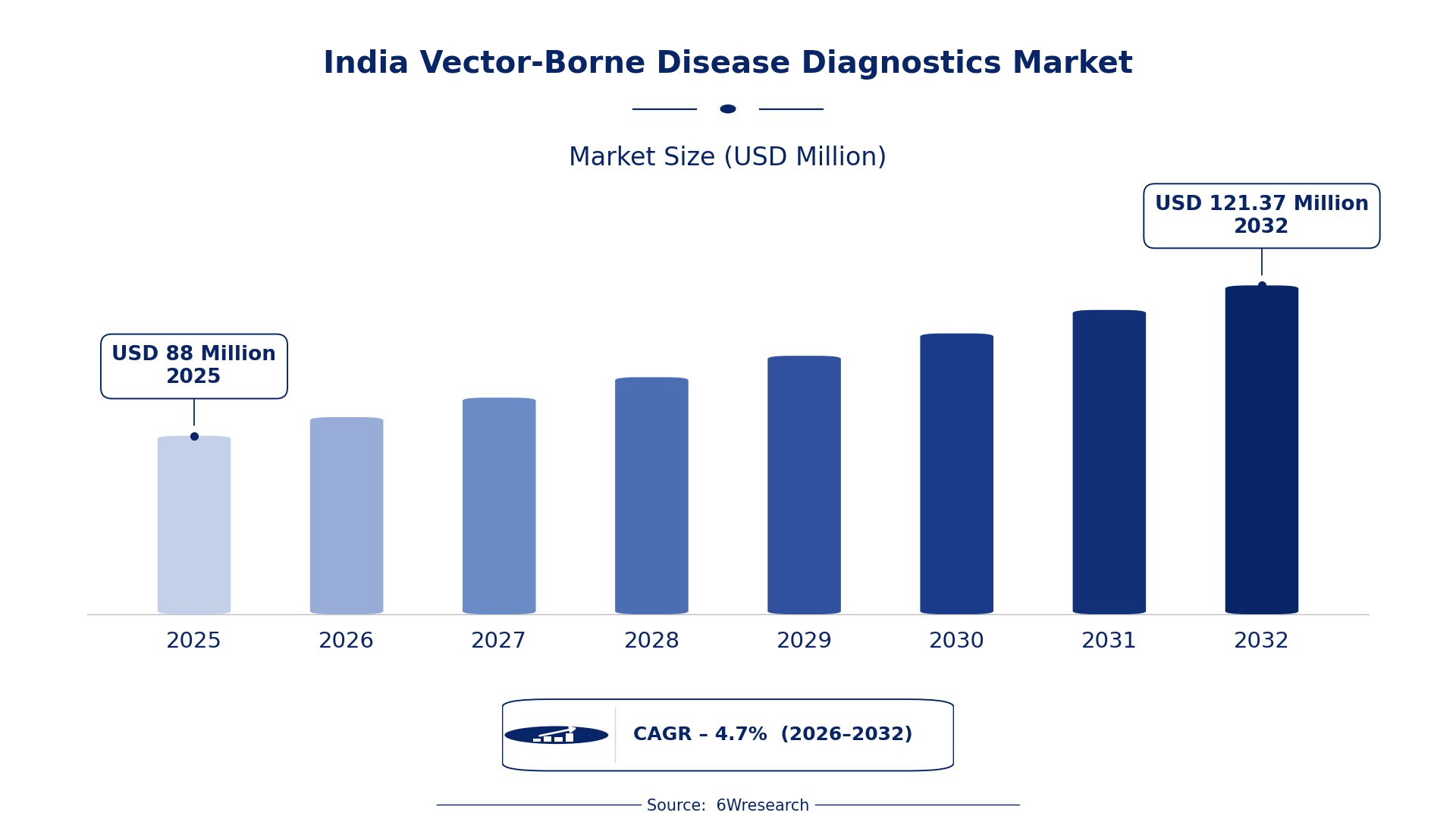
According to 6Wresearch internal database and industry insights, the India Vector-Borne Disease Diagnostics Market was valued at USD 88.0 million in 2025 and is projected to reach USD 121.37 million by 2032, growing at a CAGR of approximately 4.7% during 2026–2032.
India Vector-Borne Disease Diagnostics Market Highlights
| Report Metric | Details |
| Report Name | India Vector-Borne Disease Diagnostics Market |
| Market Size 2025 | USD 88.0 million |
| Market Size 2032 | USD 121.37 million |
| Absolute Growth 2025–2032 | USD 33.37 million |
| CAGR 2026–2032 | 4.7% |
| Peak Annual Growth | 6.8% in 2030 |
| Forecast Period | 2026–2032 |
| Historical Data | 2022–2025 |
| Base Year | 2025 |
| Leading Disease Type, 2025 | Malaria (43% share) |
| Leading Test Type, 2025 | Rapid Diagnostic Test (36% share) |
| Leading Sample Type, 2025 | Blood (43% share) |
| Leading End User, 2025 | Hospitals (48% share) |
| Fastest-Growing Disease Type | Dengue (7.3% CAGR) |
| Fastest-Growing Test Type | PCR/ELISA (6.7% CAGR) |
| Fastest-Growing Sample Type | Serum/Plasma (7.4% CAGR) |
| Fastest-Growing End User | Primary Health Clinics (6.6% CAGR) |
| Growing Sector | Primary Health Clinics |
| Key End Users | Hospitals, Primary Health Clinics, Pathology Labs, Travel Clinics |
India Vector-Borne Disease Diagnostics Market Year-wise Growth Rate and Key Drivers (2022–2032)
This graph illustrates the annual growth rates of the market from 2022 to 2032, highlighting a steady upward trajectory and projected market expansion over the forecast period.
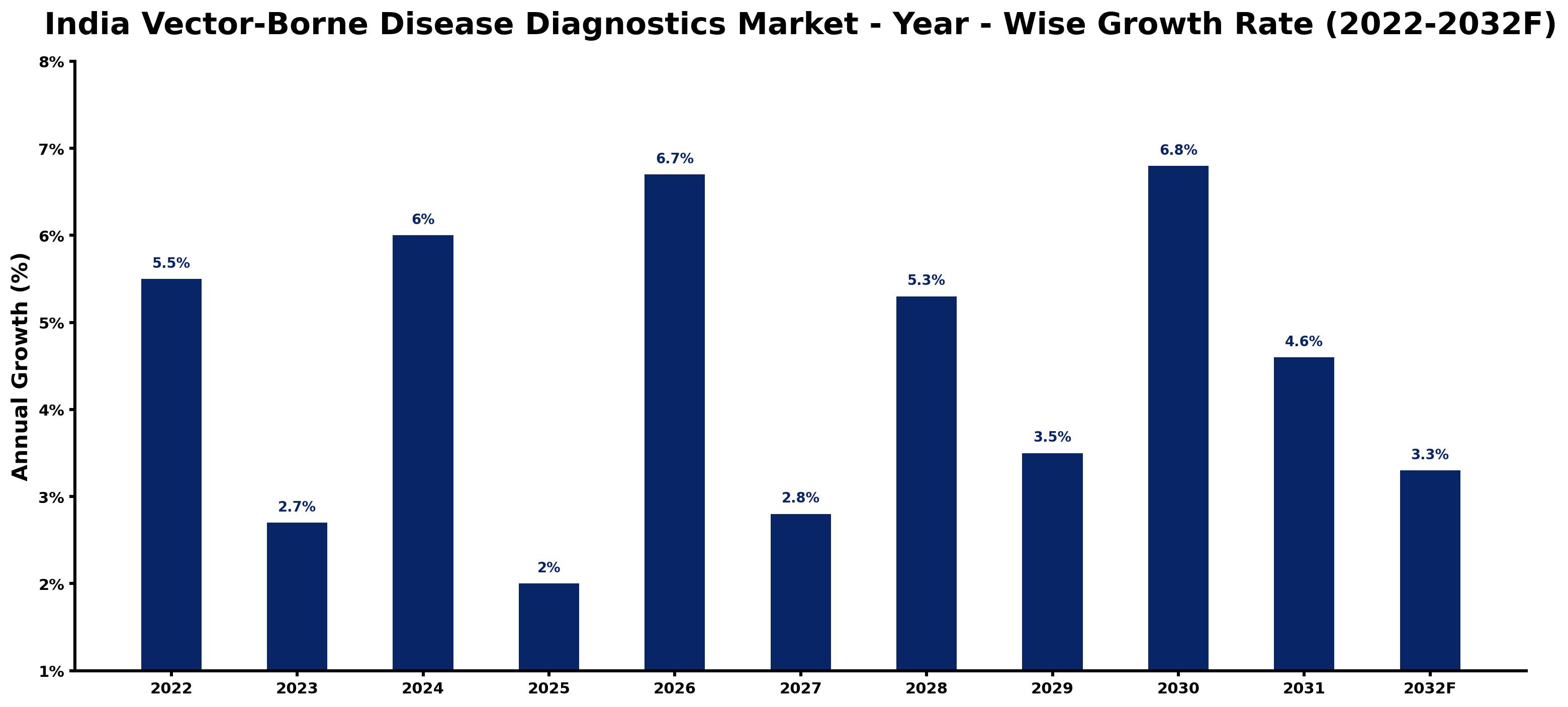
Year by year, the estimates below pair each growth rate with the development that shaped it.
| Year | Estimated Annual Growth (%) | Market Rationale |
| 2022 | 5.5 | The market experienced steady demand due to ongoing malaria and dengue cases. |
| 2023 | 2.7 | Growth slowed as healthcare resources were redirected towards other pressing health issues. |
| 2024 | 6.0 | Demand surged with increased malaria testing initiatives across urban hospitals. |
| 2025 | 2.0 | A slowdown occurred as seasonal variations affected disease prevalence. |
| 2026 | 6.7 | Growth accelerated with rising investments in diagnostic technologies and infrastructure. |
| 2027 | 2.8 | Demand growth slowed as healthcare facilities faced resource constraints. |
| 2028 | 5.3 | Increased testing for Chikungunya boosted demand in southern states. |
| 2029 | 3.5 | Demand growth slowed due to heightened competition among diagnostic providers. |
| 2030 | 6.8 | A peak in growth was driven by heightened awareness and government campaigns. |
| 2031 | 4.6 | Growth decelerated as the National Vector Borne Disease Control Programme began to stabilise testing protocols. |
| 2032 | 3.3 | Demand growth slowed as market maturity set in with established testing protocols. |
Note: Market size estimations and growth projections presented in this report are based on 6Wresearch's proprietary forecasting methodology, utilizing the latest available industry data, government publications, and primary research inputs.
India Vector-Borne Disease Diagnostics Market Synopsis
Vector-Borne Disease Diagnostics in India encompasses laboratory tests designed to identify diseases transmitted by vectors such as mosquitoes and ticks. Techniques like PCR and rapid tests are employed primarily for the early detection of malaria and dengue. The India Vector-Borne Disease Diagnostics Market is growing due to increased healthcare investments and a rise in disease prevalence. With over 1 million malaria cases and more than 100,000 dengue cases reported annually, the demand for reliable testing solutions is clear. Initiatives such as the National Vector Borne Disease Control Programme are improving testing capabilities nationwide.
Market Dynamics Impact Analysis (2026–2032)
| Factor | Type | Impact | Primary Segment Affected |
| Rising investments in healthcare infrastructure | Driver | High | Rapid Diagnostic Test |
| Increased prevalence of malaria and dengue | Driver | High | Malaria |
| Growing demand for reliable testing in rural areas | Opportunity | High | Primary Health Clinics |
| Need for advanced diagnostic technologies | Opportunity | High | Hospitals |
| Limited access to diagnostic facilities in remote regions | Restraint | High | Dengue |
| High cost of advanced diagnostic equipment | Restraint | Medium | PCR/ELISA |
| Resource constraints in healthcare facilities | Challenge | High | Pathology Labs |
| Inconsistent supply of diagnostic reagents | Challenge | Medium | Rapid Diagnostic Test |
Evaluation of Drivers in India Vector-Borne Disease Diagnostics Market (2026–2032)
Below mentioned are some major drivers and their influence on market dynamics.
| Drivers | Primary Segment Affected | Why It Matters (Evidence) |
| Increased government funding for disease control initiatives | Malaria | The Indian government allocated INR 500 crore for vector-borne disease control initiatives, boosting testing capabilities. |
| Growing healthcare investments in diagnostic technologies | PCR/ELISA | Investment in advanced testing technologies is rising, leading to more accurate disease detection. |
| High disease prevalence driving testing demand | Dengue | With over 100,000 dengue cases reported annually, healthcare providers are increasing test availability. |
| Expansion of healthcare facilities in rural areas | Primary Health Clinics | The National Health Mission promotes rapid tests in rural clinics, enhancing accessibility for diagnostics. |
| Adoption of international quality standards | Pathology Labs | ISO 15189 standards are increasingly adopted, ensuring quality assurance in diagnostic testing. |
Healthcare providers are increasing the availability of tests due to the high number of dengue cases. The National Health Mission promotes rapid tests in rural clinics, improving access to diagnostics. The adoption of international quality standards in pathology labs ensures quality assurance, critical for accurate detection.
Evaluation of Restraints in India Vector-Borne Disease Diagnostics Market
Below mentioned are some major restraints and their influence on market dynamics.
| Market Restraint | Primary Segment Affected | Why It Matters (Evidence) |
| Limited access to diagnostic facilities in remote regions | Dengue | Many rural areas lack adequate healthcare infrastructure, hindering timely disease diagnosis. |
| High cost of advanced diagnostic equipment | PCR/ELISA | The expensive nature of PCR equipment limits its widespread adoption in smaller facilities. |
| Resource constraints in healthcare facilities | Pathology Labs | Many pathology labs face staffing shortages, affecting their operational capacity and service delivery. |
| Inconsistent supply of diagnostic reagents | Rapid Diagnostic Test | Supply chain issues often lead to shortages of essential reagents, delaying testing processes. |
| Limited awareness of vector-borne diseases | Chikungunya | Inadequate public awareness campaigns result in lower testing rates for diseases like Chikungunya. |
India Vector-Borne Disease Diagnostics Market Challenges
India faces over 1 million malaria cases annually, leading to supply shortages as producers struggle to meet the urgent demand for diagnostics. A lack of skilled professionals in the healthcare sector hampers the effective use of advanced diagnostic technologies, causing delays that impact clinics' ability to deliver timely diagnoses. Intense competition among diagnostic providers drives prices down, which can compromise test quality for buyers seeking affordable options. Rising raw material costs and compliance with ISO 15189 standards increase operational expenses for pathology labs, ultimately raising prices for healthcare providers.
Trends in the India Vector-Borne Disease Diagnostics Market
Buyers and suppliers in the India Vector-Borne Disease Diagnostics Market are adjusting to the following trends.
- Shift towards Rapid Diagnostic Tests in Rural Clinics: In India, rapid diagnostic tests are becoming more prevalent in rural health clinics, with over 70% of these clinics adopting them for malaria detection. This shift enhances accessibility and accelerates diagnosis.
- Increased Focus on Quality Assurance in Diagnostics: Pathology labs are increasingly adopting ISO 15189 standards to ensure quality in testing. This trend highlights a commitment to improving diagnostic accuracy and reliability across India.
- Expansion of Diagnostic Services in Southern States: In southern states like Kerala, there has been a notable increase in testing for Chikungunya, driven by rising case numbers. This focus has resulted in a surge in demand for reliable diagnostic services.
- Government Campaigns Raising Disease Awareness: The 2023 government campaign aims to boost awareness of vector-borne diseases, educating the public on prevention and testing. This initiative is expected to significantly increase testing rates.
Investment Opportunities in the India Vector-Borne Disease Diagnostics Market
Some of the investment opportunities in the India Vector-Borne Disease Diagnostics Market are mentioned below.
- Primary Health Clinics Seeking Advanced Testing Solutions: Primary health clinics are in search of advanced diagnostic solutions, with over 10,000 clinics across India. Investing in partnerships can facilitate access to necessary technologies.
- Joint Ventures for Diagnostic Technology Development: Collaborations with local healthcare providers can introduce new diagnostic technologies. The growing demand for reliable testing presents a substantial opportunity for investment.
- Investment in Laboratory Infrastructure in Rural Areas: With INR 500 crore allocated for enhancing laboratory infrastructure, there is a significant opportunity for suppliers to invest in rural health facilities to meet diagnostic needs.
- Increasing Demand for Quality Testing in Hospitals: Hospitals are prioritising quality diagnostics, focusing on compliance with ISO standards. Suppliers can enter this market by ensuring their products meet these requirements.
Government Initiatives in the India Vector-Borne Disease Diagnostics Market
The Ministry of Health and Family Welfare updated the National Vector Borne Disease Control Programme (NVBDCP) in 2021 to improve diagnostic capabilities for malaria and dengue. This update has led to better testing protocols and increased funding for diagnostic initiatives. In 2022, the Indian government approved the Integrated Vector Management Plan, which aims to enhance disease control measures, including diagnostics. This plan has improved the infrastructure for testing and surveillance of vector-borne diseases across the country. Additionally, the National Health Mission has allocated funds for enhancing laboratory infrastructure for vector-borne disease testing in rural areas since 2020, ensuring better access to diagnostic services.
The Indian Council of Medical Research (ICMR) oversees vector-borne disease research and diagnostics, approving new testing methods and technologies. The ICMR's initiatives aim to strengthen laboratory capacity across India, ensuring they meet the required standards for effective disease detection. The agency provides funding for research projects focused on developing advanced diagnostic solutions, which supports the overall growth of the vector-borne disease diagnostics market.
Future Insight of the India Vector-Borne Disease Diagnostics Market
The India Vector-Borne Disease Diagnostics Market is set for transformation as several forward-looking factors should support growth in the coming years. The National Vector Borne Disease Control Programme will enhance testing capabilities and awareness, particularly in rural areas. In 2022, the government allocated INR 500 crore for vector-borne disease control initiatives, facilitating infrastructure improvements. The adoption of rapid diagnostic tests in over 70% of primary health clinics will expedite disease detection processes, benefiting both patients and healthcare providers.
Market Segmentation Analysis
The analysis below covers each segmentation, its leading category in 2025 and its fastest-growing category through 2032.
By Disease Type – Malaria Dominated, Dengue Expected to Grow Fastest
According to Bhawna Singh, Assistant Manager at 6Wresearch, Malaria held a 43% share of the India Vector-Borne Disease Diagnostics Market by disease type in 2025. Malaria diagnostics hold the largest share due to the high incidence of over 1 million cases reported annually in India. The National Vector Borne Disease Control Programme prioritises malaria control, ensuring a steady demand for related diagnostic tests. Dengue is projected to grow fastest, at a CAGR of 7.3% during 2026–2032. Dengue is experiencing rapid growth, driven by recent outbreaks exceeding 100,000 cases, which amplifies the need for reliable testing solutions. As awareness campaigns increase, the demand for dengue diagnostics is expected to surge further. Suppliers should focus on expanding their offerings in dengue diagnostics to capture the growing market share.
By Test Type – Rapid Diagnostic Test Dominated, PCR/ELISA Expected to Grow Fastest
The largest test type category in 2025 was Rapid Diagnostic Test, with a 36% share of total revenue. Rapid Diagnostic Tests dominate the market share as they are used in over 70% of primary health clinics, providing quick malaria detection. Their ability to deliver immediate results is crucial for healthcare providers, particularly in rural areas where timely treatment is essential. The quickest growth will come from PCR/ELISA, forecast to expand at a CAGR of 6.7% between 2026 and 2032. PCR and ELISA tests are witnessing rapid growth due to their critical role in accurately diagnosing vector-borne diseases within urban hospitals. The increasing complexity of disease management necessitates precise diagnostics, which will further accelerate their adoption. This trend indicates that suppliers must prioritise the enhancement of PCR and ELISA offerings to meet the rising demand for accurate vector-borne disease diagnostics.
By Sample Type – Blood Dominated, Serum/Plasma Expected to Grow Fastest
With a 43% revenue share in 2025, Blood was the largest sample type category. Blood is the primary sample type for most vector-borne disease tests, making it the leading choice among diagnostic providers. Its widespread use in various testing methodologies ensures a consistent demand across healthcare settings. Serum/Plasma is set to record the highest CAGR in this split, 7.4% over 2026–2032. Serum and plasma are gaining traction due to their common application in serological testing, which is increasingly important for accurate diagnostics. The shift towards these sample types reflects the need for more precise testing outcomes. Suppliers must adapt their product lines to include serum and plasma testing options to align with market trends.
By End User – Hospitals Dominated, Primary Health Clinics Expected to Grow Fastest
In 2025, Hospitals led the end user split with a 48% share. Hospitals represent the largest share of the market as major users of advanced diagnostic technologies necessary for effective disease management. Their capacity to handle complex cases ensures a steady demand for high-quality diagnostics. Over 2026–2032, Primary Health Clinics are expected to post the fastest growth, at a CAGR of 6.6%. Primary health clinics are experiencing the fastest growth as they serve as frontline providers for disease diagnostics, particularly in rural areas. Increased government initiatives are likely to boost their capabilities and testing volumes. Suppliers should target primary health clinics to expand their market share in the diagnostics sector.
Key Attractiveness of the Report
- 10 Years of Market Numbers
- Historical Data Starting from 2022 to 2025
- Base Year 2025
- Forecast Data until 2032
- Key Performance Indicators Impacting the Market
- Major Upcoming Developments and Projects
Key Highlights of the Report:
- India Vector-Borne Disease Diagnostics Market Outlook
- Market Size of India Vector-Borne Disease Diagnostics Market, 2025
- Forecast of India Vector-Borne Disease Diagnostics Market, 2032
- Historical Data and Forecast of India Vector-Borne Disease Diagnostics Revenues & Volume for the Period 2022 - 2032F
- India Vector-Borne Disease Diagnostics Market Trend Evolution
- India Vector-Borne Disease Diagnostics Market Drivers and Challenges
- India Vector-Borne Disease Diagnostics Price Trends
- India Vector-Borne Disease Diagnostics Porter's Five Forces
- India Vector-Borne Disease Diagnostics Industry Life Cycle
- Historical Data and Forecast of India Vector-Borne Disease Diagnostics Market Revenues & Volume By Disease Type for the Period 2022 - 2032F
- Historical Data and Forecast of India Vector-Borne Disease Diagnostics Market Revenues & Volume By Malaria for the Period 2022 - 2032F
- Historical Data and Forecast of India Vector-Borne Disease Diagnostics Market Revenues & Volume By Dengue for the Period 2022 - 2032F
- Historical Data and Forecast of India Vector-Borne Disease Diagnostics Market Revenues & Volume By Lyme Disease for the Period 2022 - 2032F
- Historical Data and Forecast of India Vector-Borne Disease Diagnostics Market Revenues & Volume By Chikungunya for the Period 2022 - 2032F
- Historical Data and Forecast of India Vector-Borne Disease Diagnostics Market Revenues & Volume By Test Type for the Period 2022 - 2032F
- Historical Data and Forecast of India Vector-Borne Disease Diagnostics Market Revenues & Volume By Rapid Diagnostic Test for the Period 2022 - 2032F
- Historical Data and Forecast of India Vector-Borne Disease Diagnostics Market Revenues & Volume By PCR/ELISA for the Period 2022 - 2032F
- Historical Data and Forecast of India Vector-Borne Disease Diagnostics Market Revenues & Volume By Western Blot/ELISA for the Period 2022 - 2032F
- Historical Data and Forecast of India Vector-Borne Disease Diagnostics Market Revenues & Volume By Antibody Testing for the Period 2022 - 2032F
- Historical Data and Forecast of India Vector-Borne Disease Diagnostics Market Revenues & Volume By Sample Type for the Period 2022 - 2032F
- Historical Data and Forecast of India Vector-Borne Disease Diagnostics Market Revenues & Volume By Blood for the Period 2022 - 2032F
- Historical Data and Forecast of India Vector-Borne Disease Diagnostics Market Revenues & Volume By Serum/Plasma for the Period 2022 - 2032F
- Historical Data and Forecast of India Vector-Borne Disease Diagnostics Market Revenues & Volume By Blood/CSF for the Period 2022 - 2032F
- Historical Data and Forecast of India Vector-Borne Disease Diagnostics Market Revenues & Volume By Whole Blood for the Period 2022 - 2032F
- Historical Data and Forecast of India Vector-Borne Disease Diagnostics Market Revenues & Volume By End User for the Period 2022 - 2032F
- Historical Data and Forecast of India Vector-Borne Disease Diagnostics Market Revenues & Volume By Primary Health Clinics for the Period 2022 - 2032F
- Historical Data and Forecast of India Vector-Borne Disease Diagnostics Market Revenues & Volume By Pathology Labs for the Period 2022 - 2032F
- Historical Data and Forecast of India Vector-Borne Disease Diagnostics Market Revenues & Volume By Hospitals for the Period 2022 - 2032F
- Historical Data and Forecast of India Vector-Borne Disease Diagnostics Market Revenues & Volume By Travel Clinics for the Period 2022 - 2032F
- India Vector-Borne Disease Diagnostics Import Export Trade Statistics
- Market Opportunity Assessment By Disease Type
- Market Opportunity Assessment By Test Type
- Market Opportunity Assessment By Sample Type
- Market Opportunity Assessment By End User
- India Vector-Borne Disease Diagnostics Top Companies Market Share
- India Vector-Borne Disease Diagnostics Competitive Benchmarking By Technical and Operational Parameters
- India Vector-Borne Disease Diagnostics Company Profiles
- India Vector-Borne Disease Diagnostics Key Strategic Recommendations
Market Covered
The report offers an extensive study of the following market segments.
By Disease Type
- Malaria
- Dengue
- Lyme Disease
- Chikungunya
By Test Type
- Rapid Diagnostic Test
- PCR/ELISA
- Western Blot/ELISA
- Antibody Testing
By Sample Type
- Blood
- Serum/Plasma
- Blood/CSF
- Whole Blood
By End User
- Primary Health Clinics
- Pathology Labs
- Hospitals
- Travel Clinics































