India Vehicle ABS Market Size & Growth Rate
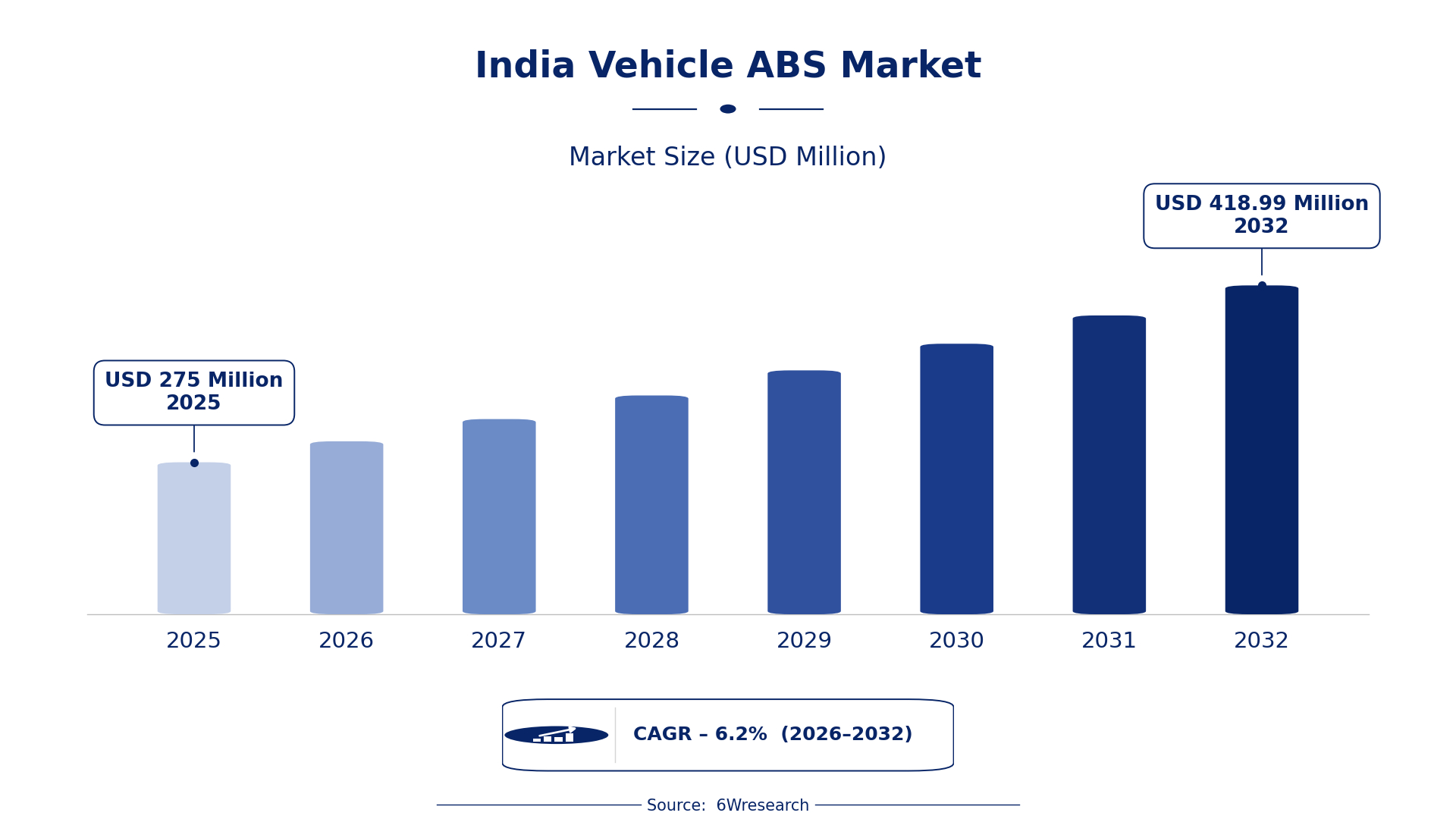
According to 6Wresearch internal database and industry insights, the India Vehicle ABS Market was valued at USD 275.0 million in 2025 and is projected to reach USD 418.99 million by 2032, growing at a CAGR of approximately 6.2% during 2026–2032.
India Vehicle ABS Market Highlights
| Report Metric | Details |
| Report Name | India Vehicle ABS Market |
| Market Size 2025 | USD 275.0 million |
| Market Size 2032 | USD 418.99 million |
| Absolute Growth 2025–2032 | USD 143.99 million |
| CAGR 2026–2032 | 6.2% |
| Peak Annual Growth | 8.8% in 2030 |
| Forecast Period | 2026–2032 |
| Historical Data | 2022–2025 |
| Base Year | 2025 |
| Leading ABS Type, 2025 | Four-Channel ABS (43% share) |
| Leading Sensor Type, 2025 | Wheel Speed Sensor (38% share) |
| Leading Vehicle Class, 2025 | Luxury Vehicles (37% share) |
| Leading End User, 2025 | OEMs (42% share) |
| Fastest-Growing ABS Type | Three-Channel ABS (7.6% CAGR) |
| Fastest-Growing Sensor Type | Hydraulic Valves (8.0% CAGR) |
| Fastest-Growing Vehicle Class | Mid-Range Cars (7.3% CAGR) |
| Fastest-Growing End User | Tier 1 Suppliers (7.3% CAGR) |
| Growing Sector | automotive safety technology |
| Key End Users | OEMs, Tier 1 Suppliers, EV Manufacturers |
India Vehicle ABS Market Year-wise Growth Rate and Key Drivers (2022–2032)
This graph illustrates the annual growth rates of the market from 2022 to 2032, highlighting a steady upward trajectory and projected market expansion over the forecast period.
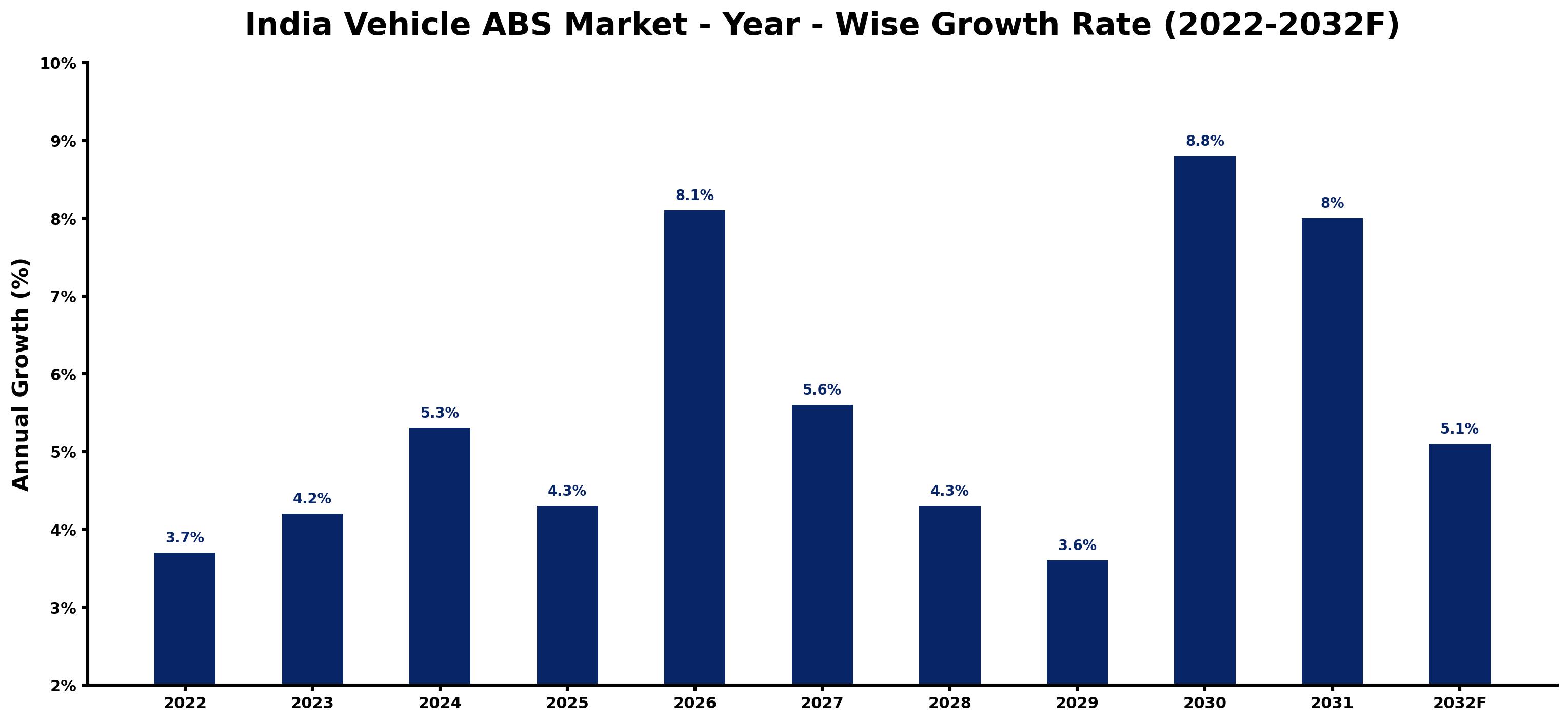
The table below sets out the estimated growth rate for each year and the main factor behind it.
| Year | Estimated Annual Growth (%) | Market Rationale |
| 2022 | 3.7 | The market experienced steady growth due to ongoing demand from domestic users. |
| 2023 | 4.2 | Growth accelerated as vehicle production increased and safety regulations tightened. |
| 2024 | 5.3 | The introduction of new safety standards further boosted demand for ABS technology. |
| 2025 | 4.3 | A slight slowdown occurred as the market adjusted to previous high growth rates. |
| 2026 | 8.1 | Demand surged as manufacturers prepared for the 100% ABS target by 2025. |
| 2027 | 5.6 | A gradual slowdown was noted as the market stabilises after rapid growth. |
| 2028 | 4.3 | The market continues to expand, supported by increasing safety awareness among consumers. |
| 2029 | 3.6 | Demand is expected to remain steady, bolstered by ongoing vehicle safety initiatives. |
| 2030 | 8.8 | A peak in growth is projected as the market responds to heightened safety concerns. |
| 2031 | 8.0 | Growth will slow slightly as the market begins to stabilise after peak demand. |
| 2032 | 5.1 | The market continues to grow, driven by ongoing safety regulations and technology adoption. |
Note: Market size estimations and growth projections presented in this report are based on 6Wresearch's proprietary forecasting methodology, utilizing the latest available industry data, government publications, and primary research inputs.
India Vehicle ABS Market Synopsis
The India Vehicle ABS Market focuses on the implementation of Anti-lock Braking Systems to enhance vehicle safety during braking. This technology merges hydraulic systems with electronic controls to prevent wheel lock-up. Growth in the market is propelled by rising vehicle production and stringent safety regulations. With a goal of 100% ABS for new vehicles by 2025, demand is primarily driven by OEMs and domestic consumers. In 2022, India's automotive sector produced over 4.4 million vehicles, further stimulating this expansion.
Market Dynamics Impact Analysis (2026–2032)
| Factor | Type | Impact | Primary Segment Affected |
| Increased vehicle production and safety regulations drive demand for ABS technology. | Driver | High | Four-Channel ABS |
| Growing consumer awareness about vehicle safety features boosts demand for ABS. | Driver | High | Luxury Vehicles |
| The push for 100% ABS adoption creates opportunities for suppliers of ABS components. | Opportunity | High | OEMs |
| Investment in advanced safety technologies is increasing among manufacturers. | Opportunity | Medium | Tier 1 Suppliers |
| The average age of vehicles in India limits the adoption of newer ABS technologies. | Restraint | High | Three-Channel ABS |
| Cost constraints in the economy segment hinder widespread ABS implementation. | Restraint | Medium | Economy Segment |
| The Vehicle ABS market in India faces challenges related to outdated vehicle fleets. | Challenge | High | Single-Channel ABS |
| Limited consumer understanding of ABS benefits can slow market penetration. | Challenge | Medium | Regenerative ABS |
Evaluation of Drivers in India Vehicle ABS Market (2026–2032)
Key forces behind demand, with the segment each one moves most, are listed below.
| Drivers | Primary Segment Affected | Why It Matters (Evidence) |
| Increased vehicle production in India drives demand for ABS systems. | OEMs | India produced over 4.4 million vehicles in 2022, leading to higher ABS installations. |
| Stricter safety regulations mandate ABS in new vehicles, boosting adoption. | Four-Channel ABS | Delhi's regulations require ABS in all new vehicles, reinforcing safety compliance. |
| Growing awareness of vehicle safety features influences consumer choices. | Luxury Vehicles | As safety becomes a priority, luxury vehicle buyers increasingly demand advanced ABS. |
| Investment from Tier 1 suppliers in ABS technology development is rising. | Tier 1 Suppliers | Suppliers are investing to meet the increasing demand for advanced safety technologies. |
| The National Electric Mobility Mission Plan promotes ABS integration in EVs. | EVs | This initiative aims to improve safety standards in electric vehicles. |
In 2022, India's automotive industry produced over 4.4 million vehicles, which has boosted the demand for ABS systems. As safety gains importance, luxury vehicle buyers are increasingly seeking advanced ABS, which propels sales. Investment from Tier 1 suppliers in ABS technology is also on the rise to satisfy the growing demand for safety technologies.
Evaluation of Restraints in India Vehicle ABS Market
The key brakes on demand, and where they bite hardest, are shown below.
| Market Restraint | Primary Segment Affected | Why It Matters (Evidence) |
| The average age of vehicles in India limits the adoption of newer ABS technologies. | Three-Channel ABS | With an average vehicle age of around 12 years, many vehicles lack modern ABS. |
| Cost constraints in the economy segment hinder widespread ABS implementation. | Economy Segment | Manufacturers often avoid installing ABS due to cost concerns in low-cost vehicles. |
| Limited consumer understanding of ABS benefits can slow market penetration. | Regenerative ABS | Many consumers are unaware of the advantages of ABS, affecting adoption rates. |
| Older vehicle models are less compatible with advanced ABS systems. | Single-Channel ABS | This limits upgrades and installations of new ABS technologies in existing fleets. |
| Regulatory compliance can be challenging for smaller manufacturers. | Tier 1 Suppliers | Smaller firms may struggle to meet the stringent standards set by authorities. |
India Vehicle ABS Market Challenges
The India Vehicle ABS market encounters several practical challenges, with the low ABS penetration rate in passenger vehicles being a primary concern, currently at 50%. This limited adoption arises as buyers often prioritise cost over safety, delaying the integration of ABS technology. Suppliers face substantial development costs, with investments in advanced ABS technology reaching up to 20% of total production costs, which pressures their pricing strategies. The industry also grapples with a skills gap; the average age of vehicles in India is around 12 years, resulting in a shortage of trained technicians skilled in modern ABS systems.
Trends in the India Vehicle ABS Market
Several trends are reshaping the India Vehicle ABS Market; the most important are set out below.
- Shift towards Stricter Vehicle Safety Regulations: India is experiencing a shift towards stricter vehicle safety regulations, particularly with ABS requirements. In 2023, Delhi mandated ABS in all new vehicles, reflecting a commitment to improving road safety. This trend is pushing manufacturers to invest in advanced safety technologies.
- Growing Demand for Advanced ABS in Luxury Vehicles: Luxury vehicle buyers are increasingly prioritising advanced ABS features, driving market changes. In 2022, luxury vehicles accounted for 37% of the ABS market share, highlighting the demand for improved safety. This trend encourages manufacturers to innovate and upgrade their ABS offerings.
- Increased Integration of ABS in Electric Vehicles: The integration of ABS technology in electric vehicles is gaining momentum, driven by the National Electric Mobility Mission Plan. By 2025, the adoption of ABS in EVs is expected to rise significantly, improving safety standards in this growing segment.
- Expansion of ABS Testing Standards: The Automotive Research Association of India is expanding ABS testing standards to ensure safety and performance. In 2023, new guidelines were introduced, improving the reliability of ABS systems. This shift is essential for maintaining consumer trust in vehicle safety.
Investment Opportunities in the India Vehicle ABS Market
Some of the investment opportunities in the India Vehicle ABS Market are mentioned below.
- Investment in ABS Component Manufacturing: With a target of 100% ABS for new vehicles by 2025, there is a gap in component manufacturing. OEMs are looking for local suppliers to meet this demand, presenting an opportunity for investment in manufacturing facilities in Maharashtra, which accounted for 30% of vehicle production.
- Growing Need for Upgrading Older Vehicles: The average vehicle age of around 12 years presents an opportunity for retrofitting ABS in older models. Service centers are looking to upgrade existing vehicles, creating a market for ABS components and installation services in urban areas.
- Increasing Demand for Safety Features in Mid-Range Cars: The mid-range car segment is projected to grow, with a CAGR of 7.3% from 2026 to 2032. Suppliers can target this segment by offering affordable ABS solutions tailored for mid-range vehicles, particularly in urban markets.
- Expansion of ABS in Tier 1 Supplier Offerings: As Tier 1 suppliers invest in ABS technology development, there is an opportunity to collaborate on solutions. This partnership can enhance the supply chain and improve the availability of advanced ABS systems across various vehicle classes.
Government Initiatives in the India Vehicle ABS Market
The Bureau of Indian Standards (BIS) has established regulations for ABS components, ensuring safety and reliability in vehicles since 2020. The Ministry of Road Transport and Highways set a target for 100% ABS adoption in new vehicles by 2025, promoting safety across the automotive sector. Additionally, Delhi's stricter vehicle safety regulations mandate ABS in all new vehicles, further reinforcing the need for compliance among manufacturers. These measures collectively aim to improve vehicle safety and encourage the adoption of advanced technologies in India.
The Automotive Research Association of India (ARAI) oversees the testing and certification of ABS systems, ensuring compliance with national standards. The agency funds research initiatives to improve ABS technology and its integration into vehicles. Furthermore, the National Electric Mobility Mission Plan supports the development of ABS in electric vehicles, facilitating safer mobility solutions. These efforts are vital for manufacturers and suppliers aiming to meet the evolving safety requirements in the automotive market.
Future Insight of the India Vehicle ABS Market
Several forward-looking factors should support the India Vehicle ABS market over the coming years. The Ministry of Road Transport and Highways aims for 100% ABS in new vehicles by 2025, which will drive demand for this safety technology. The National Electric Mobility Mission Plan will encourage ABS integration in electric vehicles, promoting advancements in safety features. By 2032, increased investments from suppliers in ABS technology development will enhance product offerings, benefiting both buyers and manufacturers.
Market Segmentation Analysis
Each segment group is reviewed below, with the leader by share and the fastest grower by CAGR.
By ABS Type – Four-Channel ABS Dominated, Three-Channel ABS Expected to Grow Fastest
According to Bhawna Singh, Assistant Manager at 6Wresearch, with a 43% revenue share in 2025, Four-Channel ABS was the largest abs type category. Four-Channel ABS holds the largest share due to its widespread use in modern vehicles, ensuring optimal braking safety. This system is particularly prevalent in new passenger vehicles produced in India, which underscores its importance in the market. Three-Channel ABS is set to record the highest CAGR in this split, 7.6% over 2026–2032. The Three-Channel ABS segment is witnessing rapid growth as older vehicle models increasingly adopt this technology. With a significant portion of India's vehicle fleet being over a decade old, there is a rising demand for retrofitting these systems to improve safety. Suppliers should concentrate on developing solutions for the Three-Channel ABS segment to take advantage of the expanding retrofitting market.
By Sensor Type – Wheel Speed Sensor Dominated, Hydraulic Valves Expected to Grow Fastest
Wheel Speed Sensor accounted for a 38% market share by sensor type in 2025. The Wheel Speed Sensor commands the largest market share because it is crucial for the functionality of ABS systems in vehicles. Its role in monitoring wheel speed makes it indispensable for both OEMs and the aftermarket. Over 2026–2032, Hydraulic Valves are expected to post the fastest growth, at a CAGR of 8.0%. Hydraulic Valves are the fastest-growing segment, recognised for their essential function in controlling brake pressure to improve vehicle safety. As manufacturers adapt to stricter safety regulations, the demand for these components is increasing significantly. Suppliers must focus on advancing Hydraulic Valves to align with rising safety standards and capture additional market share.
By Vehicle Class – Luxury Vehicles Dominated, Mid-Range Cars Expected to Grow Fastest
In 2025, Luxury Vehicles led the vehicle class split with a 37% share. Luxury Vehicles dominate the market share as they are equipped with advanced safety features, including high-performance ABS systems. The affluent consumer base in India prioritises safety, which drives demand for these premium vehicles. Mid-Range Cars are projected to grow fastest, at a CAGR of 7.3% during 2026–2032. Mid-Range Cars are experiencing the fastest growth as consumers increasingly seek safety features in more affordable options. The expanding middle class in India is prompting manufacturers to integrate ABS technology into this segment. Manufacturers should enhance their ABS offerings for Mid-Range Cars to satisfy the growing consumer demand for safety.
By End User – OEMs Dominated, Tier 1 Suppliers Expected to Grow Fastest
The largest end user category in 2025 was OEMs, with a 42% share of total revenue. OEMs represent the largest share in the market as they are the primary users of ABS technology in new vehicle production. Their commitment to safety standards drives the adoption of advanced braking systems across various vehicle classes. The quickest growth will come from Tier 1 Suppliers, forecast to expand at a CAGR of 7.3% between 2026 and 2032. Tier 1 Suppliers are the fastest-growing segment as they supply critical components to OEMs, responding to increased demand for ABS integration. Their role in the supply chain is becoming more vital as safety regulations tighten. Suppliers should strengthen partnerships with Tier 1 Suppliers to ensure a steady flow of ABS components in the evolving market.
Key Attractiveness of the Report
- 10 Years of Market Numbers
- Historical Data Starting from 2022 to 2025
- Base Year 2025
- Forecast Data until 2032
- Key Performance Indicators Impacting the Market
- Major Upcoming Developments and Projects
Key Highlights of the Report:
- India Vehicle ABS Market Outlook
- Market Size of India Vehicle ABS Market, 2025
- Forecast of India Vehicle ABS Market, 2032
- Historical Data and Forecast of India Vehicle ABS Revenues & Volume for the Period 2022 - 2032F
- India Vehicle ABS Market Trend Evolution
- India Vehicle ABS Market Drivers and Challenges
- India Vehicle ABS Price Trends
- India Vehicle ABS Porter's Five Forces
- India Vehicle ABS Industry Life Cycle
- Historical Data and Forecast of India Vehicle ABS Market Revenues & Volume By ABS Type for the Period 2022 - 2032F
- Historical Data and Forecast of India Vehicle ABS Market Revenues & Volume By Four-Channel ABS for the Period 2022 - 2032F
- Historical Data and Forecast of India Vehicle ABS Market Revenues & Volume By Three-Channel ABS for the Period 2022 - 2032F
- Historical Data and Forecast of India Vehicle ABS Market Revenues & Volume By Single-Channel ABS for the Period 2022 - 2032F
- Historical Data and Forecast of India Vehicle ABS Market Revenues & Volume By Regenerative ABS for the Period 2022 - 2032F
- Historical Data and Forecast of India Vehicle ABS Market Revenues & Volume By Sensor Type for the Period 2022 - 2032F
- Historical Data and Forecast of India Vehicle ABS Market Revenues & Volume By Wheel Speed Sensor for the Period 2022 - 2032F
- Historical Data and Forecast of India Vehicle ABS Market Revenues & Volume By Hydraulic Valves for the Period 2022 - 2032F
- Historical Data and Forecast of India Vehicle ABS Market Revenues & Volume By Basic Sensor Unit for the Period 2022 - 2032F
- Historical Data and Forecast of India Vehicle ABS Market Revenues & Volume By Integrated Systems for the Period 2022 - 2032F
- Historical Data and Forecast of India Vehicle ABS Market Revenues & Volume By Vehicle Class for the Period 2022 - 2032F
- Historical Data and Forecast of India Vehicle ABS Market Revenues & Volume By Luxury Vehicles for the Period 2022 - 2032F
- Historical Data and Forecast of India Vehicle ABS Market Revenues & Volume By Mid-Range Cars for the Period 2022 - 2032F
- Historical Data and Forecast of India Vehicle ABS Market Revenues & Volume By Economy Segment for the Period 2022 - 2032F
- Historical Data and Forecast of India Vehicle ABS Market Revenues & Volume By EVs for the Period 2022 - 2032F
- Historical Data and Forecast of India Vehicle ABS Market Revenues & Volume By End User for the Period 2022 - 2032F
- Historical Data and Forecast of India Vehicle ABS Market Revenues & Volume By OEMs for the Period 2022 - 2032F
- Historical Data and Forecast of India Vehicle ABS Market Revenues & Volume By Tier 1 Suppliers for the Period 2022 - 2032F
- Historical Data and Forecast of India Vehicle ABS Market Revenues & Volume By Garage/Service Centers for the Period 2022 - 2032F
- Historical Data and Forecast of India Vehicle ABS Market Revenues & Volume By EV Manufacturers for the Period 2022 - 2032F
- India Vehicle ABS Import Export Trade Statistics
- Market Opportunity Assessment By ABS Type
- Market Opportunity Assessment By Sensor Type
- Market Opportunity Assessment By Vehicle Class
- Market Opportunity Assessment By End User
- India Vehicle ABS Top Companies Market Share
- India Vehicle ABS Competitive Benchmarking By Technical and Operational Parameters
- India Vehicle ABS Company Profiles
- India Vehicle ABS Key Strategic Recommendations
Market Covered
Segments analysed in this report are listed below.
By ABS Type
- Four-Channel ABS
- Three-Channel ABS
- Single-Channel ABS
- Regenerative ABS
By Sensor Type
- Wheel Speed Sensor
- Hydraulic Valves
- Basic Sensor Unit
- Integrated Systems
By Vehicle Class
- Luxury Vehicles
- Mid-Range Cars
- Economy Segment
- EVs
By End User
- OEMs
- Tier 1 Suppliers
- Garage/Service Centers
- EV Manufacturers































