India Vehicle Acoustic Systems Market Size & Growth Rate
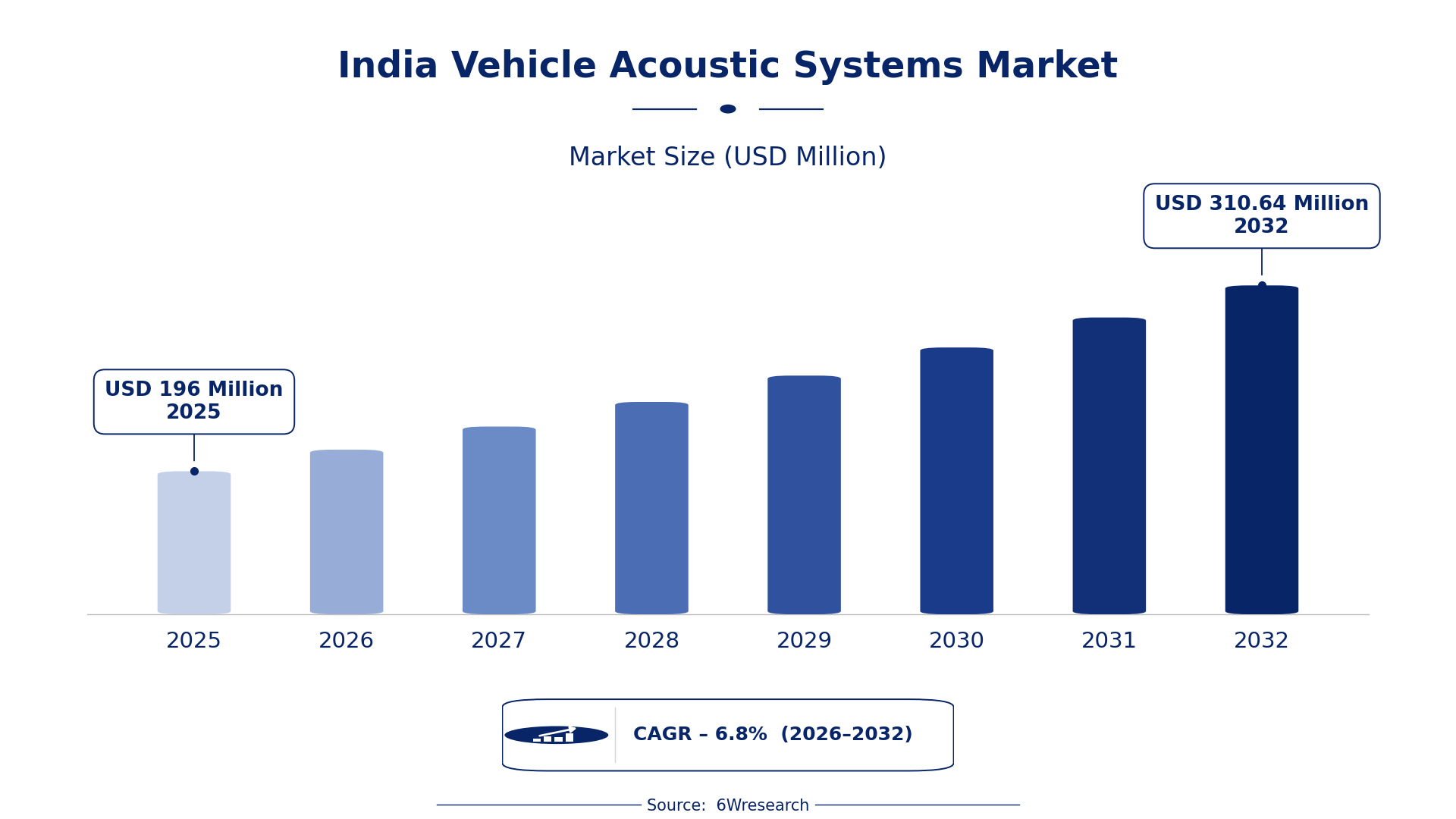
According to 6Wresearch internal database and industry insights, the India Vehicle Acoustic Systems Market was valued at USD 196.0 million in 2025 and is projected to reach USD 310.64 million by 2032, growing at a CAGR of approximately 6.8% during 2026–2032.
India Vehicle Acoustic Systems Market Highlights
| Report Metric | Details |
| Report Name | India Vehicle Acoustic Systems Market |
| Market Size 2025 | USD 196.0 million |
| Market Size 2032 | USD 310.64 million |
| Absolute Growth 2025–2032 | USD 114.64 million |
| CAGR 2026–2032 | 6.8% |
| Peak Annual Growth | 8.9% in 2028 |
| Forecast Period | 2026–2032 |
| Historical Data | 2022–2025 |
| Base Year | 2025 |
| Leading System Type, 2025 | Active Noise Control (47% share) |
| Leading Noise Source, 2025 | Road/Tire/Vibration (35% share) |
| Leading Technology Used, 2025 | DSP (41% share) |
| Leading End User, 2025 | Premium Car Manufacturers (39% share) |
| Fastest-Growing System Type | Cabin Quiet Systems (8.3% CAGR) |
| Fastest-Growing Noise Source | Wind & Ambient Noise (9.1% CAGR) |
| Fastest-Growing End User | EV Makers (9.0% CAGR) |
| Growing Sector | Electric Vehicle Manufacturing |
| Key End Users | Premium Car Manufacturers, Vehicle Assemblers, EV Makers |
India Vehicle Acoustic Systems Market Year-wise Growth Rate and Key Drivers (2022–2032)
This graph illustrates the annual growth rates of the market from 2022 to 2032, highlighting a steady upward trajectory and projected market expansion over the forecast period.
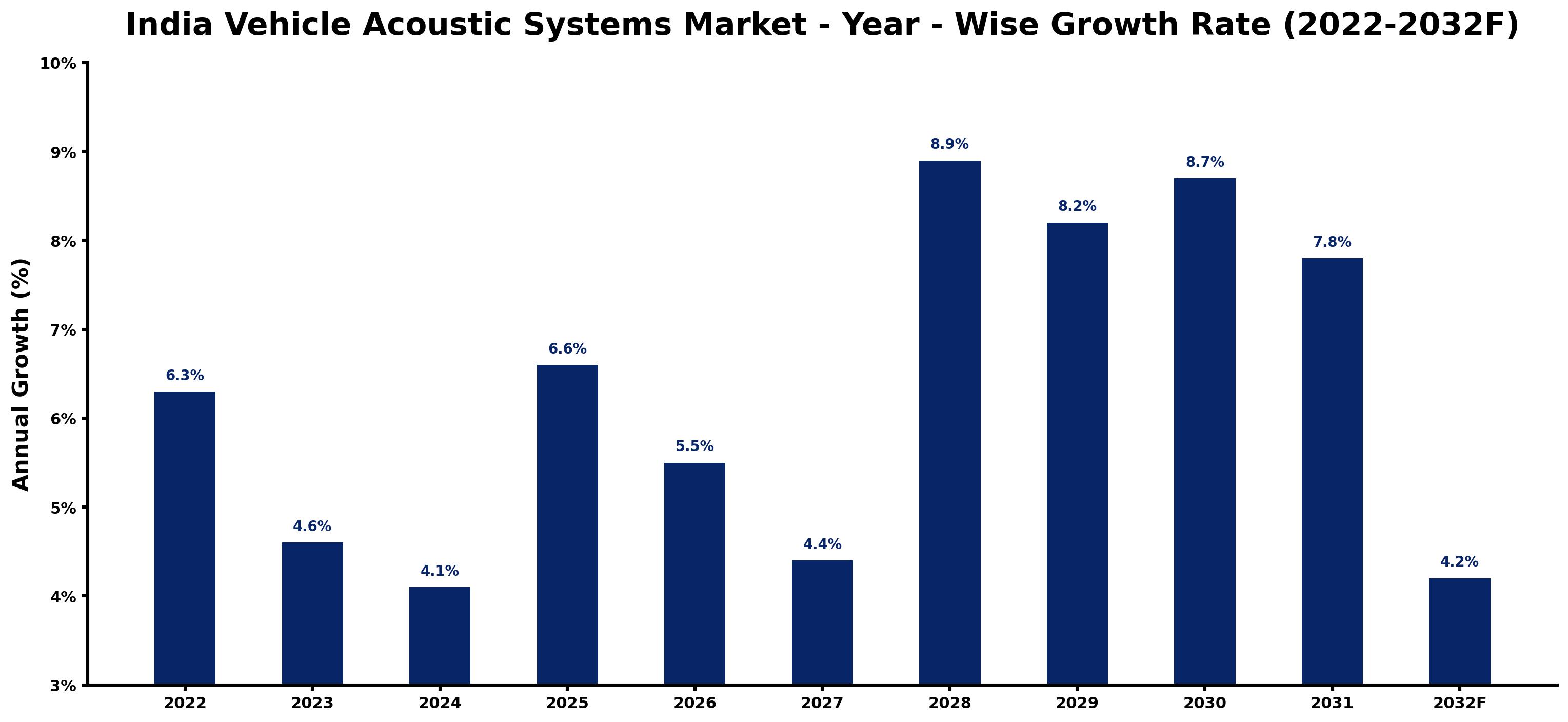
Each row of the following table gives one year's estimated growth and the event or demand shift that explains it.
| Year | Estimated Annual Growth (%) | Market Rationale |
| 2022 | 6.3 | The market showed strong demand from domestic manufacturers and assemblers. |
| 2023 | 4.6 | Growth slowed due to the implementation of new noise regulations by the Bureau of Indian Standards. |
| 2024 | 4.1 | Demand continued to decrease slightly as manufacturers adapted to the updated standards. |
| 2025 | 6.6 | The market rebounded with renewed interest in premium vehicle features and acoustic systems. |
| 2026 | 5.5 | Growth is expected to slow as the Production Linked Incentive Scheme encourages local manufacturing. |
| 2027 | 4.4 | Demand for electric vehicles will contribute to slower growth as manufacturers adjust their offerings. |
| 2028 | 8.9 | The market is projected to surge as luxury vehicle manufacturers adopt advanced noise control systems. |
| 2029 | 8.2 | Demand is expected to moderate slightly as manufacturers adjust to evolving market conditions. |
| 2030 | 8.7 | Growth will increase again with rising electric vehicle adoption rates and consumer preferences. |
| 2031 | 7.8 | The market is projected to experience slower growth as competition intensifies in the premium segment. |
| 2032 | 4.2 | Growth is expected to slow again as the market stabilises after rapid expansion. |
Note: Market size estimations and growth projections presented in this report are based on 6Wresearch's proprietary forecasting methodology, utilizing the latest available industry data, government publications, and primary research inputs.
India Vehicle Acoustic Systems Market Synopsis
Vehicle Acoustic Systems are designed to reduce unwanted noise in vehicles, improving passenger comfort. These systems utilise technologies like active noise control and passive damping, primarily in premium and electric vehicles. The India Vehicle Acoustic Systems Market is expanding due to rising demand from domestic manufacturers and the electric vehicle sector. In 2023, the electric vehicle segment is anticipated to grow by 50%, prompting investments in acoustic technologies. The National Electric Mobility Mission Plan supports this shift by promoting EV adoption with incentives.
Market Dynamics Impact Analysis (2026–2032)
| Factor | Type | Impact | Primary Segment Affected |
| Rising demand from premium car manufacturers for enhanced passenger comfort | Driver | High | Active Noise Control |
| Increased adoption of electric vehicles requiring advanced acoustic solutions | Driver | High | Cabin Quiet Systems |
| Growing electric vehicle segment creating demand for innovative acoustic systems | Opportunity | High | EV Makers |
| Expansion of automotive manufacturing hubs in Maharashtra and Tamil Nadu | Opportunity | High | Vehicle Assemblers |
| Challenges in meeting new noise regulations set by the Bureau of Indian Standards | Restraint | High | Passive Damping |
| High costs associated with implementing advanced acoustic technologies | Restraint | Medium | Engine Sound Design |
| Supply chain disruptions affecting component availability for manufacturers | Challenge | High | DSP |
| Intense competition among manufacturers leading to price pressures | Challenge | Medium | Wind & Ambient Noise |
Evaluation of Drivers in India Vehicle Acoustic Systems Market (2026–2032)
Key forces behind demand, with the segment each one moves most, are listed below.
| Drivers | Primary Segment Affected | Why It Matters (Evidence) |
| Increased demand for passenger comfort in luxury vehicles | Active Noise Control | This drives manufacturers to integrate advanced noise control systems, with 47% market share expected by 2025. |
| The rise of electric vehicles requiring quieter cabins | Cabin Quiet Systems | This segment is projected to grow at 8.3% CAGR from 2026 to 2032, reflecting changing consumer preferences. |
| Growing consumer preference for premium features in vehicles | Engine Sound Design | This trend is supported by the increasing focus on auditory experiences in luxury models, enhancing sales. |
| Government incentives promoting electric vehicle adoption | EV Makers | The electric vehicle segment is anticipated to grow by 50% in 2023, driving demand for acoustic systems. |
| Development of automotive manufacturing hubs in key regions | Vehicle Assemblers | Maharashtra and Tamil Nadu are major hubs, enhancing local supply chains and production capabilities. |
The Vehicle Acoustic Systems market in India is expanding as demand from premium car manufacturers and electric vehicle makers rises. The average passenger vehicle ownership in India is about 22 vehicles per 1,000 people, indicating a growing consumer base. The electric vehicle segment is expected to grow significantly in 2023, creating substantial demand for advanced acoustic solutions. Incentives under the National Electric Mobility Mission Plan further drive this trend, encouraging manufacturers to adopt new technologies. The integration of active noise control systems in luxury vehicles improves passenger comfort, leading to increased sales in this segment.
Evaluation of Restraints in India Vehicle Acoustic Systems Market
Below mentioned are some major restraints and their influence on market dynamics.
| Market Restraint | Primary Segment Affected | Why It Matters (Evidence) |
| Challenges in meeting new noise regulations set by the Bureau of Indian Standards | Passive Damping | Compliance with these regulations requires substantial investment in technology and testing, impacting smaller manufacturers. |
| High costs associated with implementing advanced acoustic technologies | Engine Sound Design | These costs can deter smaller manufacturers from adopting new systems, limiting market participation. |
| Supply chain disruptions affecting component availability for manufacturers | DSP | This causes delays in production and increases costs for manufacturers, hindering timely delivery. |
| Intense competition among manufacturers resulting in price pressures | Wind & Ambient Noise | This can reduce profit margins and affect investment in innovation, impacting long-term growth. |
| Limited awareness of acoustic system benefits among consumers | Cabin Quiet Systems | This can slow adoption rates in the broader vehicle market, affecting overall sales. |
India Vehicle Acoustic Systems Market Challenges
Rising material costs in the India Vehicle Acoustic Systems market have surged by 15% over the past year, which pressures buyers to reconsider their purchasing strategies. Compliance costs from the Bureau of Indian Standards create delays in product launches, affecting suppliers' ability to meet the growing demand for noise reduction solutions. The integration of advanced technologies necessitates substantial investments, which can overwhelm smaller manufacturers and restrict their competitiveness. The rapid growth of the electric vehicle segment, projected at 50% this year, forces producers to innovate quickly, risking missed opportunities for those unable to adapt.
Trends in the India Vehicle Acoustic Systems Market
Four trends stand out in the India Vehicle Acoustic Systems Market.
- Shift towards Active Noise Control in Luxury Vehicles: The adoption of Active Noise Control systems is increasing among luxury vehicle manufacturers, with 47% market share expected by 2025. This shift improves passenger comfort and aligns with consumer preferences for quieter cabins.
- Growing Focus on Electric Vehicle Acoustic Solutions: The electric vehicle segment is anticipated to grow by 50% in 2023, driving demand for advanced acoustic solutions. This trend reflects a broader industry shift towards sustainable and quieter driving experiences.
- Transition to Advanced Noise Regulations: New noise regulations introduced by the Bureau of Indian Standards in 2023 are prompting manufacturers to enhance their acoustic systems. Compliance with these regulations is essential for market competitiveness and sustainability.
- Emergence of Cabin Quiet Systems: Cabin Quiet Systems are becoming a focal point for manufacturers as consumer expectations for comfort rise. This segment is projected to grow at a CAGR of 8.3% from 2026 to 2032, reflecting changing market dynamics.
Investment Opportunities in the India Vehicle Acoustic Systems Market
Several openings in the India Vehicle Acoustic Systems Market merit attention from investors.
- Growing Demand from Premium Car Manufacturers: Premium car manufacturers are actively seeking advanced acoustic solutions to enhance passenger comfort. With a projected 39% market share in 2025, this segment offers a robust opportunity for suppliers.
- Investment in Electric Vehicle Manufacturing Facilities: The rapid expansion of the electric vehicle market creates a pressing need for acoustic systems. Establishing manufacturing facilities in Maharashtra and Tamil Nadu can facilitate entry into this burgeoning market.
- Increased Focus on Noise Reduction Technologies: There is a growing demand for technologies that mitigate noise pollution in vehicles. Suppliers can take advantage of this trend by providing innovative acoustic solutions that comply with new regulatory standards.
- Partnerships with Vehicle Assemblers: Collaborating with vehicle assemblers can broaden market access. This strategy is particularly relevant as the automotive industry in India employs over 37 million people, underscoring the sector's importance.
Government Initiatives in the India Vehicle Acoustic Systems Market
The Automotive Mission Plan 2026, initiated by the Ministry of Heavy Industries, aims for the automotive sector to achieve $300 billion in revenue by 2026. This initiative encourages investment in advanced technologies, including vehicle acoustic systems, to improve competitiveness. Additionally, the National Electric Mobility Mission Plan 2020 promotes electric vehicle adoption with a budget of INR 10,000 crore over three years, supporting infrastructure and technology development for acoustic solutions in EVs.
The Bureau of Indian Standards has introduced new noise regulations effective from 2023, aimed at reducing noise pollution. This regulatory framework ensures that manufacturers comply with standards that promote the adoption of advanced acoustic technologies. The Ministry of Heavy Industries and Public Enterprises oversees automotive policies and regulations, approving initiatives that improve manufacturing capabilities and support innovation in the sector.
Future Insight of the India Vehicle Acoustic Systems Market
The India Vehicle Acoustic Systems market is set for significant changes by 2032, driven by the National Electric Mobility Mission Plan that promotes electric vehicle adoption. With the electric vehicle segment expected to grow by 50%, suppliers must enhance their noise reduction technologies to meet consumer expectations. The adoption of ISO 14001 standards will encourage manufacturers to focus on environmental compliance. Innovations in acoustic technologies will improve sound quality, directly benefiting passenger comfort and satisfaction in vehicles.
Market Segmentation Analysis
Each segment group is reviewed below, with the leader by share and the fastest grower by CAGR.
By System Type – Active Noise Control Dominated, Cabin Quiet Systems Expected to Grow Fastest
According to Bhawna Singh, Assistant Manager at 6Wresearch, Active Noise Control accounted for a 47% market share by system type in 2025. Active Noise Control holds the largest share due to its effectiveness in reducing unwanted noise through sound wave interference, making it essential for premium vehicles. This technology is increasingly favoured by manufacturers aiming to enhance passenger comfort in high-end models. Cabin Quiet Systems are set to record the highest CAGR in this split, 8.3% over 2026–2032. Cabin Quiet Systems are experiencing rapid growth as they specifically target in-cabin noise reduction, which is crucial for electric vehicles that operate more quietly. The rising demand for superior comfort in modern vehicles is propelling this segment's expansion. Suppliers should focus on developing Cabin Quiet Systems to meet the increasing demand for comfort in vehicles.
By Noise Source – Road/Tire/Vibration Dominated, Wind & Ambient Noise Expected to Grow Fastest
Road/Tire/Vibration took a 35% share of noise source in 2025, more than any other category. Road/Tire/Vibration noise dominates the market as it significantly affects passenger comfort and is a primary concern for vehicle manufacturers. This type of noise is prevalent across all vehicle types, making it a critical area for the development of acoustic systems. Over 2026–2032, Wind & Ambient Noise is expected to post the fastest growth, at a CAGR of 9.1%. Wind & Ambient Noise is the fastest-growing segment, as it increasingly impacts sound quality in vehicles, particularly with the rise of quieter electric vehicles. The demand for improved cabin acoustics in these vehicles is driving this growth. Manufacturers must address Wind & Ambient Noise to enhance the overall driving experience in modern vehicles.
By Technology Used – DSP Dominated and Is Expected to Record the Fastest Growth
The largest technology used category in 2025 was DSP, with a 41% share of total revenue. DSP technology leads the market due to its ability to process sound signals effectively, improving both audio quality and noise cancellation. Its widespread application across various vehicle types solidifies its dominant market position. The same category is also set to grow fastest, at a CAGR of 8.2% during 2026–2032. DSP is also the fastest-growing technology, adapting well to the changing requirements of acoustic systems in electric vehicles, ensuring superior sound management. Its versatility in addressing diverse acoustic challenges keeps it at the forefront of market trends. Investing in DSP technology will be crucial for suppliers aiming to remain competitive in the vehicle acoustic systems market.
By End User – Premium Car Manufacturers Dominated, EV Makers Expected to Grow Fastest
Premium Car Manufacturers held a 39% share of the India Vehicle Acoustic Systems Market by end user in 2025. Premium Car Manufacturers represent the largest share as they require advanced acoustic systems to provide exceptional comfort in luxury vehicles. Their focus on delivering high-quality passenger experiences drives their reliance on sophisticated noise reduction technologies. The quickest growth will come from EV Makers, forecast to expand at a CAGR of 9.0% between 2026 and 2032. EV Makers are the fastest-growing segment, increasingly adopting advanced acoustic solutions to enhance the driving experience in electric vehicles. The surge in electric vehicle production and sales is fuelling this segment's growth. Suppliers should align their offerings with the needs of EV Makers to capitalise on the expanding electric vehicle market.
Key Attractiveness of the Report
- 10 Years of Market Numbers
- Historical Data Starting from 2022 to 2025
- Base Year 2025
- Forecast Data until 2032
- Key Performance Indicators Impacting the Market
- Major Upcoming Developments and Projects
Key Highlights of the Report:
- India Vehicle Acoustic Systems Market Outlook
- Market Size of India Vehicle Acoustic Systems Market, 2025
- Forecast of India Vehicle Acoustic Systems Market, 2032
- Historical Data and Forecast of India Vehicle Acoustic Systems Revenues & Volume for the Period 2022 - 2032F
- India Vehicle Acoustic Systems Market Trend Evolution
- India Vehicle Acoustic Systems Market Drivers and Challenges
- India Vehicle Acoustic Systems Price Trends
- India Vehicle Acoustic Systems Porter's Five Forces
- India Vehicle Acoustic Systems Industry Life Cycle
- Historical Data and Forecast of India Vehicle Acoustic Systems Market Revenues & Volume By System Type for the Period 2022 - 2032F
- Historical Data and Forecast of India Vehicle Acoustic Systems Market Revenues & Volume By Active Noise Control for the Period 2022 - 2032F
- Historical Data and Forecast of India Vehicle Acoustic Systems Market Revenues & Volume By Passive Damping for the Period 2022 - 2032F
- Historical Data and Forecast of India Vehicle Acoustic Systems Market Revenues & Volume By Engine Sound Design for the Period 2022 - 2032F
- Historical Data and Forecast of India Vehicle Acoustic Systems Market Revenues & Volume By Cabin Quiet Systems for the Period 2022 - 2032F
- Historical Data and Forecast of India Vehicle Acoustic Systems Market Revenues & Volume By Noise Source for the Period 2022 - 2032F
- Historical Data and Forecast of India Vehicle Acoustic Systems Market Revenues & Volume By Road/Tire/Vibration for the Period 2022 - 2032F
- Historical Data and Forecast of India Vehicle Acoustic Systems Market Revenues & Volume By Insulation Panels for the Period 2022 - 2032F
- Historical Data and Forecast of India Vehicle Acoustic Systems Market Revenues & Volume By Speaker Integration for the Period 2022 - 2032F
- Historical Data and Forecast of India Vehicle Acoustic Systems Market Revenues & Volume By Wind & Ambient Noise for the Period 2022 - 2032F
- Historical Data and Forecast of India Vehicle Acoustic Systems Market Revenues & Volume By Technology Used for the Period 2022 - 2032F
- Historical Data and Forecast of India Vehicle Acoustic Systems Market Revenues & Volume By DSP, Microphones for the Period 2022 - 2032F
- Historical Data and Forecast of India Vehicle Acoustic Systems Market Revenues & Volume By Foam, Composite Materials for the Period 2022 - 2032F
- Historical Data and Forecast of India Vehicle Acoustic Systems Market Revenues & Volume By Sound Generators for the Period 2022 - 2032F
- Historical Data and Forecast of India Vehicle Acoustic Systems Market Revenues & Volume By Sensor Feedback Loop for the Period 2022 - 2032F
- Historical Data and Forecast of India Vehicle Acoustic Systems Market Revenues & Volume By End User for the Period 2022 - 2032F
- Historical Data and Forecast of India Vehicle Acoustic Systems Market Revenues & Volume By Premium Car Manufacturers for the Period 2022 - 2032F
- Historical Data and Forecast of India Vehicle Acoustic Systems Market Revenues & Volume By Vehicle Assemblers for the Period 2022 - 2032F
- Historical Data and Forecast of India Vehicle Acoustic Systems Market Revenues & Volume By EV Makers for the Period 2022 - 2032F
- Historical Data and Forecast of India Vehicle Acoustic Systems Market Revenues & Volume By Luxury OEMs for the Period 2022 - 2032F
- India Vehicle Acoustic Systems Import Export Trade Statistics
- Market Opportunity Assessment By System Type
- Market Opportunity Assessment By Noise Source
- Market Opportunity Assessment By Technology Used
- Market Opportunity Assessment By End User
- India Vehicle Acoustic Systems Top Companies Market Share
- India Vehicle Acoustic Systems Competitive Benchmarking By Technical and Operational Parameters
- India Vehicle Acoustic Systems Company Profiles
- India Vehicle Acoustic Systems Key Strategic Recommendations
Market Covered
This report examines the market across the segments below.
By System Type
- Active Noise Control
- Passive Damping
- Engine Sound Design
- Cabin Quiet Systems
By Noise Source
- Road/Tire/Vibration
- Insulation Panels
- Speaker Integration
- Wind & Ambient Noise
By Technology Used
- DSP
- Microphones
- Foam
- Composite Materials
- Sound Generators
- Sensor Feedback Loop
By End User
- Premium Car Manufacturers
- Vehicle Assemblers
- EV Makers
- Luxury OEMs































