India Vehicle Aerodynamics Market Size & Growth Rate
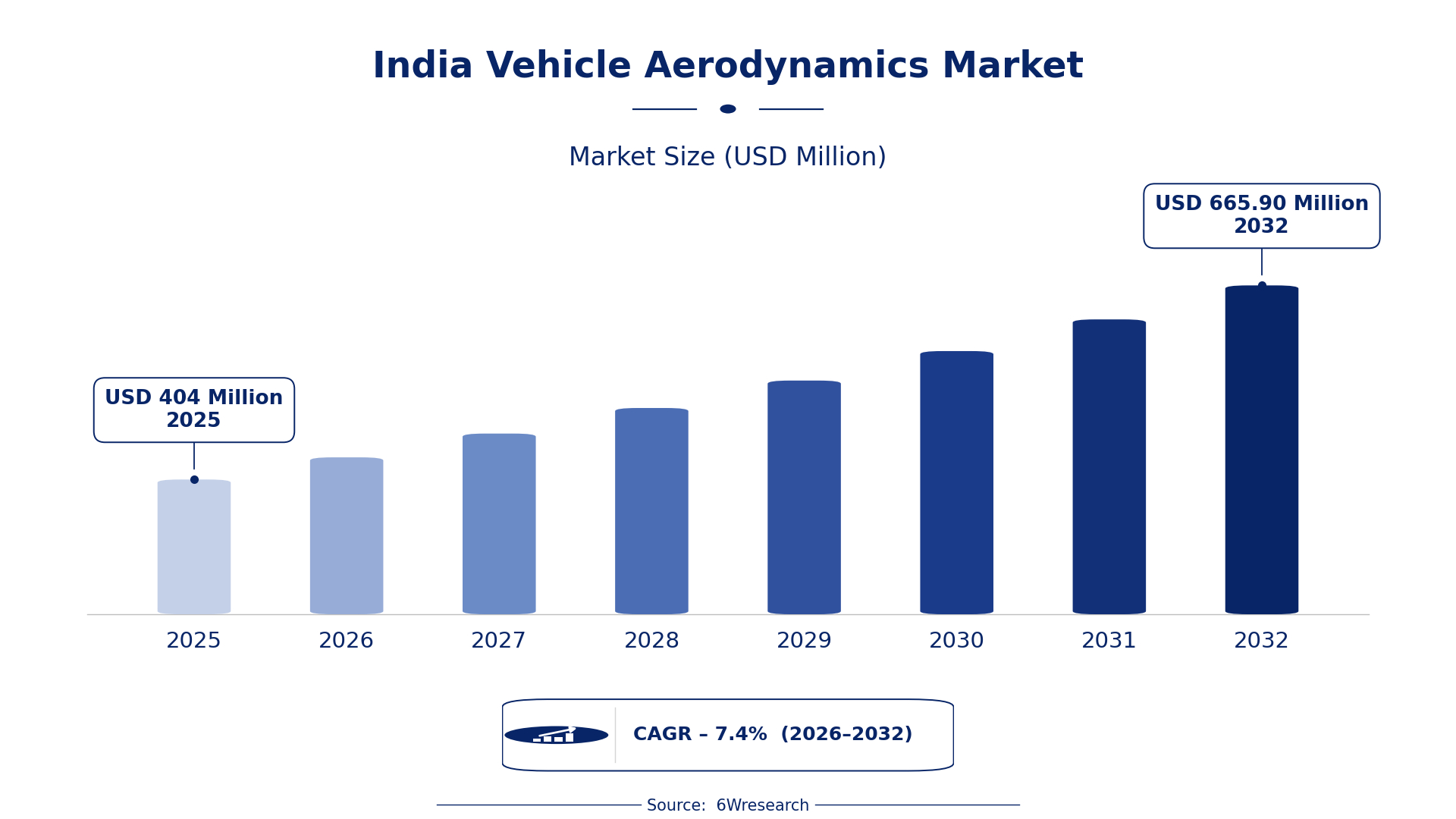
According to 6Wresearch internal database and industry insights, the India Vehicle Aerodynamics Market was valued at USD 404.0 million in 2025 and is projected to reach USD 665.90 million by 2032, growing at a CAGR of approximately 7.4% during 2026–2032.
India Vehicle Aerodynamics Market Highlights
| Report Metric | Details |
| Report Name | India Vehicle Aerodynamics Market |
| Market Size 2025 | USD 404.0 million |
| Market Size 2032 | USD 665.90 million |
| Absolute Growth 2025–2032 | USD 261.90 million |
| CAGR 2026–2032 | 7.4% |
| Peak Annual Growth | 10.0% in 2030 |
| Forecast Period | 2026–2032 |
| Historical Data | 2022–2025 |
| Base Year | 2025 |
| Leading Component Type, 2025 | Front Splitters (45% share) |
| Leading Material Used, 2025 | Carbon Fiber/Plastic (42% share) |
| Leading Functional Purpose, 2025 | Drag Reduction (46% share) |
| Leading Vehicle Segment, 2025 | Electric Cars (40% share) |
| Fastest-Growing Component Type | Rear Spoilers (9.7% CAGR) |
| Fastest-Growing Functional Purpose | Improve Traction (9.2% CAGR) |
| Fastest-Growing Vehicle Segment | Performance Vehicles (10.1% CAGR) |
| Growing Sector | Electric Vehicles |
| Key End Users | Automotive manufacturers, Electric vehicle producers, Performance vehicle developers |
India Vehicle Aerodynamics Market Year-wise Growth Rate and Key Drivers (2022–2032)
This graph illustrates the annual growth rates of the market from 2022 to 2032, highlighting a steady upward trajectory and projected market expansion over the forecast period.
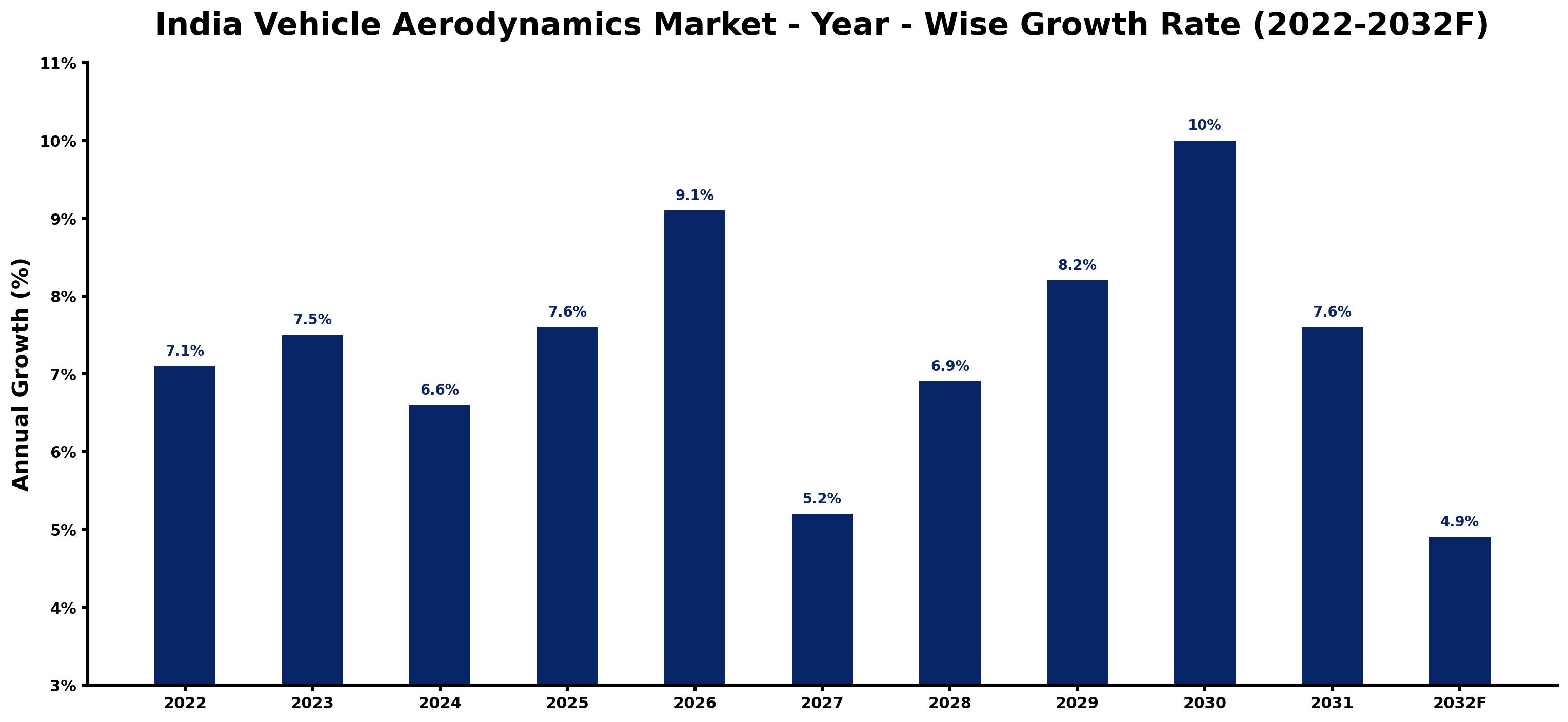
The table below sets out the estimated growth rate for each year and the main factor behind it.
| Year | Estimated Annual Growth (%) | Market Rationale |
| 2022 | 7.1 | The market experienced steady growth due to increasing interest in fuel-efficient vehicles. |
| 2023 | 7.5 | Demand surged as electric vehicle sales reached 1.5 million units, boosting aerodynamics needs. |
| 2024 | 6.6 | Growth slowed as manufacturers adjusted to new aerodynamic performance metrics introduced in 2022. |
| 2025 | 7.6 | A rise in passenger vehicle production contributed to faster growth in vehicle aerodynamics. |
| 2026 | 9.1 | Investment in electric vehicle technology spurred demand for advanced aerodynamic components. |
| 2027 | 5.2 | Growth slowed as the market faced challenges in scaling production capabilities. |
| 2028 | 6.9 | Increased focus on performance vehicles led to a resurgence in demand for aerodynamics. |
| 2029 | 8.2 | The market grew as consumers increasingly prioritised fuel efficiency in vehicle purchases. |
| 2030 | 10.0 | The peak growth year was driven by the government's push for electric vehicle adoption. |
| 2031 | 7.6 | Growth slowed as the market began to stabilise after rapid expansion in the previous years. |
| 2032 | 4.9 | Demand continued to grow, albeit at a slower pace, as electric vehicle penetration increased. |
Note: Market size estimations and growth projections presented in this report are based on 6Wresearch's proprietary forecasting methodology, utilizing the latest available industry data, government publications, and primary research inputs.
India Vehicle Aerodynamics Market Synopsis
The Vehicle Aerodynamics Market in India centres on optimising vehicle design to improve fuel efficiency and performance. This includes components such as spoilers and splitters, primarily crafted from carbon fibre and moulded polymers. Growth in this market is driven by the rise in electric vehicle sales and substantial investments in the automotive sector. With the Indian automotive industry projected to reach $300 billion by 2026, the demand for aerodynamic solutions is set to increase. The Faster Adoption and Manufacturing of Hybrid and Electric Vehicles scheme plays a crucial role in this expansion.
Market Dynamics Impact Analysis (2026–2032)
| Factor | Type | Impact | Primary Segment Affected |
| Rising electric vehicle sales boost demand for aerodynamic components to maximise range. | Driver | High | Electric Cars |
| Investment in aerodynamic testing facilities enhances product development and innovation. | Driver | High | Front Splitters |
| Growing electric vehicle market creates opportunities for suppliers of lightweight materials. | Opportunity | High | Carbon Fiber/Plastic |
| Increasing focus on performance vehicles opens avenues for advanced aerodynamic solutions. | Opportunity | High | Performance Vehicles |
| High costs associated with advanced materials can limit adoption in budget segments. | Restraint | Medium | ABS Plastic |
| Regulatory compliance with performance metrics may slow down product launches. | Restraint | Medium | Front Splitters |
| The Vehicle Aerodynamics Market in India faces challenges in scaling production capabilities. | Challenge | High | Electric Cars |
| Competition from international suppliers may hinder local manufacturers' growth. | Challenge | High | Carbon Fiber/Plastic |
Evaluation of Drivers in India Vehicle Aerodynamics Market (2026–2032)
The factors lifting demand, and the evidence behind each, are summarised below.
| Drivers | Primary Segment Affected | Why It Matters (Evidence) |
| Increasing electric vehicle sales drive demand for aerodynamic components. | Electric Cars | Electric vehicle sales in India reached 1.5 million units in 2022, leading to higher demand for aerodynamics. |
| Investment in aerodynamic testing facilities supports product development. | Front Splitters | The National Automotive Testing and R&D Infrastructure Project supports advanced testing capabilities, enhancing product development. |
| Focus on fuel efficiency drives demand for lightweight materials in vehicle design. | Carbon Fiber/Plastic | Carbon fiber components are increasingly used in high-end vehicle models in India, improving performance. |
| Rising consumer preference for performance vehicles boosts aerodynamic features. | Performance Vehicles | The Automotive Mission Plan 2026 targets a 5 million unit production capacity, increasing demand for performance features. |
| Government initiatives promote electric vehicle adoption, increasing aerodynamics needs. | Electric Cars | The FAME India Scheme Phase II supports electric vehicle technologies, driving demand for aerodynamic innovations. |
Expansion of the Vehicle Aerodynamics market in India is backed by rising electric vehicle sales, investment in aerodynamic testing facilities, and a growing focus on fuel efficiency. Electric vehicle sales reached 1.5 million units in 2022, which increased the demand for aerodynamic components. The National Automotive Testing and R&D Infrastructure Project supports advanced testing capabilities, which improves product development. The Automotive Mission Plan 2026 aims for a production capacity of 5 million units, further driving demand.
Evaluation of Restraints in India Vehicle Aerodynamics Market
The table below lists the restraints and the evidence behind each.
| Market Restraint | Primary Segment Affected | Why It Matters (Evidence) |
| High costs of advanced materials limit adoption in budget segments. | ABS Plastic | Carbon fiber components, while effective, are more expensive than traditional materials, increasing production costs. |
| Regulatory compliance with performance metrics may slow down product launches. | Front Splitters | The updated Automotive Industry Standards require extensive testing, delaying market entry. |
| Limited local manufacturing capabilities can hinder production scalability. | Electric Cars | Many local manufacturers struggle to meet the demand for advanced aerodynamic components. |
| Competition from international suppliers may hinder local manufacturers' growth. | Carbon Fiber/Plastic | International suppliers often have established supply chains and lower production costs. |
| Market fluctuations can impact investment in new aerodynamic technologies. | Performance Vehicles | Economic uncertainty may lead to reduced spending on high-performance vehicle features. |
India Vehicle Aerodynamics Market Challenges
The India Vehicle Aerodynamics Market faces a few practical problems, and the first is high production costs. The use of advanced materials like carbon fiber can increase manufacturing expenses, raising vehicle prices by up to 15% for producers. Limited access to aerodynamic testing technology restricts local manufacturers, causing delays in product launches that can extend up to six months for buyers. Fluctuating consumer demand for performance and electric vehicles complicates inventory management for suppliers, risking stock shortages. Regulatory compliance with the Bureau of Indian Standards can further prolong the approval process, adding up to six months for verification.
Trends in the India Vehicle Aerodynamics Market
Several trends are reshaping the India Vehicle Aerodynamics Market; the most important are set out below.
- Shift Towards Electric Vehicles in India: India is experiencing a shift towards electric vehicles, with sales reaching 1.5 million units in 2022. This trend is driving demand for advanced aerodynamic components to improve range and efficiency.
- Growing Adoption of Carbon Fiber in Vehicle Design: The use of carbon fiber in vehicle design is increasing, with a projected 42% share in 2025. This shift is driven by the need for lightweight materials that improve fuel efficiency and performance.
- Increased Focus on Aerodynamic Testing Standards: The Automotive Industry Standards were updated in 2022 to include aerodynamic performance metrics. This change is prompting manufacturers to invest in testing facilities to comply with new regulations.
- Rising Demand for Performance Vehicles: The performance vehicle segment is growing rapidly, with a CAGR of 10.1% expected from 2026 to 2032. This trend reflects consumer preferences for speed and handling, necessitating advanced aerodynamic features.
Investment Opportunities in the India Vehicle Aerodynamics Market
The following opportunities in the India Vehicle Aerodynamics Market pair current demand with a clear way in.
- Partner with Local Manufacturers for Aerodynamic Solutions: Local manufacturers are seeking partnerships to improve their aerodynamic capabilities. With the Indian automotive industry projected to reach $300 billion by 2026, there is an opportunity for collaboration.
- Supply Lightweight Materials for Electric Vehicles: The demand for lightweight materials is rising, particularly in electric vehicles. Suppliers can target electric vehicle manufacturers, utilising the FAME India Scheme for support.
- Invest in Aerodynamic Testing Facilities: There is a growing need for advanced aerodynamic testing facilities in automotive hubs like Pune and Chennai. Investing in these facilities can meet the demand for compliance and innovation.
- Focus on Performance Vehicle Components: With the performance vehicle segment growing rapidly, suppliers can focus on providing advanced aerodynamic components. Targeting this segment aligns with the market's shift towards high-performance features.
Government Initiatives in the India Vehicle Aerodynamics Market
In 2023, the Government of India approved the National Automotive Policy, which mandates stricter performance metrics for vehicle aerodynamics. This policy builds upon the National Electric Mobility Mission Plan 2020, which promotes electric vehicles and their aerodynamic designs. The new policy requires manufacturers to invest in advanced aerodynamic technologies to comply with updated standards. Additionally, the Bureau of Indian Standards (BIS) has revised regulations to align with these new metrics, fostering innovation in vehicle design and efficiency.
The Automotive Research Association of India (ARAI) plays an important role in implementing the National Automotive Policy. ARAI funds research projects that focus on improving vehicle aerodynamics and efficiency. The Bureau of Energy Efficiency (BEE) supports initiatives aimed at promoting energy-efficient vehicles through its Standards & Labeling Program. This program encourages manufacturers to adopt aerodynamic designs that improve fuel efficiency, benefiting both producers and buyers in the market. In 2022, the BEE approved funding for several projects aimed at enhancing vehicle performance.
Future Insight of the India Vehicle Aerodynamics Market
The India Vehicle Aerodynamics Market will experience significant changes by 2032, primarily driven by the government's focus on electric vehicle adoption and fuel efficiency standards. The Faster Adoption and Manufacturing of Hybrid and Electric Vehicles scheme is expected to stimulate innovation in aerodynamic design, with average fuel efficiency projected to improve by 20% by 2025. Enhanced testing facilities through the National Automotive Testing and R&D Infrastructure Project will enable suppliers to develop more effective aerodynamic solutions. As electric vehicle sales aim for 30% penetration by 2030, demand for specialized aerodynamic components will create new opportunities for buyers and producers.
Market Segmentation Analysis
Each segment group is reviewed below, with the leader by share and the fastest grower by CAGR.
By Component Type – Front Splitters Dominated, Rear Spoilers Expected to Grow Fastest
According to Bhawna Singh, Assistant Manager at 6Wresearch, Front Splitters took a 45% share of component type in 2025, more than any other category. Front splitters capture the largest market share because they play a crucial role in reducing drag and enhancing vehicle stability. Their importance is particularly evident in high-performance models, which are increasingly popular in India's automotive sector. Rear Spoilers are projected to grow fastest, at a CAGR of 9.7% during 2026–2032. Rear spoilers are rapidly gaining traction as they significantly improve downforce and stability at high speeds, essential for performance-oriented vehicles. This growth is driven by manufacturers' commitment to optimising vehicle dynamics and safety features. Suppliers should focus on developing advanced aerodynamic components that meet the rising demand in the market.
By Material Used – Carbon Fiber/Plastic Dominated and Is Expected to Record the Fastest Growth
In 2025, Carbon Fiber/Plastic led the material used split with a 42% share. Carbon fiber and plastic dominate the market share due to their lightweight and strong characteristics, making them ideal for aerodynamic components. Their extensive application is particularly notable in electric and performance vehicles that emphasise efficiency. Its lead should widen, with a projected CAGR of 8.5% during 2026–2032, the highest in this split. The carbon fiber and plastic segment is also the fastest-growing, driven by the increasing focus on lightweight materials to enhance fuel efficiency and performance. This trend is likely to accelerate as the automotive industry shifts towards electric vehicle production. Suppliers should consider expanding their product lines to include more carbon fiber and plastic materials to capitalise on growth opportunities.
By Functional Purpose – Drag Reduction Dominated, Improve Traction Expected to Grow Fastest
With a 46% revenue share in 2025, Drag Reduction was the largest functional purpose category. Drag reduction holds the largest market share as it is a primary objective in vehicle design aimed at improving fuel efficiency. This focus is especially relevant in India's expanding automotive industry, where efficiency remains a top priority. Over 2026–2032, Improve Traction is expected to post the fastest growth, at a CAGR of 9.2%. The improve traction function is experiencing rapid growth as manufacturers recognise its critical role in maintaining tire contact with the road, particularly in performance vehicles. This trend indicates a broader shift towards enhancing vehicle handling and safety. Suppliers need to innovate aerodynamic designs that effectively reduce drag while improving traction to align with market demands.
By Vehicle Segment – Electric Cars Dominated, Performance Vehicles Expected to Grow Fastest
The largest vehicle segment category in 2025 was Electric Cars, with a 40% share of total revenue. Electric cars lead the market share as they are increasingly favoured for their efficiency and range, aligning with India's commitment to electric mobility. The government's goal of achieving 30% electric vehicle penetration by 2030 further supports this trend. Performance Vehicles are set to record the highest CAGR in this split, 10.1% over 2026–2032. Performance vehicles represent the fastest-growing segment, driven by consumer interest in speed and advanced handling capabilities. As the market for high-performance models expands, the demand for sophisticated aerodynamic features will continue to rise. Suppliers should strategically invest in technologies that enhance the aerodynamics of both electric and performance vehicles.
Key Attractiveness of the Report
- 10 Years of Market Numbers
- Historical Data Starting from 2022 to 2025
- Base Year 2025
- Forecast Data until 2032
- Key Performance Indicators Impacting the Market
- Major Upcoming Developments and Projects
Key Highlights of the Report:
- India Vehicle Aerodynamics Market Outlook
- Market Size of India Vehicle Aerodynamics Market, 2025
- Forecast of India Vehicle Aerodynamics Market, 2032
- Historical Data and Forecast of India Vehicle Aerodynamics Revenues & Volume for the Period 2022 - 2032F
- India Vehicle Aerodynamics Market Trend Evolution
- India Vehicle Aerodynamics Market Drivers and Challenges
- India Vehicle Aerodynamics Price Trends
- India Vehicle Aerodynamics Porter's Five Forces
- India Vehicle Aerodynamics Industry Life Cycle
- Historical Data and Forecast of India Vehicle Aerodynamics Market Revenues & Volume By Component Type for the Period 2022 - 2032F
- Historical Data and Forecast of India Vehicle Aerodynamics Market Revenues & Volume By Front Splitters for the Period 2022 - 2032F
- Historical Data and Forecast of India Vehicle Aerodynamics Market Revenues & Volume By Rear Spoilers for the Period 2022 - 2032F
- Historical Data and Forecast of India Vehicle Aerodynamics Market Revenues & Volume By Underbody Panels for the Period 2022 - 2032F
- Historical Data and Forecast of India Vehicle Aerodynamics Market Revenues & Volume By Air Curtains for the Period 2022 - 2032F
- Historical Data and Forecast of India Vehicle Aerodynamics Market Revenues & Volume By Material Used for the Period 2022 - 2032F
- Historical Data and Forecast of India Vehicle Aerodynamics Market Revenues & Volume By Carbon Fiber/Plastic for the Period 2022 - 2032F
- Historical Data and Forecast of India Vehicle Aerodynamics Market Revenues & Volume By Composite Materials for the Period 2022 - 2032F
- Historical Data and Forecast of India Vehicle Aerodynamics Market Revenues & Volume By ABS Plastic for the Period 2022 - 2032F
- Historical Data and Forecast of India Vehicle Aerodynamics Market Revenues & Volume By Molded Polymer for the Period 2022 - 2032F
- Historical Data and Forecast of India Vehicle Aerodynamics Market Revenues & Volume By Functional Purpose for the Period 2022 - 2032F
- Historical Data and Forecast of India Vehicle Aerodynamics Market Revenues & Volume By Reduce Lift for the Period 2022 - 2032F
- Historical Data and Forecast of India Vehicle Aerodynamics Market Revenues & Volume By Improve Traction for the Period 2022 - 2032F
- Historical Data and Forecast of India Vehicle Aerodynamics Market Revenues & Volume By Drag Reduction for the Period 2022 - 2032F
- Historical Data and Forecast of India Vehicle Aerodynamics Market Revenues & Volume By Direct Airflow for the Period 2022 - 2032F
- Historical Data and Forecast of India Vehicle Aerodynamics Market Revenues & Volume By Vehicle Segment for the Period 2022 - 2032F
- Historical Data and Forecast of India Vehicle Aerodynamics Market Revenues & Volume By Sports Cars for the Period 2022 - 2032F
- Historical Data and Forecast of India Vehicle Aerodynamics Market Revenues & Volume By Performance Vehicles for the Period 2022 - 2032F
- Historical Data and Forecast of India Vehicle Aerodynamics Market Revenues & Volume By Electric Cars for the Period 2022 - 2032F
- Historical Data and Forecast of India Vehicle Aerodynamics Market Revenues & Volume By Sedans & SUVs for the Period 2022 - 2032F
- India Vehicle Aerodynamics Import Export Trade Statistics
- Market Opportunity Assessment By Component Type
- Market Opportunity Assessment By Material Used
- Market Opportunity Assessment By Functional Purpose
- Market Opportunity Assessment By Vehicle Segment
- India Vehicle Aerodynamics Top Companies Market Share
- India Vehicle Aerodynamics Competitive Benchmarking By Technical and Operational Parameters
- India Vehicle Aerodynamics Company Profiles
- India Vehicle Aerodynamics Key Strategic Recommendations
Market Covered
The report offers an extensive study of the following market segments.
By Component Type
- Front Splitters
- Rear Spoilers
- Underbody Panels
- Air Curtains
By Material Used
- Carbon Fiber/Plastic
- Composite Materials
- ABS Plastic
- Molded Polymer
By Functional Purpose
- Reduce Lift
- Improve Traction
- Drag Reduction
- Direct Airflow
By Vehicle Segment
- Sports Cars
- Performance Vehicles
- Electric Cars
- Sedans & SUVs































