India Vehicle Ancillary Components Market Size & Growth Rate
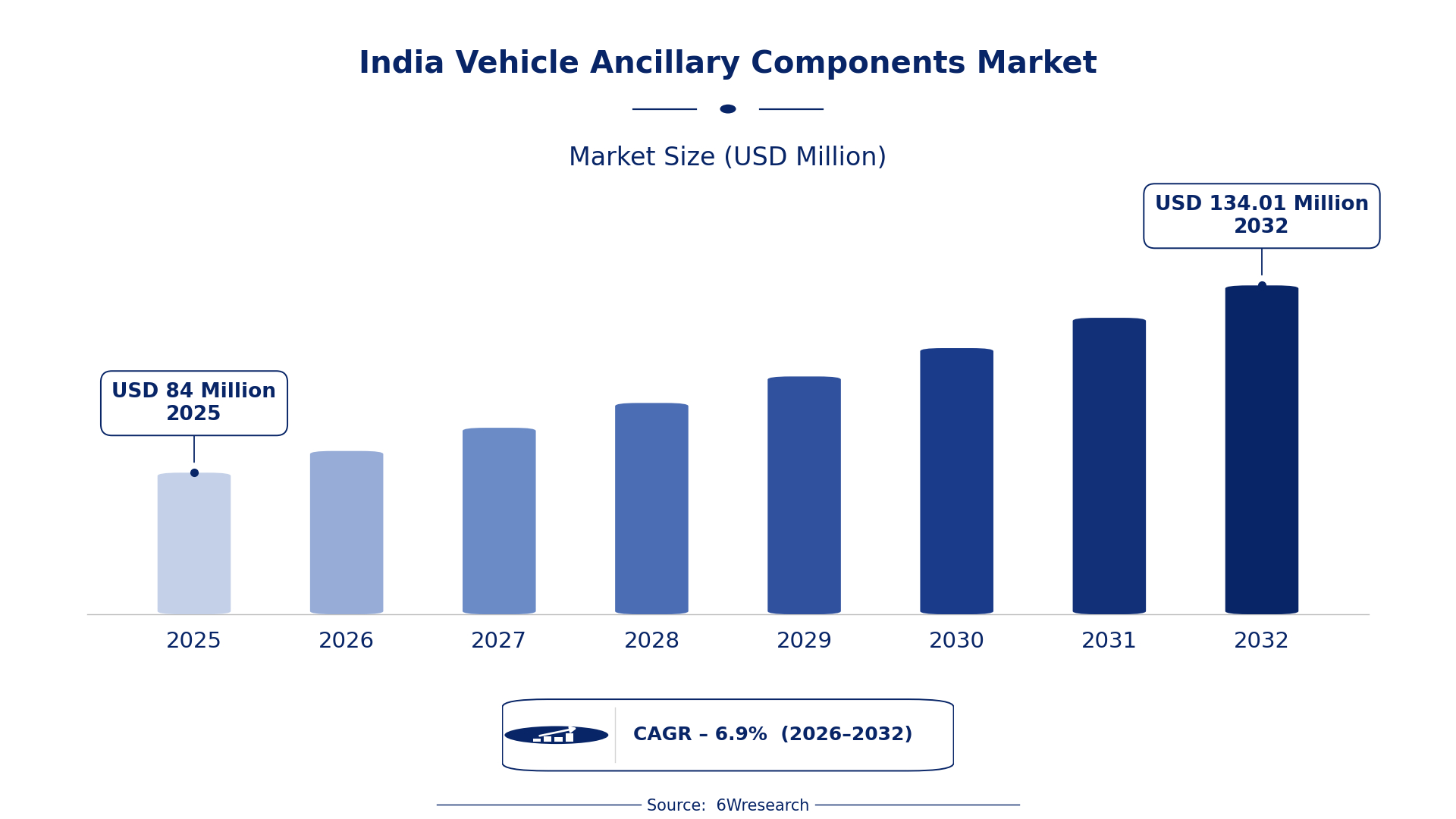
According to 6Wresearch internal database and industry insights, the India Vehicle Ancillary Components Market was valued at USD 84.0 million in 2025 and is projected to reach USD 134.01 million by 2032, growing at a CAGR of approximately 6.9% during 2026–2032.
India Vehicle Ancillary Components Market Highlights
| Report Metric | Details |
| Report Name | India Vehicle Ancillary Components Market |
| Market Size 2025 | USD 84.0 million |
| Market Size 2032 | USD 134.01 million |
| Absolute Growth 2025–2032 | USD 50.01 million |
| CAGR 2026–2032 | 6.9% |
| Peak Annual Growth | 8.9% in 2026 |
| Forecast Period | 2026–2032 |
| Historical Data | 2022–2025 |
| Base Year | 2025 |
| Leading Component Type, 2025 | Wiper Blades (41% share) |
| Leading Functionality, 2025 | Visibility Maintenance (34% share) |
| Leading Material Used, 2025 | Rubber/Composite (48% share) |
| Leading End User, 2025 | Aftermarket Suppliers (40% share) |
| Fastest-Growing Component Type | Horn Systems (8.6% CAGR) |
| Fastest-Growing Functionality | Alert Mechanism (9.4% CAGR) |
| Fastest-Growing Material Used | Electromechanical Units (8.4% CAGR) |
| Fastest-Growing End User | OEMs (8.0% CAGR) |
| Growing Sector | Aftermarket Suppliers |
| Key End Users | Aftermarket Suppliers, OEMs, Passenger Vehicles, Tier 1 Suppliers |
India Vehicle Ancillary Components Market Year-wise Growth Rate and Key Drivers (2022–2032)
This graph illustrates the annual growth rates of the market from 2022 to 2032, highlighting a steady upward trajectory and projected market expansion over the forecast period.
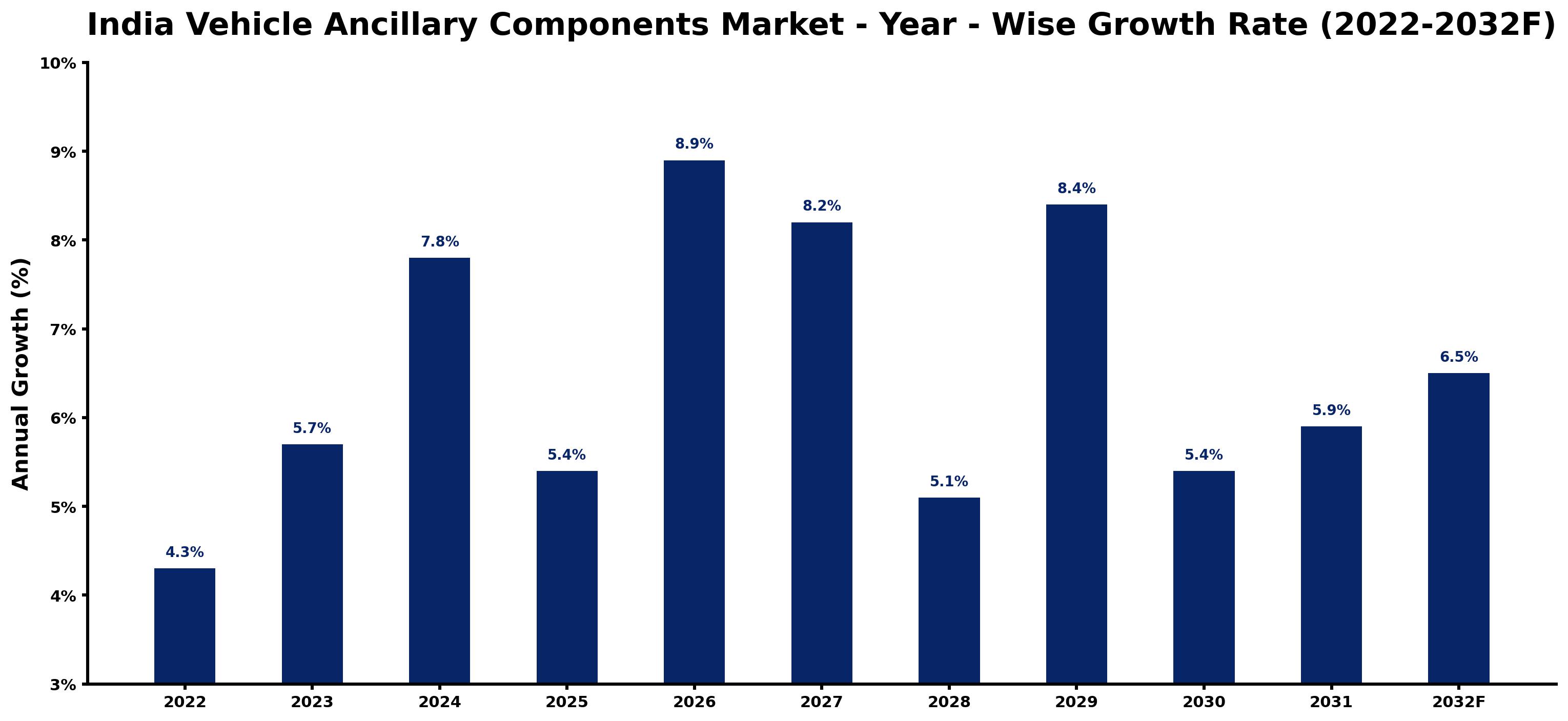
Annual growth estimates for each year appear below with the principal reason behind them, explaining the shifts that set the pace of the market.
| Year | Estimated Annual Growth (%) | Market Rationale |
| 2022 | 4.3 | The automotive sector showed steady demand from domestic users and aftermarket suppliers. |
| 2023 | 5.7 | Growth was driven by increased vehicle production and consumer spending on automotive components. |
| 2024 | 7.8 | Demand surged as the passenger vehicle segment accounted for 45% of total sales. |
| 2025 | 5.4 | A slowdown occurred due to supply chain disruptions affecting production rates. |
| 2026 | 8.9 | The peak growth year is expected to be marked by foreign direct investment of $24 billion in the sector. |
| 2027 | 8.2 | Growth is projected to slow as the National Automotive Testing and R&D Infrastructure Project stabilises the market after the previous peak in demand. |
| 2028 | 5.1 | Demand is anticipated to continue growing, albeit at a slower rate due to market maturity. |
| 2029 | 8.4 | Faster growth is expected to resume, driven by rising demand for vehicle safety components such as Horn Systems. |
| 2030 | 5.4 | A slowdown is projected as manufacturers adjust to changing consumer preferences for safety features. |
| 2031 | 5.9 | Growth is expected to accelerate again as new vehicle models enter the market. |
| 2032 | 6.5 | The market is projected to grow steadily as the automotive industry targets $300 billion by 2026. |
Note: Market size estimations and growth projections presented in this report are based on 6Wresearch's proprietary forecasting methodology, utilizing the latest available industry data, government publications, and primary research inputs.
India Vehicle Ancillary Components Market Synopsis
Vehicle Ancillary Components in India encompasses parts that support vehicle operation, including wiper blades and horn systems. These components are vital for vehicle safety and functionality. The India Vehicle Ancillary Components Market is expanding due to rising domestic demand from aftermarket suppliers and OEMs. Investment of $24 billion in 2022 is driving innovation and production capacity. The Automotive Mission Plan 2026 aims to create a $300 billion industry, further boosting growth opportunities.
Market Dynamics Impact Analysis (2026–2032)
| Factor | Type | Impact | Primary Segment Affected |
| Increasing vehicle production and sales | Driver | High | Wiper Blades |
| Growing demand for safety features in vehicles | Driver | High | Horn Systems |
| Expansion of the aftermarket sector | Opportunity | High | Aftermarket Suppliers |
| Investment in local manufacturing capabilities | Opportunity | High | OEMs |
| Supply chain disruptions affecting component availability | Restraint | High | Interior Lighting |
| Stringent safety regulations increasing compliance costs | Restraint | Medium | Accessory Switches |
| High competition among local manufacturers | Challenge | High | Wiper Blades |
| Technological advancements requiring continuous investment | Challenge | Medium | Horn Systems |
Evaluation of Drivers in India Vehicle Ancillary Components Market (2026–2032)
The main growth drivers and the segments they affect most are set out below.
| Drivers | Primary Segment Affected | Why It Matters (Evidence) |
| Rising domestic vehicle production | Wiper Blades | India's automotive market is expected to reach 29.5 million units by 2026, increasing demand for components. |
| Growing consumer preference for safety features | Horn Systems | The passenger vehicle segment accounts for 45% of total vehicle sales, driving demand for alert mechanisms. |
| Increasing investment in automotive infrastructure | Interior Lighting | In 2022, the Indian automotive sector attracted $24 billion in FDI, improving production capabilities. |
| Expansion of the aftermarket sector | Accessory Switches | The Automotive Component Manufacturers Association of India represents over 800 manufacturers, boosting component supply. |
| Government initiatives supporting local manufacturing | Visibility Maintenance | The Production Linked Incentive Scheme launched in 2021 aims to boost local manufacturing. |
Growth across the Vehicle Ancillary Components market in India is anchored in rising domestic vehicle production, increasing consumer preference for safety features, and substantial investment in automotive infrastructure. The automotive market is projected to reach 29.5 million units by 2026, which will increase demand for components. In 2022, the sector attracted $24 billion in foreign direct investment, improving production capabilities. The aftermarket sector is expanding, supported by over 1,500 registered vehicle manufacturers, which boosts component supply. The National Automotive Testing and R&D Infrastructure Project is enhancing innovation in component design and safety standards.
Evaluation of Restraints in India Vehicle Ancillary Components Market
The key brakes on demand, and where they bite hardest, are shown below.
| Market Restraint | Primary Segment Affected | Why It Matters (Evidence) |
| Supply chain disruptions affecting component availability | Interior Lighting | In 2022, global supply chain issues delayed component deliveries, impacting production timelines. |
| Stringent safety regulations increasing compliance costs | Accessory Switches | The Bureau of Indian Standards sets safety standards, requiring manufacturers to invest in compliance. |
| High competition among local manufacturers | Wiper Blades | With over 1,500 registered vehicle manufacturers, competition drives pricing pressures. |
| Technological advancements requiring continuous investment | Horn Systems | Rapid technological changes necessitate ongoing investment in R&D for manufacturers. |
| Market saturation limiting growth potential | Visibility Maintenance | As the market matures, growth rates are stabilising, affecting new investments. |
India Vehicle Ancillary Components Market Challenges
The India Vehicle Ancillary Components Market faces strict regulatory standards that can delay product approvals by up to six months, affecting suppliers' ability to introduce new parts. Skills shortages in the workforce limit production efficiency, causing manufacturers to operate at only 70% capacity, which impacts timely deliveries to OEMs. Buyers are experiencing rising costs due to fluctuating raw material prices, with rubber prices increasing by 15% in the last year, ultimately raising the final price of vehicle components. Supply chain disruptions have resulted in delays in component availability, forcing manufacturers to extend lead times by an average of four weeks, affecting vehicle production schedules.
Trends in the India Vehicle Ancillary Components Market
The trends below show where the India Vehicle Ancillary Components Market is heading.
- Shift towards Advanced Safety Features: Aftermarket suppliers are concentrating on advanced safety components, with a projected growth rate of 8.4% for Horn Systems by 2032. This shift corresponds with rising consumer demand for improved vehicle safety.
- Transition to Sustainable Materials: The automotive industry is adopting sustainable materials, with Rubber/Composite holding a 48% share in 2025. This change reflects increasing environmental awareness among consumers and manufacturers.
- Emergence of Smart Vehicle Components: Smart vehicle components are gaining popularity, driven by technological advancements. The adoption of Electromechanical Units is projected to grow at 8.4% through 2032, enhancing vehicle functionality.
- Expansion of Aftermarket Services: Aftermarket suppliers are broadening their services to meet rising demand, with a projected 40% market share in 2025. This trend is fuelled by increasing vehicle ownership and maintenance needs.
Investment Opportunities in the India Vehicle Ancillary Components Market
Below are the investment opportunities with the strongest case in the India Vehicle Ancillary Components Market.
- Investment in Local Manufacturing Facilities: India's automotive sector is experiencing a surge in local manufacturing, targeting $300 billion by 2026. Investing in local facilities can serve both OEMs and aftermarket suppliers.
- Collaboration with Aftermarket Suppliers: Aftermarket suppliers are seeking innovative components to meet consumer demands. Partnering with these suppliers can strengthen market presence and drive sales.
- Focus on Safety Compliance Solutions: With stringent safety regulations in place, there is a growing need for compliance solutions. Investing in safety compliance technologies can benefit both manufacturers and suppliers.
- Expansion into Emerging Markets: Emerging markets are seeing increased vehicle ownership, presenting opportunities for component suppliers. Establishing joint ventures in these regions can facilitate market entry.
Government Initiatives in the India Vehicle Ancillary Components Market
The Bureau of Indian Standards sets safety standards for vehicle components, ensuring compliance for manufacturers. This regulation affects production processes and requires investment in quality assurance measures. The Automotive Mission Plan 2026 aims to create a $300 billion industry, promoting innovation and local manufacturing. The Ministry of Heavy Industries and Public Enterprises oversees automotive regulations, ensuring alignment with safety and environmental standards. These measures improve the competitiveness of the automotive sector.
The Ministry of Heavy Industries and Public Enterprises approves funding for the National Automotive Testing and R&D Infrastructure Project, which supports innovation in vehicle components. This initiative aims to enhance testing capabilities and R&D infrastructure, benefiting manufacturers. Additionally, the Automotive Component Manufacturers Association of India plays a key role in advocating for industry standards and funding opportunities, representing over 800 manufacturers. This collaboration promotes growth and innovation within the automotive component sector.
Future Insight of the India Vehicle Ancillary Components Market
The India Vehicle Ancillary Components Market will undergo notable changes by 2032, driven by the Automotive Mission Plan 2026 aiming for a $300 billion industry. Innovations from the National Automotive Testing and R&D Infrastructure Project will enhance component quality and safety standards. The Production Linked Incentive Scheme will encourage local manufacturing, reducing dependence on imports. As the automotive market expands, projected to reach 29.5 million units by 2026, suppliers must adjust to increased demand and technological advancements.
Market Segmentation Analysis
The analysis below covers each segmentation, its leading category in 2025 and its fastest-growing category through 2032.
By Component Type – Wiper Blades Dominated, Horn Systems Expected to Grow Fastest
According to Bhawna Singh, Assistant Manager at 6Wresearch, Wiper Blades took a 41% share of component type in 2025, more than any other category. Wiper blades maintain the largest share in the India Vehicle Ancillary Components Market because they are essential for driver visibility, particularly during rain or fog. With the automotive sector projected to reach 29.5 million units by 2026, the need for reliable wiper systems is crucial for safety. Horn Systems are projected to grow fastest, at a CAGR of 8.6% during 2026–2032. Horn systems are rapidly growing in demand as they play a vital role in alert mechanisms, with increasing road safety awareness propelling this trend. The rise in vehicle production further boosts the necessity for effective horn systems, ensuring their growth continues. Suppliers must enhance the availability of horn systems to meet rising safety standards and consumer expectations.
By Functionality – Visibility Maintenance Dominated, Alert Mechanism Expected to Grow Fastest
With a 34% revenue share in 2025, Visibility Maintenance was the largest functionality category. Visibility maintenance functionality holds the largest market share due to its critical importance in ensuring driver safety across various conditions. Given that passenger vehicles account for 45% of total vehicle sales in India, the emphasis on visibility maintenance remains high. Over 2026–2032, Alert Mechanism is expected to post the fastest growth, at a CAGR of 9.4%. The alert mechanism functionality is expanding quickly, driven by stricter safety regulations and growing consumer awareness about road safety. The increasing number of vehicles on the road further necessitates effective communication tools like horns, supporting this segment's growth. Buyers should invest in alert mechanism components to improve vehicle safety and adhere to regulatory requirements.
By Material Used – Rubber/Composite Dominated, Electromechanical Units Expected to Grow Fastest
Rubber/Composite accounted for a 48% market share by material used in 2025. Rubber and composite materials dominate the market share due to their widespread use in various vehicle components, offering durability and performance. These materials are vital for complying with the safety standards established by the Bureau of Indian Standards, ensuring reliable vehicle operation. The quickest growth will come from Electromechanical Units, forecast to expand at a CAGR of 8.4% between 2026 and 2032. Electromechanical units are experiencing the fastest growth as they become more common in modern vehicles, influenced by advancements in automotive technology. The demand for sophisticated vehicle features is driving the need for these components, ensuring their continued expansion. Suppliers should focus on developing electromechanical units to keep pace with technological advancements in the automotive industry.
By End User – Aftermarket Suppliers Dominated, OEMs Expected to Grow Fastest
The largest end user category in 2025 was Aftermarket Suppliers, with a 40% share of total revenue. Aftermarket suppliers hold the largest market share as they are crucial players in the supply of vehicle components, particularly for maintenance and repairs. The extensive network of registered vehicle manufacturers and suppliers in India supports a strong aftermarket ecosystem. OEMs are set to record the highest CAGR in this split, 8.0% over 2026–2032. OEMs represent the fastest-growing end user segment, propelled by the rising production of vehicles in India, which is projected to reach 29.5 million units by 2026. This growth indicates an increasing demand for new vehicle production and the necessary components for assembly. Suppliers should strengthen partnerships with OEMs to capture the growing demand for vehicle components in new vehicle production.
Key Attractiveness of the Report
- 10 Years of Market Numbers
- Historical Data Starting from 2022 to 2025
- Base Year 2025
- Forecast Data until 2032
- Key Performance Indicators Impacting the Market
- Major Upcoming Developments and Projects
Key Highlights of the Report:
- India Vehicle Ancillary Components Market Outlook
- Market Size of India Vehicle Ancillary Components Market, 2025
- Forecast of India Vehicle Ancillary Components Market, 2032
- Historical Data and Forecast of India Vehicle Ancillary Components Revenues & Volume for the Period 2022 - 2032F
- India Vehicle Ancillary Components Market Trend Evolution
- India Vehicle Ancillary Components Market Drivers and Challenges
- India Vehicle Ancillary Components Price Trends
- India Vehicle Ancillary Components Porter's Five Forces
- India Vehicle Ancillary Components Industry Life Cycle
- Historical Data and Forecast of India Vehicle Ancillary Components Market Revenues & Volume By Component Type for the Period 2022 - 2032F
- Historical Data and Forecast of India Vehicle Ancillary Components Market Revenues & Volume By Wiper Blades for the Period 2022 - 2032F
- Historical Data and Forecast of India Vehicle Ancillary Components Market Revenues & Volume By Horn Systems for the Period 2022 - 2032F
- Historical Data and Forecast of India Vehicle Ancillary Components Market Revenues & Volume By Interior Lighting for the Period 2022 - 2032F
- Historical Data and Forecast of India Vehicle Ancillary Components Market Revenues & Volume By Accessory Switches for the Period 2022 - 2032F
- Historical Data and Forecast of India Vehicle Ancillary Components Market Revenues & Volume By Functionality for the Period 2022 - 2032F
- Historical Data and Forecast of India Vehicle Ancillary Components Market Revenues & Volume By Visibility Maintenance for the Period 2022 - 2032F
- Historical Data and Forecast of India Vehicle Ancillary Components Market Revenues & Volume By Alert Mechanism for the Period 2022 - 2032F
- Historical Data and Forecast of India Vehicle Ancillary Components Market Revenues & Volume By Cabin Illumination for the Period 2022 - 2032F
- Historical Data and Forecast of India Vehicle Ancillary Components Market Revenues & Volume By User Interface for the Period 2022 - 2032F
- Historical Data and Forecast of India Vehicle Ancillary Components Market Revenues & Volume By Material Used for the Period 2022 - 2032F
- Historical Data and Forecast of India Vehicle Ancillary Components Market Revenues & Volume By Rubber/Composite for the Period 2022 - 2032F
- Historical Data and Forecast of India Vehicle Ancillary Components Market Revenues & Volume By Electromechanical Units for the Period 2022 - 2032F
- Historical Data and Forecast of India Vehicle Ancillary Components Market Revenues & Volume By LED Modules for the Period 2022 - 2032F
- Historical Data and Forecast of India Vehicle Ancillary Components Market Revenues & Volume By Polycarbonate Housings for the Period 2022 - 2032F
- Historical Data and Forecast of India Vehicle Ancillary Components Market Revenues & Volume By End User for the Period 2022 - 2032F
- Historical Data and Forecast of India Vehicle Ancillary Components Market Revenues & Volume By Aftermarket Suppliers for the Period 2022 - 2032F
- Historical Data and Forecast of India Vehicle Ancillary Components Market Revenues & Volume By OEMs for the Period 2022 - 2032F
- Historical Data and Forecast of India Vehicle Ancillary Components Market Revenues & Volume By Passenger Vehicles for the Period 2022 - 2032F
- Historical Data and Forecast of India Vehicle Ancillary Components Market Revenues & Volume By Tier 1 Suppliers for the Period 2022 - 2032F
- India Vehicle Ancillary Components Import Export Trade Statistics
- Market Opportunity Assessment By Component Type
- Market Opportunity Assessment By Functionality
- Market Opportunity Assessment By Material Used
- Market Opportunity Assessment By End User
- India Vehicle Ancillary Components Top Companies Market Share
- India Vehicle Ancillary Components Competitive Benchmarking By Technical and Operational Parameters
- India Vehicle Ancillary Components Company Profiles
- India Vehicle Ancillary Components Key Strategic Recommendations
Market Covered
The report offers an extensive study of the following market segments.
By Component Type
- Wiper Blades
- Horn Systems
- Interior Lighting
- Accessory Switches
By Functionality
- Visibility Maintenance
- Alert Mechanism
- Cabin Illumination
- User Interface
By Material Used
- Rubber/Composite
- Electromechanical Units
- LED Modules
- Polycarbonate Housings
By End User
- Aftermarket Suppliers
- OEMs
- Passenger Vehicles
- Tier 1 Suppliers































