India Vehicle Assistive Devices Market Size & Growth Rate
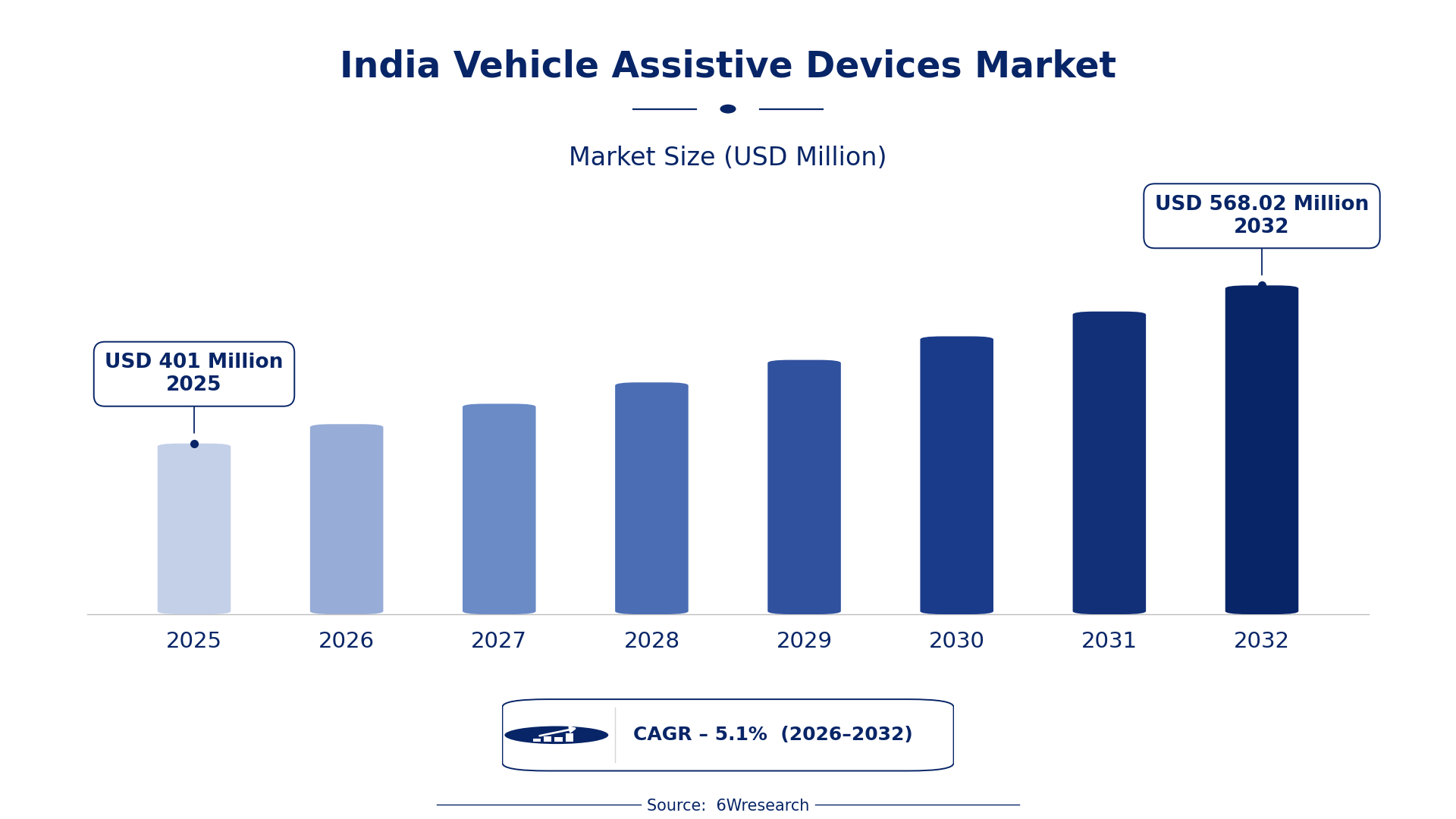
According to 6Wresearch internal database and industry insights, the India Vehicle Assistive Devices Market was valued at USD 401.0 million in 2025 and is projected to reach USD 568.02 million by 2032, growing at a CAGR of approximately 5.1% during 2026–2032.
India Vehicle Assistive Devices Market Highlights
| Report Metric | Details |
| Report Name | India Vehicle Assistive Devices Market |
| Market Size 2025 | USD 401.0 million |
| Market Size 2032 | USD 568.02 million |
| Absolute Growth 2025–2032 | USD 167.02 million |
| CAGR 2026–2032 | 5.1% |
| Peak Annual Growth | 7.7% in 2027 |
| Forecast Period | 2026–2032 |
| Historical Data | 2022–2025 |
| Base Year | 2025 |
| Leading Device Type, 2025 | Pedal Extenders (46% share) |
| Leading Operation Type, 2025 | Mechanical (41% share) |
| Leading Vehicle Compatibility, 2025 | Cars (37% share) |
| Leading End User, 2025 | Elderly Drivers (42% share) |
| Fastest-Growing Device Type | Hand Controls (7.0% CAGR) |
| Fastest-Growing Operation Type | Hydraulic (6.3% CAGR) |
| Fastest-Growing Vehicle Compatibility | Vans (6.5% CAGR) |
| Fastest-Growing End User | Physically Disabled (7.6% CAGR) |
| Growing Sector | Physically Disabled |
| Key End Users | Elderly Drivers, Physically Disabled, Mobility Assistance Orgs, Rehabilitation Clinics |
India Vehicle Assistive Devices Market Year-wise Growth Rate and Key Drivers (2022–2032)
This graph illustrates the annual growth rates of the market from 2022 to 2032, highlighting a steady upward trajectory and projected market expansion over the forecast period.
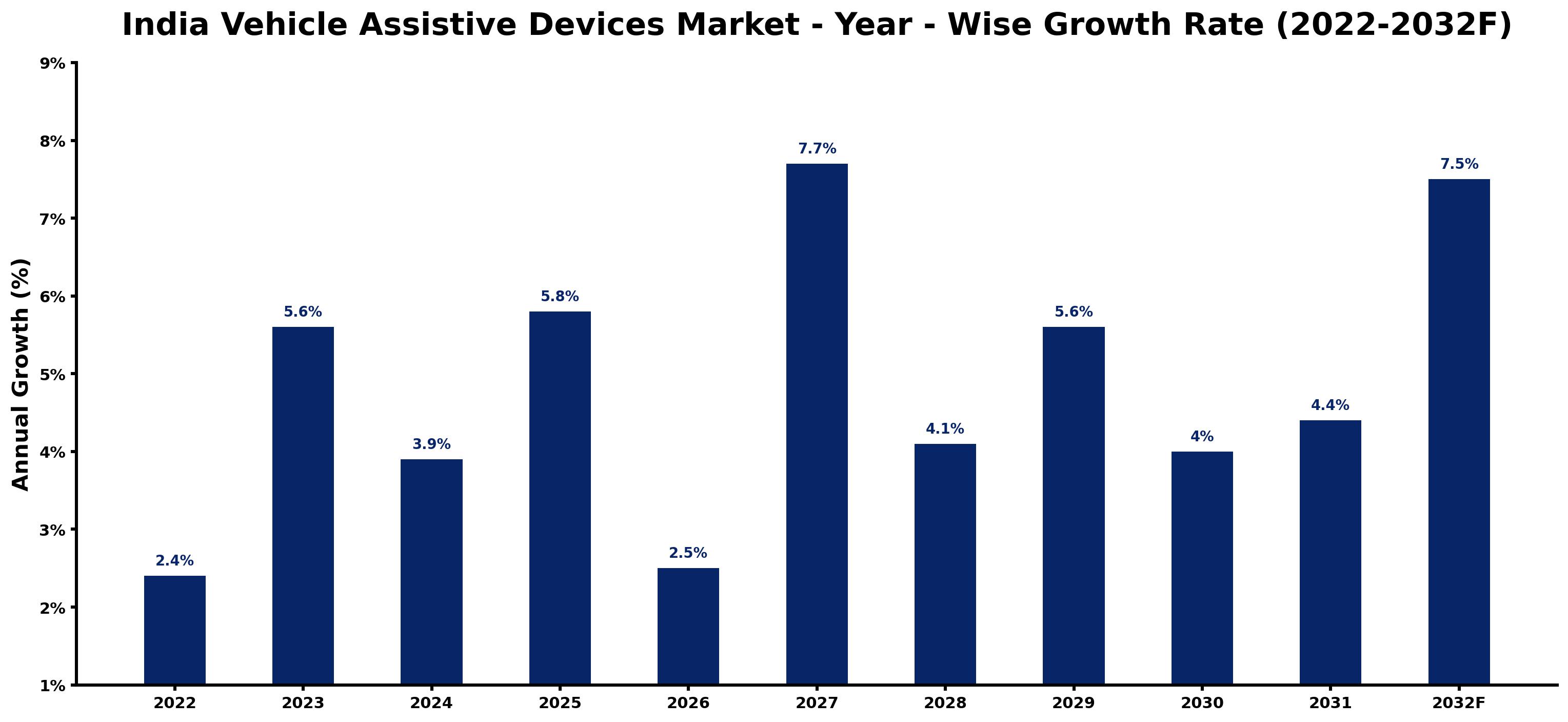
The following table presents the estimated annual growth rate for each year together with the principal factor influencing market performance.
| Year | Estimated Annual Growth (%) | Market Rationale |
| 2022 | 2.4 | The market experienced steady growth, reflecting increasing awareness of assistive devices among elderly drivers. |
| 2023 | 5.6 | The introduction of new assistive technologies contributed to faster growth than the previous year. |
| 2024 | 3.9 | Growth slowed as the market adjusted to the 'Assistive Devices for Disabled Persons Scheme' launched in 2021. |
| 2025 | 5.8 | The market saw renewed interest, driven by the 'Assistive Devices for Disabled Persons Scheme' supporting mobility needs. |
| 2026 | 2.5 | Growth is expected to slow as manufacturers face challenges in meeting rising demand levels. |
| 2027 | 7.7 | Investment in assistive technologies and user adoption is expected to peak this year. |
| 2028 | 4.1 | Growth is expected to moderate as the market begins to stabilise after the peak year. |
| 2029 | 5.6 | Demand is expected to surge again as more rehabilitation clinics adopt vehicle assistive devices. |
| 2030 | 4.0 | Growth is projected to slow slightly as the market adjusts to new standards and regulations. |
| 2031 | 4.4 | The market is expected to rebound with increased focus on inclusive transportation solutions. |
| 2032 | 7.5 | The market is expected to grow due to ongoing government support for assistive devices. |
Note: Market size estimations and growth projections presented in this report are based on 6Wresearch's proprietary forecasting methodology, utilizing the latest available industry data, government publications, and primary research inputs.
India Vehicle Assistive Devices Market Synopsis
The Vehicle Assistive Devices Market in India encompasses tools designed to improve mobility for individuals with disabilities and elderly drivers. These devices are crafted using advanced technology to ensure safety and ease of use. With over 100 million elderly individuals in India, demand for these products is substantial. Key factors driving growth include government initiatives promoting accessibility and rising adoption by rehabilitation clinics for patient therapy.
Market Dynamics Impact Analysis (2026–2032)
| Factor | Type | Impact | Primary Segment Affected |
| Increasing elderly population drives demand for mobility solutions. | Driver | High | Elderly Drivers |
| Government funding for assistive technology initiatives boosts market growth. | Driver | High | Mobility Assistance Orgs |
| Growing number of rehabilitation clinics adopting assistive devices presents opportunities. | Opportunity | High | Rehabilitation Clinics |
| Rising awareness of vehicle assistive devices among elderly drivers creates demand. | Opportunity | High | Elderly Drivers |
| High costs of advanced assistive devices limit accessibility for some users. | Restraint | Medium | Hand Controls |
| Limited availability of trained technicians for installation and maintenance hinders growth. | Restraint | Medium | Wheelchair Lifts |
| Buyers face challenges in accessing affordable assistive devices due to high prices. | Challenge | Medium | Pedal Extenders |
| Suppliers struggle with regulatory compliance and certification processes, delaying market entry. | Challenge | Medium | Steering Aids |
Evaluation of Drivers in India Vehicle Assistive Devices Market (2026–2032)
The factors lifting demand, and the evidence behind each, are summarised below.
| Drivers | Primary Segment Affected | Why It Matters (Evidence) |
| Rising elderly population increases demand for mobility solutions. | Elderly Drivers | With over 100 million elderly individuals in India, the need for vehicle assistive devices is surging. |
| Government funding for assistive technology initiatives boosts market growth. | Mobility Assistance Orgs | The Government of India allocated ₹500 crores for assistive technology initiatives in 2023. |
| Growing number of rehabilitation clinics adopting assistive devices presents opportunities. | Rehabilitation Clinics | Over 50% of rehabilitation clinics in urban areas use vehicle assistive devices for patient therapy. |
| Increased awareness of vehicle assistive devices among elderly drivers creates demand. | Elderly Drivers | The average age of drivers using assistive devices is around 65 years, highlighting the need for mobility solutions. |
| Technological advancements in assistive devices improve user experience and safety. | Hand Controls | Innovations in device technology are improving the functionality of assistive devices for users. |
With a significant elderly demographic, the demand for mobility solutions is substantial. The average age of users indicates a pressing need for effective mobility solutions. Innovations in technology are further improving the functionality and safety of these devices, driving user adoption.
Evaluation of Restraints in India Vehicle Assistive Devices Market
The following restraints limit how fast demand can grow.
| Market Restraint | Primary Segment Affected | Why It Matters (Evidence) |
| High costs of advanced assistive devices limit accessibility for some users. | Hand Controls | Many potential users find the prices of advanced assistive devices prohibitive, restricting market growth. |
| Limited availability of trained technicians for installation and maintenance hinders growth. | Wheelchair Lifts | A shortage of skilled technicians affects the support and maintenance services for assistive devices. |
| Regulatory compliance and certification processes can delay product availability. | Pedal Extenders | Suppliers often face lengthy certification processes, which can slow down market entry for new products. |
| Awareness of assistive devices is still low in rural areas, limiting market reach. | Steering Aids | Many rural users remain unaware of available assistive technologies, hindering potential sales. |
| Inconsistent quality standards among manufacturers can lead to safety concerns. | Wheelchair Lifts | Variability in product quality affects user confidence and market acceptance. |
India Vehicle Assistive Devices Market Challenges
Buyers and suppliers in the India Vehicle Assistive Devices market confront supply chain disruptions that hinder timely product availability, particularly in metropolitan areas where demand is high. These disruptions can lead to delays of up to three months, impacting rehabilitation clinics that rely on consistent access to mobility tools for effective patient therapy. High costs also challenge buyers, as limited local manufacturing can inflate prices by 20% compared to imported options. Furthermore, technological advancements lag behind global standards, resulting in devices that may not fully satisfy user needs, which can reduce adoption rates among elderly drivers and individuals with disabilities.
Trends in the India Vehicle Assistive Devices Market
Several trends are reshaping the India Vehicle Assistive Devices Market; the most important are set out below.
- Shift from Basic to Advanced Assistive Technologies: Since 2021, there has been a marked shift towards advanced assistive technologies in India. The introduction of smart devices has enhanced user control and safety, with over 50% of rehabilitation clinics adopting these innovations.
- Transition from Manual to Automated Devices: In 2023, the trend towards automation in assistive devices gained traction, with a notable increase in electric wheelchair lifts. This shift is set to improve user experience and accessibility in urban areas.
- Elderly Drivers Prioritised over Other User Groups: As of 2025, elderly drivers are becoming the primary focus for vehicle assistive devices. With 42% market share, this group is driving demand for tailored mobility solutions across major cities.
- Expansion of Rehabilitation Clinics Using Assistive Devices: The number of rehabilitation clinics adopting vehicle assistive devices has risen significantly since 2022, with over 50% now using them for therapy, indicating a growing market for these products.
Investment Opportunities in the India Vehicle Assistive Devices Market
Investors looking at the India Vehicle Assistive Devices Market should consider the following areas.
- Elderly Drivers Seeking Enhanced Mobility Solutions: With over 100 million elderly individuals in India, the demand for vehicle assistive devices is considerable. Investing in tailored solutions for this demographic can tap into a growing market.
- Significant Funding for Assistive Technology Initiatives: The Government of India allocated ₹500 crores for assistive technology initiatives in 2023. Suppliers can collaborate with government agencies to provide innovative solutions.
- Urban Areas as Key Markets for Assistive Devices: Metropolitan cities like Delhi and Mumbai are experiencing increased adoption of vehicle assistive devices. Targeting these regions can yield substantial returns for manufacturers.
- Rehabilitation Clinics Expanding Services: With over 50% of rehabilitation clinics using vehicle assistive devices, there is a clear opportunity for suppliers to partner with these facilities to meet their growing needs.
Government Initiatives in the India Vehicle Assistive Devices Market
The 'Assistive Devices for Disabled Persons Scheme' launched by the Ministry of Social Justice and Empowerment in 2021 provides financial assistance for purchasing assistive devices. This measure directly benefits buyers by making these products more accessible. The scheme aims to improve the quality of life for individuals with disabilities, ensuring they have the necessary tools for mobility. Additionally, the 'Accessible India Campaign' was updated in 2022 to include vehicle assistive devices, further promoting their use.
The Ministry of Social Justice and Empowerment oversees various initiatives, including funding for training programs that enhance technician skills for installing and maintaining assistive devices. The 'Skill India Mission' initiated in 2021 focuses on equipping technicians with necessary skills, ensuring better service availability. This initiative is crucial for improving the support infrastructure for users of these products.
Future Insight of the India Vehicle Assistive Devices Market
Several forward-looking factors should support the India Vehicle Assistive Devices market in the coming years. The National Institute for Empowerment of Persons with Multiple Disabilities will enhance the promotion of mobility aids, encouraging greater acceptance among users. By 2025, the automotive sector is expected to incorporate more assistive technologies, which will improve overall product functionality. Additionally, the Ministry of Road Transport and Highways' policy for inclusive transportation will encourage broader adoption of these devices, ultimately increasing accessibility for elderly individuals and those with disabilities.
Market Segmentation Analysis
The analysis below covers each segmentation, its leading category in 2025 and its fastest-growing category through 2032.
By Device Type – Pedal Extenders Dominated, Hand Controls Expected to Grow Fastest
According to Bhawna Singh, Assistant Manager at 6Wresearch, Pedal Extenders accounted for a 46% market share by device type in 2025. Pedal extenders hold the largest share in the India Vehicle Assistive Devices Market as they provide essential support for shorter drivers, enabling them to comfortably reach vehicle pedals. This is particularly crucial in urban areas with a growing elderly population, ensuring safe driving for this demographic. Hand Controls are projected to grow fastest, at a CAGR of 7.0% during 2026–2032. Hand controls are experiencing rapid growth because they offer necessary assistance for drivers with limited hand mobility, especially in metropolitan cities that emphasise accessibility. The supportive policies from the Ministry of Road Transport and Highways further promote their adoption, widening the lead of pedal extenders. Suppliers should prioritise developing hand controls to meet the increasing demand in this expanding segment.
By Operation Type – Mechanical Dominated, Hydraulic Expected to Grow Fastest
With a 41% revenue share in 2025, Mechanical was the largest operation type category. Mechanical devices lead the market due to their straightforward design and reliability, making them a preferred choice for various vehicle assistive applications. Their extensive use in rehabilitation clinics across urban areas solidifies their dominant market position. Over 2026–2032, Hydraulic is expected to post the fastest growth, at a CAGR of 6.3%. Hydraulic devices are experiencing the fastest growth as they are increasingly incorporated into modern assistive technologies, particularly in urban rehabilitation settings. The government's investment in assistive technology initiatives is likely to accelerate their adoption. Manufacturers should focus on integrating hydraulic technology to meet the rising demand in the market.
By Vehicle Compatibility – Cars Dominated, Vans Expected to Grow Fastest
Cars took a 37% share of vehicle compatibility in 2025, more than any other category. Cars dominate the market share as most vehicle assistive devices are specifically designed for personal vehicles, which are widely used by elderly drivers. This trend is particularly evident in metropolitan areas where car ownership is common among the elderly population, ensuring a steady demand. Vans are set to record the highest CAGR in this split, 6.5% over 2026–2032. Vans are the fastest-growing segment due to their suitability for transporting individuals with mobility issues, particularly in urban settings where accessibility is paramount. The increasing focus on inclusive transportation policies supports this growth, allowing cars to maintain their lead. Suppliers should expand their product offerings to include van-compatible assistive devices to address the rising demand.
By End User – Elderly Drivers Dominated, Physically Disabled Expected to Grow Fastest
Elderly Drivers held a 42% share of the India Vehicle Assistive Devices Market by end user in 2025. Elderly drivers represent the largest share of end users for vehicle assistive devices, driven by India's substantial elderly population exceeding 100 million. This demographic shift necessitates tailored solutions that enhance mobility and safety for older individuals, ensuring sustained market demand. The quickest growth will come from Physically Disabled, forecast to expand at a CAGR of 7.6% between 2026 and 2032. The physically disabled segment is witnessing rapid growth as these devices are crucial for their mobility and independence, especially in urban areas that prioritise accessibility. Government initiatives aimed at improving mobility for disabled individuals will further accelerate this growth, while elderly drivers continue to dominate. Suppliers must focus on creating products that specifically address the needs of physically disabled users to capitalise on this growth opportunity.
Key Attractiveness of the Report
- 10 Years of Market Numbers
- Historical Data Starting from 2022 to 2025
- Base Year 2025
- Forecast Data until 2032
- Key Performance Indicators Impacting the Market
- Major Upcoming Developments and Projects
Key Highlights of the Report:
- India Vehicle Assistive Devices Market Outlook
- Market Size of India Vehicle Assistive Devices Market, 2025
- Forecast of India Vehicle Assistive Devices Market, 2032
- Historical Data and Forecast of India Vehicle Assistive Devices Revenues & Volume for the Period 2022 - 2032F
- India Vehicle Assistive Devices Market Trend Evolution
- India Vehicle Assistive Devices Market Drivers and Challenges
- India Vehicle Assistive Devices Price Trends
- India Vehicle Assistive Devices Porter's Five Forces
- India Vehicle Assistive Devices Industry Life Cycle
- Historical Data and Forecast of India Vehicle Assistive Devices Market Revenues & Volume By Device Type for the Period 2022 - 2032F
- Historical Data and Forecast of India Vehicle Assistive Devices Market Revenues & Volume By Pedal Extenders for the Period 2022 - 2032F
- Historical Data and Forecast of India Vehicle Assistive Devices Market Revenues & Volume By Hand Controls for the Period 2022 - 2032F
- Historical Data and Forecast of India Vehicle Assistive Devices Market Revenues & Volume By Wheelchair Lifts for the Period 2022 - 2032F
- Historical Data and Forecast of India Vehicle Assistive Devices Market Revenues & Volume By Steering Aids for the Period 2022 - 2032F
- Historical Data and Forecast of India Vehicle Assistive Devices Market Revenues & Volume By Operation Type for the Period 2022 - 2032F
- Historical Data and Forecast of India Vehicle Assistive Devices Market Revenues & Volume By Mechanical for the Period 2022 - 2032F
- Historical Data and Forecast of India Vehicle Assistive Devices Market Revenues & Volume By Hydraulic for the Period 2022 - 2032F
- Historical Data and Forecast of India Vehicle Assistive Devices Market Revenues & Volume By Electric for the Period 2022 - 2032F
- Historical Data and Forecast of India Vehicle Assistive Devices Market Revenues & Volume By Electronic for the Period 2022 - 2032F
- Historical Data and Forecast of India Vehicle Assistive Devices Market Revenues & Volume By Vehicle Compatibility for the Period 2022 - 2032F
- Historical Data and Forecast of India Vehicle Assistive Devices Market Revenues & Volume By Cars for the Period 2022 - 2032F
- Historical Data and Forecast of India Vehicle Assistive Devices Market Revenues & Volume By Vans for the Period 2022 - 2032F
- Historical Data and Forecast of India Vehicle Assistive Devices Market Revenues & Volume By Buses for the Period 2022 - 2032F
- Historical Data and Forecast of India Vehicle Assistive Devices Market Revenues & Volume By SUVs for the Period 2022 - 2032F
- Historical Data and Forecast of India Vehicle Assistive Devices Market Revenues & Volume By End User for the Period 2022 - 2032F
- Historical Data and Forecast of India Vehicle Assistive Devices Market Revenues & Volume By Elderly Drivers for the Period 2022 - 2032F
- Historical Data and Forecast of India Vehicle Assistive Devices Market Revenues & Volume By Physically Disabled for the Period 2022 - 2032F
- Historical Data and Forecast of India Vehicle Assistive Devices Market Revenues & Volume By Mobility Assistance Orgs for the Period 2022 - 2032F
- Historical Data and Forecast of India Vehicle Assistive Devices Market Revenues & Volume By Rehabilitation Clinics for the Period 2022 - 2032F
- India Vehicle Assistive Devices Import Export Trade Statistics
- Market Opportunity Assessment By Device Type
- Market Opportunity Assessment By Operation Type
- Market Opportunity Assessment By Vehicle Compatibility
- Market Opportunity Assessment By End User
- India Vehicle Assistive Devices Top Companies Market Share
- India Vehicle Assistive Devices Competitive Benchmarking By Technical and Operational Parameters
- India Vehicle Assistive Devices Company Profiles
- India Vehicle Assistive Devices Key Strategic Recommendations
Market Covered
This report examines the market across the segments below.
By Device Type
- Pedal Extenders
- Hand Controls
- Wheelchair Lifts
- Steering Aids
By Operation Type
- Mechanical
- Hydraulic
- Electric
- Electronic
By Vehicle Compatibility
- Cars
- Vans
- Buses
- SUVs
By End User
- Elderly Drivers
- Physically Disabled
- Mobility Assistance Orgs
- Rehabilitation Clinics































