India Vehicle Braking System Lubricants Market Size & Growth Rate
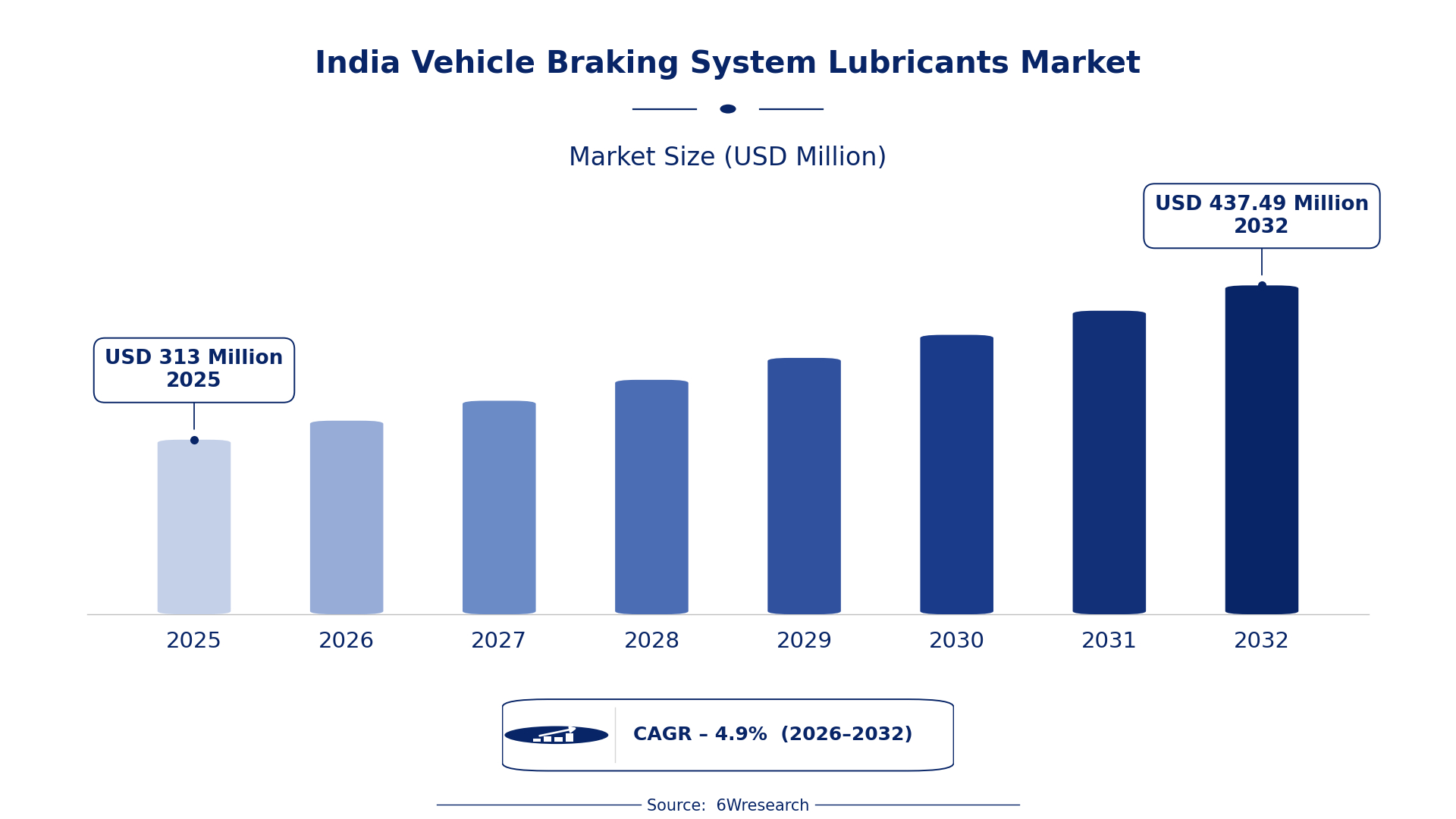
According to 6Wresearch internal database and industry insights, the India Vehicle Braking System Lubricants Market was valued at USD 313.0 million in 2025 and is projected to reach USD 437.49 million by 2032, growing at a CAGR of approximately 4.9% during 2026–2032.
India Vehicle Braking System Lubricants Market Highlights
| Report Metric | Details |
| Report Name | India Vehicle Braking System Lubricants Market |
| Market Size 2025 | USD 313.0 million |
| Market Size 2032 | USD 437.49 million |
| Absolute Growth 2025–2032 | USD 124.49 million |
| CAGR 2026–2032 | 4.9% |
| Peak Annual Growth | 7.0% in 2027 |
| Forecast Period | 2026–2032 |
| Historical Data | 2022–2025 |
| Base Year | 2025 |
| Leading Lubricant Type, 2025 | Brake Caliper Grease (47% share) |
| Leading Base Material, 2025 | Silicone-Based (52% share) |
| Leading Application Area, 2025 | High Temp Zones (49% share) |
| Leading End User, 2025 | Workshop Mechanics (43% share) |
| Fastest-Growing Lubricant Type | Ceramic Brake Lubricants (6.5% CAGR) |
| Fastest-Growing Base Material | Synthetic-Based (6.7% CAGR) |
| Fastest-Growing Application Area | Disc Pads (6.5% CAGR) |
| Fastest-Growing End User | OEM Service Stations (6.8% CAGR) |
| Growing Sector | automotive maintenance |
| Key End Users | workshop mechanics, OEM service stations, maintenance service firms |
India Vehicle Braking System Lubricants Market Year-wise Growth Rate and Key Drivers (2022–2032)
This graph illustrates the annual growth rates of the market from 2022 to 2032, highlighting a steady upward trajectory and projected market expansion over the forecast period.
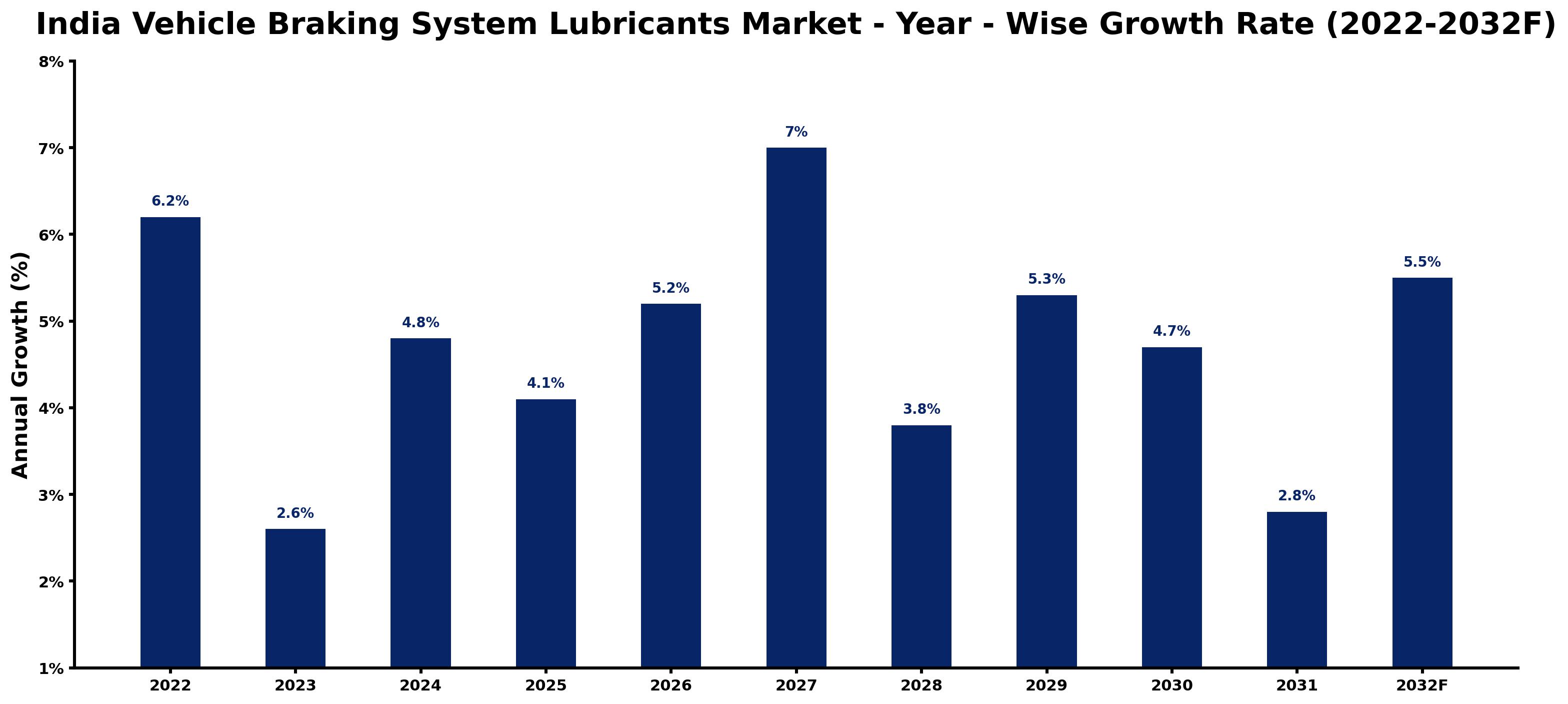
The table below sets out the estimated growth rate for each year and the main factor behind it.
| Year | Estimated Annual Growth (%) | Market Rationale |
| 2022 | 6.2 | The market experienced steady growth, driven by consistent demand from maintenance service firms. |
| 2023 | 2.6 | Growth slowed due to economic uncertainties affecting automotive maintenance spending. |
| 2024 | 4.8 | Demand picked up as urban workshops increased vehicle servicing activities. |
| 2025 | 4.1 | Growth slowed again as supply chain issues impacted lubricant availability. |
| 2026 | 5.2 | The market is expected to rebound with rising adoption of synthetic-based lubricants in high-performance vehicles. |
| 2027 | 7.0 | A surge in demand is projected, driven by increased vehicle registrations and maintenance activities. |
| 2028 | 3.8 | Growth is expected to slow as market saturation begins to affect lubricant sales. |
| 2029 | 5.3 | Demand is anticipated to increase again as OEM service stations expand their operations. |
| 2030 | 4.7 | Growth is projected to slow due to rising prices of raw materials affecting lubricant production. |
| 2031 | 2.8 | The market is expected to continue growing slowly amid changing consumer preferences. |
| 2032 | 5.5 | Demand is projected to rise as the automotive aftermarket expands. |
Note: Market size estimations and growth projections presented in this report are based on 6Wresearch's proprietary forecasting methodology, utilizing the latest available industry data, government publications, and primary research inputs.
India Vehicle Braking System Lubricants Market Synopsis
Vehicle Braking System Lubricants in India consist of specialised formulations that minimise friction and wear in braking components. These lubricants play a crucial role in ensuring vehicle safety and performance. The India Vehicle Braking System Lubricants Market is growing due to an increase in vehicle registrations and a rise in the number of OEM service stations. With over 300 million registered vehicles, the demand for effective lubricants remains high. Government initiatives aimed at promoting vehicle safety standards further contribute to the market's expansion.
Market Dynamics Impact Analysis (2026–2032)
| Factor | Type | Impact | Primary Segment Affected |
| Increased vehicle registrations drive demand for lubricants essential for maintenance. | Driver | High | Brake Caliper Grease |
| Rising adoption of synthetic-based lubricants enhances performance in high-performance vehicles. | Driver | High | Synthetic-Based |
| Growing urban workshops require high-quality lubricants for regular vehicle servicing. | Opportunity | High | Workshop Mechanics |
| Expansion of OEM service stations increases the demand for specialized lubricants. | Opportunity | High | OEM Service Stations |
| Supply chain disruptions limit the availability of lubricants in the market. | Restraint | High | Brake Caliper Grease |
| Economic uncertainties lead to reduced spending on vehicle maintenance and lubricants. | Restraint | Medium | Synthetic-Based |
| Rising raw material costs affect lubricant pricing and availability. | Challenge | High | Ceramic Brake Lubricants |
| Regulatory compliance for lubricant standards can delay product approvals. | Challenge | Medium | Brake Hardware |
Evaluation of Drivers in India Vehicle Braking System Lubricants Market (2026–2032)
The factors lifting demand, and the evidence behind each, are summarised below.
| Drivers | Primary Segment Affected | Why It Matters (Evidence) |
| Increasing vehicle registrations lead to higher demand for brake lubricants. | Brake Caliper Grease | With over 300 million registered vehicles, maintenance needs surge, driving lubricant purchases. |
| Adoption of synthetic-based lubricants improves performance in high-performance vehicles. | Synthetic-Based | These lubricants are preferred by consumers seeking better braking efficiency and longevity. |
| Urban workshops are expanding their services, increasing lubricant demand. | Workshop Mechanics | As vehicle ownership rises, workshops require more lubricants for servicing activities. |
| The growth of OEM service stations boosts the need for quality lubricants. | OEM Service Stations | These stations are key consumers, driving consistent lubricant purchases for maintenance. |
| Technological advancements in lubricant formulations improve performance standards. | Ceramic Brake Lubricants | Innovations lead to better product offerings, attracting more buyers in the automotive sector. |
Market growth for Vehicle Braking System Lubricants in India is driven by the rise in vehicle registrations, the expansion of urban workshops, and advancements in lubricant formulations. With over 300 million registered vehicles, the need for maintenance escalates, boosting lubricant demand. The trend towards synthetic lubricants reflects consumer preferences for better performance, with adoption rates on the rise. Urban workshops are broadening their service offerings, leading to increased purchases of brake lubricants. The growth of OEM service stations ensures consistent demand for quality lubricants, as they are integral to vehicle maintenance.
Evaluation of Restraints in India Vehicle Braking System Lubricants Market
The key brakes on demand, and where they bite hardest, are shown below.
| Market Restraint | Primary Segment Affected | Why It Matters (Evidence) |
| Supply chain disruptions limit the availability of lubricants in the market. | Brake Caliper Grease | These disruptions have led to delays in product delivery, impacting workshop operations. |
| Economic uncertainties lead to reduced spending on vehicle maintenance and lubricants. | Synthetic-Based | Consumers are hesitant to spend on non-essential services, affecting lubricant sales. |
| Rising raw material costs affect lubricant pricing and availability. | Ceramic Brake Lubricants | Higher costs can lead to increased prices, deterring some buyers from purchasing. |
| Regulatory compliance for lubricant standards can delay product approvals. | Brake Hardware | Producers must navigate complex regulations, which can slow market entry for new products. |
| Competition from lower-quality alternatives affects market pricing. | Brake Caliper Grease | Some consumers opt for cheaper products, impacting sales of premium lubricants. |
India Vehicle Braking System Lubricants Market Challenges
The India Vehicle Braking System Lubricants market faces a challenge as buyers often struggle to find high-quality lubricants that meet stringent safety standards, resulting in increased vehicle maintenance costs by up to 20%. Limited research funding restricts technological advancements in lubricant formulations, leading to products that may underperform at high temperatures, jeopardising vehicle safety. Suppliers encounter cost pressures due to fluctuating raw material prices, which can inflate production expenses by as much as 15%, compelling them to adjust pricing strategies. Regulatory compliance presents another obstacle, as navigating the various standards set by the Bureau of Indian Standards can delay product approvals by several months for new entrants.
Trends in the India Vehicle Braking System Lubricants Market
Several trends are reshaping the India Vehicle Braking System Lubricants Market; the most important are set out below.
- Shift Towards Synthetic-Based Lubricants: The adoption of synthetic-based lubricants is increasing among vehicle owners in urban areas, with a projected growth of 6.7% from 2026 to 2032. This shift is driven by the desire for improved performance and longevity in braking systems.
- Expansion of OEM Service Stations: OEM service stations are rapidly expanding across India, with a notable increase in the number of facilities. This growth is expected to boost lubricant demand, particularly for high-quality formulations, as these stations cater to a growing vehicle population.
- Rising Demand for High-Performance Lubricants: The market for ceramic brake lubricants is experiencing a notable uptick, driven by the increasing number of high-performance vehicles. With a projected CAGR of 6.5%, this trend indicates a shift towards superior lubricant options in the automotive sector.
- Increased Focus on Vehicle Safety Standards: Government initiatives aimed at improving vehicle safety standards are influencing lubricant formulations. As safety regulations tighten, manufacturers are innovating to meet these standards, ensuring that lubricants perform effectively under demanding conditions.
Investment Opportunities in the India Vehicle Braking System Lubricants Market
Some of the investment opportunities in the India Vehicle Braking System Lubricants Market are mentioned below.
- Partnerships with Urban Workshops: Now is an excellent time to establish partnerships with urban workshops, which are the largest consumers of lubricants. With a growing number of registered vehicles, these workshops require dependable lubricant supplies to meet maintenance demands.
- Investment in Synthetic-Based Lubricants: Investing in synthetic-based lubricants offers a valuable opportunity, particularly as consumer preferences evolve. OEM service stations are increasingly seeking high-performance products, creating a demand for new lubricant solutions.
- Expansion into Tier 2 and Tier 3 Cities: Expanding lubricant distribution into Tier 2 and Tier 3 cities presents a timely opportunity, as vehicle ownership rates continue to rise. These regions are witnessing increased vehicle registrations, leading to a higher demand for maintenance services.
- Focus on Regulatory Compliance: Engaging in regulatory compliance initiatives can pave the way for new lubricant products. By aligning with the Bureau of Indian Standards, manufacturers can gain market access and enhance product credibility.
Government Initiatives in the India Vehicle Braking System Lubricants Market
The Bureau of Indian Standards (BIS) regulates automotive lubricants, ensuring that quality and safety standards are met. This regulation, established in 2020, mandates rigorous testing for all automotive lubricants before market entry. The Automotive Research Association of India sets additional testing standards, promoting advancements in lubricant formulations. Furthermore, the National Automotive Testing and R&D Infrastructure Project, initiated in 2021, supports research and development efforts in lubricant technology, advancing the industry.
Workshops and OEM service stations benefit from government initiatives that promote vehicle safety standards. The Ministry of Road Transport and Highways has launched several schemes to improve vehicle safety, which indirectly boosts lubricant demand. These initiatives encourage service stations to adopt higher quality lubricants, ensuring compliance with safety regulations. Additionally, funding for training programs helps workshops enhance their service quality, leading to increased lubricant usage in maintenance activities.
Future Insight of the India Vehicle Braking System Lubricants Market
The India Vehicle Braking System Lubricants market is set to evolve by 2032, driven by advancements in synthetic lubricant technology that improve performance and safety. Government initiatives promoting electric vehicles will shift lubricant demand towards formulations specifically designed for electric braking systems. The automotive aftermarket is expected to flourish, supported by a growing number of urban workshops that require high-quality lubricants and an expansion of service stations. With over 300 million registered vehicles in the country, the demand for products that comply with the latest safety standards will continue to rise.
Market Segmentation Analysis
Each segment group is reviewed below, with the leader by share and the fastest grower by CAGR.
By Lubricant Type – Brake Caliper Grease Dominated, Ceramic Brake Lubricants Expected to Grow Fastest
According to Bhawna Singh, Assistant Manager at 6Wresearch, Brake Caliper Grease held a 47% share of the India Vehicle Braking System Lubricants Market by lubricant type in 2025. Brake caliper grease holds the largest share as it is essential for reducing friction in brake calipers, which is critical for vehicle safety and performance. The extensive installed base of over 300 million registered vehicles in India ensures a steady demand for this lubricant type among maintenance service firms. The quickest growth will come from Ceramic Brake Lubricants, forecast to expand at a CAGR of 6.5% between 2026 and 2032. Ceramic brake lubricants are growing rapidly, increasingly favoured for high-performance braking applications, particularly in urban areas where performance vehicles are on the rise. This trend is supported by the automotive aftermarket's expansion and the heightened demand for advanced braking solutions. Suppliers should focus on enhancing their ceramic brake lubricant offerings to seize the expanding market share.
By Base Material – Silicone-Based Dominated, Synthetic-Based Expected to Grow Fastest
The largest base material category in 2025 was Silicone-Based, with a 52% share of total revenue. Silicone-based lubricants dominate the market due to their excellent temperature resistance, making them suitable for a range of braking applications. Their widespread use in workshops and service stations significantly bolsters their market share in India. Synthetic-Based is projected to grow fastest, at a CAGR of 6.7% during 2026–2032. Synthetic-based lubricants are witnessing the fastest growth, as they are increasingly adopted in high-performance vehicles that demand superior lubrication under extreme conditions. This trend is expected to continue as the automotive industry embraces advanced technologies. Buyers should consider investing in synthetic-based lubricants to achieve optimal performance and longevity of their braking systems.
By Application Area – High Temp Zones Dominated, Disc Pads Expected to Grow Fastest
High Temp Zones took a 49% share of application area in 2025, more than any other category. High temp zones represent the largest share as they are critical for performance in areas exposed to extreme heat during braking. The necessity for reliable lubrication in these zones drives demand from both workshops and OEMs alike. Disc Pads are set to record the highest CAGR in this split, 6.5% over 2026–2032. Disc pads are the fastest-growing application area due to their vital role in ensuring smooth braking, especially in urban environments with heavy traffic. As vehicle ownership rises, maintaining effective braking systems becomes increasingly crucial. Suppliers must prioritise the development of products for disc pad applications to align with the growing market demand.
By End User – Workshop Mechanics Dominated, OEM Service Stations Expected to Grow Fastest
In 2025, Workshop Mechanics led the end user split with a 43% share. Workshop mechanics are the primary users of vehicle lubricants, commanding the largest share due to their direct involvement in vehicle maintenance and repair services. Their extensive reach across urban and rural areas solidifies their strong market position. Over 2026–2032, OEM Service Stations are expected to post the fastest growth, at a CAGR of 6.8%. OEM service stations are experiencing the fastest growth as they become significant users for vehicle servicing, driven by the increasing number of registered vehicles and the need for regular maintenance. This trend underscores the importance of professional servicing in the automotive sector. Suppliers should strengthen collaborations with OEM service stations to capitalise on the rising demand for high-quality lubricants.
Key Attractiveness of the Report
- 10 Years of Market Numbers
- Historical Data Starting from 2022 to 2025
- Base Year 2025
- Forecast Data until 2032
- Key Performance Indicators Impacting the Market
- Major Upcoming Developments and Projects
Key Highlights of the Report:
- India Vehicle Braking System Lubricants Market Outlook
- Market Size of India Vehicle Braking System Lubricants Market, 2025
- Forecast of India Vehicle Braking System Lubricants Market, 2032
- Historical Data and Forecast of India Vehicle Braking System Lubricants Revenues & Volume for the Period 2022 - 2032F
- India Vehicle Braking System Lubricants Market Trend Evolution
- India Vehicle Braking System Lubricants Market Drivers and Challenges
- India Vehicle Braking System Lubricants Price Trends
- India Vehicle Braking System Lubricants Porter's Five Forces
- India Vehicle Braking System Lubricants Industry Life Cycle
- Historical Data and Forecast of India Vehicle Braking System Lubricants Market Revenues & Volume By Lubricant Type for the Period 2022 - 2032F
- Historical Data and Forecast of India Vehicle Braking System Lubricants Market Revenues & Volume By Brake Caliper Grease for the Period 2022 - 2032F
- Historical Data and Forecast of India Vehicle Braking System Lubricants Market Revenues & Volume By Ceramic Brake Lubricants for the Period 2022 - 2032F
- Historical Data and Forecast of India Vehicle Braking System Lubricants Market Revenues & Volume By Anti-Seize Compounds for the Period 2022 - 2032F
- Historical Data and Forecast of India Vehicle Braking System Lubricants Market Revenues & Volume By Dry Film Lubricants for the Period 2022 - 2032F
- Historical Data and Forecast of India Vehicle Braking System Lubricants Market Revenues & Volume By Base Material for the Period 2022 - 2032F
- Historical Data and Forecast of India Vehicle Braking System Lubricants Market Revenues & Volume By Silicone-Based for the Period 2022 - 2032F
- Historical Data and Forecast of India Vehicle Braking System Lubricants Market Revenues & Volume By Synthetic-Based for the Period 2022 - 2032F
- Historical Data and Forecast of India Vehicle Braking System Lubricants Market Revenues & Volume By Copper/Aluminum for the Period 2022 - 2032F
- Historical Data and Forecast of India Vehicle Braking System Lubricants Market Revenues & Volume By PTFE-Based for the Period 2022 - 2032F
- Historical Data and Forecast of India Vehicle Braking System Lubricants Market Revenues & Volume By Application Area for the Period 2022 - 2032F
- Historical Data and Forecast of India Vehicle Braking System Lubricants Market Revenues & Volume By High Temp Zones for the Period 2022 - 2032F
- Historical Data and Forecast of India Vehicle Braking System Lubricants Market Revenues & Volume By Disc Pads for the Period 2022 - 2032F
- Historical Data and Forecast of India Vehicle Braking System Lubricants Market Revenues & Volume By Brake Lines for the Period 2022 - 2032F
- Historical Data and Forecast of India Vehicle Braking System Lubricants Market Revenues & Volume By Brake Hardware for the Period 2022 - 2032F
- Historical Data and Forecast of India Vehicle Braking System Lubricants Market Revenues & Volume By End User for the Period 2022 - 2032F
- Historical Data and Forecast of India Vehicle Braking System Lubricants Market Revenues & Volume By Workshop Mechanics for the Period 2022 - 2032F
- Historical Data and Forecast of India Vehicle Braking System Lubricants Market Revenues & Volume By OEM Service Stations for the Period 2022 - 2032F
- Historical Data and Forecast of India Vehicle Braking System Lubricants Market Revenues & Volume By Industrial Vehicle Users for the Period 2022 - 2032F
- Historical Data and Forecast of India Vehicle Braking System Lubricants Market Revenues & Volume By Maintenance Service Firms for the Period 2022 - 2032F
- India Vehicle Braking System Lubricants Import Export Trade Statistics
- Market Opportunity Assessment By Lubricant Type
- Market Opportunity Assessment By Base Material
- Market Opportunity Assessment By Application Area
- Market Opportunity Assessment By End User
- India Vehicle Braking System Lubricants Top Companies Market Share
- India Vehicle Braking System Lubricants Competitive Benchmarking By Technical and Operational Parameters
- India Vehicle Braking System Lubricants Company Profiles
- India Vehicle Braking System Lubricants Key Strategic Recommendations
Market Covered
Segments analysed in this report are listed below.
By Lubricant Type
- Brake Caliper Grease
- Ceramic Brake Lubricants
- Anti-Seize Compounds
- Dry Film Lubricants
By Base Material
- Silicone-Based
- Synthetic-Based
- Copper/Aluminum
- PTFE-Based
By Application Area
- High Temp Zones
- Disc Pads
- Brake Lines
- Brake Hardware
By End User
- Workshop Mechanics
- OEM Service Stations
- Industrial Vehicle Users
- Maintenance Service Firms































