Indonesia Connected Agriculture Market Size & Growth Rate (2026-2032)
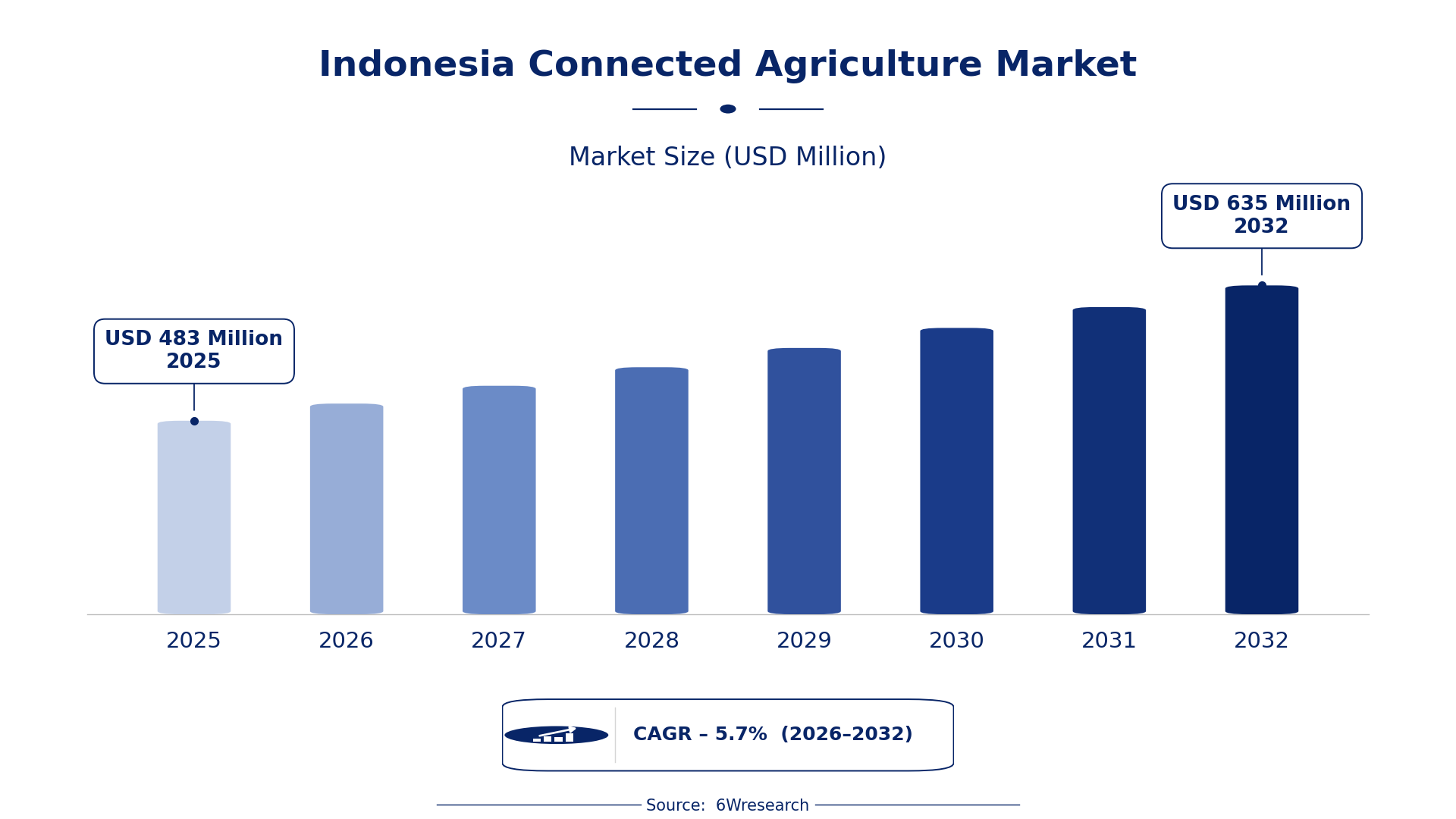
The Indonesia Connected Agriculture Market was estimated at USD 483 Million in 2025 and is projected to reach USD 635 Million by 2032, growing at a CAGR of 5.7% from 2026 to 2032.
Indonesia Connected Agriculture Market Synopsis
The adoption of digital technologies in Indonesia's agricultural sector is no longer a future prospect; it’s happening now. Farmers are increasingly turning to IoT devices and data analytics to refine their practices, enhance productivity, and ensure food security in a growing population.
With the government's push towards modernization and efficiency, the Connected Agriculture market is rapidly gaining traction. Farmers and agribusinesses are utilizing smart technologies to monitor crop conditions and optimize resources, establishing a clear path for sustainable agricultural practices.
Indonesia Connected Agriculture Market Year-wise Growth Rate and Key Drivers
This graph illustrates the annual growth rates of the Indonesia Connected Agriculture Market from 2021 to 2032, highlighting a steady upward trajectory and projected expansion over the forecast period.
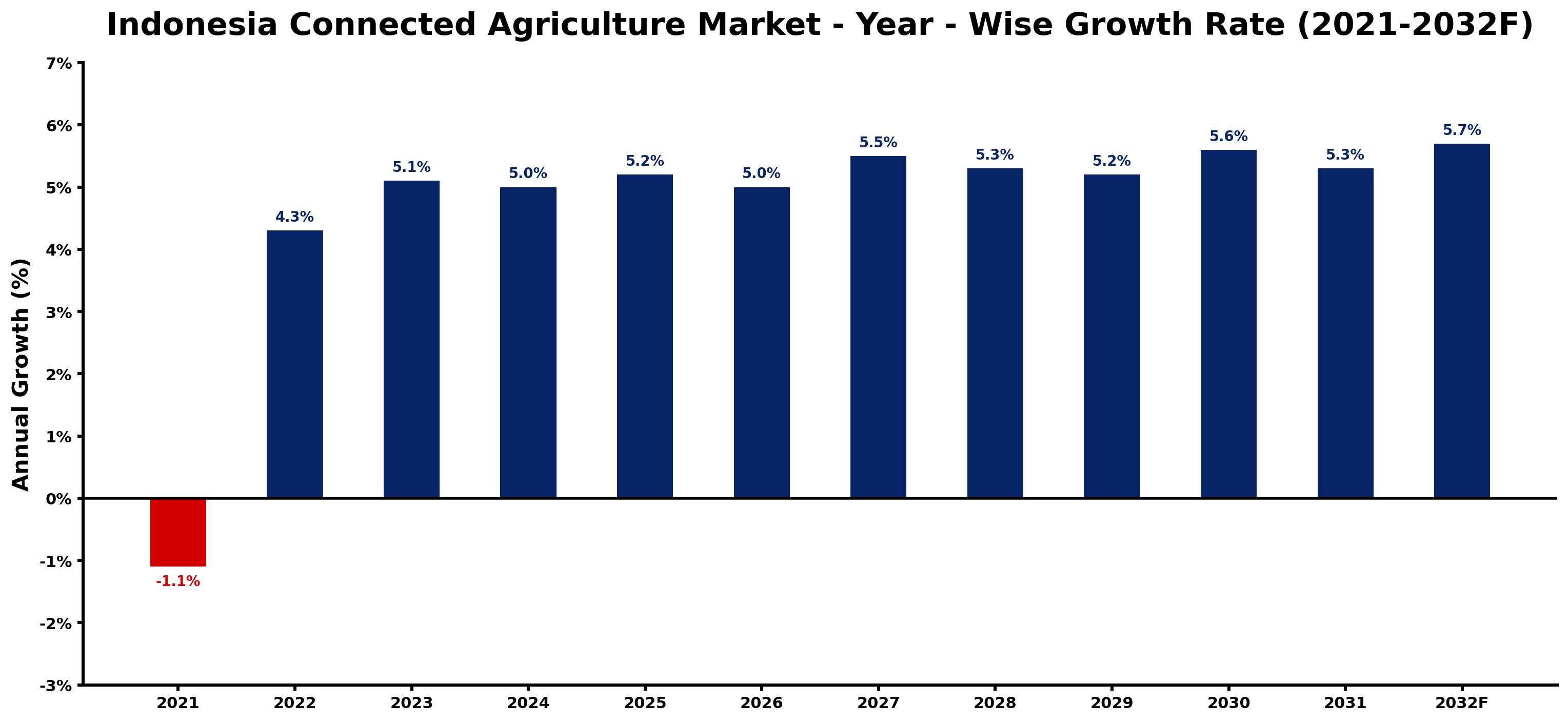
The table below presents the year‑wise growth rates along with the key drivers influencing the market
| Year | Growth Rate | Major Drivers |
| 2021 | -1.1% | Rising installation costs for rural IoT infrastructure. |
| 2022 | 4.3% | Increased smartphone penetration among Indonesian farmers |
| 2023 | 5.1% | Government support for smart farming initiatives via subsidies |
| 2024 | 5.0% | Surge in demand for precision agriculture technologies |
| 2025 | 5.2% | Boost from local NGOs promoting digital farming solutions |
| 2026 | 5.0% | Rising interest in sustainable agricultural practices programs |
| 2027 | 5.5% | Improved internet connectivity in rural farming regions |
| 2028 | 5.3% | Adoption of IoT devices for crop monitoring systems |
| 2029 | 5.2% | Growing awareness of climate-smart agriculture techniques |
| 2030 | 5.6% | Investment in agritech startups driving local innovations |
| 2031 | 5.3% | Policy incentives for data sharing in agricultural sectors |
| 2032 | 5.7% | Increased collaboration between universities and farmers for tech |
Note: Market size estimations and growth projections presented in this report are based on 6Wresearch's proprietary forecasting methodology, utilizing the latest available industry data, government publications, and primary research inputs.
Indonesia Connected Agriculture Market Key Takeaways
Below are some of the specific key takeaways from the market, including:
- Government initiatives are enhancing connectivity and modernizing agricultural practices.
- The growing adoption of IoT and data analytics is optimizing farming efficiency.
- Market growth is crucial for addressing Indonesia's food security challenges.
- Local startups are emerging alongside established firms, driving innovation.
- Investment in smart agriculture technologies is expected to increase significantly.
Evaluation of Restraints in Indonesia Connected Agriculture Market
While the market is on an upward trajectory, several restraints are holding back its full potential. Access to reliable internet remains a significant barrier in rural areas, limiting the reach of connected technologies. Additionally, the high initial costs associated with IoT devices can deter smallholder farmers from adopting these innovations. on top of that, a lack of technical know-how among farmers can hinder the effective utilization of digital tools, creating a gap between technology availability and actual usage.
Indonesia Connected Agriculture Market Trends
Several trends are shaping the Connected Agriculture market in Indonesia. The integration of AI and machine learning into agricultural practices is on the rise, enabling predictive analytics for crop management. Additionally, the focus on sustainable agriculture is prompting more farmers to adopt technologies that minimize environmental impact. Partnerships between tech companies and agribusinesses are also emerging, fostering innovation and enhancing the distribution of smart farming solutions.
Indonesia Connected Agriculture Market Opportunities
The potential for growth within the Connected Agriculture market is substantial. With increasing investments in digital infrastructure, companies have a ripe opportunity to develop solutions tailored for smallholder farmers. Expansion into underserved rural areas represents a major market opportunity, allowing for a broader adoption of connected technologies. Additionally, the rising global demand for sustainable food production opens avenues for innovative solutions that meet both local and international needs.
Government Initiatives in the Indonesia Connected Agriculture Market
The Indonesian government recognizes the critical role of agriculture in the economy and is actively implementing initiatives to modernize this sector. By enhancing digital infrastructure and providing support for technology adoption, the government aims to improve agricultural productivity and sustainability. These initiatives are essential as they lay the groundwork for the future of agriculture in Indonesia.
- A recently completed national digital infrastructure upgrade program aims to improve connectivity in rural agricultural zones.
- Current initiatives include training programs for farmers focused on the utilization of IoT devices and data analytics for crop management.
- A planned public-private initiative expected to launch in 2026 will expand access to smart agricultural technologies for smallholder farmers.
- Ongoing regulatory reforms are being introduced to streamline the approval process for new agricultural technologies.
- The government has initiated a funding program designed to subsidize the cost of IoT devices for farmers.
Future Insights of the Indonesia Connected Agriculture Market
Looking ahead to 2026-2032, the Indonesia Connected Agriculture market is set to evolve significantly. As digital literacy increases among farmers, the adoption of smart technologies will accelerate. on top of that, greater collaboration between technology providers and agricultural stakeholders will drive innovation, leading to more tailored solutions for local needs. This momentum will not only enhance productivity but also contribute to the overall sustainability of Indonesia's agricultural sector.
Indonesia Connected Agriculture Market Latest Developments
In the past year, activity in the Indonesia Connected Agriculture market has gained momentum, reflecting a strong commitment to modernization and efficiency. Various initiatives and partnerships have emerged, indicating a robust interest in leveraging technology to improve agricultural practices.
- A major technology vendor announced the launch of a new IoT platform for precision agriculture, which began roll-out in Q1 2025.
- An initiative to provide training for over 5,000 farmers on smart farming techniques is currently underway, aiming to boost technology adoption.
- In mid-2025, a collaboration between tech startups and agricultural cooperatives was formed to develop localized solutions for crop monitoring.
- A rollout expected to begin in late 2026 will introduce solar-powered IoT devices designed for remote farming areas.
Indonesia Connected Agriculture Market - Key Attractiveness of the Report
- 10 Years of Market Numbers
- Historical Data Starting from 2022 to 2025
- Base Year: 2025
- Forecast Data until 2032
- Key Performance Indicators Impacting the Market
- Major Upcoming Developments and Projects
Key Highlights of the Report:
- Indonesia Connected Agriculture Market Outlook
- Market Size of Indonesia Connected Agriculture Market, 2025
- Forecast of Indonesia Connected Agriculture Market, 2032
- Historical Data and Forecast of Indonesia Connected Agriculture Revenues & Volume for the Period 2022-2032F
- Indonesia Connected Agriculture Market Trend Evolution
- Indonesia Connected Agriculture Market Drivers and Challenges
- Indonesia Connected Agriculture Price Trends
- Indonesia Connected Agriculture Porter's Five Forces
- Indonesia Connected Agriculture Industry Life Cycle
- Historical Data and Forecast of Indonesia Connected Agriculture Market Revenues & Volume By Component for the Period 2022-2032F
- Historical Data and Forecast of Indonesia Connected Agriculture Market Revenues & Volume By Solution for the Period 2022-2032F
- Historical Data and Forecast of Indonesia Connected Agriculture Market Revenues & Volume By Platforms for the Period 2022-2032F
- Historical Data and Forecast of Indonesia Connected Agriculture Market Revenues & Volume By Services for the Period 2022-2032F
- Historical Data and Forecast of Indonesia Connected Agriculture Market Revenues & Volume By Platforms for the Period 2022-2032F
- Historical Data and Forecast of Indonesia Connected Agriculture Market Revenues & Volume By Device Management for the Period 2022-2032F
- Historical Data and Forecast of Indonesia Connected Agriculture Market Revenues & Volume By Application Enablement for the Period 2022-2032F
- Historical Data and Forecast of Indonesia Connected Agriculture Market Revenues & Volume By Connectivity Management for the Period 2022-2032F
- Historical Data and Forecast of Indonesia Connected Agriculture Market Revenues & Volume By Application for the Period 2022-2032F
- Historical Data and Forecast of Indonesia Connected Agriculture Market Revenues & Volume By Pre-Production Planning and Management for the Period 2022-2032F
- Historical Data and Forecast of Indonesia Connected Agriculture Market Revenues & Volume By In-Production Planning and Management for the Period 2022-2032F
- Historical Data and Forecast of Indonesia Connected Agriculture Market Revenues & Volume By Post-Production Planning and Management for the Period 2022-2032F
- Indonesia Connected Agriculture Import Export Trade Statistics
- Market Opportunity Assessment By Component
- Market Opportunity Assessment By Platforms
- Market Opportunity Assessment By Application
- Indonesia Connected Agriculture Top Companies Market Share
- Indonesia Connected Agriculture Competitive Benchmarking By Technical and Operational Parameters
- Indonesia Connected Agriculture Company Profiles
- Indonesia Connected Agriculture Key Strategic Recommendations






































