Indonesia Crab Market: Import Trend Analysis
Indonesia`s import trend for the crab market experienced a significant decline from 2023 to 2024, with a growth rate of -92.86%. The compound annual growth rate (CAGR) for imports from 2020 to 2024 stood at -86.0%. This drastic decrease can be attributed to shifts in consumer preferences, supply chain disruptions, or changes in trade policies impacting the market stability.

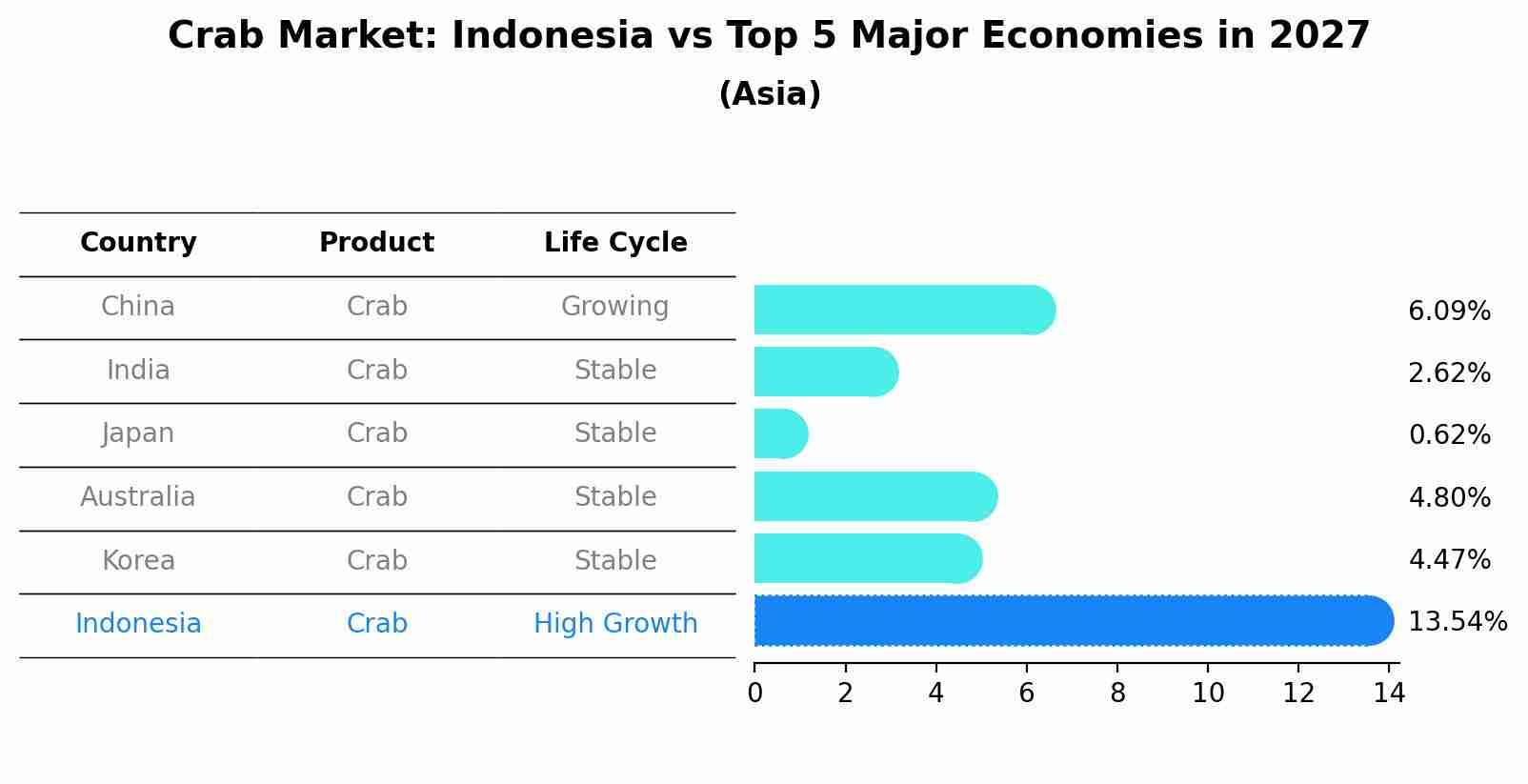
Crab Market: Indonesia vs Top 5 Major Economies in 2027 (Asia)
Indonesia's Crab market is anticipated to experience a high growth rate of 13.54% by 2027, reflecting trends observed in the largest economy China, followed by India, Japan, Australia and South Korea.
Indonesia Crab Market Synopsis
Indonesia is a major producer and exporter of crab, accounting for nearly 40% of the global production. The country exports a variety of crabs including green (mud) crab, rock crab, king crank, soft-shell crab and blue swimming crabs among other species. It has one of the most diversified fisheries in Southeast Asia with a large number of small-scale fishermen operating along its coastlines.
Market Trends
The Indonesia seafood industry is worth around US$ 4 billion annually with a large portion being exported to other countries in Asia as well as Europe and North America. Indonesia export market for crustaceans such as crabs have been steadily increasing over recent years due to growing demand from international buyers who are willing to pay higher prices for quality products. As such, the country has become an important source for many types of live/frozen/processed seafood products both domestically and abroad.
Market Drivers
In recent years, there has been an increase in demand for fresh seafood such as mud crabs which are highly sought after by foreign markets due to their superior taste when compared to artificially grown alternatives like farmed shrimp or prawns. Moreover, there has also been an upsurge in popularity amongst local consumers especially those living in urban areas where access to fresh seafood can be limited given its seasonal nature or high cost associated with it particularly during certain times throughout the year. In addition, technological advancements have allowed producers to bring out more consistent product qualities that match consumer?s needs better than ever before resulting greater satisfaction levels amongst them thus boosting sales further still.
COVID-19 Impact on the Market
The COVID-19 pandemic has had a significant impact on the Indonesia crab market. Fishing and trade activities have been severely affected due to travel restrictions, disruption of supply chains, and reduced demand from buyers in both domestic and international markets. Prices for crabs have fallen drastically as a result, leading to financial losses for many fishermen and traders in the sector.
Challenges of the Market
One of the main challenges faced by the Indonesia crab market is access to capital. Many small-scale fishing operations lack access to credit or other financing options that would help them stay afloat during this difficult time. Additionally, there are concerns about food safety due to poor hygiene practices at some processing plants which could lead to contamination of seafood products with COVID-19 virus particles. Finally, there is also an increased risk of illegal fishing activity as regulations are not being strictly enforced by authorities amid the crisis situation caused by COVID-19.
Industry Key Players
The key players in Indonesia crab industry include both large commercial fishing operations as well as smaller independent fishers who make up most of the workforce in this sector. The major exporters include companies such as PT Aqua Blue International (ABI), PT Karimun Indah Seafood (KIS), PT Marine Harvest Indonesia (MHI) and others who export their products mainly to countries like Malaysia, Singapore, China & Japan etc.. There are also several traditional coastal villages spread across various islands throughout Indonesia where people engage in subsistence level crab harvesting for local consumption or sale within their communities.
Key Highlights of the Report:
- Indonesia Crab Market Outlook
- Market Size of Indonesia Crab Market, 2025
- Forecast of Indonesia Crab Market, 2032
- Historical Data and Forecast of Indonesia Crab Revenues & Volume for the Period 2022-2032F
- Indonesia Crab Market Trend Evolution
- Indonesia Crab Market Drivers and Challenges
- Indonesia Crab Price Trends
- Indonesia Crab Porter's Five Forces
- Indonesia Crab Industry Life Cycle
- Historical Data and Forecast of Indonesia Crab Market Revenues & Volume By Type for the Period 2022-2032F
- Historical Data and Forecast of Indonesia Crab Market Revenues & Volume By Blue Crab for the Period 2022-2032F
- Historical Data and Forecast of Indonesia Crab Market Revenues & Volume By Chinese Mitten Crab for the Period 2022-2032F
- Historical Data and Forecast of Indonesia Crab Market Revenues & Volume By Gazami Crab for the Period 2022-2032F
- Historical Data and Forecast of Indonesia Crab Market Revenues & Volume By Others for the Period 2022-2032F
- Historical Data and Forecast of Indonesia Crab Market Revenues & Volume By Form for the Period 2022-2032F
- Historical Data and Forecast of Indonesia Crab Market Revenues & Volume By Frozen for the Period 2022-2032F
- Historical Data and Forecast of Indonesia Crab Market Revenues & Volume By Canned for the Period 2022-2032F
- Historical Data and Forecast of Indonesia Crab Market Revenues & Volume By Others for the Period 2022-2032F
- Indonesia Crab Import Export Trade Statistics
- Market Opportunity Assessment By Type
- Market Opportunity Assessment By Form
- Indonesia Crab Top Companies Market Share
- Indonesia Crab Competitive Benchmarking By Technical and Operational Parameters
- Indonesia Crab Company Profiles
- Indonesia Crab Key Strategic Recommendations






































