Indonesia Distilled Water Market Size, Share & Growth Rate
The Indonesia Distilled Water Market was estimated at USD 331 Million in 2025 and is projected to reach USD 437 Million by 2032, growing at a CAGR of 4.0% from 2026 to 2032. This growth trajectory is primarily driven by an increasing awareness of health and wellness among Indonesian consumers, leading to a greater preference for purified drinking options. Additionally, rising disposable incomes are enabling more consumers to opt for higher quality bottled water, while the flourishing tourism sector is further propelling demand for bottled water products.
Indonesia Distilled Water Market Growth Rate Analysis (2021-2032)
The Indonesian distilled water market experienced a notable recovery from a decline of -1.0% in 2021, influenced by pandemic-related disruptions. The subsequent years marked a robust resurgence, with growth rates of 4.2% in 2022 and accelerating to 5.2% in 2023. This upward trend is driven by increasing consumer demand for purified water, bolstered by heightened health awareness and the expansion of industrial sectors requiring high-quality water. As investments in infrastructure improve accessibility and distribution, projections indicate a steady growth of approximately 5.6% through 2032. Additionally, the ongoing energy transition and digitalization in the purification processes are expected to enhance efficiency, further supporting market expansion.
Indonesia Distilled Water Market Year-wise Growth Rate and Key Drivers
This graph highlights how the Indonesia Distilled Water Market has steadily grown over the past five years, supported by major growth factors.
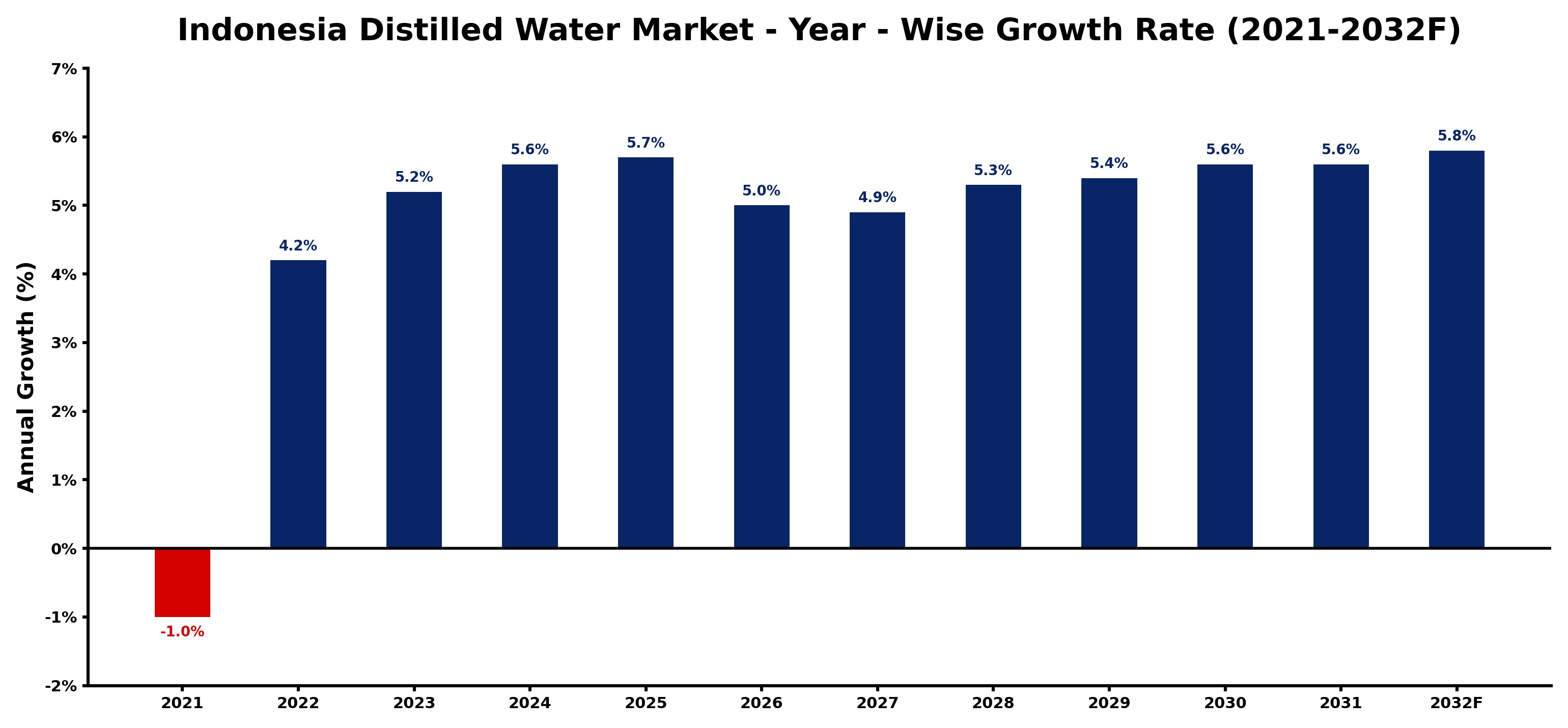
The table below presents the year‑wise growth rates along with the key drivers influencing the market
| Year | Growth Rate | Major Drivers |
| 2021 | -1.0% | Consumer preferences shifted downward |
| 2022 | 4.2% | Health awareness drove consumption growth |
| 2023 | 5.2% | Increased urbanization boosted demand |
| 2024 | 5.6% | Infrastructure improvements enhanced distribution |
| 2025 | 5.7% | Sustainability trends increased popularity |
| 2026 | 5.0% | Technological advancements improved efficiency |
| 2027 | 4.9% | Rising disposable incomes fueled sales |
| 2028 | 5.3% | Product innovation attracted new customers |
| 2029 | 5.4% | E-commerce growth expanded market reach |
| 2030 | 5.6% | Brand loyalty strengthened consumer trust |
| 2031 | 5.6% | Partnerships enhanced market penetration |
| 2032 | 5.8% | Regulatory support encouraged industry expansion |
Note - Market size estimations and growth projections presented in this report are based on 6Wresearch’s advanced forecasting approach, validated with industry datasets as of June 2026.
Indonesia Distilled Water Market Synopsis
The Indonesia distilled water market has demonstrated remarkable resilience, rebounding from the impacts of the COVID-19 pandemic. As the economy gradually stabilizes, a renewed focus on health and cleanliness is influencing consumer choices, propelling growth in the segment. In contrast, the market is poised for sustained expansion as urbanization and lifestyle changes continue to drive the demand for convenient and safe drinking water solutions.
Recent shifts indicate a clear migration from traditional tap or groundwater sources towards bottled distilled water. The growing emphasis on sanitation, paired with the increasing popularity of eco-friendly packaging solutions, is expected to further fuel market dynamics. This transition reflects broader consumer trends prioritizing health, convenience, and sustainability in their purchasing decisions.
Indonesia Distilled Water Market Key Takeaways
- Strong growth is projected driven by rising health consciousness and disposable incomes.
- Urbanization and increased tourism contribute to heightened demand for bottled water options.
- Shifts in consumer preferences emphasize eco-friendly packaging and product quality.
- Government initiatives are enhancing access to safe drinking water, aligning with public health goals.
- Technological advancements in vending solutions enhance customer engagement and service convenience.
Evaluation of Restraints in Indonesia Distilled Water Market
Despite the positive growth outlook, several challenges continue to restrain the Indonesia distilled water market. High production costs associated with advanced distillation technologies can limit profitability for manufacturers. Moreover, stringent environmental regulations pose hurdles in sourcing raw materials sustainably. Counterfeit products in the market, combined with inadequate consumer awareness regarding the benefits of distilled water, also present barriers to growth. The cumulative effect of these restraints could dampen the market's overall potential.
Indonesia Distilled Water Market Trends
The market is currently witnessing a shift towards smart vending machines, offering an interactive and convenient solution for consumers. These technological advancements enhance the purchasing experience and foster brand loyalty. Additionally, there is a growing trend of consumers prioritizing products with eco-friendly packaging, which is shaping manufacturing practices. This emerging focus on sustainability not only meets consumer demand but also addresses the increasing concerns surrounding plastic waste management.
Indonesia Distilled Water Market Opportunities
Future investment opportunities lie within the expansion of distribution channels, particularly in rural areas where access to clean drinking water remains limited. Partnering with local governments to improve infrastructure can enhance product availability. Furthermore, as health awareness continues to grow, innovative marketing strategies tailored to educate consumers about the benefits of distilled water can drive sales. Companies can also explore collaborations aimed at developing sustainable packaging solutions to align with consumer preferences.
Government Initiatives in the Indonesia Distilled Water Market
The Indonesian government has undertaken several initiatives to promote public health and improve access to safe drinking water. These initiatives include regulatory frameworks that ensure product safety and environmental protection during water extraction and purification processes. Public awareness campaigns aimed at educating citizens about the importance of hygiene and clean water consumption further support the distilled water market's growth by fostering a culture of health-conscious living.
Future Insights of the Indonesia Distilled Water Market
Looking ahead to 2026-2032, the Indonesia distilled water market is likely to evolve with increasing integration of technology in consumer engagement. As the trend toward health-conscious living continues, the market will benefit from innovative solutions that prioritize quality and convenience. Additionally, heightened government support for sanitation initiatives and a shift towards environmentally sustainable practices will create a favorable environment for sustained market growth. Overall, the future of the market appears promising, driven by consumer demand and supportive policies.
Indonesia Distilled Water Market Latest Developments (May 2025 - June 2026)
In recent months, the Indonesia distilled water market has seen significant advancements, particularly in the introduction of eco-friendly packaging solutions. Companies are increasingly adopting biodegradable materials in their product offerings to address environmental concerns. Concurrently, smart vending machines are becoming more prevalent across urban centers, enhancing consumer access to distilled water products. Regulatory developments also aim to tighten safety standards in water purification processes, ensuring consumer trust in the quality of bottled water available in the market.
Indonesia Distilled Water Market - Key Attractiveness of the Report
- 10 Years of Market Numbers
- Historical Data Starting from 2022 to 2025
- Base Year: 2025
- Forecast Data until 2032
- Key Performance Indicators Impacting the Market
- Major Upcoming Developments and Projects
Key Highlights of the Report:
- Indonesia Distilled Water Market Outlook
- Market Size of Indonesia Distilled Water Market, 2025
- Forecast of Indonesia Distilled Water Market, 2032
- Historical Data and Forecast of Indonesia Distilled Water Revenues & Volume for the Period 2022-2032F
- Indonesia Distilled Water Market Trend Evolution
- Indonesia Distilled Water Market Drivers and Challenges
- Indonesia Distilled Water Price Trends
- Indonesia Distilled Water Porter's Five Forces
- Indonesia Distilled Water Industry Life Cycle
- Historical Data and Forecast of Indonesia Distilled Water Market Revenues & Volume By Types for the Period 2022-2032F
- Historical Data and Forecast of Indonesia Distilled Water Market Revenues & Volume By Pharmaceutical Grade for the Period 2022-2032F
- Historical Data and Forecast of Indonesia Distilled Water Market Revenues & Volume By Industrial Grade for the Period 2022-2032F
- Historical Data and Forecast of Indonesia Distilled Water Market Revenues & Volume By Applications for the Period 2022-2032F
- Historical Data and Forecast of Indonesia Distilled Water Market Revenues & Volume By Drinking for the Period 2022-2032F
- Historical Data and Forecast of Indonesia Distilled Water Market Revenues & Volume By Chemical and Biological Laboratories for the Period 2022-2032F
- Historical Data and Forecast of Indonesia Distilled Water Market Revenues & Volume By Automotive Cooling Systems and Batteries for the Period 2022-2032F
- Historical Data and Forecast of Indonesia Distilled Water Market Revenues & Volume By Medical for the Period 2022-2032F
- Historical Data and Forecast of Indonesia Distilled Water Market Revenues & Volume By Others for the Period 2022-2032F
- Indonesia Distilled Water Import Export Trade Statistics
- Market Opportunity Assessment By Types
- Market Opportunity Assessment By Applications
- Indonesia Distilled Water Top Companies Market Share
- Indonesia Distilled Water Competitive Benchmarking By Technical and Operational Parameters
- Indonesia Distilled Water Company Profiles
- Indonesia Distilled Water Key Strategic Recommendations






































