Indonesia Hepatitis Vaccine Market Size, Share & Growth Rate
The Indonesia Hepatitis Vaccine Market was estimated at USD 254 Million in 2025 and is projected to reach USD 335 Million by 2032, growing at a CAGR of 4.0% from 2026 to 2032. This growth trajectory is primarily fueled by the governments renewed commitment to expanding vaccination programs and increasing public awareness surrounding hepatitis infections. The elevated incidence rates of hepatitis B and A, particularly in urban areas, are propelling the demand for effective vaccination solutions, underlining the urgency of preventive healthcare in the country.
Indonesia Hepatitis Vaccine Market Year-wise Growth Rate and Key Drivers
This graph highlights how the Indonesia Hepatitis Vaccine Market has steadily grown over the years, supported by major growth factors.
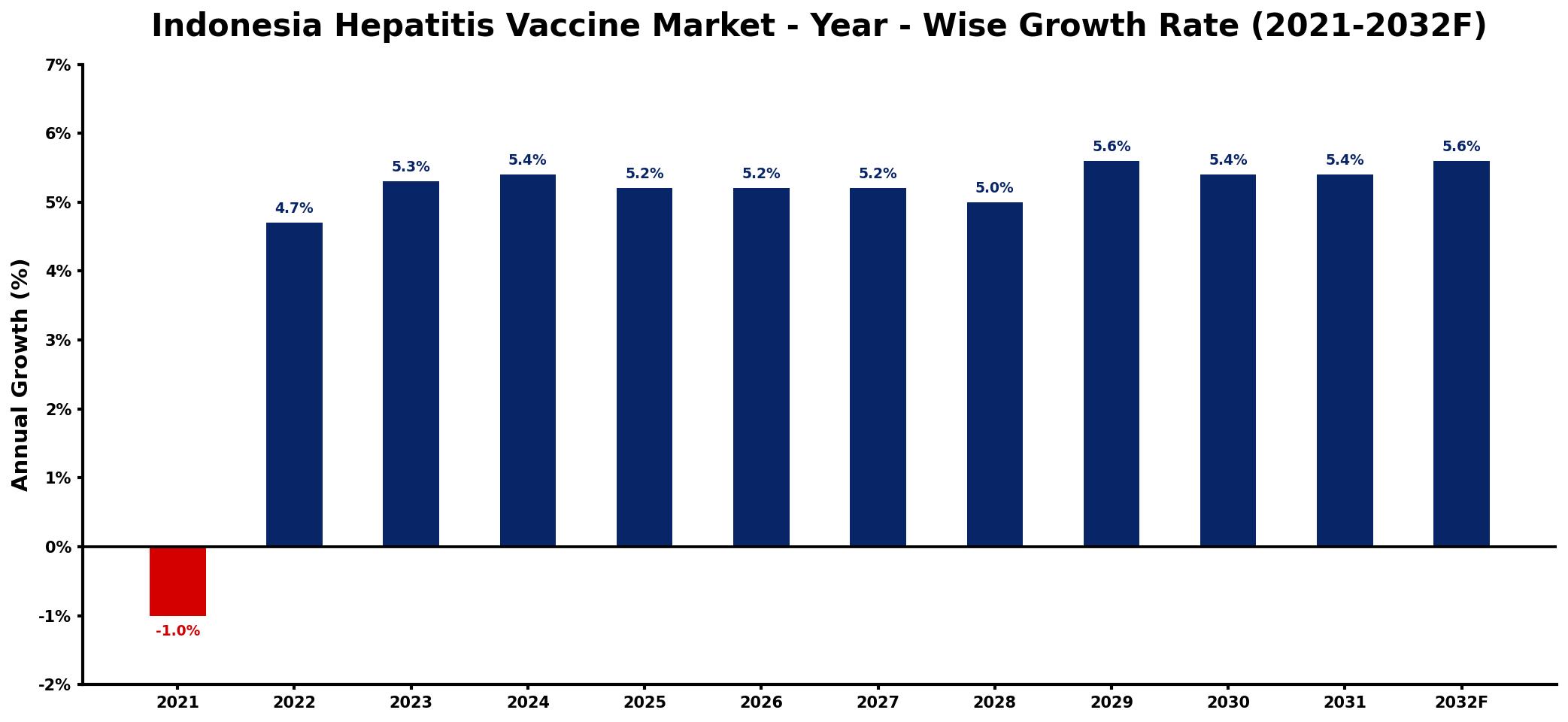
The table below presents the year‑wise growth rates along with the key drivers influencing the market
| Year | Growth Rate | Major Drivers |
| 2021 | -1.0% | decreased healthcare funding availability |
| 2022 | 4.7% | rising public health awareness campaigns |
| 2023 | 5.3% | increased government health initiatives |
| 2024 | 5.4% | growing investment in healthcare infrastructure |
| 2025 | 5.2% | expansion of healthcare access programs |
| 2026 | 5.2% | enhanced disease prevention strategies |
| 2027 | 5.2% | development of new healthcare technologies |
| 2028 | 5.0% | increased collaboration with NGOs |
| 2029 | 5.6% | growing focus on preventive medicine |
| 2030 | 5.4% | enhanced product quality standards |
| 2031 | 5.4% | strengthened regulatory health frameworks |
| 2032 | 5.6% | increased funding for health research |
Note: Market size estimations and growth projections presented in this report are based on 6Wresearch's proprietary forecasting methodology, utilizing the latest available industry data, government publications, and primary research inputs.
Indonesia Hepatitis Vaccine Market Synopsis
A significant force shaping the Indonesia Hepatitis Vaccine Market is the concerted government effort to boost vaccination rates amid rising infection trends. Public health campaigns designed to educate citizens about hepatitis and the importance of vaccination are becoming increasingly common, which enhances accessibility and acceptance across diverse demographics.
This market is also supported by ongoing collaborations between healthcare providers and global pharmaceutical companies. The combination of local and international expertise aims to strengthen the distribution networks and ensure that vaccines reach underserved communities, critical for curbing the prevalence of hepatitis infections in Indonesia.
Indonesia Hepatitis Vaccine Market Key Takeaways
- Rising public awareness and government initiatives are driving market growth.
- Significant rates of hepatitis B and A infections necessitate robust vaccination strategies.
- Challenges related to vaccine distribution in remote areas are being addressed.
- COVID-19 has heightened the focus on vaccines, potentially benefiting hepatitis vaccination efforts.
- Future growth is anticipated through increased investments in healthcare infrastructure and education.
Evaluation of Restraints in Indonesia Hepatitis Vaccine Market
Despite the encouraging growth outlook, several factors impede the full potential of the Indonesia Hepatitis Vaccine Market. One notable challenge is the uneven distribution of healthcare resources, particularly in rural and remote regions where healthcare infrastructure is less developed. This can hinder vaccine accessibility and proper storage, which is vital for maintaining vaccine efficacy. Moreover, while public awareness campaigns are increasing, there is still a gap in understanding among certain demographics regarding the importance of vaccinations, which could slow the uptake rates needed for herd immunity.
Indonesia Hepatitis Vaccine Market Trends
Currently, there is an observable shift towards integrating hepatitis vaccination into broader public health initiatives. This includes collaboration with local health ministries to ensure that vaccination becomes part of routine healthcare for children and high-risk populations. Additionally, technological innovations in vaccine delivery, such as mobile vaccination clinics, are emerging to enhance accessibility. The trend towards personalized healthcare is also shaping vaccine development, with an increasing focus on tailored solutions that address the specific needs of different population segments.
Indonesia Hepatitis Vaccine Market Opportunities
Growth opportunities within the Indonesia Hepatitis Vaccine Market lie in the expansion of strategic partnerships between public and private sectors aimed at enhancing vaccine distribution. Investment in healthcare infrastructure, particularly in remote areas, can significantly increase vaccination rates. Moreover, the increasing interest of pharmaceutical companies in local manufacturing capabilities presents an opportunity to lower costs and improve availability. Lastly, the ongoing globalization of health initiatives encourages investment in research and development to create more effective vaccines.
Government Initiatives in the Indonesia Hepatitis Vaccine Market
The Indonesian government has initiated several programs to bolster hepatitis vaccination rates. These include public awareness campaigns aimed at educating the population on the risks associated with hepatitis infections and the benefits of vaccination. Additionally, the government is working to enhance vaccination accessibility through healthcare policy reforms and increased funding for immunization programs, striving to improve healthcare delivery in underserved regions.
Future Insights of the Indonesia Hepatitis Vaccine Market
Looking ahead to 2026-2032, the Indonesia Hepatitis Vaccine Market is expected to evolve significantly due to enhanced public health strategies and a growing awareness of vaccine-preventable diseases. The collaboration between government bodies and pharmaceutical companies is anticipated to yield innovative solutions that address existing barriers to vaccination. Furthermore, with a focus on improving healthcare infrastructure and tackling misinformation, the market stands to achieve its potential in significantly reducing hepatitis infection rates over the coming years.
Indonesia Hepatitis Vaccine Market Latest Developments (2025 - 2026)
Recent trends indicate a burgeoning emphasis on expanding hepatitis vaccination access across Indonesia. The government has ramped up efforts to ensure that vaccines are available in more remote locations, utilizing mobile clinics and community health workers. Additionally, health campaigns have seen increased engagement through digital platforms, reaching a wider audience and educating citizens about the importance of vaccination in disease prevention. Partnerships with international health organizations have also been strengthened to facilitate knowledge sharing and resource allocation.
Indonesia Hepatitis Vaccine Market - Key Attractiveness of the Report
- 10 Years of Market Numbers
- Historical Data Starting from 2022 to 2025
- Base Year: 2025
- Forecast Data until 2032
- Key Performance Indicators Impacting the Market
- Major Upcoming Developments and Projects
Key Highlights of the Report:
- Indonesia Hepatitis Vaccine Market Outlook
- Market Size of Indonesia Hepatitis Vaccine Market, 2025
- Forecast of Indonesia Hepatitis Vaccine Market, 2032
- Historical Data and Forecast of Indonesia Hepatitis Vaccine Revenues & Volume for the Period 2022-2032F
- Indonesia Hepatitis Vaccine Market Trend Evolution
- Indonesia Hepatitis Vaccine Market Drivers and Challenges
- Indonesia Hepatitis Vaccine Price Trends
- Indonesia Hepatitis Vaccine Porter's Five Forces
- Indonesia Hepatitis Vaccine Industry Life Cycle
- Historical Data and Forecast of Indonesia Hepatitis Vaccine Market Revenues & Volume By Indication for the Period 2022-2032F
- Historical Data and Forecast of Indonesia Hepatitis Vaccine Market Revenues & Volume By Hepatitis A for the Period 2022-2032F
- Historical Data and Forecast of Indonesia Hepatitis Vaccine Market Revenues & Volume By Hepatitis B for the Period 2022-2032F
- Historical Data and Forecast of Indonesia Hepatitis Vaccine Market Revenues & Volume By Vaccine Type for the Period 2022-2032F
- Historical Data and Forecast of Indonesia Hepatitis Vaccine Market Revenues & Volume By Recombinant Vaccine for the Period 2022-2032F
- Historical Data and Forecast of Indonesia Hepatitis Vaccine Market Revenues & Volume By Inactivated Vaccine for the Period 2022-2032F
- Historical Data and Forecast of Indonesia Hepatitis Vaccine Market Revenues & Volume By Distribution Channel for the Period 2022-2032F
- Historical Data and Forecast of Indonesia Hepatitis Vaccine Market Revenues & Volume By Hospitals for the Period 2022-2032F
- Historical Data and Forecast of Indonesia Hepatitis Vaccine Market Revenues & Volume By Retail Pharmacy for the Period 2022-2032F
- Historical Data and Forecast of Indonesia Hepatitis Vaccine Market Revenues & Volume By Online Pharmacy for the Period 2022-2032F
- Indonesia Hepatitis Vaccine Import Export Trade Statistics
- Market Opportunity Assessment By Indication
- Market Opportunity Assessment By Vaccine Type
- Market Opportunity Assessment By Distribution Channel
- Indonesia Hepatitis Vaccine Top Companies Market Share
- Indonesia Hepatitis Vaccine Competitive Benchmarking By Technical and Operational Parameters
- Indonesia Hepatitis Vaccine Company Profiles
- Indonesia Hepatitis Vaccine Key Strategic Recommendations






































