Indonesia Hospital Equipment and Supplies Market: Import Trend Analysis
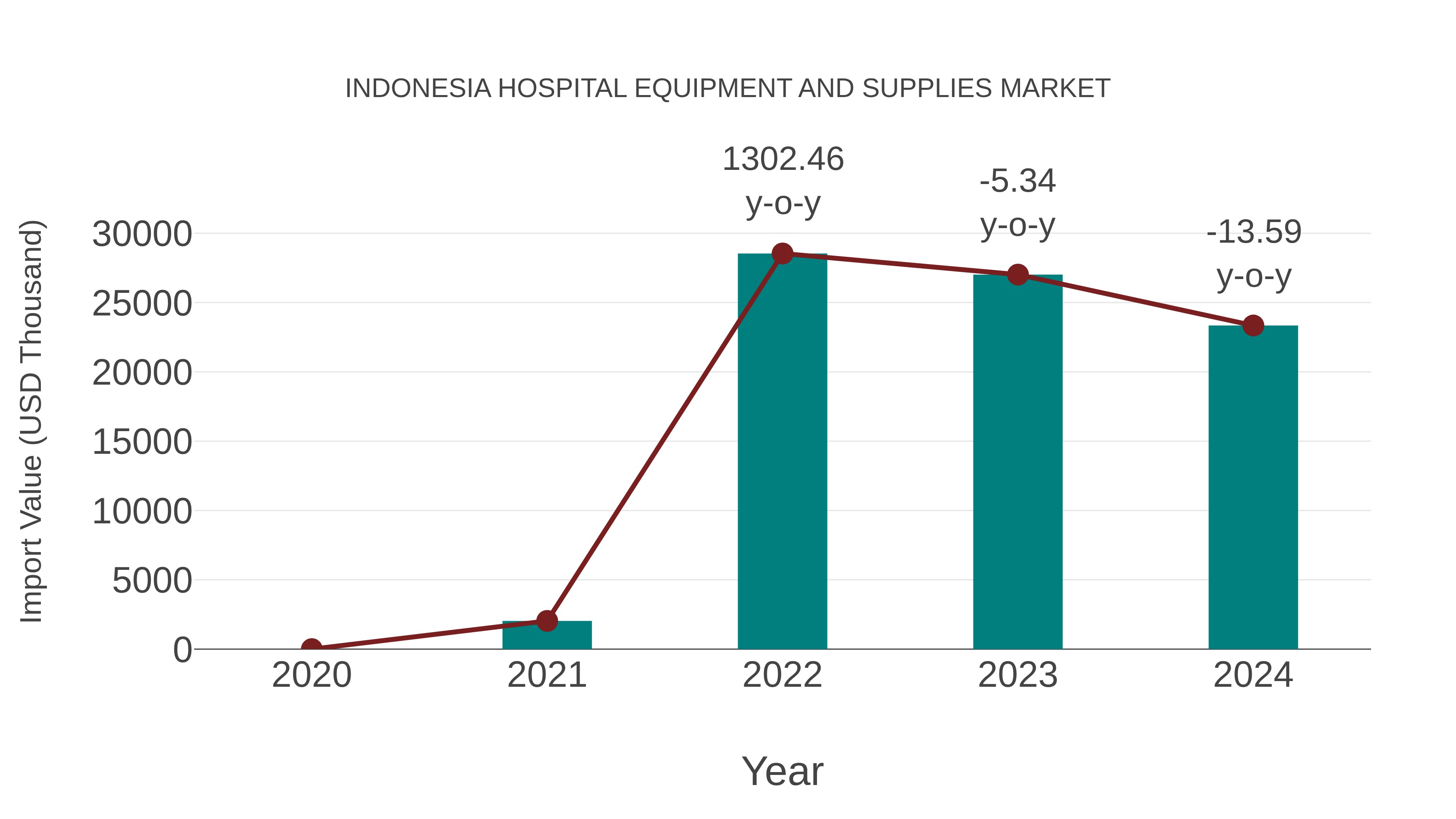
In the Indonesia hospital equipment and supplies market, the import trend experienced a decline with a growth rate of -13.59% from 2023 to 2024, while the compound annual growth rate (CAGR) for 2020-2024 stood at 125.53%. This sharp decline in import momentum could be attributed to shifts in demand patterns or changes in trade policies impacting market stability.
Indonesia Hospital Equipment And Supplies Market Synopsis
The hospital equipment and supplies market in Indonesia has been experiencing significant growth in recent years. With the country`s expanding healthcare infrastructure and rising demand for quality medical services, the market for hospital equipment and supplies is expected to continue its upward trajectory. This growth is driven by various factors, including government initiatives to improve healthcare access, an aging population requiring more medical care, and increased healthcare spending. Key segments within this market include diagnostic equipment, surgical instruments, medical consumables, and patient monitoring devices. The market is also witnessing a shift towards more advanced and technologically sophisticated medical equipment to enhance patient care and streamline healthcare processes.
Drivers of the Market
The Indonesia Hospital Equipment and Supplies market are poised for substantial growth, primarily due to the country`s expanding healthcare infrastructure and the increasing demand for healthcare services. The government`s efforts to improve healthcare facilities and expand access to medical services are driving the demand for hospital equipment and supplies. Furthermore, the ongoing COVID-19 pandemic has underscored the importance of having adequate healthcare infrastructure, including ventilators, personal protective equipment (PPE), and diagnostic tools, which has further boosted market growth. Private sector investments in the healthcare industry are also contributing to the market`s expansion.
Challenges of the Market
The Indonesia Hospital Equipment and Supplies market face challenges related to healthcare infrastructure and government regulations. Hospitals and healthcare facilities in some regions may lack the necessary equipment and supplies, leading to unequal access to healthcare services. Stringent regulatory requirements and import restrictions can also slow down market growth. Manufacturers should work closely with healthcare providers and government agencies to ensure equitable access to quality equipment and navigate regulatory hurdles effectively.
COVID-19 Impact on the Market
The hospital equipment and supplies market in Indonesia saw increased demand during the COVID-19 pandemic due to the need for medical equipment and personal protective gear. Hospitals and healthcare facilities had to quickly adapt to the crisis, driving up the demand for medical supplies. As the pandemic subsides and healthcare services normalize, the market may return to a more stable growth trajectory, with a continued focus on modernizing healthcare facilities.
Key Players in the Market
The Indonesia Hospital Equipment and Supplies market is witnessing significant growth due to the increasing demand for advanced medical equipment and the expansion of healthcare infrastructure. Key players in this market include well-established companies such as PT. Philips Indonesia, GE Healthcare Indonesia, and Siemens Healthineers. These companies are at the forefront of providing state-of-the-art medical devices and supplies to healthcare facilities across the country. With the rising healthcare expenditure and the need for better patient care, these players are expected to continue dominating the market and driving innovation in hospital equipment and supplies.
Key Highlights of the Report:
- Indonesia Hospital Equipment And Supplies Market Outlook
- Market Size of Indonesia Hospital Equipment And Supplies Market, 2025
- Forecast of Indonesia Hospital Equipment And Supplies Market, 2032
- Historical Data and Forecast of Indonesia Hospital Equipment And Supplies Revenues & Volume for the Period 2022-2032F
- Indonesia Hospital Equipment And Supplies Market Trend Evolution
- Indonesia Hospital Equipment And Supplies Market Drivers and Challenges
- Indonesia Hospital Equipment And Supplies Price Trends
- Indonesia Hospital Equipment And Supplies Porter's Five Forces
- Indonesia Hospital Equipment And Supplies Industry Life Cycle
- Historical Data and Forecast of Indonesia Hospital Equipment And Supplies Market Revenues & Volume By Product for the Period 2022-2032F
- Historical Data and Forecast of Indonesia Hospital Equipment And Supplies Market Revenues & Volume By Sterilization And Disinfectant Equipment for the Period 2022-2032F
- Historical Data and Forecast of Indonesia Hospital Equipment And Supplies Market Revenues & Volume By Disposable Hospital Supplies Patient Examination Devices for the Period 2022-2032F
- Historical Data and Forecast of Indonesia Hospital Equipment And Supplies Market Revenues & Volume By Syringes And Needles for the Period 2022-2032F
- Historical Data and Forecast of Indonesia Hospital Equipment And Supplies Market Revenues & Volume By Application for the Period 2022-2032F
- Historical Data and Forecast of Indonesia Hospital Equipment And Supplies Market Revenues & Volume By OEMs for the Period 2022-2032F
- Historical Data and Forecast of Indonesia Hospital Equipment And Supplies Market Revenues & Volume By Aftermarket for the Period 2022-2032F
- Indonesia Hospital Equipment And Supplies Import Export Trade Statistics
- Market Opportunity Assessment By Product
- Market Opportunity Assessment By Application
- Indonesia Hospital Equipment And Supplies Top Companies Market Share
- Indonesia Hospital Equipment And Supplies Competitive Benchmarking By Technical and Operational Parameters
- Indonesia Hospital Equipment And Supplies Company Profiles
- Indonesia Hospital Equipment And Supplies Key Strategic Recommendations






































