Indonesia Isoprene Market Size, Share & Growth Rate
The Indonesia Isoprene Market was estimated at USD 461 Million in 2025 and is projected to reach USD 607 Million by 2032, growing at a CAGR of 4.0% from 2026 to 2032. This growth trajectory is propelled by Indonesia's strategic position as a leading supplier of isoprene in Southeast Asia, coupled with rising demand from both domestic and international markets. The market's expansion is further fueled by increasing industrial activity, particularly in automotive and consumer goods sectors, where isoprene's applications are highly valued.
Indonesia Isoprene Market Growth Rate Analysis (2021-2032)
The isoprene market in Indonesia has shown a notable recovery following a downturn, reflecting a much-anticipated upward shift in demand. After experiencing a dip of -1.0% in 2021, the market rebounded with growth rates of 4.2% in 2022 and 5.7% in 2023, driven by increasing consumer demand for synthetic rubber and the burgeoning automotive sector. Investments in technological advancements foster greater production efficiencies, while supportive government policies are bolstering industrial capacity. The growth is projected to stabilize around 5.1% to 5.6% from 2024 through 2032, indicating robust confidence in the sector. This trend showcases Indonesia's commitment to energy transition and infrastructure development, ensuring sustained market vitality.
Indonesia Isoprene Market Year-wise Growth Rate and Key Drivers
This graph highlights how the Indonesia Isoprene Market has steadily grown over the past five years, supported by major growth factors.
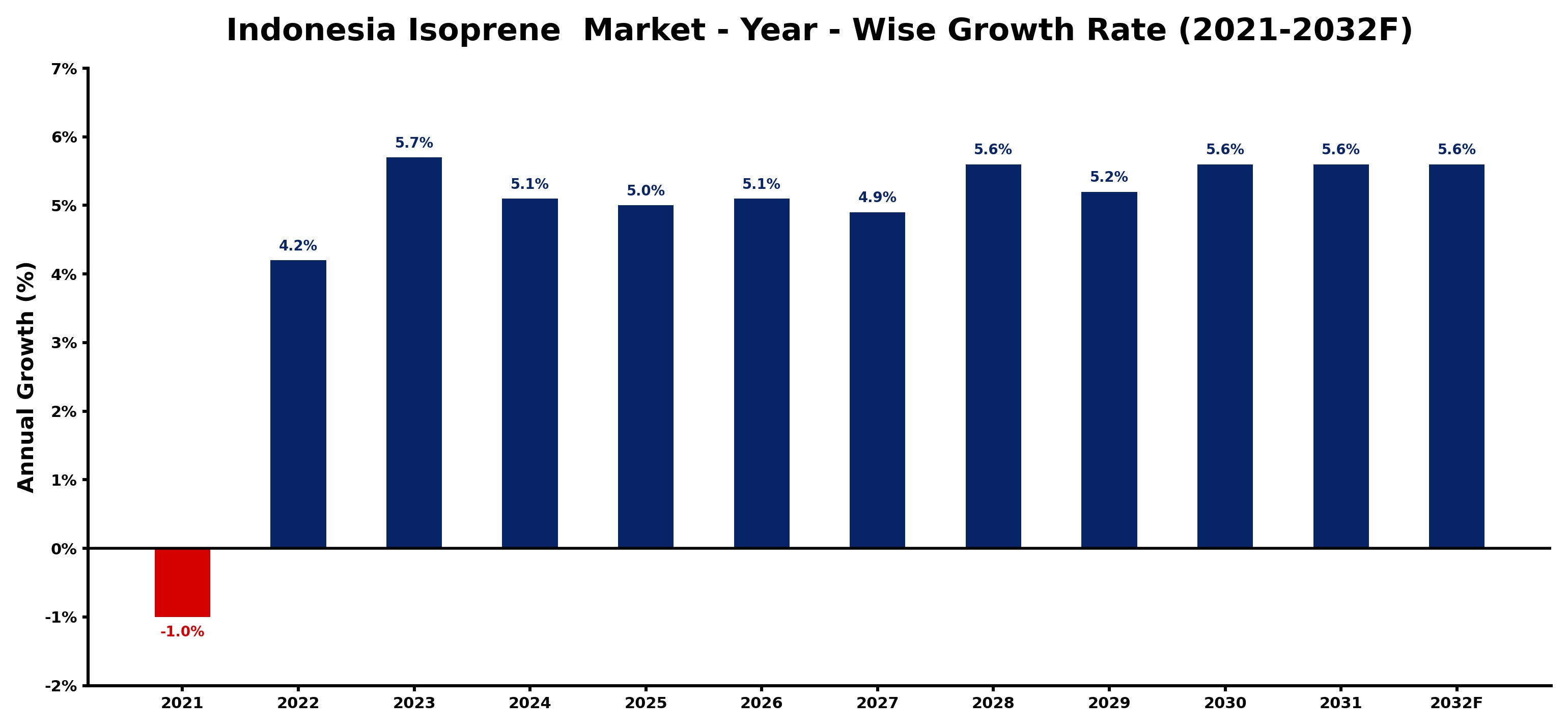
The table below presents the year‑wise growth rates along with the key drivers influencing the market
| Year | Growth Rate | Major Drivers |
| 2021 | -1.0% | Growing renewable energy integration projects |
| 2022 | 4.2% | Increasing adoption of advanced technologies |
| 2023 | 5.7% | Increasing adoption of advanced technologies |
| 2024 | 5.1% | Increasing smart city development projects |
| 2025 | 5.0% | Increasing industrial infrastructure investments |
| 2026 | 5.1% | Government infrastructure modernization initiatives |
| 2027 | 4.9% | Expansion of commercial construction activities |
| 2028 | 5.6% | Expansion of commercial construction activities |
| 2029 | 5.2% | Expansion of manufacturing activities |
| 2030 | 5.6% | Expansion of commercial construction activities |
| 2031 | 5.6% | Government infrastructure modernization initiatives |
| 2032 | 5.6% | Expansion of commercial construction activities |
Note - Market size estimations and growth projections presented in this report are based on 6Wresearch's advanced forecasting approach, validated with industry datasets as of June 2026.
Indonesia Isoprene Market Synopsis
In recent years, Indonesia has seen a steady rise in isoprene demand, largely attributed to the country's robust natural rubber industry, which facilitates efficient production. With the domestic market's affordability drawing attention from local manufacturers, the potential for export growth is becoming increasingly apparent as foreign companies seek cost-effective sourcing options.
Looking forward, the Indonesia Isoprene Market appears poised for significant growth as international markets, particularly in Asia, continue to recover post-pandemic. Enhanced demand for isoprene in various applications, including adhesives and automotive components, underlines the material's vital role in modern manufacturing processes.
Indonesia Isoprene Market Key Takeaways
- The market benefits from Indonesia's significant natural rubber production, allowing for cost-effective isoprene output.
- Increasing global demand, particularly from countries like China and India, enhances export potential.
- Lower energy costs related to production contribute to better profit margins for local manufacturers.
- Applications of isoprene in various industries, including automotive and consumer goods, are expanding.
- Market resilience is evident despite disruptions caused by global events like the COVID-19 pandemic.
Evaluation of Restraints in Indonesia Isoprene Market
While the Indonesia Isoprene Market shows considerable promise, it faces notable constraints that could limit its growth. One of the primary issues is the price volatility linked to crude oil, from which isoprene is derived. Fluctuations in global oil prices can significantly impact production costs and profit margins. Furthermore, stringent environmental regulations pose challenges to production capabilities, potentially hindering output. Competitive pressures from alternative petrochemical derivatives also require strategic positioning to maintain market share.
Indonesia Isoprene Market Trends
Current trends indicate a marked increase in demand for isoprene, driven by innovation in manufacturing processes and material applications. Manufacturers are increasingly recognizing the benefits of isoprene in producing environmentally friendly alternatives in various sectors. Additionally, the automotive industry's growing emphasis on sustainable practices is directing attention toward isoprene's role in high-performance synthetic rubbers. This shift is expected to catalyze further advancements in the isoprene market.
Indonesia Isoprene Market Opportunities
The potential for growth in the Indonesia Isoprene Market is ripe with opportunity, particularly in expanding export channels. As global manufacturers seek lower-cost inputs, Indonesian isoprene stands out as an appealing alternative. Furthermore, investments in technology aimed at enhancing production efficiency could bolster profitability while meeting increasing domestic and export demand. Collaboration with automotive and manufacturing sectors to develop innovative applications presents another avenue for growth.
Government Initiatives in the Indonesia Isoprene Market
The Indonesian government has been proactive in fostering growth within the petrochemical sector, including isoprene production. Policies aimed at enhancing industrial capabilities and encouraging foreign investment create a favorable environment for market expansion. Various public programs are focusing on sustainable manufacturing practices, aligning with global trends toward environmental responsibility. These initiatives not only support local production but also promote Indonesia as a competitive player in the global isoprene market.
Future Insights of the Indonesia Isoprene Market
As we look towards 2026-2032, the Indonesia Isoprene Market is expected to flourish, driven by a combination of domestic industrial growth and increasing export demand. The ongoing recovery of the global economy will likely amplify the call for isoprene across various applications. Additionally, advancements in processing technologies could enhance production efficiency, further solidifying Indonesia's position in the international market. The focus on sustainable products will also shape future developments, steering the industry towards greener alternatives.
Indonesia Isoprene Market Latest Developments (May 2025 - June 2026)
The Indonesian isoprene sector has witnessed several developments aimed at enhancing production capabilities and tapping into new markets. Various initiatives have been introduced to improve supply chain resilience and increase the efficiency of waste material processing, further diversifying sources of isoprene. Moreover, partnerships between local manufacturers and international firms are emerging, facilitating technology transfer and bolstering competitive advantages in the region.
Indonesia Isoprene Market - Key Attractiveness of the Report
- 10 Years of Market Numbers
- Historical Data Starting from 2022 to 2025
- Base Year: 2025
- Forecast Data until 2032
- Key Performance Indicators Impacting the Market
- Major Upcoming Developments and Projects
Key Highlights of the Report:
- Indonesia Isoprene Market Outlook
- Market Size of Indonesia Isoprene Market, 2025
- Forecast of Indonesia Isoprene Market, 2032
- Historical Data and Forecast of Indonesia Isoprene Revenues & Volume for the Period 2022-2032F
- Indonesia Isoprene Market Trend Evolution
- Indonesia Isoprene Market Drivers and Challenges
- Indonesia Isoprene Price Trends
- Indonesia Isoprene Porter's Five Forces
- Indonesia Isoprene Industry Life Cycle
- Historical Data and Forecast of Indonesia Isoprene Market Revenues & Volume By Type for the Period 2022-2032F
- Historical Data and Forecast of Indonesia Isoprene Market Revenues & Volume By Polymer Grade for the Period 2022-2032F
- Historical Data and Forecast of Indonesia Isoprene Market Revenues & Volume By Chemical Grade for the Period 2022-2032F
- Historical Data and Forecast of Indonesia Isoprene Market Revenues & Volume By Application for the Period 2022-2032F
- Historical Data and Forecast of Indonesia Isoprene Market Revenues & Volume By Polyisoprene (IR) for the Period 2022-2032F
- Historical Data and Forecast of Indonesia Isoprene Market Revenues & Volume By Styrene-isoprene-styrene (SIS) for the Period 2022-2032F
- Historical Data and Forecast of Indonesia Isoprene Market Revenues & Volume By Isobutylene-isoprene rubber (IIR) for the Period 2022-2032F
- Historical Data and Forecast of Indonesia Isoprene Market Revenues & Volume By Others for the Period 2022-2032F
- Historical Data and Forecast of Indonesia Isoprene Market Revenues & Volume By End-use Industry for the Period 2022-2032F
- Historical Data and Forecast of Indonesia Isoprene Market Revenues & Volume By Tires for the Period 2022-2032F
- Historical Data and Forecast of Indonesia Isoprene Market Revenues & Volume By Non-tires for the Period 2022-2032F
- Historical Data and Forecast of Indonesia Isoprene Market Revenues & Volume By Adhesives for the Period 2022-2032F
- Historical Data and Forecast of Indonesia Isoprene Market Revenues & Volume By Others for the Period 2022-2032F
- Indonesia Isoprene Import Export Trade Statistics
- Market Opportunity Assessment By Type
- Market Opportunity Assessment By Application
- Market Opportunity Assessment By End-use Industry
- Indonesia Isoprene Top Companies Market Share
- Indonesia Isoprene Competitive Benchmarking By Technical and Operational Parameters
- Indonesia Isoprene Company Profiles
- Indonesia Isoprene Key Strategic Recommendations






































