Indonesia Optical Instrument And Lens Market Size, Share & Growth Rate
The Indonesia Optical Instrument And Lens Market was estimated at USD 199 Million in 2025 and is projected to reach USD 263 Million by 2032, growing at a CAGR of 4.1% from 2026 to 2032. This growth trajectory is primarily fueled by increasing investments in healthcare infrastructure and technological advancements in optical devices. Furthermore, the rising demand from sectors like telecommunications and education adds momentum to the market's expansion, as businesses and consumers alike seek enhanced visual clarity and precision.
Indonesia Optical Instrument And Lens Market Year-wise Growth Rate and Key Drivers
This graph highlights how the Indonesia Optical Instrument And Lens Market has steadily grown over the years, supported by major growth factors.
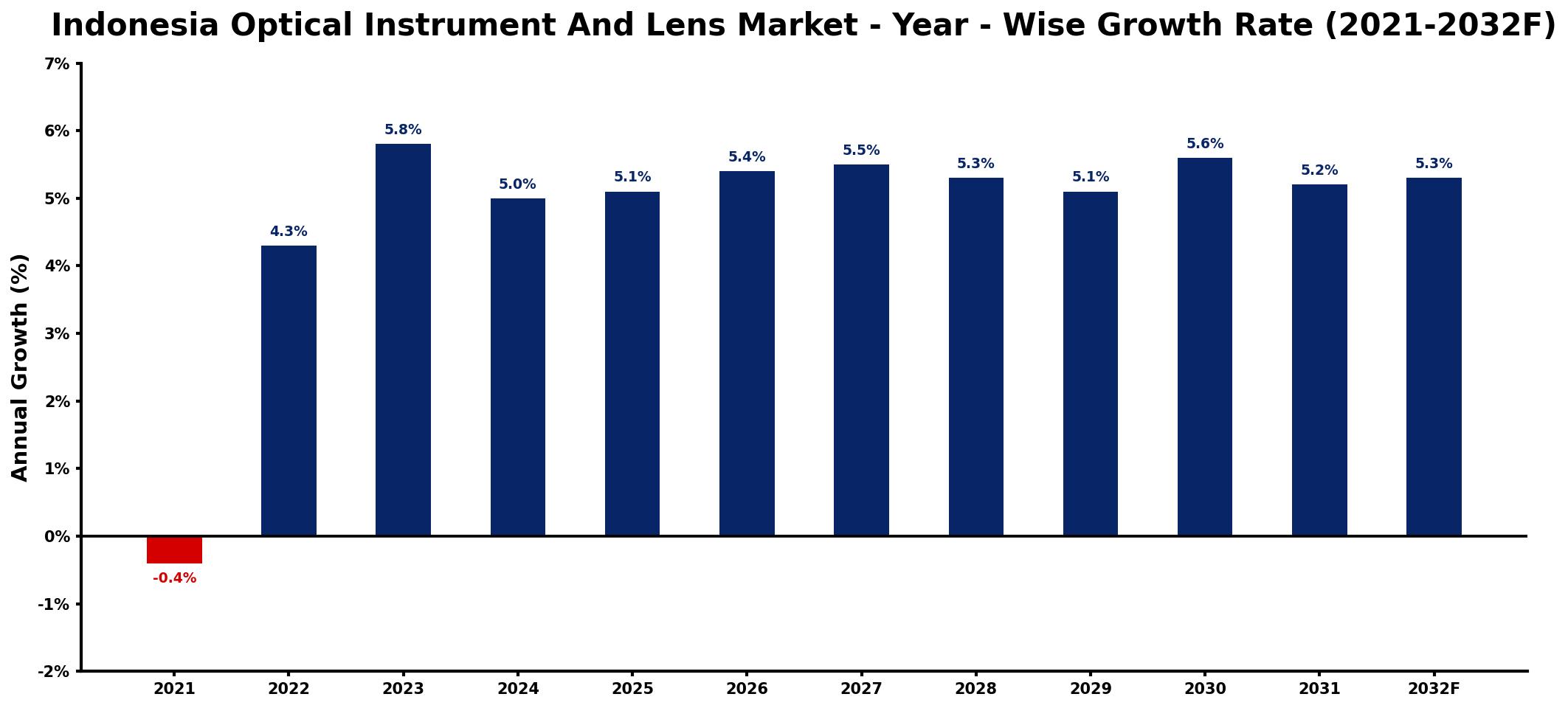
The table below presents the year‑wise growth rates along with the key drivers influencing the market
| Year | Growth Rate | Major Drivers |
| 2021 | -0.4% | decreased consumer spending on technology |
| 2022 | 4.3% | rising demand for healthcare services |
| 2023 | 5.8% | increased investment in R&D |
| 2024 | 5.0% | growing interest in digital solutions |
| 2025 | 5.1% | expansion of e-commerce platforms |
| 2026 | 5.4% | surge in telemedicine applications |
| 2027 | 5.5% | enhanced manufacturing capabilities emerging |
| 2028 | 5.3% | growing awareness of visual health |
| 2029 | 5.1% | expanding industrial usage applications |
| 2030 | 5.6% | increased focus on sustainability initiatives |
| 2031 | 5.2% | increased pharmaceutical industry usage |
| 2032 | 5.3% | growth in aging population demographics |
Note: Market size estimations and growth projections presented in this report are based on 6Wresearch's proprietary forecasting methodology, utilizing the latest available industry data, government publications, and primary research inputs.
Indonesia Optical Instrument And Lens Market Synopsis
The strongest force shaping the Indonesia Optical Instrument and Lens Market currently is the governments commitment to improving healthcare facilities. This initiative is not only enhancing the quality of healthcare services but also leading to increased demand for medical imaging devices and other optical instruments.
In addition, the burgeoning interest in educational advancements, particularly in science and technology disciplines, is driving the need for optical tools and instruments. As educational institutions prioritize quality resources for practical learning, demand for high-performance optical instruments is poised to rise.
Indonesia Optical Instrument And Lens Market Key Takeaways
- The market is supported by government initiatives aimed at bolstering healthcare and education sectors.
- Technological innovations in optics are enhancing the quality and efficiency of optical instruments.
- Healthcare, telecommunications, and educational sectors are the primary drivers of market demand.
- Local manufacturers face competition from international players but have opportunities for niche markets through innovation.
- The impact of COVID-19 on market dynamics presents both challenges and opportunities for recovery and growth.
Evaluation of Restraints in Indonesia Optical Instrument And Lens Market
Despite the positive growth outlook, the Indonesia Optical Instrument and Lens Market faces several restraints. Stringent regulations governing the importation and distribution of optical products can hinder market entry for new players. Additionally, the relatively high competition from established international brands may pose challenges for local manufacturers, who need to prioritize innovation, quality assurance, and cost-efficient distribution to differentiate themselves effectively.
Indonesia Optical Instrument And Lens Market Trends
The market is currently witnessing a trend towards the integration of smart technology in optical devices, leading to improved functionality and user experience. The growing use of augmented reality (AR) and virtual reality (VR) technologies is also influencing demand, as these applications require advanced optical solutions. Additionally, the increasing focus on sustainability in manufacturing processes is prompting producers to innovate in environmentally friendly materials and techniques.
Indonesia Optical Instrument And Lens Market Opportunities
Significant growth opportunities exist in the medical sector, particularly in the development of advanced diagnostic and therapeutic optical tools. The education sector also presents substantial prospects, with increasing budgets for laboratory equipment and educational resources. As Indonesian businesses adapt to new technologies, the demand for customized optical solutions will likely surge, providing a fertile ground for innovation and investment.
Government Initiatives in the Indonesia Optical Instrument And Lens Market
The Indonesian government is implementing various initiatives to enhance the healthcare and education sectors, including increased budget allocations and public-private partnerships. These policies aim to boost local manufacturing capabilities and encourage the adoption of advanced optical technologies. Programs that promote research and development in optics, along with supportive regulations, further aim to establish a more robust market environment.
Future Insights of the Indonesia Optical Instrument And Lens Market
Looking ahead to the period from 2026 to 2032, the Indonesia Optical Instrument and Lens Market is expected to evolve significantly, driven by sustained investments in healthcare and education. Advancements in optical technology will continue to shape the landscape, fostering new applications and demand across diverse sectors. As competition heats up, local players will need to innovate continuously to remain relevant, while collaboration between stakeholders may pave the way for a more integrated market ecosystem.
Indonesia Optical Instrument And Lens Market Latest Developments (2025 - 2026)
Recently, the market has seen a surge in investments aimed at modernizing optical manufacturing facilities. Several initiatives are underway to enhance product quality and diversify offerings in line with consumer needs. Furthermore, collaborations between educational institutions and optical manufacturers are on the rise, focusing on research and development to promote cutting-edge solutions tailored to local markets.
Indonesia Optical Instrument And Lens Market - Key Attractiveness of the Report
- 10 Years of Market Numbers
- Historical Data Starting from 2022 to 2025
- Base Year: 2025
- Forecast Data until 2032
- Key Performance Indicators Impacting the Market
- Major Upcoming Developments and Projects
Key Highlights of the Report:
- Indonesia Optical Instrument And Lens Market Outlook
- Market Size of Indonesia Optical Instrument And Lens Market, 2025
- Forecast of Indonesia Optical Instrument And Lens Market, 2032
- Historical Data and Forecast of Indonesia Optical Instrument And Lens Revenues & Volume for the Period 2022-2032F
- Indonesia Optical Instrument And Lens Market Trend Evolution
- Indonesia Optical Instrument And Lens Market Drivers and Challenges
- Indonesia Optical Instrument And Lens Price Trends
- Indonesia Optical Instrument And Lens Porter's Five Forces
- Indonesia Optical Instrument And Lens Industry Life Cycle
- Historical Data and Forecast of Indonesia Optical Instrument And Lens Market Revenues & Volume By Product for the Period 2022-2032F
- Historical Data and Forecast of Indonesia Optical Instrument And Lens Market Revenues & Volume By Binoculars for the Period 2022-2032F
- Historical Data and Forecast of Indonesia Optical Instrument And Lens Market Revenues & Volume By Microscopes for the Period 2022-2032F
- Historical Data and Forecast of Indonesia Optical Instrument And Lens Market Revenues & Volume By Telescopes for the Period 2022-2032F
- Historical Data and Forecast of Indonesia Optical Instrument And Lens Market Revenues & Volume By Others for the Period 2022-2032F
- Historical Data and Forecast of Indonesia Optical Instrument And Lens Market Revenues & Volume By Category for the Period 2022-2032F
- Historical Data and Forecast of Indonesia Optical Instrument And Lens Market Revenues & Volume By Optical Instruments for the Period 2022-2032F
- Historical Data and Forecast of Indonesia Optical Instrument And Lens Market Revenues & Volume By Interchangeable Camera Lenses for the Period 2022-2032F
- Historical Data and Forecast of Indonesia Optical Instrument And Lens Market Revenues & Volume By Application for the Period 2022-2032F
- Historical Data and Forecast of Indonesia Optical Instrument And Lens Market Revenues & Volume By Medical for the Period 2022-2032F
- Historical Data and Forecast of Indonesia Optical Instrument And Lens Market Revenues & Volume By Astronomy for the Period 2022-2032F
- Historical Data and Forecast of Indonesia Optical Instrument And Lens Market Revenues & Volume By Commercial for the Period 2022-2032F
- Historical Data and Forecast of Indonesia Optical Instrument And Lens Market Revenues & Volume By Defense for the Period 2022-2032F
- Historical Data and Forecast of Indonesia Optical Instrument And Lens Market Revenues & Volume By Others for the Period 2022-2032F
- Indonesia Optical Instrument And Lens Import Export Trade Statistics
- Market Opportunity Assessment By Product
- Market Opportunity Assessment By Category
- Market Opportunity Assessment By Application
- Indonesia Optical Instrument And Lens Top Companies Market Share
- Indonesia Optical Instrument And Lens Competitive Benchmarking By Technical and Operational Parameters
- Indonesia Optical Instrument And Lens Company Profiles
- Indonesia Optical Instrument And Lens Key Strategic Recommendations






































