Indonesia Printing Market Summary
The indonesia printing market was estimated at USD 216 Million in 2025 and is projected to reach USD 288 Million by 2032, growing at a CAGR of 5.7% from 2026 to 2032.
Indonesia Printing Market Year-wise Growth Rate and Key Drivers
This graph highlights how the Indonesia Printing Market has steadily grown over the past five years, supported by major growth factors.
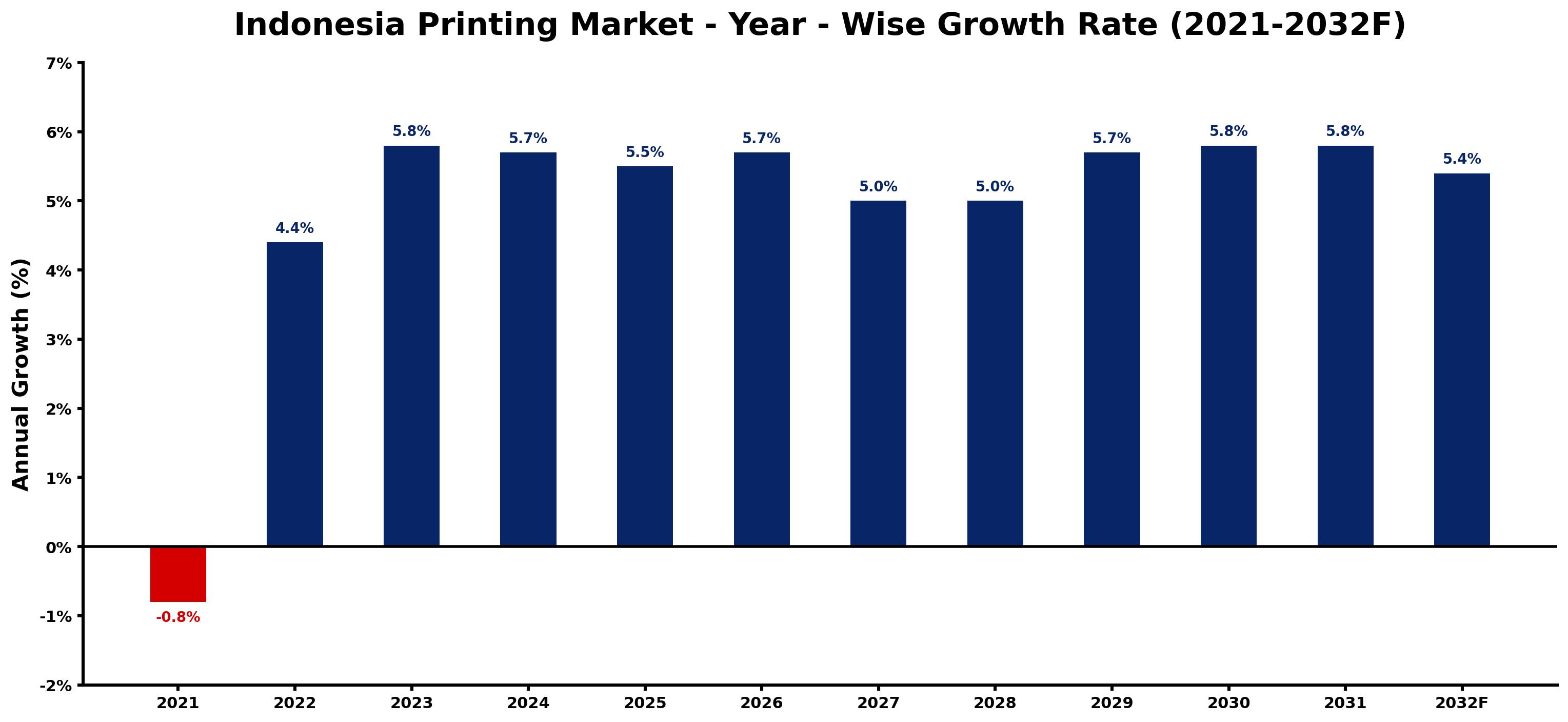
The table below presents the year wise growth rates along with the key drivers influencing the market
| Year | Growth Rate | Major Drivers |
| 2021 | -0.8% | Supply chain disruptions during 2021 limited access to essential printing materials, hindering market growth prospects. |
| 2022 | 4.4% | Sustainability trends prompt printers to adopt eco-friendly materials, enhancing market competitiveness. |
| 2023 | 5.8% | Digital transformation drives investment in new printing technologies for efficiency and quality. |
| 2024 | 5.7% | E-commerce expansion fuels demand for custom packaging and branding solutions in printing. |
| 2025 | 5.5% | Local manufacturers increasingly pursue partnerships with printing firms to optimize supply chains. |
| 2026 | 5.7% | Technological innovations in 3D printing create niche opportunities within traditional markets. |
| 2027 | 5.0% | Consumer preferences shift towards personalized products, pushing printers to innovate rapidly. |
| 2028 | 5.0% | Urbanization trends lead to higher demands for promotional materials catering to city dwellers. |
| 2029 | 5.7% | Local firms explore collaborative projects, enhancing the customization of printing services. |
| 2030 | 5.8% | Emergence of smart packaging solutions emphasizes the integration of digital technology in printing. |
| 2031 | 5.8% | Renewable energy initiatives encourage eco-conscious practices among printing companies, boosting sustainability. |
| 2032 | 5.4% | Increased competition among regional players drives continuous improvements in pricing and service delivery. |
Note - Market size estimations and growth projections presented in this report are based on 6Wresearch's advanced forecasting approach, validated with industry datasets as of June 2026.
Indonesia Printing Market Synopsis
The Indonesia Printing Market is projected to reach 5.7% and witness significant growth during the forecast period (2026-2032). This market is poised to expand at a CAGR of 5.3% as a result of the rising demand for printed materials, including books, magazines, and various publishing tools. Additionally, the swift development of digital technology is propelling the need for diverse printing services, especially concerning promotional materials and packaging design. With increasing financial commitments from both public and private sectors in projects related to publishing and advertising, the market dynamics are expected to strengthen over the coming years.
Indonesia Printing Market Growth Drivers
A variety of factors contribute to the robust growth trajectory of the Indonesia printing market. Among these, the following elements are particularly notable:
- Increasing literacy rates correlate with rising per capita income and improved living standards, which have catalyzed a greater demand for printed literature, such as books and educational materials.
- Technological advancements in printing have resulted in more efficient and cost-effective production processes, enabling publishers to offer a wider range of products at competitive prices.
- A growing number of businesses are recognizing the importance of print media in their marketing strategies. This trend is expected to enhance the overall visibility of companies and drive higher sales opportunities.
- The demand for high-quality promotional materials is on the rise, resulting in increased investments in printing services that cater to corporate branding and advertising needs.
- The surge in e-commerce has created a parallel need for effective packaging solutions, further propelling the demand for printing services across various sectors.
Indonesia Printing Market Challenges and Restraints
Despite the optimistic outlook, several challenges could impede growth within the Indonesia printing market. These challenges include:
- The high installation and maintenance costs associated with modern printing equipment can be a significant barrier, particularly for small and medium-sized enterprises (SMEs) that may struggle to afford such investments.
- Market saturation in certain segments may lead to fierce competition, compelling companies to lower prices, thereby impacting overall profitability.
- The shift towards digital alternatives is a continuing trend that can affect the traditional printing market, as consumers increasingly favor online content over printed materials.
- Environmental regulations may impose constraints on printing operations, particularly regarding the sustainability of materials used and waste management practices.
- Adapting to changing consumer preferences requires constant innovation, which can strain resources and present challenges for companies in the sector.
Indonesia Printing Market Government Investment and Initiatives
The Indonesian government has been actively involved in promoting the growth of the printing industry through various investment initiatives and policies. These initiatives aim to enhance the capabilities of local businesses and improve the quality of printing services available in the market. Key government efforts include:
- Investment incentives for companies that adopt advanced printing technologies and sustainable practices, encouraging modernization within the sector.
- Public funding for literacy and education programs that increase the demand for printed materials and contribute to a higher literacy rate in the population.
- Support for small businesses through subsidies and grants that facilitate access to modern printing equipment and technology.
- Regulatory frameworks designed to streamline business operations in the printing sector to foster a more competitive environment.
- Collaboration with private entities to develop training programs for employees in the printing industry, ensuring they are well-versed in modern technologies and practices.
Indonesia Printing Market Latest Developments (May 2025 - June 2026)
The recent developments in the Indonesia printing market from May 2025 to June 2026 indicate a continual evolution towards integrating digital technologies with traditional printing methods. Companies have increasingly adopted hybrid printing solutions that combine digital processes with conventional techniques to meet diverse customer demands. Additionally, there has been heightened emphasis on eco-friendly printing practices, leading firms to explore sustainable materials and methods that minimize environmental impact. Industry players are expected to continue pursuing partnerships that enhance their service offerings, particularly in the realms of packaging and promotional materials, aligning with market trends that favor personalization and high-quality outputs.
Indonesia Printing Market - Key Attractiveness of the Report
- 10 Years of Market Numbers
- Historical Data Starting from 2022 to 2025
- Base Year: 2025
- Forecast Data until 2032
- Key Performance Indicators Impacting the Market
- Major Upcoming Developments and Projects
Key Highlights of the Report:
- Indonesia Printing Market Outlook
- Market Size of Indonesia Printing Market, 2025
- Forecast of Indonesia Printing Market, 2032F
- Historical Data and Forecast of Indonesia Printing Revenues & Volume for the Period 2022-2032F
- Indonesia Printing Market Trend Evolution
- Indonesia Printing Market Drivers and Challenges
- Indonesia Printing Price Trends
- Indonesia Printing Porter's Five Forces
- Indonesia Printing Industry Life Cycle
- Historical Data and Forecast of Indonesia Printing Market Revenues & Volume By Types for the Period 2022-2032F
- Historical Data and Forecast of Indonesia Printing Market Revenues & Volume By Commercial Printing for the Period 2022-2032F
- Historical Data and Forecast of Indonesia Printing Market Revenues & Volume By Commercial Screen Printing for the Period 2022-2032F
- Historical Data and Forecast of Indonesia Printing Market Revenues & Volume By Books Printing for the Period 2022-2032F
- Historical Data and Forecast of Indonesia Printing Market Revenues & Volume By Technology for the Period 2022-2032F
- Historical Data and Forecast of Indonesia Printing Market Revenues & Volume By Flexography Printing for the Period 2022-2032F
- Historical Data and Forecast of Indonesia Printing Market Revenues & Volume By Rotogravure Printing for the Period 2022-2032F
- Historical Data and Forecast of Indonesia Printing Market Revenues & Volume By Digital Printing for the Period 2022-2032F
- Historical Data and Forecast of Indonesia Printing Market Revenues & Volume By OffSet Printing for the Period 2022-2032F
- Historical Data and Forecast of Indonesia Printing Market Revenues & Volume By Others for the Period 2022-2032F
- Indonesia Printing Import Export Trade Statistics
- Market Opportunity Assessment By Types
- Market Opportunity Assessment By Technology
- Indonesia Printing Top Companies Market Share
- Indonesia Printing Competitive Benchmarking By Technical and Operational Parameters
- Indonesia Printing Company Profiles
- Indonesia Printing Key Strategic Recommendations






































