Indonesia Stainless Steel Round Bar Market Size, Share & Growth Rate
The Indonesia Stainless Steel Round Bar Market was estimated at USD 1465 Million in 2025 and is projected to reach USD 2226 Million by 2032, growing at a CAGR of 6.2% from 2026 to 2032. This growth trajectory is primarily driven by the burgeoning construction sector and the increasing adoption of stainless steel in automotive and consumer goods manufacturing. As urbanization accelerates and infrastructure projects multiply across the archipelago, the demand for durable, corrosion-resistant materials will continue to rise, solidifying the market's positive outlook.
Indonesia Stainless Steel Round Bar Market Year-wise Growth Rate and Key Drivers
This graph highlights how the Indonesia Stainless Steel Round Bar Market has steadily grown over the years, supported by major growth factors.
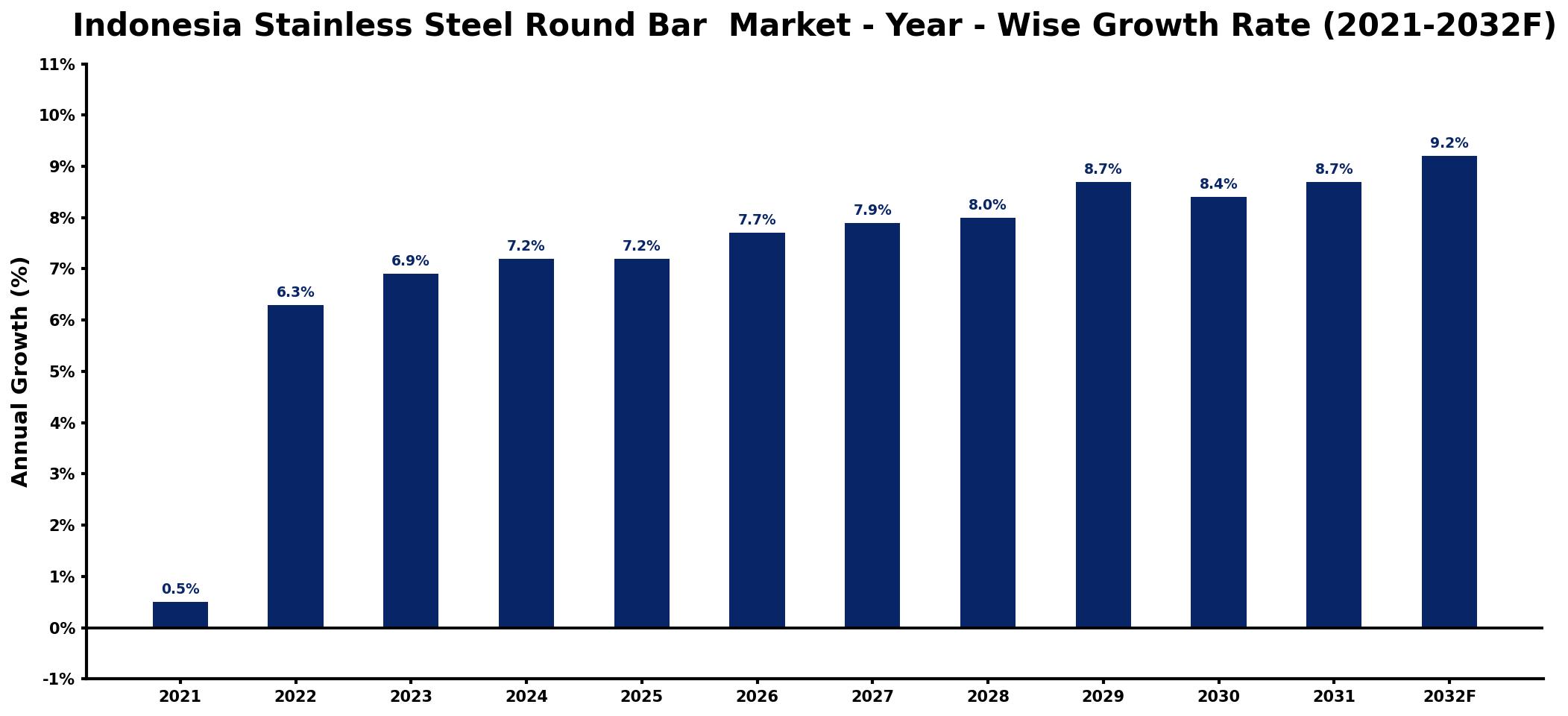
The table below presents the year‑wise growth rates along with the key drivers influencing the market
| Year | Growth Rate | Major Drivers |
| 2021 | 0.5% | Increased demand from construction sector |
| 2022 | 6.3% | Growing investments in manufacturing facilities |
| 2023 | 6.9% | Rising automotive industry requirements |
| 2024 | 7.2% | Expansion of energy sector projects |
| 2025 | 7.2% | Surge in infrastructure development initiatives |
| 2026 | 7.7% | Boost in consumer goods production |
| 2027 | 7.9% | Enhanced export opportunities for manufacturers |
| 2028 | 8.0% | Technological advancements in production processes |
| 2029 | 8.7% | Strengthened supply chain networks established |
| 2030 | 8.4% | stronger distribution network expansion |
| 2031 | 8.7% | Increased usage in transportation applications |
| 2032 | 9.2% | Rising demand for durable materials |
Note: Market size estimations and growth projections presented in this report are based on 6Wresearch's proprietary forecasting methodology, utilizing the latest available industry data, government publications, and primary research inputs.
Indonesia Stainless Steel Round Bar Market Synopsis
Currently, the Indonesia Stainless Steel Round Bar Market is experiencing a surge in demand, attributed to strong growth in key industries. The construction sector, in particular, is witnessing a notable boom as urbanization progresses, leading to increased use of stainless steel for structural reinforcement and safety.
In addition to construction, the automotive industry is also a significant contributor to market expansion. Manufacturers are increasingly favoring stainless steel for automotive components and machinery, driven by its durability and resistance to corrosion. This multifaceted demand underscores the robustness of the market.
Indonesia Stainless Steel Round Bar Market Key Takeaways
- The market is anticipated to benefit from rapid urbanization and increased construction projects.
- Rising disposable incomes in Indonesia are shifting consumer preferences toward durable materials.
- Growth in the automotive and consumer goods sectors is significantly influencing stainless steel round bar demand.
- Price volatility in raw materials like nickel and chromium poses challenges to manufacturers.
- Domestic manufacturers must focus on cost efficiency and product quality to remain competitive.
Evaluation of Restraints in Indonesia Stainless Steel Round Bar Market
Despite the promising growth, the Indonesia Stainless Steel Round Bar Market faces several key restraints. Notably, fluctuations in global prices of nickel and chromium, essential components in stainless steel production, can lead to unpredictable production costs and pricing strategies. Additionally, competition from imported stainless steel products can dilute market shares for local manufacturers. These challenges necessitate a focus on operational efficiencies and enhanced product offerings to ensure competitiveness in the evolving market landscape.
Indonesia Stainless Steel Round Bar Market Trends
One prominent trend is the increasing focus on sustainable manufacturing practices within the stainless steel industry. As environmental concerns gain traction, manufacturers are exploring recycled materials and greener production techniques. Furthermore, the integration of advanced technology, such as automation and AI in production processes, is enhancing productivity and efficiency in meeting the growing demand for stainless steel round bars.
Additionally, there is a shift toward customization, with manufacturers providing tailored solutions to meet the specific requirements of various sectors, especially in construction and automotive applications. This trend is helping to establish long-term relationships between manufacturers and clients.
Indonesia Stainless Steel Round Bar Market Opportunities
Investment opportunities abound in the Indonesia Stainless Steel Round Bar Market, particularly in enhancing production capabilities and expanding product lines. As the construction and automotive industries grow, there is a clear need for more sophisticated and specialized stainless steel products. Companies that can innovate and offer high-quality, customized solutions are likely to capitalize on this demand. Moreover, tapping into the healthcare sector, which has shown resilience even during economic downturns, could provide additional growth avenues.
Government Initiatives in the Indonesia Stainless Steel Round Bar Market
The Indonesian government has recognized the strategic importance of the manufacturing sector, including stainless steel production. Various initiatives aim to bolster infrastructure development, encouraging investments in construction and manufacturing projects. Programs promoting local production and the use of domestically sourced materials are also being implemented, which could enhance the competitiveness of local manufacturers. These efforts, combined with public spending on infrastructure, promise to further stimulate market growth.
Future Insights of the Indonesia Stainless Steel Round Bar Market
Looking ahead to 2026-2032, the Indonesia Stainless Steel Round Bar Market is poised for substantial growth, fueled by ongoing urban development and increasing industrial activities. As more projects are initiated, both in infrastructure and manufacturing, demand for high-quality stainless steel round bars will continue to escalate. Furthermore, advancements in technology and sustainability practices will likely shape production processes, ensuring that the market adapts to both consumer preferences and environmental standards.
Indonesia Stainless Steel Round Bar Market Latest Developments (2025 - 2026)
Recent developments indicate a shift towards greater investment in production capabilities, as manufacturers look to enhance efficiency and output. Notably, there has been an uptick in research and development initiatives aimed at improving the quality and performance of stainless steel products. This includes exploration into innovative production techniques and sustainable practices, aligning with global trends in environmental responsibility.
Indonesia Stainless Steel Round Bar Market - Key Attractiveness of the Report
- 10 Years of Market Numbers
- Historical Data Starting from 2022 to 2025
- Base Year: 2025
- Forecast Data until 2032
- Key Performance Indicators Impacting the Market
- Major Upcoming Developments and Projects
Key Highlights of the Report:
- Indonesia Stainless Steel Round Bar Market Outlook
- Market Size of Indonesia Stainless Steel Round Bar Market, 2025
- Forecast of Indonesia Stainless Steel Round Bar Market, 2032
- Historical Data and Forecast of Indonesia Stainless Steel Round Bar Revenues & Volume for the Period 2022-2032F
- Indonesia Stainless Steel Round Bar Market Trend Evolution
- Indonesia Stainless Steel Round Bar Market Drivers and Challenges
- Indonesia Stainless Steel Round Bar Price Trends
- Indonesia Stainless Steel Round Bar Porter's Five Forces
- Indonesia Stainless Steel Round Bar Industry Life Cycle
- Historical Data and Forecast of Indonesia Stainless Steel Round Bar Market Revenues & Volume By Product for the Period 2022-2032F
- Historical Data and Forecast of Indonesia Stainless Steel Round Bar Market Revenues & Volume By Cr-Ni for the Period 2022-2032F
- Historical Data and Forecast of Indonesia Stainless Steel Round Bar Market Revenues & Volume By Duplex & Super Duplex for the Period 2022-2032F
- Historical Data and Forecast of Indonesia Stainless Steel Round Bar Market Revenues & Volume By High Nickel Alloys for the Period 2022-2032F
- Indonesia Stainless Steel Round Bar Import Export Trade Statistics
- Market Opportunity Assessment By Product
- Indonesia Stainless Steel Round Bar Top Companies Market Share
- Indonesia Stainless Steel Round Bar Competitive Benchmarking By Technical and Operational Parameters
- Indonesia Stainless Steel Round Bar Company Profiles
- Indonesia Stainless Steel Round Bar Key Strategic Recommendations






































