Indonesia Toys and Hobby Goods Market: Import Trend Analysis
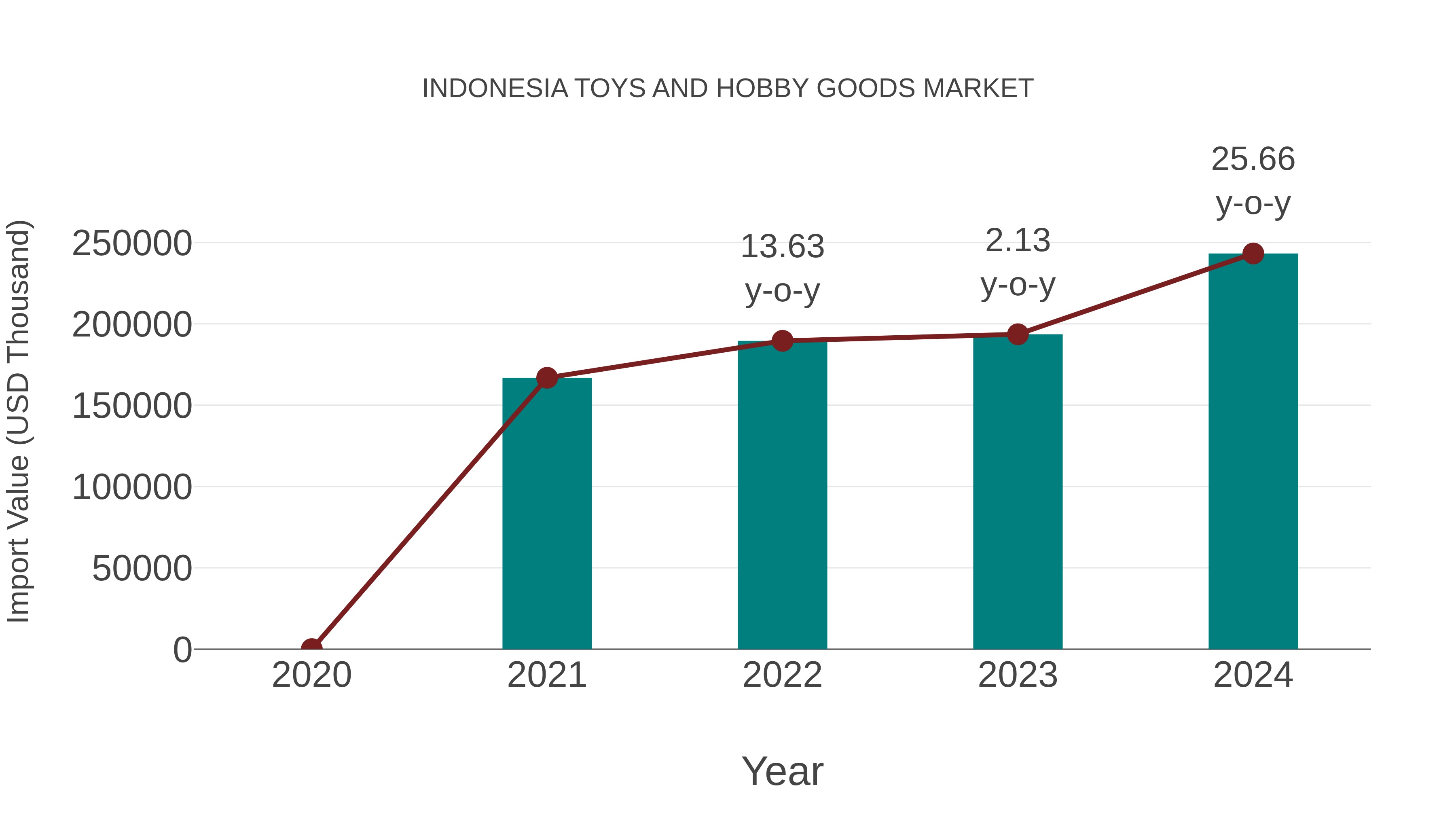
In the Indonesia toys and hobby goods market, the import trend showed significant growth from 2023 to 2024, with a 25.66% increase. The compound annual growth rate (CAGR) for the period 2020-2024 stood at 13.4%. This import momentum can be attributed to a notable shift in consumer demand towards premium and innovative products, indicating a positive market stability and growing interest in these goods.
Indonesia Toys and Hobby Goods Market Synopsis
The Indonesia Toys and Hobby Goods Market is estimated to register a CAGR of 8.3% during theperiod (2020-2026). Growing population rising disposable income increasing number of working women growing middle class segment are some key factors driving theof Indonesia`s toys and hobby goods market. The major players in this market are Bandai Namco Holdings Inc. Mattel Inc. Hasbro Inc. MGA Entertainment Inc. Jakks Pacific Inc.
Key Factors Driving the Market
Increasing Disposable Income: The increasing per capita disposable income has led to an increase in the purchasing power of consumers which will lead to an increase in demand for toys hobby products along with other recreational activities such as travelling and gaming. This factor is expected to drive theof Indonesia toys hobby goods market during theperiod. Growing Middle Class Segment: With growing economic development there is a rapid increase in middle-class households across Indonesia which will eventually lead to increased spending on leisure items including educational and recreational toys hobby products. Online Retailing Platforms: Online retail platforms such as Lazada and Tokopedia have provided easy access for customers to purchase their desired toy or hobby product from home itself with just few clicks without any hassle involved in it leading more people attracted towards online shopping portals. This factor is projected to contribute positively towards theof Indonesia toy Hobby goods market over next six years.
Challenges Facing the Market
High Pricing Of Products : Most international brands charge higher prices than local ones due to high import duties applied on foreign products making domestic brands more affordable compared international ones which might limit customer choice .This can prove hamper for further expansion opportunities present in Indonesia Toy&Hobby Goods Market.
Key Market Players
Bandai Namco Holdings inc.: Established on 29th December 2005 Bandai Namco Holdings inc located at Tokyo is one among largest entertainmentbased out Japan dealing into video game software publishing toy manufacturing etc .It operates under four business segments namely Amusement Facility Business Toys And Hobby Business Retail network businessVisual And Music Production Business having wide geographic presence throughout world . Mattel inc.: Founded by Elliot Handler Ruth Handler back on 1945 Mattel inc located at California USA deals into designing production marketing selling toy related accessories worldwide operating through two main divisions namely North America.
Key Highlights of the Report:
- Indonesia Toys and Hobby Goods Market Outlook
- Market Size of Indonesia Toys and Hobby Goods Market, 2023
- Forecast of Indonesia Toys and Hobby Goods Market, 2030
- Historical Data and Forecast of Indonesia Toys and Hobby Goods Revenues & Volume for the Period 2020-2030
- Indonesia Toys and Hobby Goods Market Trend Evolution
- Indonesia Toys and Hobby Goods Market Drivers and Challenges
- Indonesia Toys and Hobby Goods Price Trends
- Indonesia Toys and Hobby Goods Porter's Five Forces
- Indonesia Toys and Hobby Goods Industry Life Cycle
- Historical Data and Forecast of Indonesia Toys and Hobby Goods Market Revenues & Volume By Type for the Period 2020-2030
- Historical Data and Forecast of Indonesia Toys and Hobby Goods Market Revenues & Volume By Sports Toys for the Period 2020-2030
- Historical Data and Forecast of Indonesia Toys and Hobby Goods Market Revenues & Volume By Intellectual Toys for the Period 2020-2030
- Historical Data and Forecast of Indonesia Toys and Hobby Goods Market Revenues & Volume By Education Toys for the Period 2020-2030
- Historical Data and Forecast of Indonesia Toys and Hobby Goods Market Revenues & Volume By Decorative Toys for the Period 2020-2030
- Historical Data and Forecast of Indonesia Toys and Hobby Goods Market Revenues & Volume By Other for the Period 2020-2030
- Historical Data and Forecast of Indonesia Toys and Hobby Goods Market Revenues & Volume By Application for the Period 2020-2030
- Historical Data and Forecast of Indonesia Toys and Hobby Goods Market Revenues & Volume By Online Sales for the Period 2020-2030
- Historical Data and Forecast of Indonesia Toys and Hobby Goods Market Revenues & Volume By Offline Sales for the Period 2020-2030
- Historical Data and Forecast of Indonesia Toys and Hobby Goods Market Revenues & Volume By Others for the Period 2020-2030
- Indonesia Toys and Hobby Goods Import Export Trade Statistics
- Market Opportunity Assessment By Type
- Market Opportunity Assessment By Application
- Indonesia Toys and Hobby Goods Top Companies Market Share
- Indonesia Toys and Hobby Goods Competitive Benchmarking By Technical and Operational Parameters
- Indonesia Toys and Hobby Goods Company Profiles
- Indonesia Toys and Hobby Goods Key Strategic Recommendations






































