Indonesia Toys & Games Market Summary
The indonesia toys & games market was estimated at USD 370 Million in 2025 and is projected to reach USD 489 Million by 2032, growing at a CAGR of 5.7% from 2026 to 2032.
Indonesia Toys & Games Market Year-wise Growth Rate and Key Drivers
This graph highlights how the Indonesia Toys & Games Market has steadily grown over the past five years, supported by major growth factors.
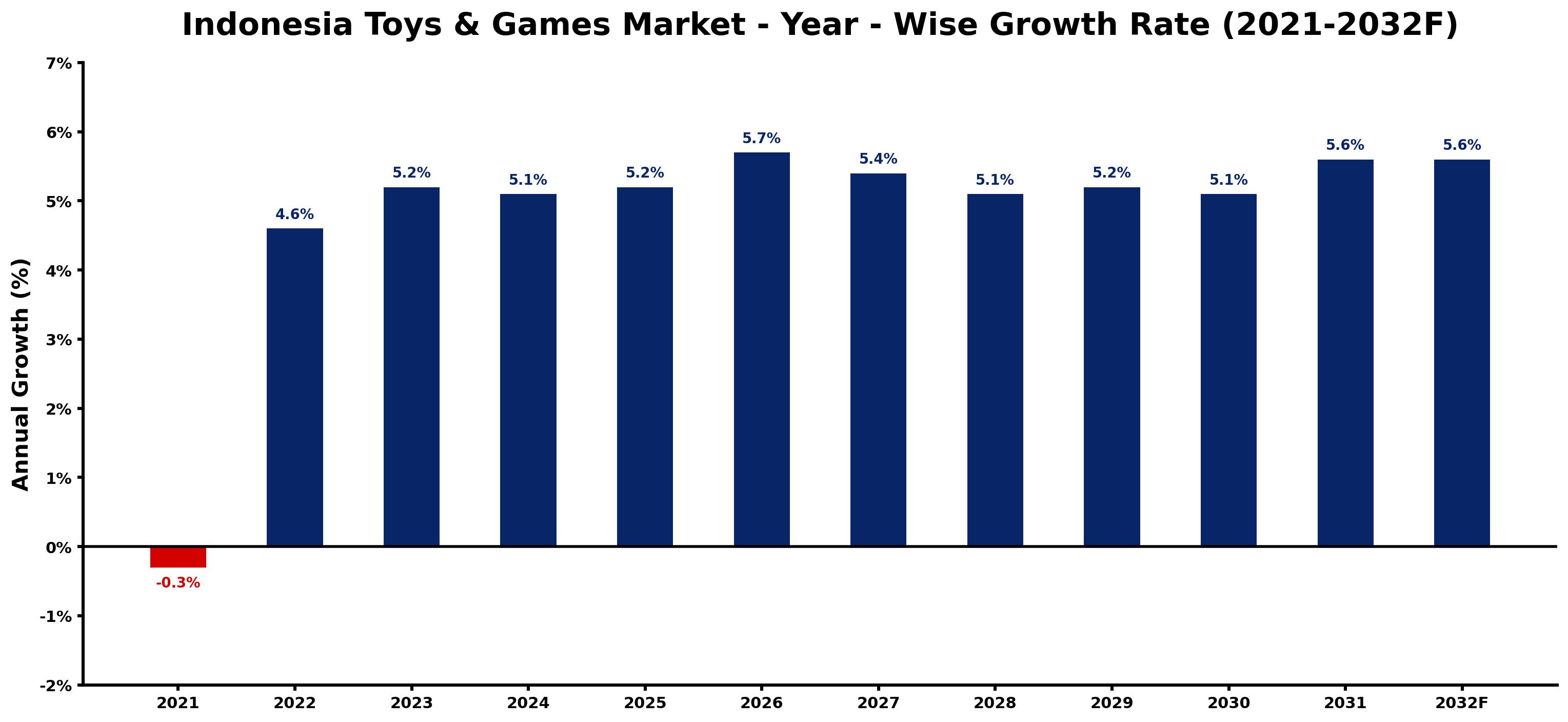
The table below presents the year wise growth rates along with the key drivers influencing the market
| Year | Growth Rate | Major Drivers |
| 2021 | -0.3% | Increased digital entertainment options diverted consumer spending away from traditional toys and games. |
| 2022 | 4.6% | E-commerce platforms expanded their reach, enabling toys to access remote areas efficiently. |
| 2023 | 5.2% | Regional manufacturing partnerships enhanced local toy production, improving supply chain resilience. |
| 2024 | 5.1% | Increasing disposable income levels drove interest in premium and educational toy options. |
| 2025 | 5.2% | Social media influencers began showcasing toys, significantly impacting purchasing decisions of parents. |
| 2026 | 5.7% | Emerging trends in sustainability encouraged eco-friendly toys, appealing to environmentally conscious consumers. |
| 2027 | 5.4% | Activity-based toys gained popularity as parents sought more interactive playtime solutions for children. |
| 2028 | 5.1% | Local festivals and cultural events began featuring traditional toys, boosting local craftsmanship awareness. |
| 2029 | 5.2% | Digital toys integrating augmented reality captured the imagination of tech-savvy children and parents. |
| 2030 | 5.1% | Investment in early childhood development programs highlighted the role of play in learning. |
| 2031 | 5.6% | Market consolidation among major toy brands reshaped competition, enhancing innovation and variety. |
| 2032 | 5.6% | Strengthening community engagements fostered local brands, creating a vibrant ecosystem of toy options. |
Note - Market size estimations and growth projections presented in this report are based on 6Wresearch's advanced forecasting approach, validated with industry datasets as of June 2026.
Indonesia Toys & Games Market Synopsis
The Indonesia Toys Games Market is projected to reach 5.7% and witness significant growth during the forecast period (2026-2032). In 2020, the market was valued at USD 9.31 billion, and this growth trajectory is largely attributed to several key factors including rising disposable incomes, an increasing number of working women, and the growing influence of digital media on consumer preferences.
Indonesia Toys & Games Market Growth Drivers
The landscape of the Indonesia Toys & Games Market is evolving due to several influential drivers:
- The rise in disposable income among urban families has empowered consumers to purchase higher-priced toys, including electronic devices and remote-controlled vehicles that often require batteries.
- A growing middle class contributes to increased consumer spending, particularly on recreational activities like toys, which are seen as a vital component of child development.
- The significant presence of eCommerce platforms has modernized the retail environment, providing convenient shopping options that encourage consumers to engage in online purchases.
- Manufacturers are innovating with designs and functionalities to capture market interest, resulting in diverse offerings that include educational toys and interactive games.
- An increasing focus on developmental benefits associated with toys, such as cognitive and motor skills enhancement, drives parental purchases supporting children's growth and learning.
Indonesia Toys & Games Market Trends and Opportunities
The Indonesia Toys & Games Market is witnessing notable trends that present various opportunities for growth:
- There is a marked shift towards educational toys that promote skill development, reflecting a growing awareness of the importance of early childhood education.
- Digitalization has spurred the demand for tech-based toys, including those that leverage augmented reality and interactive software, appealing to tech-savvy consumers.
- As sustainability becomes a priority, eco-friendly toys are gaining traction, attracting consumers who are committed to environmental responsibility.
- The integration of storytelling and educational content in toys is becoming a standard, creating deeper engagement and learning experiences for children.
- International brands are increasingly entering the Indonesian market, bringing innovative products that enhance competition and expand consumer choices.
Indonesia Toys & Games Market Challenges and Restraints
Despite its growth potential, the Indonesia Toys & Games Market faces several challenges that could hinder its expansion:
- The lack of standardized quality regulations in toy manufacturing often leads to a proliferation of low-quality products, undermining consumer trust and safety.
- Counterfeit goods pose a significant threat, as they flood the market with inferior alternatives at lower prices, damaging the reputations of legitimate manufacturers.
- High investment requirements for distribution channels create a barrier for smaller players, while large retailers with attractive discounts dominate the market.
- Consumer awareness around the benefits of branded and high-quality toys remains limited, impacting sales of premium products.
- Economic disparities between urban and rural areas lead to uneven market penetration, often limiting access to a wide range of toy offerings in less developed regions.
Indonesia Toys & Games Market Government Investment and Initiatives
The Indonesian government is actively investing in various initiatives that foster growth within the Toys & Games Market. These initiatives include:
- Policy frameworks aimed at enhancing industry standards and safety regulations for toy manufacturing, ensuring consumer protection and product quality.
- Incentives for local manufacturers to innovate and develop products that align with educational and developmental needs, driving consumer interest in quality toys.
- Support for entrepreneurship in the children's product sector, providing resources and funding opportunities for startups and small businesses.
- Investments in public awareness campaigns that promote the importance of educational toys and their developmental benefits, particularly in urban and rural communities.
- Collaboration with international organizations to adopt best practices from global markets, enhancing local industry competitiveness.
Indonesia Toys & Games Market Latest Developments (May 2025 - June 2026)
In the period from May 2025 to June 2026, the Indonesia Toys & Games Market has been characterized by several key developments:
- A surge in the production and launch of educational toys that align with curriculum-based learning, fostering a greater emphasis on developmental benefits for children.
- Continued growth of eCommerce platforms has led to partnerships between brands and online retailers, optimizing distribution channels and enhancing market reach.
- New regulations have been introduced focused on improving safety standards in toy manufacturing, aiming to reduce counterfeit products in the market.
- Increased investment from both domestic and international players into innovative and sustainable toy designs, catering to environmentally conscious consumers.
- Recognition of the importance of interactive and tech-based toys has resulted in significant interest from investors, leading to new product categories emerging within the market.
Indonesia Toys & Games Market - Key Attractiveness of the Report
- 10 Years of Market Numbers
- Historical Data Starting from 2022 to 2025
- Base Year: 2025
- Forecast Data until 2032
- Key Performance Indicators Impacting the Market
- Major Upcoming Developments and Projects
Key Highlights of the Report:
- Indonesia Toys & Games Market Outlook
- Market Size of Indonesia Toys & Games Market, 2025
- Forecast of Indonesia Toys & Games Market, 2032F
- Historical Data and Forecast of Indonesia Toys & Games Revenues & Volume for the Period 2022-2032F
- Indonesia Toys & Games Market Trend Evolution
- Indonesia Toys & Games Market Drivers and Challenges
- Indonesia Toys & Games Price Trends
- Indonesia Toys & Games Porter's Five Forces
- Indonesia Toys & Games Industry Life Cycle
- Historical Data and Forecast of Indonesia Toys & Games Market Revenues & Volume By Product Type for the Period 2022-2032F
- Historical Data and Forecast of Indonesia Toys & Games Market Revenues & Volume By Puzzles for the Period 2022-2032F
- Historical Data and Forecast of Indonesia Toys & Games Market Revenues & Volume By Preschool Toys for the Period 2022-2032F
- Historical Data and Forecast of Indonesia Toys & Games Market Revenues & Volume By Outdoor/Sports for the Period 2022-2032F
- Historical Data and Forecast of Indonesia Toys & Games Market Revenues & Volume By Dolls for the Period 2022-2032F
- Historical Data and Forecast of Indonesia Toys & Games Market Revenues & Volume By Video Games for the Period 2022-2032F
- Historical Data and Forecast of Indonesia Toys & Games Market Revenues & Volume By Others for the Period 2022-2032F
- Historical Data and Forecast of Indonesia Toys & Games Market Revenues & Volume By Applications for the Period 2022-2032F
- Historical Data and Forecast of Indonesia Toys & Games Market Revenues & Volume By 0 - 8 Years for the Period 2022-2032F
- Historical Data and Forecast of Indonesia Toys & Games Market Revenues & Volume By 8 - 15 Years for the Period 2022-2032F
- Historical Data and Forecast of Indonesia Toys & Games Market Revenues & Volume By 15 Years & Above for the Period 2022-2032F
- Historical Data and Forecast of Indonesia Toys & Games Market Revenues & Volume By Distribution Channel for the Period 2022-2032F
- Historical Data and Forecast of Indonesia Toys & Games Market Revenues & Volume By Offline for the Period 2022-2032F
- Historical Data and Forecast of Indonesia Toys & Games Market Revenues & Volume By Online for the Period 2022-2032F
- Indonesia Toys & Games Import Export Trade Statistics
- Market Opportunity Assessment By Product Type
- Market Opportunity Assessment By Applications
- Market Opportunity Assessment By Distribution Channel
- Indonesia Toys & Games Top Companies Market Share
- Indonesia Toys & Games Competitive Benchmarking By Technical and Operational Parameters
- Indonesia Toys & Games Company Profiles
- Indonesia Toys & Games Key Strategic Recommendations






































