Iraq Automotive Wheel Rims Market Size, Share & Growth Rate
The Iraq Automotive Wheel Rims Market was estimated at USD 550 Million in 2025 and is projected to reach USD 794 Million by 2032, growing at a CAGR of 5.4% from 2026 to 2032. This positive trajectory can largely be attributed to an uptick in vehicle sales, driven by rising disposable incomes and a burgeoning middle class. Furthermore, ongoing government initiatives aimed at enhancing infrastructure are significantly contributing to the market's expansion.
Iraq Automotive Wheel Rims Market Year-wise Growth Rate and Key Drivers
This graph highlights how the Iraq Automotive Wheel Rims Market has steadily grown over the years, supported by major growth factors.
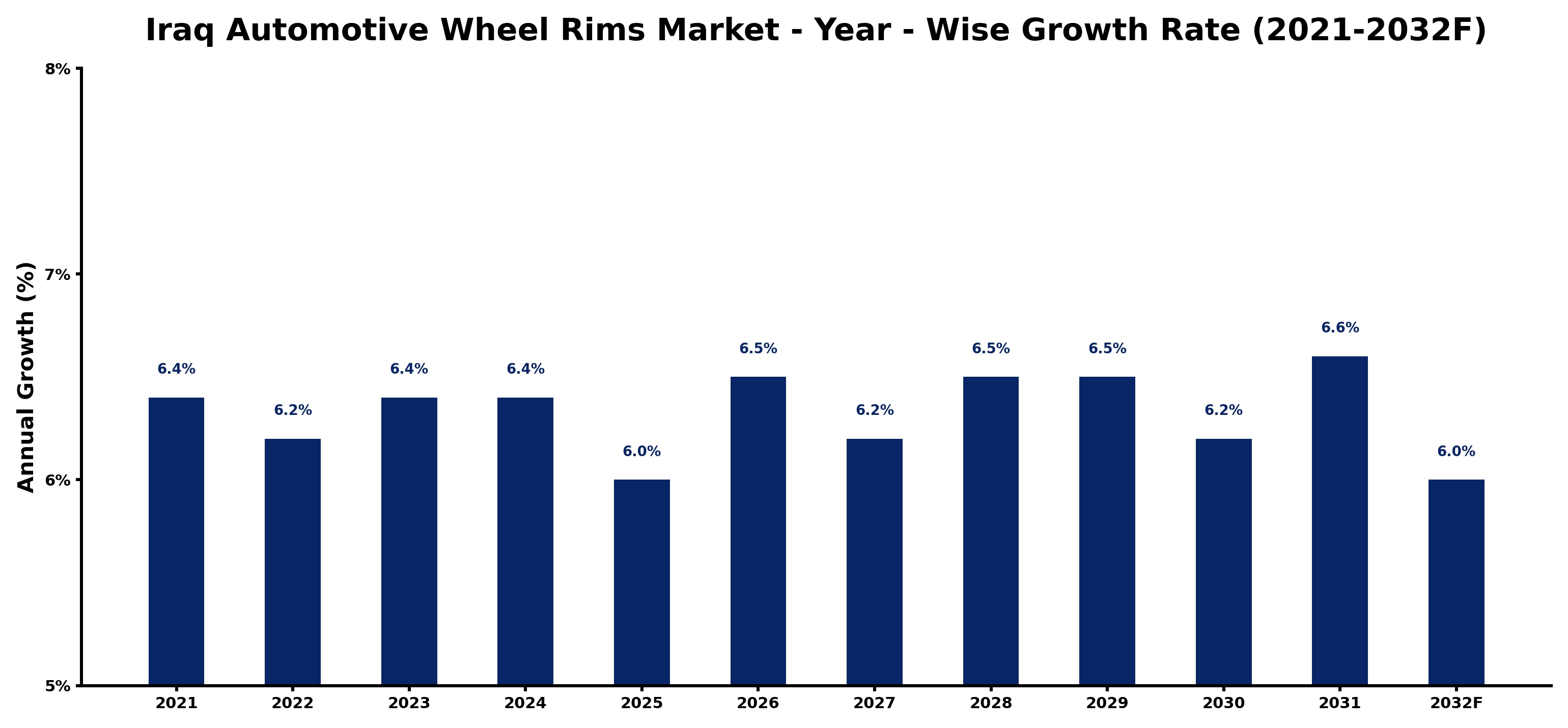
The table below presents the year‑wise growth rates along with the key drivers influencing the market
| Year | Growth Rate | Major Drivers |
| 2021 | 6.4% | Increased vehicle production demand |
| 2022 | 6.2% | Rising consumer spending on vehicles |
| 2023 | 6.4% | Infrastructure development enhanced accessibility |
| 2024 | 6.4% | Growing automotive aftermarket services |
| 2025 | 6.0% | Technological advancements in manufacturing |
| 2026 | 6.5% | Sustainability trends influenced purchases |
| 2027 | 6.2% | Rising popularity of electric vehicles |
| 2028 | 6.5% | Enhanced distribution networks expanded reach |
| 2029 | 6.5% | Export opportunities boosted market growth |
| 2030 | 6.2% | Growing urbanization increased vehicle ownership |
| 2031 | 6.6% | Improved quality standards attracted buyers |
| 2032 | 6.0% | Rising disposable income fueled demand |
Note - Market size estimations and growth projections presented in this report are based on 6Wresearch’s advanced forecasting approach, validated with industry datasets as of June 2026.
Iraq Automotive Wheel Rims Market Synopsis
In Iraq, steel wheel rims currently dominate the market, thanks to their cost-effectiveness and durability. However, there is a noticeable shift towards alloy wheel rims, driven by consumer preferences for enhanced aesthetics and improved vehicle performance.
Moreover, with urbanization on the rise, more consumers are investing in vehicles, thus increasing the demand for both standard and customized wheel rims. As Iraqi consumers become increasingly quality-conscious, the trend toward personalized rim designs is also gaining momentum.
Iraq Automotive Wheel Rims Market Key Takeaways
- The market is projected to grow at a CAGR of 5.4% from 2026 to 2032.
- Consumer demand for aesthetic and performance-oriented alloys is rising.
- Urbanization and increased disposable income are significant growth drivers.
- Technological advancements are facilitating new product features like smart monitoring.
- Investment in eco-friendly materials is becoming a priority in manufacturing.
Evaluation of Restraints in Iraq Automotive Wheel Rims Market
Despite the promising growth outlook, the Iraq Automotive Wheel Rims Market is hindered by several critical restraints. A significant lack of manufacturing infrastructure and advanced technology presents challenges for local producers striving to meet rising demand. Additionally, fluctuating raw material prices create uncertainty, while high import tariffs on automotive components inhibit international competitiveness. The prevailing political instability and economic volatility further complicate the market landscape, presenting a multifaceted set of challenges for stakeholders.
Iraq Automotive Wheel Rims Market Trends
Several notable trends are shaping the Iraq Automotive Wheel Rims Market. Not only is there an increasing demand for lightweight rims to enhance fuel efficiency, but consumer preference is also shifting towards customization and unique designs. Furthermore, as global sustainability initiatives gain traction, manufacturers are exploring eco-friendly materials and sustainable production processes. The integration of smart technologies, such as sensors for tire pressure and temperature monitoring, is also starting to influence consumer purchasing decisions.
Iraq Automotive Wheel Rims Market Opportunities
The Iraq Automotive Wheel Rims Market presents various investment opportunities, particularly in manufacturing and supplying high-quality rims to meet the burgeoning vehicle demand. As the local economy stabilizes and disposable incomes rise, the potential for tailored and innovative wheel rim solutions is significant. Moreover, collaborative ventures with local automotive manufacturers or distributors can pave the way for successful market penetration, while advancements in material technology also offer pathways for product differentiation.
Government Initiatives in the Iraq Automotive Wheel Rims Market
The Iraqi government has implemented several policies aimed at enhancing the local automotive sector, including trade regulations and import tariffs designed to protect domestic manufacturers. By promoting local production, the government seeks to foster competitiveness within the industry while enforcing quality standards that ensure safety and durability for consumers. Additionally, there are various incentives available for local manufacturers that bolster the growth of the automotive wheel rims market.
Future Insights of the Iraq Automotive Wheel Rims Market
Looking forward to the period between 2026 and 2032, the Iraq Automotive Wheel Rims Market is anticipated to continue its growth trajectory. This is primarily due to the anticipated rise in vehicle ownership, spurred by economic stabilization and increased consumer purchasing power. Infrastructure improvements and government backing are likely to facilitate this growth, while the demand for innovative and aesthetically appealing products will continue to shape market dynamics. However, stakeholders will need to remain cognizant of economic uncertainties and global market trends that may impact future expansion.
Iraq Automotive Wheel Rims Market Latest Developments (May 2025 - June 2026)
Recent developments in the Iraq Automotive Wheel Rims Market indicate a growing interest in sustainable practices and innovative product features. As local manufacturers begin to invest in advanced technologies, there is an increasing focus on lightweight materials and smart technologies in wheel rim production. Furthermore, ongoing infrastructure projects are expected to bolster vehicle sales, thereby positively impacting wheel rim demand in the near future.
Iraq Automotive Wheel Rims Market - Key Attractiveness of the Report
- 10 Years of Market Numbers
- Historical Data Starting from 2022 to 2025
- Base Year: 2025
- Forecast Data until 2032
- Key Performance Indicators Impacting the Market
- Major Upcoming Developments and Projects
Key Highlights of the Report:
- Iraq Automotive Wheel Rims Market Outlook
- Market Size of Iraq Automotive Wheel Rims Market, 2025
- Forecast of Iraq Automotive Wheel Rims Market, 2032
- Historical Data and Forecast of Iraq Automotive Wheel Rims Revenues & Volume for the Period 2022-2032F
- Iraq Automotive Wheel Rims Market Trend Evolution
- Iraq Automotive Wheel Rims Market Drivers and Challenges
- Iraq Automotive Wheel Rims Price Trends
- Iraq Automotive Wheel Rims Porter's Five Forces
- Iraq Automotive Wheel Rims Industry Life Cycle
- Historical Data and Forecast of Iraq Automotive Wheel Rims Market Revenues & Volume By Material Type for the Period 2022-2032F
- Historical Data and Forecast of Iraq Automotive Wheel Rims Market Revenues & Volume By Alloy for the Period 2022-2032F
- Historical Data and Forecast of Iraq Automotive Wheel Rims Market Revenues & Volume By Steel for the Period 2022-2032F
- Historical Data and Forecast of Iraq Automotive Wheel Rims Market Revenues & Volume By Carbon Fiber for the Period 2022-2032F
- Historical Data and Forecast of Iraq Automotive Wheel Rims Market Revenues & Volume By Sales Channel for the Period 2022-2032F
- Historical Data and Forecast of Iraq Automotive Wheel Rims Market Revenues & Volume By OEM for the Period 2022-2032F
- Historical Data and Forecast of Iraq Automotive Wheel Rims Market Revenues & Volume By Aftermarket for the Period 2022-2032F
- Historical Data and Forecast of Iraq Automotive Wheel Rims Market Revenues & Volume By Vehicle Type for the Period 2022-2032F
- Historical Data and Forecast of Iraq Automotive Wheel Rims Market Revenues & Volume By Passenger Cars for the Period 2022-2032F
- Historical Data and Forecast of Iraq Automotive Wheel Rims Market Revenues & Volume By Commercial Vehicles for the Period 2022-2032F
- Iraq Automotive Wheel Rims Import Export Trade Statistics
- Market Opportunity Assessment By Material Type
- Market Opportunity Assessment By Sales Channel
- Market Opportunity Assessment By Vehicle Type
- Iraq Automotive Wheel Rims Top Companies Market Share
- Iraq Automotive Wheel Rims Competitive Benchmarking By Technical and Operational Parameters
- Iraq Automotive Wheel Rims Company Profiles
- Iraq Automotive Wheel Rims Key Strategic Recommendations






































