Iraq Aviation Test Equipment Market Size, Share & Growth Rate
The Iraq Aviation Test Equipment Market was estimated at USD 470 Million in 2025 and is projected to reach USD 637 Million by 2032, growing at a CAGR of 4.4% from 2026 to 2032. This growth trajectory is fueled by a rejuvenating aviation sector, highlighted by increased investments in modernizing fleet capabilities and infrastructure. Additionally, the growing complexity of aircraft technologies necessitates advanced testing solutions, driving demand within the market.
Iraq Aviation Test Equipment Market Year-wise Growth Rate and Key Drivers
This graph highlights how the Iraq Aviation Test Equipment Market has steadily grown over the years, supported by major growth factors.
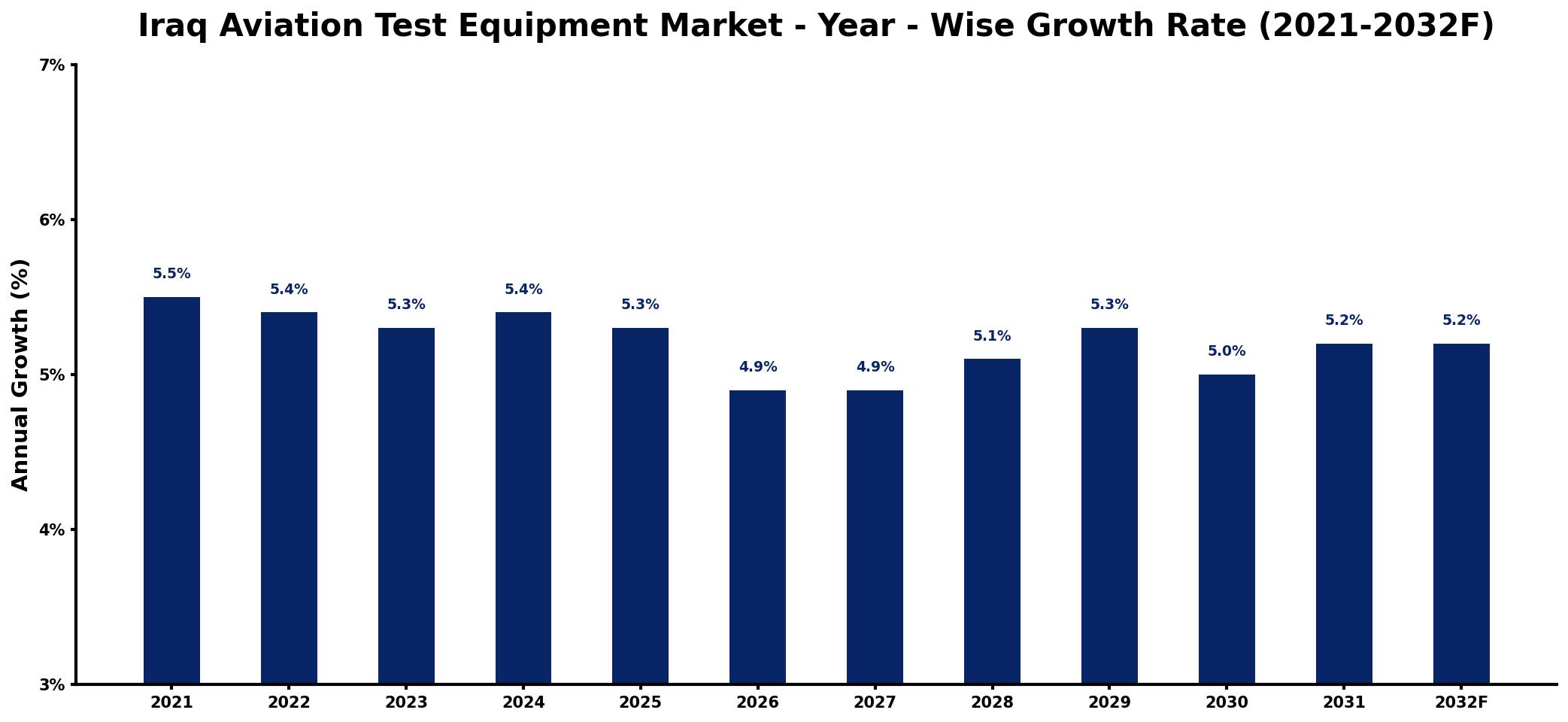
The table below presents the year‑wise growth rates along with the key drivers influencing the market
| Year | Growth Rate | Major Drivers |
| 2021 | 5.5% | Increased defense spending initiatives |
| 2022 | 5.4% | Expansion of commercial air travel |
| 2023 | 5.3% | Growing demand for pilot training |
| 2024 | 5.4% | Investments in military modernization programs |
| 2025 | 5.3% | Rising focus on safety regulations |
| 2026 | 4.9% | Technological advancements in simulations |
| 2027 | 4.9% | Emerging regional airline investments |
| 2028 | 5.1% | Strengthened partnerships with manufacturers |
| 2029 | 5.3% | Increased demand for maintenance services |
| 2030 | 5.0% | strengthening international trade flows |
| 2031 | 5.2% | Growing interest in drone technology |
| 2032 | 5.2% | Enhanced training program collaborations |
Note: Market size estimations and growth projections presented in this report are based on 6Wresearch's proprietary forecasting methodology, utilizing the latest available industry data, government publications, and primary research inputs.
Iraq Aviation Test Equipment Market Synopsis
Recent developments in the Iraqi aviation sector indicate a transition towards modernization, a stark contrast to past stagnation due to political and economic challenges. With the government prioritizing the enhancement of aviation infrastructure, the demand for sophisticated aviation test equipment is rapidly increasing.
As the market progresses, stakeholders are observing a growing emphasis on innovative technologies and testing solutions that ensure aircraft safety and operational efficiency. This pivot towards advanced systems signals an exciting future for the Iraq Aviation Test Equipment Market.
Iraq Aviation Test Equipment Market Key Takeaways
- The market is expected to expand significantly due to the modernization of the aviation sector.
- Government initiatives are fostering a conducive environment for aviation safety and compliance.
- Technological advancements are driving demand for automated and portable testing solutions.
- Investment opportunities are emerging in both equipment supply and maintenance services.
- Infrastructure upgrades are critical to supporting the growing needs of the aviation industry.
Evaluation of Restraints in Iraq Aviation Test Equipment Market
The Iraq Aviation Test Equipment Market is constrained by several factors that limit its full potential. Political instability and economic sanctions have led to limited access to cutting-edge technology, leaving many operators reliant on outdated equipment. Additionally, a significant skills gap in technical expertise poses challenges for effective equipment operation and maintenance. Furthermore, existing infrastructure inadequacies complicate testing processes, creating operational hurdles that necessitate urgent attention to overcome and promote growth in the sector.
Iraq Aviation Test Equipment Market Trends
One prominent trend is the increasing adoption of automated testing solutions, which enhance efficiency and reduce human error. This shift towards automation is being coupled with the emergence of digital technologies, including IoT and AI, that promise to transform how testing processes are conducted. Moreover, the demand for portable testing devices reflects the industrys need for flexibility and real-time diagnostics, aligning with global aviation standards aimed at enhancing safety and compliance.
Iraq Aviation Test Equipment Market Opportunities
The current landscape presents numerous investment opportunities, especially in the provision of advanced testing equipment such as avionics test sets and engine test stands. With the commercial aviation sector expanding, there is a noteworthy demand for maintenance and repair services, which represents an appealing avenue for new entrants and existing players alike. Moreover, as the government continues to focus on enhancing airport infrastructure, companies that offer innovative and reliable testing solutions will find themselves well-positioned for growth and success in this evolving market.
Government Initiatives in the Iraq Aviation Test Equipment Market
Government policies are increasingly directed towards fostering safety and efficiency within the aviation industry. Initiatives are underway to ensure that test equipment meets international standards through stringent regulations. Additionally, the government is encouraging investment in local manufacturing capabilities and R&D to reduce reliance on imports, thereby creating a self-sustaining ecosystem for the aviation test equipment market.
Future Insights of the Iraq Aviation Test Equipment Market
Looking ahead to 2026-2032, the Iraq Aviation Test Equipment Market is on a promising upward trajectory. The expansion of commercial airlines and the establishment of new airports are expected to significantly increase demand for testing solutions. A focused commitment to safety and modernization will likely drive further investment in advanced technologies, propelling the market forward. This period may witness a significant transformation as key stakeholders adapt to the evolving demands of the aviation landscape.
Iraq Aviation Test Equipment Market Latest Developments (2025 - 2026)
Recent industry activity reflects a concerted effort towards upgrading existing aviation test equipment in Iraq. Initiatives for enhancing training programs aimed at skilled technicians have gained traction, addressing workforce limitations. Furthermore, investments in new technologies are being prioritized, with industry players exploring collaborations to leverage innovative solutions. This momentum suggests a future-oriented market landscape, aligning with global best practices in aviation maintenance and testing.
Iraq Aviation Test Equipment Market - Key Attractiveness of the Report
- 10 Years of Market Numbers
- Historical Data Starting from 2022 to 2025
- Base Year: 2025
- Forecast Data until 2032
- Key Performance Indicators Impacting the Market
- Major Upcoming Developments and Projects
Key Highlights of the Report:
- Iraq Aviation Test Equipment Market Outlook
- Market Size of Iraq Aviation Test Equipment Market, 2025
- Forecast of Iraq Aviation Test Equipment Market, 2032
- Historical Data and Forecast of Iraq Aviation Test Equipment Revenues & Volume for the Period 2022-2032F
- Iraq Aviation Test Equipment Market Trend Evolution
- Iraq Aviation Test Equipment Market Drivers and Challenges
- Iraq Aviation Test Equipment Price Trends
- Iraq Aviation Test Equipment Porter's Five Forces
- Iraq Aviation Test Equipment Industry Life Cycle
- Historical Data and Forecast of Iraq Aviation Test Equipment Market Revenues & Volume By Product for the Period 2022-2032F
- Historical Data and Forecast of Iraq Aviation Test Equipment Market Revenues & Volume By Electrical Aviation Test Equipment for the Period 2022-2032F
- Historical Data and Forecast of Iraq Aviation Test Equipment Market Revenues & Volume By Hydraulic Aviation Test Equipment for the Period 2022-2032F
- Historical Data and Forecast of Iraq Aviation Test Equipment Market Revenues & Volume By Power Aviation Test Equipment for the Period 2022-2032F
- Historical Data and Forecast of Iraq Aviation Test Equipment Market Revenues & Volume By Pneumatic Aviation Test Equipment for the Period 2022-2032F
- Historical Data and Forecast of Iraq Aviation Test Equipment Market Revenues & Volume By End User for the Period 2022-2032F
- Historical Data and Forecast of Iraq Aviation Test Equipment Market Revenues & Volume By Commercial for the Period 2022-2032F
- Historical Data and Forecast of Iraq Aviation Test Equipment Market Revenues & Volume By Defense/Military Sector for the Period 2022-2032F
- Iraq Aviation Test Equipment Import Export Trade Statistics
- Market Opportunity Assessment By Product
- Market Opportunity Assessment By End User
- Iraq Aviation Test Equipment Top Companies Market Share
- Iraq Aviation Test Equipment Competitive Benchmarking By Technical and Operational Parameters
- Iraq Aviation Test Equipment Company Profiles
- Iraq Aviation Test Equipment Key Strategic Recommendations






































