Iraq Coal Based Activated Carbon Market Size, Share & Growth Rate
The Iraq Coal Based Activated Carbon Market was estimated at USD 177 Million in 2025 and is projected to reach USD 218 Million by 2032, growing at a CAGR of 3.0% from 2026 to 2032. This growth trajectory is largely driven by increasing environmental regulations that mandate cleaner industrial practices, alongside a growing demand for effective air and water purification solutions. The rising awareness among Iraqi industries about the benefits of activated carbon for pollution control further propels market expansion.
Iraq Coal Based Activated Carbon Market Year-wise Growth Rate and Key Drivers
This graph highlights how the Iraq Coal Based Activated Carbon Market has steadily grown over the years, supported by major growth factors.
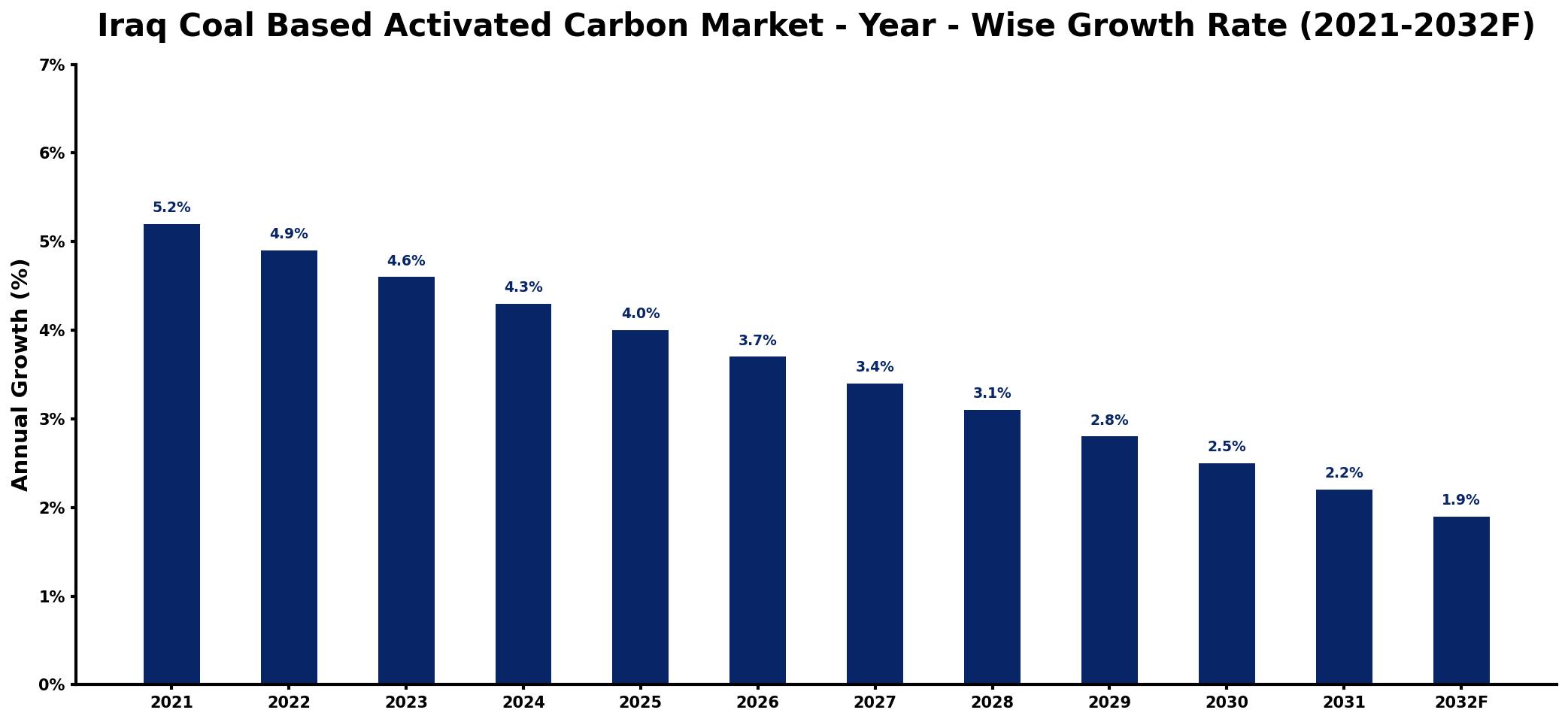
The table below presents the year‑wise growth rates along with the key drivers influencing the market
| Year | Growth Rate | Major Drivers |
| 2021 | 5.2% | Rising demand from water treatment |
| 2022 | 4.9% | Growth in air purification sector |
| 2023 | 4.6% | Increased industrial applications adoption |
| 2024 | 4.3% | Expansion in chemical processing industries |
| 2025 | 4.0% | rising infrastructure development spending |
| 2026 | 3.7% | Investments in environmental protection technologies |
| 2027 | 3.4% | Emergence of renewable energy projects |
| 2028 | 3.1% | Growing awareness of pollution issues |
| 2029 | 2.8% | Development of waste management solutions |
| 2030 | 2.5% | Strengthened regulations on emissions |
| 2031 | 2.2% | Focus on sustainable manufacturing practices |
| 2032 | 1.9% | Shift towards circular economy initiatives |
Note: Market size estimations and growth projections presented in this report are based on 6Wresearch's proprietary forecasting methodology, utilizing the latest available industry data, government publications, and primary research inputs.
Iraq Coal Based Activated Carbon Market Synopsis
The utilization of coal-based activated carbon in Iraq is particularly pronounced in the water treatment and air purification sectors, where it plays a critical role in meeting stringent environmental standards. With the government emphasizing sustainable practices, industries are increasingly turning to activated carbon solutions to comply with regulatory requirements.
Additionally, coal-derived activated carbon is gaining traction for its effectiveness in industrial gas treatment, making it an indispensable material in various manufacturing processes. This growing reliance reflects a broader shift toward environmentally responsible technologies in Iraqs industrial landscape.
Iraq Coal Based Activated Carbon Market Key Takeaways
- The market is witnessing steady growth driven by environmental regulations.
- Activated carbon is increasingly sought after for water treatment and air purification applications.
- Technological advancements could enhance the quality and cost-effectiveness of coal-based activated carbon.
- Government policies are steering the industry towards more sustainable production practices.
- Competition from alternative sources of activated carbon is intensifying, impacting market dynamics.
Evaluation of Restraints in Iraq Coal Based Activated Carbon Market
Despite its growth potential, the Iraq coal-based activated carbon market faces significant constraints. Environmental concerns are at the forefront, as increasing scrutiny over carbon emissions drives industries to explore cleaner alternatives. Technological limitations also pose challenges, as there is a scarcity of research and development focused on enhancing production methods. This lack of innovation limits both the quality and the competitiveness of coal-based activated carbon against emerging alternatives such as coconut shell and wood-based variants. As the market evolves, addressing these constraints will be essential for sustained growth.
Iraq Coal Based Activated Carbon Market Trends
Recent trends in the Iraq Coal Based Activated Carbon Market reflect a shift towards environmentally sustainable practices. Industries are increasingly integrating advanced filtration technologies that leverage activated carbon for enhanced efficacy in pollutant removal. Additionally, theres a growing emphasis on circular economy practices, which encourage recycling and reuse of activated carbon, further driving demand. The focus on renewable energy sources is also shaping the market as businesses strive to reduce their carbon footprint, thereby influencing purchasing decisions.
Iraq Coal Based Activated Carbon Market Opportunities
The market offers substantial growth and investment opportunities in the sectors of water treatment and air purification, particularly as regulations tighten. Companies that can innovate in production techniques or develop higher quality activated carbon products are well-positioned to capture market share. Additionally, strategic partnerships with governmental and environmental organizations could provide pathways to enhance market presence and credibility. Investing in research and development to overcome current technological constraints will also unlock new avenues for growth.
Government Initiatives in the Iraq Coal Based Activated Carbon Market
The Iraqi government has implemented various policies aimed at regulating the production and use of coal-based activated carbon. These regulations focus on promoting environmental sustainability and ensuring the quality of activated carbon products. Frameworks governing manufacturing processes, waste management, and emissions standards are designed to mitigate environmental impacts. Moreover, public initiatives aimed at improving industrial practices highlight the government's commitment to cleaner technologies, further influencing the market landscape.
Future Insights of the Iraq Coal Based Activated Carbon Market
Looking ahead to the period from 2026 to 2032, the Iraq Coal Based Activated Carbon Market is poised for evolution. As environmental regulations become increasingly stringent, the demand for coal-based activated carbon is likely to rise, especially in water purification and air quality enhancement applications. Innovations in production methods may also lead to higher quality products that meet growing consumer expectations. The interplay between government policy and industrial practices will shape market dynamics, potentially paving the way for a more sustainable and robust industry.
Iraq Coal Based Activated Carbon Market Latest Developments (2025 - 2026)
In the most recent developments, the industry has seen a renewed focus on sustainability, prompting manufacturers to explore eco-friendly production methods. There's also a marked increase in partnerships between private companies and government agencies aimed at improving environmental compliance and product reliability. This collaborative effort could lead to advancements in production technologies and enhanced quality standards for coal-based activated carbon in Iraq. As the market responds to these changes, stakeholders are keenly observing emerging opportunities for growth.
Iraq Coal Based Activated Carbon Market - Key Attractiveness of the Report
- 10 Years of Market Numbers
- Historical Data Starting from 2022 to 2025
- Base Year: 2025
- Forecast Data until 2032
- Key Performance Indicators Impacting the Market
- Major Upcoming Developments and Projects
Key Highlights of the Report:
- Iraq Coal Based Activated Carbon Market Outlook
- Market Size of Iraq Coal Based Activated Carbon Market, 2025
- Forecast of Iraq Coal Based Activated Carbon Market, 2032
- Historical Data and Forecast of Iraq Coal Based Activated Carbon Revenues & Volume for the Period 2022-2032F
- Iraq Coal Based Activated Carbon Market Trend Evolution
- Iraq Coal Based Activated Carbon Market Drivers and Challenges
- Iraq Coal Based Activated Carbon Price Trends
- Iraq Coal Based Activated Carbon Porter's Five Forces
- Iraq Coal Based Activated Carbon Industry Life Cycle
- Historical Data and Forecast of Iraq Coal Based Activated Carbon Market Revenues & Volume By Product for the Period 2022-2032F
- Historical Data and Forecast of Iraq Coal Based Activated Carbon Market Revenues & Volume By Granular for the Period 2022-2032F
- Historical Data and Forecast of Iraq Coal Based Activated Carbon Market Revenues & Volume By Powdered for the Period 2022-2032F
- Historical Data and Forecast of Iraq Coal Based Activated Carbon Market Revenues & Volume By Others for the Period 2022-2032F
- Historical Data and Forecast of Iraq Coal Based Activated Carbon Market Revenues & Volume By End-Use for the Period 2022-2032F
- Historical Data and Forecast of Iraq Coal Based Activated Carbon Market Revenues & Volume By Water Treatment for the Period 2022-2032F
- Historical Data and Forecast of Iraq Coal Based Activated Carbon Market Revenues & Volume By Food & Beverage Processing for the Period 2022-2032F
- Historical Data and Forecast of Iraq Coal Based Activated Carbon Market Revenues & Volume By Pharmaceutical & Medical for the Period 2022-2032F
- Historical Data and Forecast of Iraq Coal Based Activated Carbon Market Revenues & Volume By Automotive for the Period 2022-2032F
- Historical Data and Forecast of Iraq Coal Based Activated Carbon Market Revenues & Volume By Air Purification for the Period 2022-2032F
- Historical Data and Forecast of Iraq Coal Based Activated Carbon Market Revenues & Volume By Others for the Period 2022-2032F
- Iraq Coal Based Activated Carbon Import Export Trade Statistics
- Market Opportunity Assessment By Product
- Market Opportunity Assessment By End-Use
- Iraq Coal Based Activated Carbon Top Companies Market Share
- Iraq Coal Based Activated Carbon Competitive Benchmarking By Technical and Operational Parameters
- Iraq Coal Based Activated Carbon Company Profiles
- Iraq Coal Based Activated Carbon Key Strategic Recommendations






































