Iraq Concrete Chain Saw Market Size, Share & Growth Rate
The Iraq Concrete Chain Saw Market was estimated at USD 351 Million in 2025 and is projected to reach USD 621 Million by 2032, growing at a CAGR of 8.5% from 2026 to 2032. This growth trajectory is propelled by an upsurge in construction activities as Iraq continues to rebuild and modernize its infrastructure. Urbanization efforts, coupled with government initiatives aimed at stimulating the construction sector, are expected to sustain demand for advanced cutting tools that enhance productivity and precision in various projects.
Iraq Concrete Chain Saw Market Year-wise Growth Rate and Key Drivers
This graph highlights how the Iraq Concrete Chain Saw Market has steadily grown over the years, supported by major growth factors.
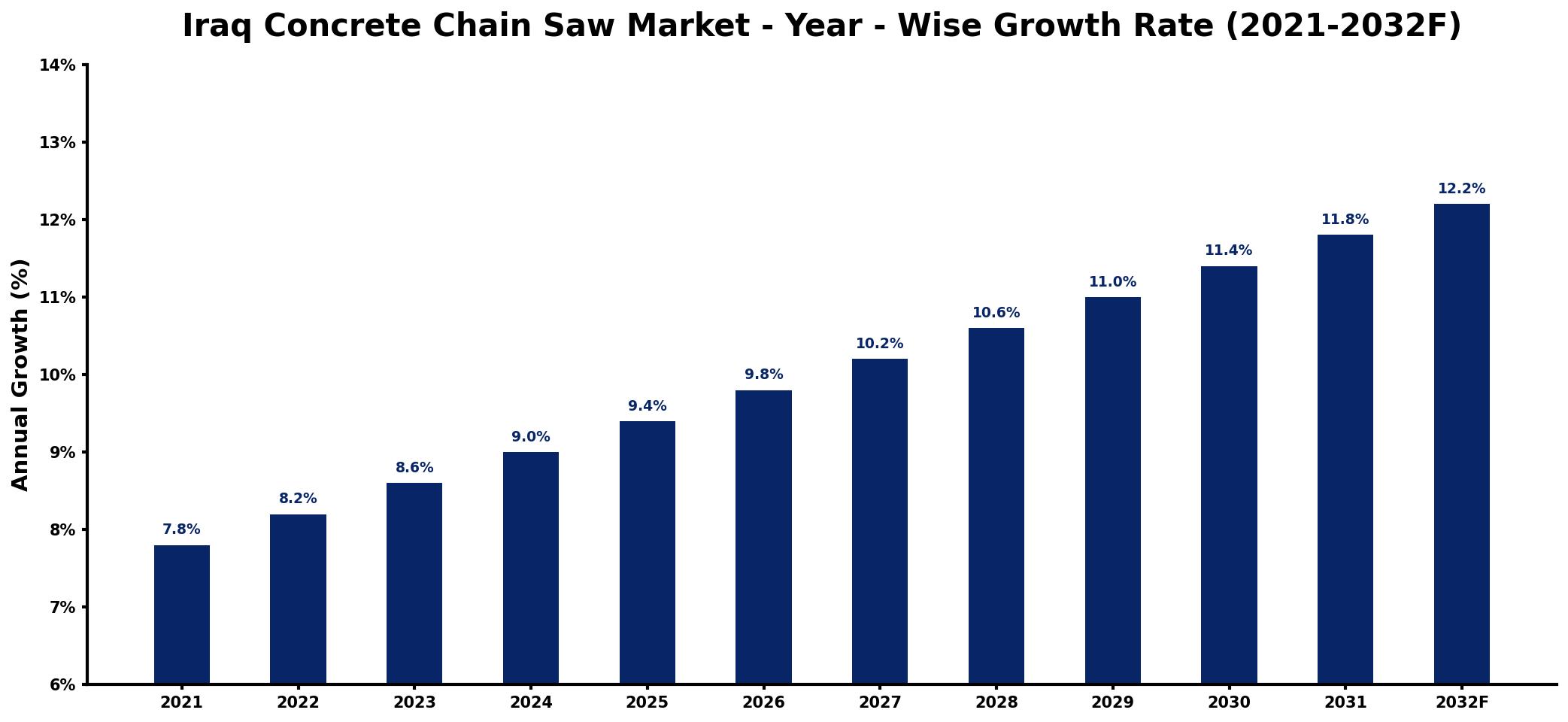
The table below presents the year‑wise growth rates along with the key drivers influencing the market
| Year | Growth Rate | Major Drivers |
| 2021 | 7.8% | Rising construction sector investments |
| 2022 | 8.2% | Increasing infrastructure development projects |
| 2023 | 8.6% | Growing demand for efficient tools |
| 2024 | 9.0% | Expansion of urban development initiatives |
| 2025 | 9.4% | Increase in residential construction activities |
| 2026 | 9.8% | Boost in government construction spending |
| 2027 | 10.2% | Technological advancements in equipment |
| 2028 | 10.6% | Surge in commercial building projects |
| 2029 | 11.0% | strengthening international trade flows |
| 2030 | 11.4% | Rising popularity of landscaping services |
| 2031 | 11.8% | Increased focus on renewable energy |
| 2032 | 12.2% | Growth in road construction efforts |
Note: Market size estimations and growth projections presented in this report are based on 6Wresearch's proprietary forecasting methodology, utilizing the latest available industry data, government publications, and primary research inputs.
Iraq Concrete Chain Saw Market Synopsis
Recently, the Iraq Concrete Chain Saw market has shown significant momentum, driven by a robust construction boom. As the sector evolves, the demand for high-performance, user-friendly cutting solutions is on the rise. Looking ahead, the market is poised for sustained expansion, with trends pointing toward increased adoption of innovative technologies and advanced features in concrete chain saws.
While current market dynamics favor established products, there is a notable shift towards lightweight and ergonomically designed chain saw models. This shift aligns with construction professionals needs for improved efficiency and safety on job sites, further indicating a transformative phase for the Iraq Concrete Chain Saw market.
Iraq Concrete Chain Saw Market Key Takeaways
- The market is driven by increasing urbanization and construction initiatives in Iraq.
- Technological advancements are leading to the development of more powerful and efficient chain saws.
- Growing preferences for ergonomic designs enhance operator comfort and productivity.
- Competitive pressures are pushing manufacturers towards innovation in features such as dust suppression systems.
- Government support for infrastructure development is positively influencing market growth prospects.
Evaluation of Restraints in Iraq Concrete Chain Saw Market
Despite the optimistic growth prospects, the Iraq Concrete Chain Saw market faces certain restraints. One significant challenge is the inconsistency in product quality and reliability, as many local customers seek durable options but often encounter untested brands. The market's competitive landscape also poses a barrier for newcomers attempting to establish a presence against established entities. Additionally, fluctuating economic conditions may impact purchasing power, while logistical issues related to distribution and after-sales service can limit market reach.
Iraq Concrete Chain Saw Market Trends
Current trends indicate a marked shift towards the use of diamond-tipped chain saws, which offer precision cutting essential for both construction and demolition. Ergonomically designed models are increasingly in demand as operators prioritize comfort and ease of use. Furthermore, there is a growing emphasis on safety features and environmentally friendly technologies, such as integrated dust suppression systems, reflecting the construction industry's commitment to enhancing worker safety and minimizing environmental impact.
Iraq Concrete Chain Saw Market Opportunities
The Iraq Concrete Chain Saw Market presents a variety of investment opportunities. With urban expansion and ongoing infrastructure projects, there is a continuous need for efficient concrete cutting tools. Contractors are seeking products that combine durability with advanced technology, paving the way for companies to introduce innovative solutions. Investing in high-quality, reliable concrete chain saws that meet the needs of construction professionals can yield substantial returns in this burgeoning market.
Government Initiatives in the Iraq Concrete Chain Saw Market
Government policies aimed at the Iraq Concrete Chain Saw Market focus on regulatory frameworks for safety and environmental standards. The Ministry of Industry and Minerals plays a critical role in establishing guidelines that manufacturers must follow to ensure quality and safety. Additionally, regulations regarding imports and exports help control product quality entering the market, while fiscal policies aim to create a conducive environment for business operations in this sector.
Future Insights of the Iraq Concrete Chain Saw Market
Looking forward to the period between 2026 and 2032, the Iraq Concrete Chain Saw Market is expected to flourish. Continued investment in infrastructure development and a growing emphasis on advanced construction techniques will likely bolster demand for innovative cutting tools. As technology evolves, so will the capabilities of concrete chain saws, enhancing their appeal to construction professionals and providing opportunities for suppliers to capture a significant share of this promising market.
Iraq Concrete Chain Saw Market Latest Developments (2025 - 2026)
In the recent months, the Iraq Concrete Chain Saw market has seen a trend towards enhanced safety features in cutting tools, with many manufacturers investing in research to integrate advanced technology into their products. Additionally, there has been increased collaboration between suppliers and construction firms to ensure that the latest tools meet the demanding needs of modern construction projects. Efforts to streamline distribution channels have also been a focal point, facilitating better access to high-quality concrete chain saws across various regions of Iraq.
Iraq Concrete Chain Saw Market - Key Attractiveness of the Report
- 10 Years of Market Numbers
- Historical Data Starting from 2022 to 2025
- Base Year: 2025
- Forecast Data until 2032
- Key Performance Indicators Impacting the Market
- Major Upcoming Developments and Projects
Key Highlights of the Report:
- Iraq Concrete Chain Saw Market Outlook
- Market Size of Iraq Concrete Chain Saw Market, 2025
- Forecast of Iraq Concrete Chain Saw Market, 2032
- Historical Data and Forecast of Iraq Concrete Chain Saw Revenues & Volume for the Period 2022-2032F
- Iraq Concrete Chain Saw Market Trend Evolution
- Iraq Concrete Chain Saw Market Drivers and Challenges
- Iraq Concrete Chain Saw Price Trends
- Iraq Concrete Chain Saw Porter's Five Forces
- Iraq Concrete Chain Saw Industry Life Cycle
- Historical Data and Forecast of Iraq Concrete Chain Saw Market Revenues & Volume By Type for the Period 2022-2032F
- Historical Data and Forecast of Iraq Concrete Chain Saw Market Revenues & Volume By Gas Chain Saw for the Period 2022-2032F
- Historical Data and Forecast of Iraq Concrete Chain Saw Market Revenues & Volume By Hydraulic Chain Saw for the Period 2022-2032F
- Historical Data and Forecast of Iraq Concrete Chain Saw Market Revenues & Volume By Pneumatic Chain Saw for the Period 2022-2032F
- Iraq Concrete Chain Saw Import Export Trade Statistics
- Market Opportunity Assessment By Type
- Iraq Concrete Chain Saw Top Companies Market Share
- Iraq Concrete Chain Saw Competitive Benchmarking By Technical and Operational Parameters
- Iraq Concrete Chain Saw Company Profiles
- Iraq Concrete Chain Saw Key Strategic Recommendations






































