Iraq Deli Meat Market Size, Share & Growth Rate
The Iraq Deli Meat Market was estimated at USD 163 Million in 2025 and is projected to reach USD 229 Million by 2032, growing at a CAGR of 5.0% from 2026 to 2032. This growth trajectory is primarily driven by a surge in consumer demand for convenient, ready-to-eat meal options, coupled with evolving dietary preferences. As lifestyles become busier, the appeal of deli meats as versatile ingredients for sandwiches, salads, and various culinary applications continues to rise, making them increasingly popular among Iraqi consumers.
Iraq Deli Meat Market Year-wise Growth Rate and Key Drivers
This graph highlights how the Iraq Deli Meat Market has steadily grown over the years, supported by major growth factors.
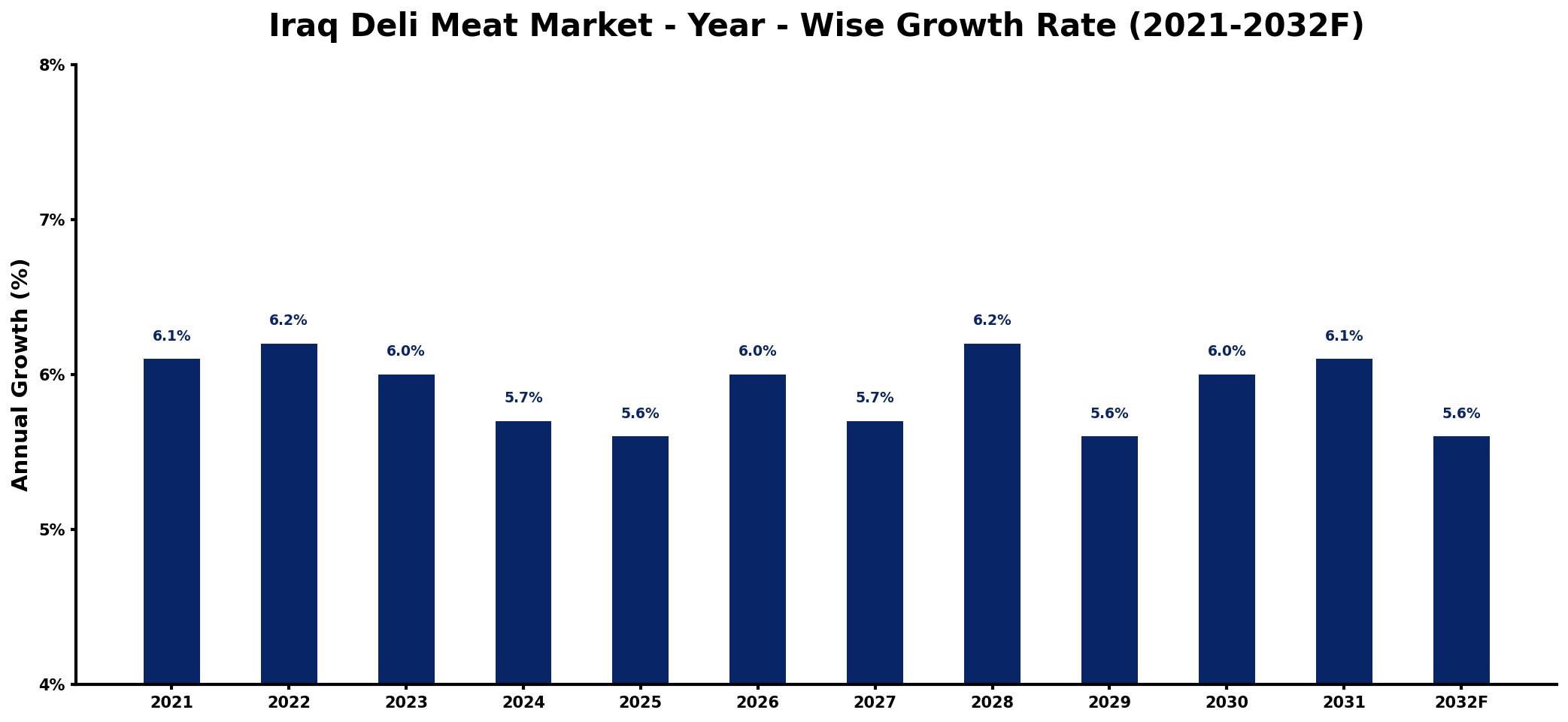
The table below presents the year‑wise growth rates along with the key drivers influencing the market
| Year | Growth Rate | Major Drivers |
| 2021 | 6.1% | Rising consumer demand for convenience |
| 2022 | 6.2% | Increased investment in distribution networks |
| 2023 | 6.0% | Growth in ready-to-eat meal segments |
| 2024 | 5.7% | rising procurement volume requirements |
| 2025 | 5.6% | Surge in health-conscious consumer trends |
| 2026 | 6.0% | Adoption of innovative packaging solutions |
| 2027 | 5.7% | Emerging local production facilities |
| 2028 | 6.2% | Strengthening of supply chain efficiency |
| 2029 | 5.6% | Growing interest in gourmet products |
| 2030 | 6.0% | Diversification of product offerings available |
| 2031 | 6.1% | Enhanced marketing strategies for awareness |
| 2032 | 5.6% | Increased focus on sustainability initiatives |
Note: Market size estimations and growth projections presented in this report are based on 6Wresearch's proprietary forecasting methodology, utilizing the latest available industry data, government publications, and primary research inputs.
Iraq Deli Meat Market Synopsis
Recently, the Iraq Deli Meat Market has experienced a notable uptick in demand, fueled by changing consumer behaviors and a shift towards more convenient food options. However, as the market expands, stakeholders must navigate a landscape that increasingly emphasizes quality and safety alongside convenience.
Looking ahead, the market is poised for significant growth driven by ongoing urbanization and the rising trend of quick-service meals. Consumers are becoming more discerning, seeking out products that not only offer flavor but also meet their standards for natural ingredients and premium quality.
Iraq Deli Meat Market Key Takeaways
- The market is witnessing a robust growth rate, supported by shifting consumer preferences for convenient meal solutions.
- Health and safety regulations are becoming increasingly stringent, influencing production and distribution practices.
- Urbanization trends and the expansion of quick-service restaurants contribute to the rising demand for deli meats.
- Innovative flavors and premium product offerings are emerging as key differentiators in a competitive market.
- The government plays a critical role in enhancing food safety standards and consumer confidence in deli meat products.
Evaluation of Restraints in Iraq Deli Meat Market
Despite its promising outlook, the Iraq Deli Meat Market faces several challenges that could impede growth. Stringent food safety and hygiene standards must be maintained throughout production and distribution processes, which can strain resources and require continuous investment. Furthermore, aligning with consumer demand for premium quality, natural ingredients, and diverse flavor profiles remains a significant hurdle. This focus on quality necessitates an ongoing commitment to innovation and improvement in sourcing, processing, and marketing.
Iraq Deli Meat Market Trends
Current trends indicate a growing preference for artisanal and gourmet deli meats, reflecting a broader consumer shift towards high-quality, ethically sourced food products. The popularity of health-conscious eating is driving the introduction of lower-sodium and nitrate-free options, further expanding consumer choice. Additionally, the rise of online grocery shopping is reshaping distribution channels, making deli meats more accessible to a wider audience.
Iraq Deli Meat Market Opportunities
The Iraq Deli Meat Market presents numerous opportunities for growth and investment. As consumer preferences evolve, there is potential for companies to develop innovative product lines that cater to health-conscious individuals and adventurous eaters alike. Furthermore, expanding distribution channels, including online platforms, can enhance product accessibility, paving the way for increased market penetration.
Government Initiatives in the Iraq Deli Meat Market
The Iraqi government has taken significant steps to promote food safety and enhance consumer confidence in the deli meat market. These initiatives include implementing rigorous inspection and certification protocols for meat processing facilities, ensuring that stringent hygiene and sanitation standards are upheld throughout the supply chain. Public awareness campaigns are also being executed to educate consumers about safe handling practices, fostering a greater understanding of the importance of purchasing certified products from reputable sources.
Future Insights of the Iraq Deli Meat Market
Looking ahead to 2026-2032, the Iraq Deli Meat Market is expected to continue its upward trajectory, fueled by ongoing urbanization and a growing appetite for convenient meal options. As more consumers seek flavorful and high-quality products, the emphasis on premium offerings will intensify. Companies that adapt to these evolving preferences through innovation in flavor profiles and health-conscious formulations will likely capture a significant share of this expanding market.
Iraq Deli Meat Market Latest Developments (2025 - 2026)
Recent developments in the Iraq Deli Meat Market suggest a shift toward greater product diversification and improved quality standards. Companies are increasingly focusing on enhancing their production processes to meet stricter safety regulations while also exploring new flavor offerings to attract consumers. Additionally, partnerships with local farmers and suppliers are becoming more common, aiming to promote sustainability and boost local economies.
Iraq Deli Meat Market - Key Attractiveness of the Report
- 10 Years of Market Numbers
- Historical Data Starting from 2022 to 2025
- Base Year: 2025
- Forecast Data until 2032
- Key Performance Indicators Impacting the Market
- Major Upcoming Developments and Projects
Key Highlights of the Report:
- Iraq Deli Meat Market Outlook
- Market Size of Iraq Deli Meat Market, 2025
- Forecast of Iraq Deli Meat Market, 2032
- Historical Data and Forecast of Iraq Deli Meat Revenues & Volume for the Period 2022-2032F
- Iraq Deli Meat Market Trend Evolution
- Iraq Deli Meat Market Drivers and Challenges
- Iraq Deli Meat Price Trends
- Iraq Deli Meat Porter's Five Forces
- Iraq Deli Meat Industry Life Cycle
- Historical Data and Forecast of Iraq Deli Meat Market Revenues & Volume By Source for the Period 2022-2032F
- Historical Data and Forecast of Iraq Deli Meat Market Revenues & Volume By Beef for the Period 2022-2032F
- Historical Data and Forecast of Iraq Deli Meat Market Revenues & Volume By Pork for the Period 2022-2032F
- Historical Data and Forecast of Iraq Deli Meat Market Revenues & Volume By Chicken for the Period 2022-2032F
- Historical Data and Forecast of Iraq Deli Meat Market Revenues & Volume By Others for the Period 2022-2032F
- Historical Data and Forecast of Iraq Deli Meat Market Revenues & Volume By Product Type for the Period 2022-2032F
- Historical Data and Forecast of Iraq Deli Meat Market Revenues & Volume By Cured Meat for the Period 2022-2032F
- Historical Data and Forecast of Iraq Deli Meat Market Revenues & Volume By Uncured Meat for the Period 2022-2032F
- Historical Data and Forecast of Iraq Deli Meat Market Revenues & Volume By Sales Channel for the Period 2022-2032F
- Historical Data and Forecast of Iraq Deli Meat Market Revenues & Volume By Hypermarkets/Supermarkets for the Period 2022-2032F
- Historical Data and Forecast of Iraq Deli Meat Market Revenues & Volume By Specialty Stores for the Period 2022-2032F
- Historical Data and Forecast of Iraq Deli Meat Market Revenues & Volume By Convenience Stores for the Period 2022-2032F
- Historical Data and Forecast of Iraq Deli Meat Market Revenues & Volume By Online Channels for the Period 2022-2032F
- Historical Data and Forecast of Iraq Deli Meat Market Revenues & Volume By Others for the Period 2022-2032F
- Iraq Deli Meat Import Export Trade Statistics
- Market Opportunity Assessment By Source
- Market Opportunity Assessment By Product Type
- Market Opportunity Assessment By Sales Channel
- Iraq Deli Meat Top Companies Market Share
- Iraq Deli Meat Competitive Benchmarking By Technical and Operational Parameters
- Iraq Deli Meat Company Profiles
- Iraq Deli Meat Key Strategic Recommendations






































