Iraq Ferrochrome Market Size, Share & Growth Rate
The Iraq Ferrochrome Market was estimated at USD 262 Million in 2025 and is projected to reach USD 370 Million by 2032, growing at a CAGR of 5.1% from 2026 to 2032. This growth is primarily driven by the surging demand for stainless steel across various sectors, particularly in construction, automotive, and manufacturing industries. Furthermore, Iraq's rich chrome ore deposits position local producers favorably within the competitive landscape, enabling them to leverage this advantage for sustained market expansion.
Iraq Ferrochrome Market Year-wise Growth Rate and Key Drivers
This graph highlights how the Iraq Ferrochrome Market has steadily grown over the years, supported by major growth factors.
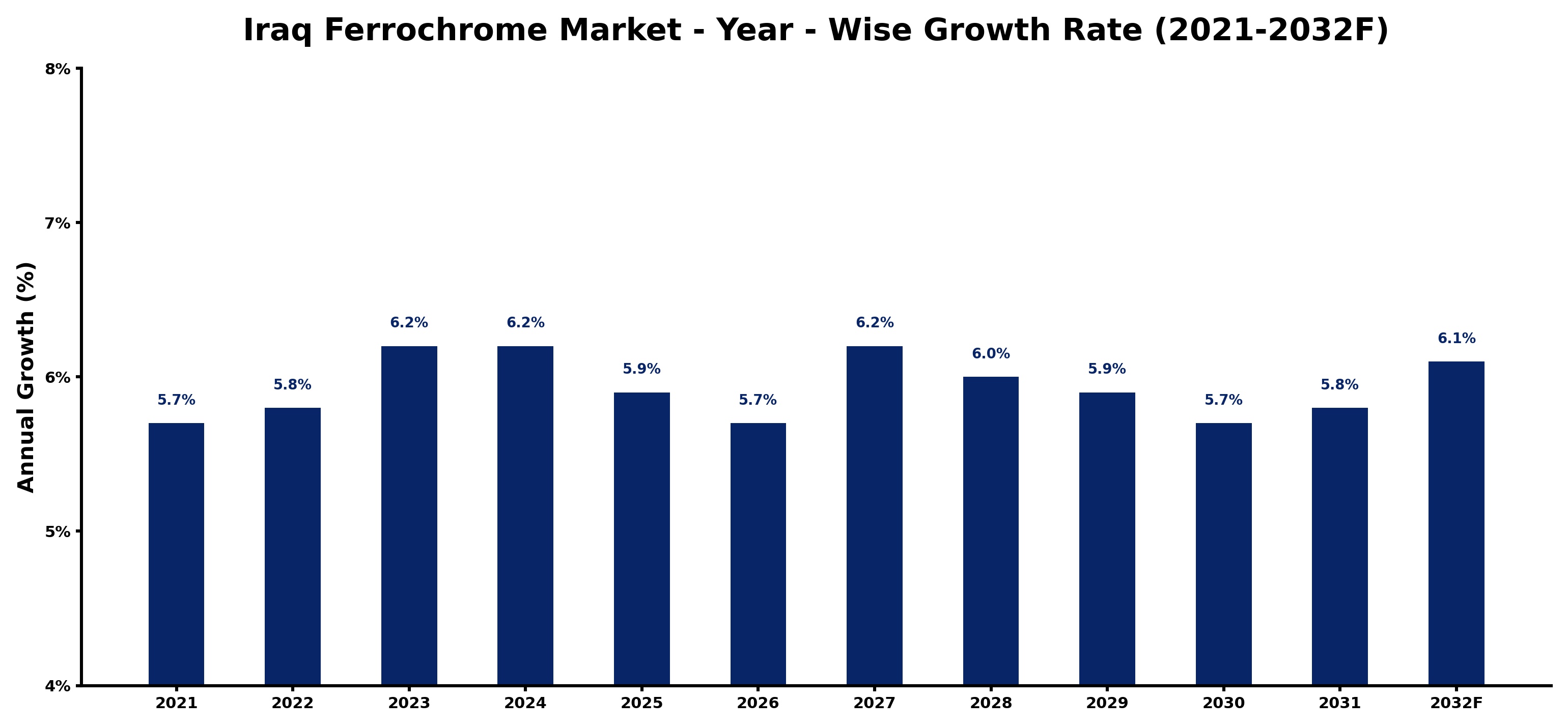
The table below presents the year‑wise growth rates along with the key drivers influencing the market
| Year | Growth Rate | Major Drivers |
| 2021 | 5.7% | Smelting capacity upgrades boosted local ferrochrome production efficiency |
| 2022 | 5.8% | Increased local manufacturing capabilities boost ferrochrome production efficiency |
| 2023 | 6.2% | Technological upgrades in furnaces enhance ferrochrome production efficiency |
| 2024 | 6.2% | Investment in smelting technologies boosted ferrochrome production efficiency |
| 2025 | 5.9% | Domestic construction projects fueled ferrochrome demand for stainless steel |
| 2026 | 5.7% | Modernized smelting facilities boost ferrochrome output and export potential |
| 2027 | 6.2% | Ferrochrome production automation boosts efficiency in domestic steel manufacturing |
| 2028 | 6.0% | New ferrochrome smelting facilities boost local stainless steel production |
| 2029 | 5.9% | Ferrochrome producers optimize smelting processes to boost output efficiency |
| 2030 | 5.7% | Ferrochrome supply chain enhancements boosted steel manufacturing competitiveness in Iraq |
| 2031 | 5.8% | Upgraded smelting technology enhanced ferrochrome production efficiency |
| 2032 | 6.1% | Ferrochrome production capacity expansions drive increased stainless steel manufacturing |
Note - Market size estimations and growth projections presented in this report are based on 6Wresearch's advanced forecasting approach, validated with industry datasets as of June 2026.
Iraq Ferrochrome Market Synopsis
The most significant force shaping the Iraq Ferrochrome Market currently is the robust demand for stainless steel, which is a critical component in numerous applications from infrastructure to consumer goods. As industries grow, the need for reliable ferrochrome supply becomes increasingly vital.
Additionally, government initiatives aimed at promoting industrialization and infrastructure development are also propelling the market forward. These efforts include enhancing mining operations and attracting foreign investments to capitalize on Iraq's abundant natural resources.
Iraq Ferrochrome Market Key Takeaways
- The market is poised for steady growth due to strong demand in stainless steel production.
- Iraq's substantial chromite reserves provide a competitive edge for domestic producers.
- Government policies are fostering investment and technological advancements in the ferrochrome sector.
- Political stability and infrastructure improvements are crucial for market potential realization.
- Investment opportunities abound in mining and production facilities to meet rising industrial demands.
Evaluation of Restraints in Iraq Ferrochrome Market
The Iraq Ferrochrome Market faces a multitude of challenges that hinder its full potential. Political instability continues to be a pressing concern, as ongoing conflicts create an unpredictable business environment, deterring both local and foreign investments. Additionally, inadequate infrastructure—specifically in transportation, energy supply, and water resources—compounds operational challenges for companies seeking to produce and distribute ferrochrome efficiently. These constraints hinder growth, making it essential for stakeholders to navigate this complex landscape effectively.
Iraq Ferrochrome Market Trends
Key trends influencing the Iraq Ferrochrome Market include a heightened focus on technological advancements aimed at improving production efficiency and product quality. Companies are investing in modern extraction techniques and sustainable practices to align with global standards and enhance competitiveness. Furthermore, strategic partnerships are becoming increasingly popular as market players look to combine resources and expertise to navigate challenges effectively.
Iraq Ferrochrome Market Opportunities
Investment opportunities in the Iraq Ferrochrome Market are gaining traction, spurred by increasing demand driven by a burgeoning industrial sector and ongoing infrastructure projects. Investors can benefit by engaging in ferrochrome production facilities or mining operations, as the market's reliance on stainless steel manufacturing continues to grow. Moreover, collaborations with local firms and alignment with government initiatives aimed at fostering the mining sector promise long-term growth avenues for those looking to enter or expand their footprint in this market.
Government Initiatives in the Iraq Ferrochrome Market
The Iraqi government has implemented various supportive policies aimed at bolstering the Ferrochrome Market, including tax incentives and subsidies to stimulate investment. There is also a strong focus on research and development to advance production capabilities and maintain quality standards. Furthermore, regulations are being put in place to ensure environmental sustainability and worker safety within ferrochrome facilities, illustrating the government's commitment to fostering a responsible and flourishing mining industry.
Future Insights of the Iraq Ferrochrome Market
Looking ahead to 2026-2032, the future of the Iraq Ferrochrome Market appears optimistic, driven by robust demand for stainless steel across various sectors. With Iraq's ambitious infrastructure projects and an expanding industrial framework, the need for high-quality ferrochrome is set to increase significantly. However, market participants must remain vigilant about external factors, such as geopolitical tensions and fluctuating global prices, which could influence growth trajectories. Strategic investments in production capacity and innovation will be essential for seizing emerging opportunities and mitigating risks.
Iraq Ferrochrome Market Latest Developments (May 2025 - June 2026)
Recent industry developments in the Iraq Ferrochrome Market indicate a shift toward modernization and efficiency. Companies are increasingly adopting innovative technologies to streamline production processes and reduce environmental impact. Moreover, there is a growing trend towards forming strategic alliances with international partners, enabling local firms to enhance their operational capabilities and access advanced technologies. These efforts signal a proactive approach to overcoming existing challenges and positioning the market for sustained growth.
Iraq Ferrochrome Market - Key Attractiveness of the Report
- 10 Years of Market Numbers
- Historical Data Starting from 2022 to 2025
- Base Year: 2025
- Forecast Data until 2032
- Key Performance Indicators Impacting the Market
- Major Upcoming Developments and Projects
Key Highlights of the Report:
- Iraq Ferrochrome Market Outlook
- Market Size of Iraq Ferrochrome Market, 2025
- Forecast of Iraq Ferrochrome Market, 2032
- Historical Data and Forecast of Iraq Ferrochrome Revenues & Volume for the Period 2022-2032F
- Iraq Ferrochrome Market Trend Evolution
- Iraq Ferrochrome Market Drivers and Challenges
- Iraq Ferrochrome Price Trends
- Iraq Ferrochrome Porter's Five Forces
- Iraq Ferrochrome Industry Life Cycle
- Historical Data and Forecast of Iraq Ferrochrome Market Revenues & Volume By Type for the Period 2022-2032F
- Historical Data and Forecast of Iraq Ferrochrome Market Revenues & Volume By High carbon for the Period 2022-2032F
- Historical Data and Forecast of Iraq Ferrochrome Market Revenues & Volume By Medium carbon for the Period 2022-2032F
- Historical Data and Forecast of Iraq Ferrochrome Market Revenues & Volume By Low carbon for the Period 2022-2032F
- Historical Data and Forecast of Iraq Ferrochrome Market Revenues & Volume By Applications for the Period 2022-2032F
- Historical Data and Forecast of Iraq Ferrochrome Market Revenues & Volume By Stainless steel for the Period 2022-2032F
- Historical Data and Forecast of Iraq Ferrochrome Market Revenues & Volume By Other steels for the Period 2022-2032F
- Iraq Ferrochrome Import Export Trade Statistics
- Market Opportunity Assessment By Type
- Market Opportunity Assessment By Applications
- Iraq Ferrochrome Top Companies Market Share
- Iraq Ferrochrome Competitive Benchmarking By Technical and Operational Parameters
- Iraq Ferrochrome Company Profiles
- Iraq Ferrochrome Key Strategic Recommendations






































