Iraq Glass Ceramics Market Size, Share & Growth Rate
The Iraq Glass Ceramics Market was estimated at USD 748 Million in 2025 and is projected to reach USD 1064 Million by 2032, growing at a CAGR of 5.2% from 2026 to 2032. This growth trajectory is being propelled by a surge in construction and infrastructure development, coupled with a growing preference for durable and aesthetically pleasing materials. Additionally, increased awareness surrounding sustainability and energy efficiency in building materials is driving the demand for innovative glass ceramic products across various sectors.
Iraq Glass Ceramics Market Year-wise Growth Rate and Key Drivers
This graph highlights how the Iraq Glass Ceramics Market has steadily grown over the years, supported by major growth factors.
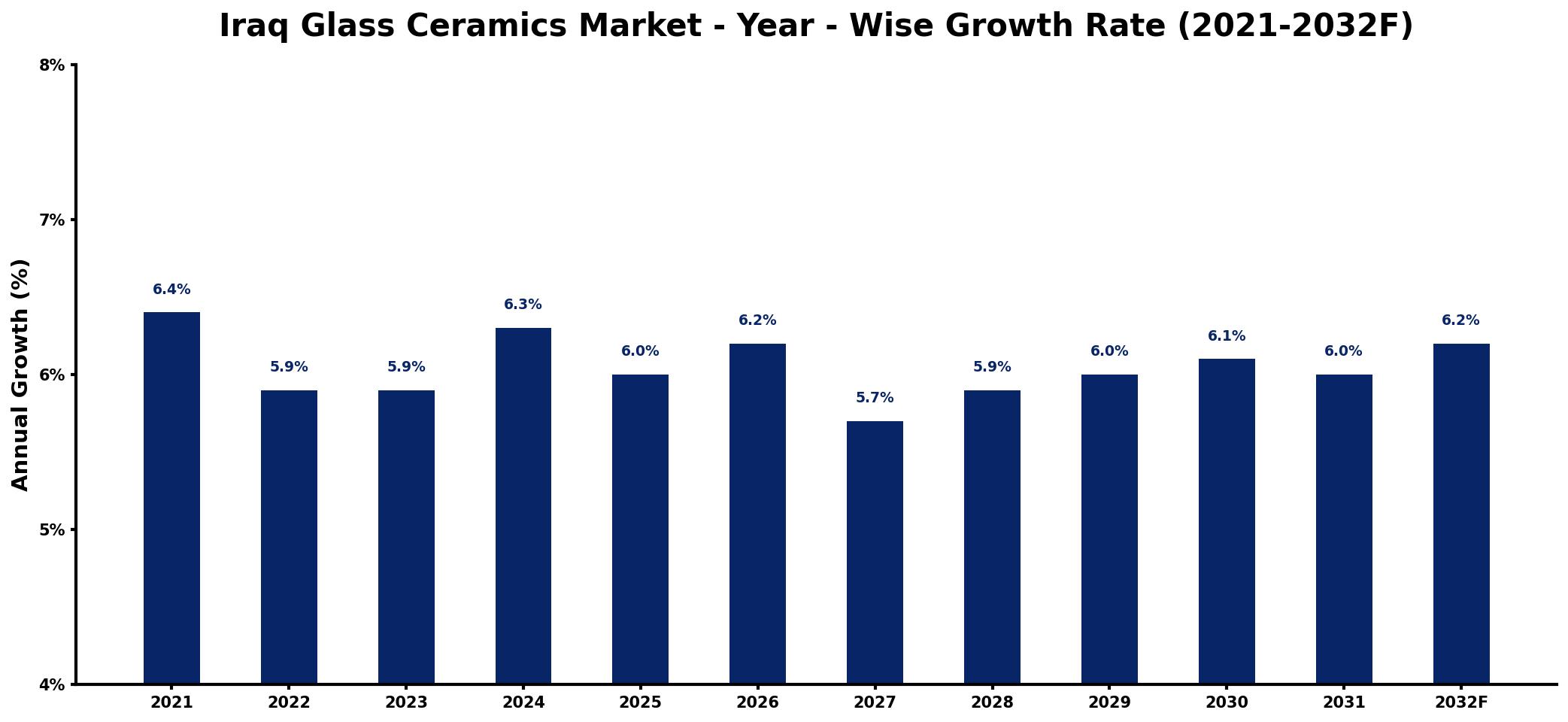
The table below presents the year‑wise growth rates along with the key drivers influencing the market
| Year | Growth Rate | Major Drivers |
| 2021 | 6.4% | Increased construction project investments |
| 2022 | 5.9% | Rising demand for decorative items |
| 2023 | 5.9% | Growing interest in sustainable materials |
| 2024 | 6.3% | Expansion of residential housing market |
| 2025 | 6.0% | Boost in tourism infrastructure projects |
| 2026 | 6.2% | Increased urbanization driving consumption |
| 2027 | 5.7% | Higher export opportunities emerging |
| 2028 | 5.9% | Investment in renewable energy projects |
| 2029 | 6.0% | Surge in home renovation activities |
| 2030 | 6.1% | Rising popularity of interior design |
| 2031 | 6.0% | Growth in commercial building sector |
| 2032 | 6.2% | Increased public infrastructure funding |
Note: Market size estimations and growth projections presented in this report are based on 6Wresearch's proprietary forecasting methodology, utilizing the latest available industry data, government publications, and primary research inputs.
Iraq Glass Ceramics Market Synopsis
The growing construction sector in Iraq has catalyzed demand for high-quality glass ceramic products, especially in residential, commercial, and industrial applications. This demand is not merely for functional materials; there is a distinct shift towards products that offer both aesthetic value and longevity.
The market is adapting to the demands of modern architecture, with manufacturers investing heavily in R&D to introduce energy-efficient and sustainable glass ceramics. This innovation is crucial as stakeholders seek to align with global standards of sustainability while meeting local market needs.
Iraq Glass Ceramics Market Key Takeaways
- The market is projected to grow significantly, driven by ongoing infrastructure projects.
- Manufacturers are emphasizing product innovation to enhance durability and aesthetic appeal.
- There is a growing trend towards sustainability in building materials.
- Investment in advanced technology is essential to meet product quality expectations.
- Domestic production is being bolstered by government initiatives aimed at reducing import dependency.
Evaluation of Restraints in Iraq Glass Ceramics Market
Despite its growth potential, the Iraq Glass Ceramics Market faces substantial challenges. Political instability and security concerns continue to impact business operations, creating an unpredictable environment for investments. Moreover, the lack of advanced manufacturing technologies and skilled labor limits the capability of local producers to compete effectively with imported alternatives. Fluctuations in raw material prices add another layer of complexity, as manufacturers struggle to maintain cost-efficiency in their production processes. These hurdles necessitate strategic adaptation and collaboration among companies to strengthen their market position.
Iraq Glass Ceramics Market Trends
The market is increasingly witnessing a trend towards digitalization and automation in manufacturing processes, enhancing both efficiency and product quality. Moreover, consumer preferences are shifting towards sustainable and eco-friendly materials, compelling manufacturers to innovate in response to market demands. The rise of modern architecture is also influencing design preferences, with a notable focus on aesthetics alongside functionality. Additionally, companies are investing in energy-efficient solutions, aligning product offerings with global trends towards sustainability.
Iraq Glass Ceramics Market Opportunities
Investment opportunities abound in the Iraq Glass Ceramics Market, particularly in the realms of modern construction and infrastructure development. With an urbanization rate on the rise, the demand for high-quality glass ceramics for diverse applications—ranging from decorative items to functional building materials—is set to grow. Investors can capitalize on the increasing necessity for eco-friendly glass ceramics, positioning themselves at the forefront of sustainable building practices. Research and development initiatives focusing on innovative product solutions also present significant potential for differentiation and market penetration.
Government Initiatives in the Iraq Glass Ceramics Market
The Iraqi government is actively promoting local production within the glass ceramics sector, implementing policies designed to reduce reliance on imports. Subsidies, tax incentives, and tariffs on imported products are being introduced to bolster domestic manufacturing capabilities. Furthermore, the government is establishing regulations to enhance product quality and safety, ensuring that locally produced goods meet international standards. These initiatives aim not only to foster industry growth but also to create job opportunities and contribute to overall economic development.
Future Insights of the Iraq Glass Ceramics Market
Looking ahead to 2026-2032, the Iraq Glass Ceramics Market is expected to maintain its positive growth trajectory, primarily driven by ongoing construction activities and increasing demand for visually appealing and durable materials. Advances in manufacturing processes and technologies will likely enhance product offerings, creating new avenues for market expansion. Additionally, as sustainability continues to take precedence, manufacturers will need to prioritize eco-friendly solutions to align with consumer expectations. Overall, the market stands poised for dynamic evolution, presenting numerous opportunities for innovation and investment.
Iraq Glass Ceramics Market Latest Developments (2025 - 2026)
Recent developments within the Iraq Glass Ceramics Market reflect a focus on advancing manufacturing technologies and improving product sustainability. Companies are increasingly exploring partnerships aimed at enhancing R&D efforts, especially in the realm of energy-efficient glass ceramic solutions. Furthermore, shifts in consumer preferences have spurred manufacturers to introduce new product lines that cater to modern architectural trends. As the market adapts to these evolving dynamics, local producers are positioning themselves to capitalize on emerging opportunities.
Iraq Glass Ceramics Market - Key Attractiveness of the Report
- 10 Years of Market Numbers
- Historical Data Starting from 2022 to 2025
- Base Year: 2025
- Forecast Data until 2032
- Key Performance Indicators Impacting the Market
- Major Upcoming Developments and Projects
Key Highlights of the Report:
- Iraq Glass Ceramics Market Outlook
- Market Size of Iraq Glass Ceramics Market, 2025
- Forecast of Iraq Glass Ceramics Market, 2032
- Historical Data and Forecast of Iraq Glass Ceramics Revenues & Volume for the Period 2022-2032F
- Iraq Glass Ceramics Market Trend Evolution
- Iraq Glass Ceramics Market Drivers and Challenges
- Iraq Glass Ceramics Price Trends
- Iraq Glass Ceramics Porter's Five Forces
- Iraq Glass Ceramics Industry Life Cycle
- Historical Data and Forecast of Iraq Glass Ceramics Market Revenues & Volume By Material for the Period 2022-2032F
- Historical Data and Forecast of Iraq Glass Ceramics Market Revenues & Volume By Lithium for the Period 2022-2032F
- Historical Data and Forecast of Iraq Glass Ceramics Market Revenues & Volume By Mangnesium for the Period 2022-2032F
- Historical Data and Forecast of Iraq Glass Ceramics Market Revenues & Volume By Zinc for the Period 2022-2032F
- Historical Data and Forecast of Iraq Glass Ceramics Market Revenues & Volume By Application for the Period 2022-2032F
- Historical Data and Forecast of Iraq Glass Ceramics Market Revenues & Volume By Building and Construction for the Period 2022-2032F
- Historical Data and Forecast of Iraq Glass Ceramics Market Revenues & Volume By Electrical & Electronics for the Period 2022-2032F
- Historical Data and Forecast of Iraq Glass Ceramics Market Revenues & Volume By Healthcare for the Period 2022-2032F
- Historical Data and Forecast of Iraq Glass Ceramics Market Revenues & Volume By Aerospace for the Period 2022-2032F
- Historical Data and Forecast of Iraq Glass Ceramics Market Revenues & Volume By Optical for the Period 2022-2032F
- Iraq Glass Ceramics Import Export Trade Statistics
- Market Opportunity Assessment By Material
- Market Opportunity Assessment By Application
- Iraq Glass Ceramics Top Companies Market Share
- Iraq Glass Ceramics Competitive Benchmarking By Technical and Operational Parameters
- Iraq Glass Ceramics Company Profiles
- Iraq Glass Ceramics Key Strategic Recommendations






































