Iraq Industrial Rubber Products Market Size, Share & Growth Rate
The Iraq Industrial Rubber Products Market was estimated at USD 101 Million in 2025 and is projected to reach USD 110 Million by 2032, growing at a CAGR of 1.2% from 2026 to 2032. This modest growth is underpinned by the increasing demand across several industrial sectors, primarily automotive, construction, and manufacturing, where resilient rubber components are essential. As Iraq's economy gradually stabilizes and infrastructure projects gain momentum, the demand for high-quality rubber products is expected to rise, contributing to improved operational efficiency and equipment reliability.
Iraq Industrial Rubber Products Market Year-wise Growth Rate and Key Drivers
This graph highlights how the Iraq Industrial Rubber Products Market has steadily grown over the years, supported by major growth factors.
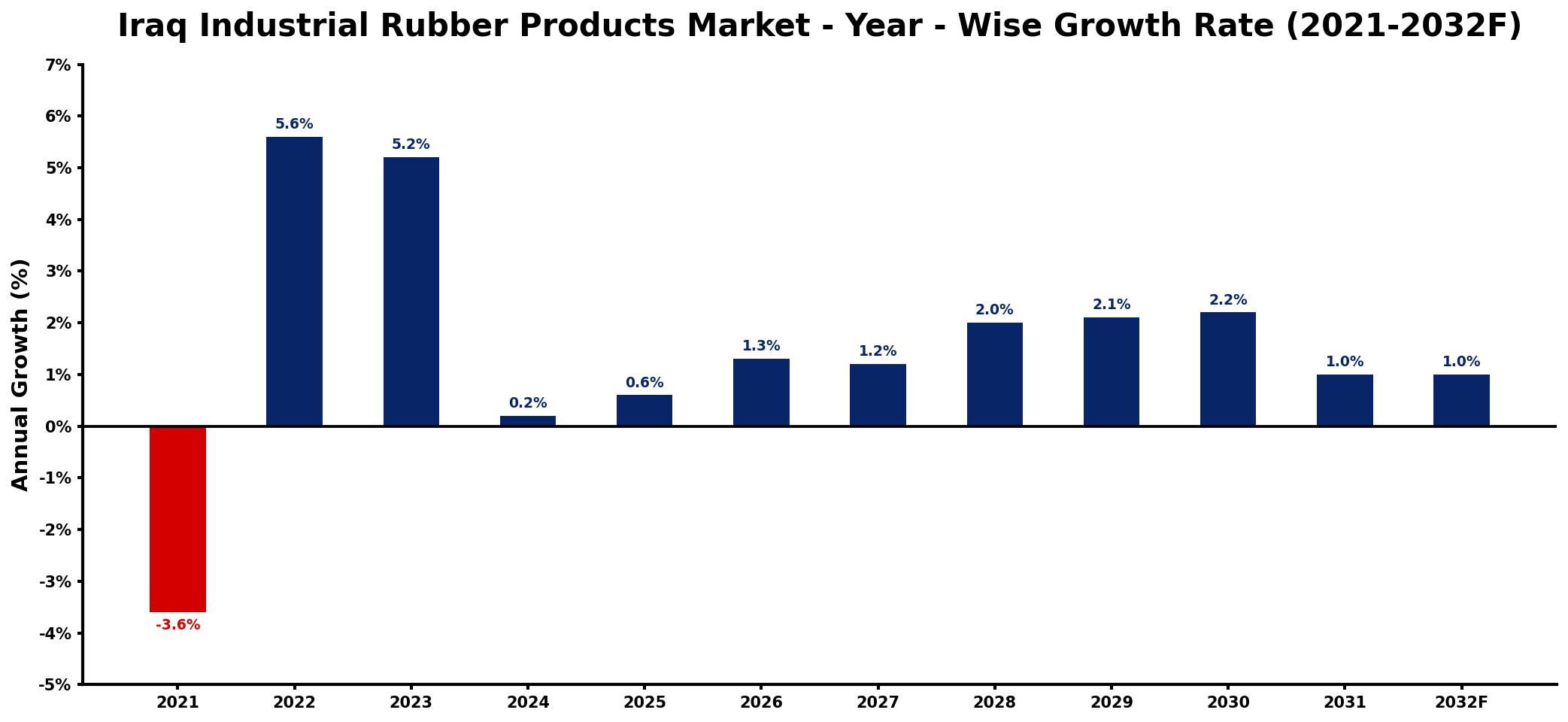
The table below presents the year‑wise growth rates along with the key drivers influencing the market
| Year | Growth Rate | Major Drivers |
| 2021 | -3.6% | decrease in construction activities |
| 2022 | 5.6% | increased automotive sector demand |
| 2023 | 5.2% | expansion of local manufacturing facilities |
| 2024 | 0.2% | growth in infrastructure investments |
| 2025 | 0.6% | rising consumer goods production |
| 2026 | 1.3% | development of renewable energy projects |
| 2027 | 1.2% | enhanced transportation network investments |
| 2028 | 2.0% | surge in export opportunities |
| 2029 | 2.1% | growing demand from agriculture sector |
| 2030 | 2.2% | increased focus on sustainability initiatives |
| 2031 | 1.0% | strengthening of domestic supply chains |
| 2032 | 1.0% | boost in construction project launches |
Note: Market size estimations and growth projections presented in this report are based on 6Wresearch's proprietary forecasting methodology, utilizing the latest available industry data, government publications, and primary research inputs.
Iraq Industrial Rubber Products Market Synopsis
In recent years, the Iraq Industrial Rubber Products Market has experienced a surge due to revitalization efforts within key industrial sectors. However, as this growth stabilizes, the market is expected to face challenges from supply chain disruptions and quality control issues that may limit access to high-quality raw materials. The focus on product reliability and performance will drive future investments in this sector.
Looking ahead, the market presents significant potential as various industries increasingly recognize the importance of durable rubber products. Despite challenges, the ongoing governmental policies aimed at improving environmental sustainability and product quality are likely to foster innovation and development within the industrial rubber space in Iraq.
Iraq Industrial Rubber Products Market Key Takeaways
- The market is heavily influenced by the automotive, construction, and manufacturing sectors.
- Resilience, flexibility, and durability of rubber products are critical for enhancing operational efficiency.
- Government initiatives are promoting the development of environmentally friendly and high-quality rubber products.
- Challenges related to supply chains and raw material availability continue to shape the market landscape.
- Investment opportunities exist in the development of innovative rubber technologies that meet industry demands.
Evaluation of Restraints in Iraq Industrial Rubber Products Market
The Iraq Industrial Rubber Products Market faces several notable constraints that could impede growth. Supply chain disruptions, often stemming from geopolitical issues and logistical challenges, can hinder the timely availability of raw materials. Furthermore, quality control issues impact manufacturers' ability to consistently provide reliable products, which is critical for maintaining customer trust and satisfaction. Limited access to skilled labor exacerbates these challenges, ultimately influencing the overall quality and availability of industrial rubber products in the region.
Iraq Industrial Rubber Products Market Trends
The industrial rubber products market in Iraq is witnessing several trends that are reshaping demand and technology. Increased emphasis on sustainability is prompting manufacturers to explore eco-friendly materials and production processes, aligning with global environmental standards. Additionally, advancements in manufacturing technologies are enabling the creation of more sophisticated and resilient rubber products tailored to specific industrial applications. As industries continue to innovate, there is a growing focus on integrating smart technologies and automation in rubber product applications, enhancing performance and operational efficiency.
Iraq Industrial Rubber Products Market Opportunities
There are compelling growth opportunities within the Iraq Industrial Rubber Products Market, particularly in infrastructure and renewable energy sectors. As the government prioritizes infrastructure development and modernization, the demand for high-quality rubber components will naturally increase. Additionally, investments in renewable energy projects will open new avenues for rubber product applications, creating a synergistic growth environment. By focusing on innovation and quality enhancement, companies can position themselves strategically to capture market share and drive long-term success.
Government Initiatives in the Iraq Industrial Rubber Products Market
The Iraqi government is actively involved in regulating the Industrial Rubber Products Market to ensure product quality and compliance with environmental standards. Recent policies emphasize support for the development and use of innovative rubber products that meet industry specifications while minimizing environmental impact. Public spending on infrastructure and industry modernization projects further reflects the governments commitment to fostering a conducive environment for growth within this market. Additionally, incentives aimed at attracting foreign investment could stimulate further advancements in the local manufacturing landscape.
Future Insights of the Iraq Industrial Rubber Products Market
From 2026 to 2032, the Iraq Industrial Rubber Products Market is poised for steady growth, driven by ongoing investments in various industrial sectors. With the governments focus on enhancing local production capabilities and the influx of foreign investment, the quality and availability of rubber products are expected to improve significantly. As industries adapt to evolving market demands and technological advancements, there will be an increasing shift towards incorporating innovative materials and practices that align with global trends. This proactive approach will play a pivotal role in sustaining long-term growth in the sector.
Iraq Industrial Rubber Products Market Latest Developments (2025 - 2026)
Recent developments in the Iraq Industrial Rubber Products Market indicate a growing interest in enhancing product quality and sustainability practices. Industry stakeholders are increasingly collaborating to address supply chain challenges, resulting in improved reliability of raw material sources. Furthermore, advancements in manufacturing technologies are being adopted, aiming to increase efficiency and product resilience. These trends reflect a significant shift in focus toward innovation, positioning the market favorably for future growth.
Iraq Industrial Rubber Products Market - Key Attractiveness of the Report
- 10 Years of Market Numbers
- Historical Data Starting from 2022 to 2025
- Base Year: 2025
- Forecast Data until 2032
- Key Performance Indicators Impacting the Market
- Major Upcoming Developments and Projects
Key Highlights of the Report:
- Iraq Industrial Rubber Products Market Outlook
- Market Size of Iraq Industrial Rubber Products Market, 2025
- Forecast of Iraq Industrial Rubber Products Market, 2032
- Historical Data and Forecast of Iraq Industrial Rubber Products Revenues & Volume for the Period 2022-2032F
- Iraq Industrial Rubber Products Market Trend Evolution
- Iraq Industrial Rubber Products Market Drivers and Challenges
- Iraq Industrial Rubber Products Price Trends
- Iraq Industrial Rubber Products Porter's Five Forces
- Iraq Industrial Rubber Products Industry Life Cycle
- Historical Data and Forecast of Iraq Industrial Rubber Products Market Revenues & Volume By Rubber Type for the Period 2022-2032F
- Historical Data and Forecast of Iraq Industrial Rubber Products Market Revenues & Volume By Natural Rubber for the Period 2022-2032F
- Historical Data and Forecast of Iraq Industrial Rubber Products Market Revenues & Volume By Styrene Butadiene Rubber for the Period 2022-2032F
- Historical Data and Forecast of Iraq Industrial Rubber Products Market Revenues & Volume By Polybutadiene for the Period 2022-2032F
- Historical Data and Forecast of Iraq Industrial Rubber Products Market Revenues & Volume By Ethylene-propylene for the Period 2022-2032F
- Historical Data and Forecast of Iraq Industrial Rubber Products Market Revenues & Volume By Nitrile Butadiene Rubber for the Period 2022-2032F
- Historical Data and Forecast of Iraq Industrial Rubber Products Market Revenues & Volume By Others for the Period 2022-2032F
- Historical Data and Forecast of Iraq Industrial Rubber Products Market Revenues & Volume By Process for the Period 2022-2032F
- Historical Data and Forecast of Iraq Industrial Rubber Products Market Revenues & Volume By Molded for the Period 2022-2032F
- Historical Data and Forecast of Iraq Industrial Rubber Products Market Revenues & Volume By Extruded for the Period 2022-2032F
- Historical Data and Forecast of Iraq Industrial Rubber Products Market Revenues & Volume By Fabricated for the Period 2022-2032F
- Historical Data and Forecast of Iraq Industrial Rubber Products Market Revenues & Volume By Latex-Based for the Period 2022-2032F
- Historical Data and Forecast of Iraq Industrial Rubber Products Market Revenues & Volume By Others for the Period 2022-2032F
- Historical Data and Forecast of Iraq Industrial Rubber Products Market Revenues & Volume By Product for the Period 2022-2032F
- Historical Data and Forecast of Iraq Industrial Rubber Products Market Revenues & Volume By Mechanical Rubber Products for the Period 2022-2032F
- Historical Data and Forecast of Iraq Industrial Rubber Products Market Revenues & Volume By Rubber Hoses for the Period 2022-2032F
- Historical Data and Forecast of Iraq Industrial Rubber Products Market Revenues & Volume By Rubber Belts for the Period 2022-2032F
- Historical Data and Forecast of Iraq Industrial Rubber Products Market Revenues & Volume By Rubber Roofing for the Period 2022-2032F
- Historical Data and Forecast of Iraq Industrial Rubber Products Market Revenues & Volume By Others for the Period 2022-2032F
- Historical Data and Forecast of Iraq Industrial Rubber Products Market Revenues & Volume By End-use for the Period 2022-2032F
- Historical Data and Forecast of Iraq Industrial Rubber Products Market Revenues & Volume By Construction & Infrastructure for the Period 2022-2032F
- Historical Data and Forecast of Iraq Industrial Rubber Products Market Revenues & Volume By Automotive for the Period 2022-2032F
- Historical Data and Forecast of Iraq Industrial Rubber Products Market Revenues & Volume By Aerospace for the Period 2022-2032F
- Historical Data and Forecast of Iraq Industrial Rubber Products Market Revenues & Volume By Energy for the Period 2022-2032F
- Historical Data and Forecast of Iraq Industrial Rubber Products Market Revenues & Volume By Others for the Period 2022-2032F
- Iraq Industrial Rubber Products Import Export Trade Statistics
- Market Opportunity Assessment By Rubber Type
- Market Opportunity Assessment By Process
- Market Opportunity Assessment By Product
- Market Opportunity Assessment By End-use
- Iraq Industrial Rubber Products Top Companies Market Share
- Iraq Industrial Rubber Products Competitive Benchmarking By Technical and Operational Parameters
- Iraq Industrial Rubber Products Company Profiles
- Iraq Industrial Rubber Products Key Strategic Recommendations






































