Iraq Iron Market Summary
The iraq iron market was estimated at USD 442 Million in 2025 and is projected to reach USD 635 Million by 2032, growing at a CAGR of 6.2% from 2026 to 2032.
Iraq Iron Market Year-wise Growth Rate and Key Drivers
This graph highlights how the Iraq Iron Market has steadily grown over the past five years, supported by major growth factors.
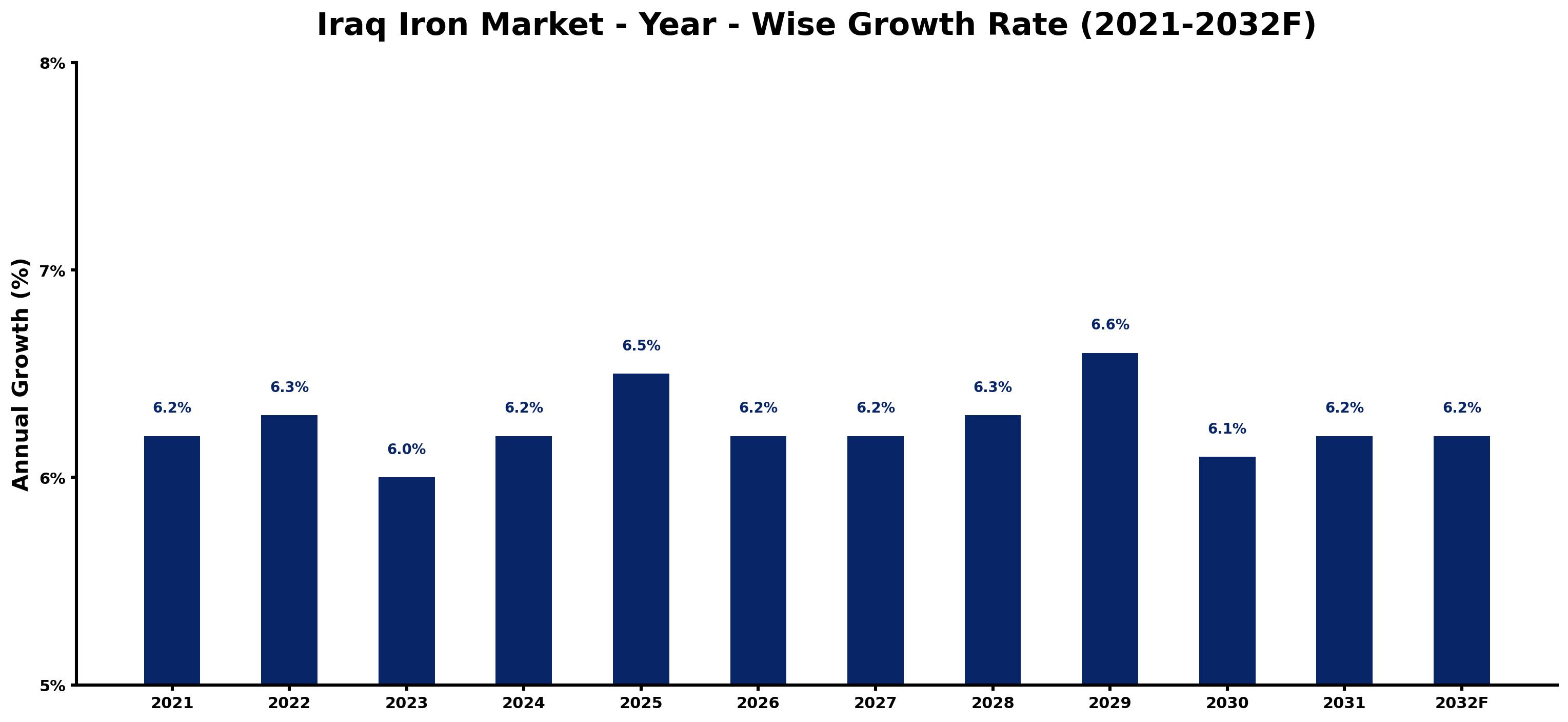
The table below presents the year wise growth rates along with the key drivers influencing the market
| Year | Growth Rate | Major Drivers |
| 2021 | 6.2% | Post-conflict construction efforts sparked interest in new iron products and suppliers. |
| 2022 | 6.3% | Market saw increased investment in infrastructure, highlighting the importance of durable materials. |
| 2023 | 6.0% | Local businesses began prioritizing partnerships with regional iron producers for reliability. |
| 2024 | 6.2% | Robust residential projects emerged, fueling a consistent demand for quality iron supplies. |
| 2025 | 6.5% | Rising urbanization drove construction projects, amplifying the need for iron reinforcement. |
| 2026 | 6.2% | International companies entered the market, introducing advanced manufacturing techniques for efficiency. |
| 2027 | 6.2% | Emerging energy projects, particularly renewables, required durable iron solutions for infrastructure. |
| 2028 | 6.3% | Economic diversification strategies prompted investments in sustainable building materials and technologies. |
| 2029 | 6.6% | Supply chain enhancements enabled local producers to improve product quality and accessibility. |
| 2030 | 6.1% | Regional trade agreements fostered collaboration, boosting iron market competitiveness and pricing. |
| 2031 | 6.2% | Technological innovations in construction practices increased the demand for high-strength iron. |
| 2032 | 6.2% | Growing emphasis on resilience against climate challenges shifted focus to sustainable iron sourcing. |
Note - Market size estimations and growth projections presented in this report are based on 6Wresearch's advanced forecasting approach, validated with industry datasets as of June 2026.
Iraq Iron Market Synopsis
The Iraq Iron Market is projected to reach 6.2% and witness significant growth during the forecast period (2026-2032). This market is expected to expand at an annualized rate of 5%, driven by a surge in construction and infrastructure activities across the country. The demand for various iron products—such as rods, bars, sheets, and mesh—will be fueled by both public and private sector investments, particularly in transportation and energy infrastructure. The ongoing development of oil fields and the associated increase in pipeline and rig activities are also contributing to the heightened need for finished steel products, including pipes.
Iraq Iron Market Growth Drivers
Several factors are underpinning the growth of the Iraq iron market, presenting substantial opportunities for stakeholders:
- Expanding Construction Sector: The revitalization of the construction industry is a primary driver, with both residential and commercial projects ramping up in response to population growth and urbanization.
- Government Investments: Enhanced public spending on infrastructure projects, particularly in transportation networks, is expected to bolster demand for iron products significantly.
- Energy Sector Demand: The development of oil fields and the subsequent requirements for pipelines and rigs are generating substantial demand for specific steel products.
- Regional Trade Dynamics: Favorable trade relations with neighboring countries, including Jordan and Syria, are encouraging the movement of iron products across borders, facilitating market growth.
- Technological Advancements: Improvements in manufacturing processes and techniques among local production facilities contribute to increased efficiency and output, positively impacting the market.
Iraq Iron Market Challenges and Restraints
While the Iraq iron market exhibits promising growth potential, several challenges could impede its progress:
- Political Instability: Ongoing political challenges may disrupt economic planning and project execution, affecting overall market stability.
- Supply Chain Disruptions: Infrastructure weaknesses and logistic bottlenecks may hinder the timely distribution of iron products to various construction sites.
- Regulatory Environment: Changes in government regulations and tariffs could impact the pricing and availability of imported iron products.
- Resource Limitations: Local producers may face challenges in sourcing raw materials, which could affect production capacities and competitiveness.
- Environmental Concerns: Increasing awareness and regulations related to sustainability may impose additional costs or operational constraints on iron production.
Iraq Iron Market Government Investment and Initiatives
The Iraqi government plays a crucial role in shaping the iron market through strategic investments and initiatives. Significant public spending is being targeted at developing essential infrastructure, including roads, bridges, and urban projects. These initiatives are designed to boost economic growth and enhance connectivity within Iraq, alongside improvements in cross-border transportation networks with neighboring countries.
Additionally, government programs aimed at revitalizing the mining and metals sector are set to attract foreign investments and technology transfer, enhancing local production capabilities. Public-private partnerships are also being encouraged to stimulate project execution across the infrastructure and energy sectors, which are integral to the demand for iron products.
Iraq Iron Market Trends and Opportunities
The Iraq iron market is witnessing several trends that signify emerging opportunities for businesses:
- Infrastructure Focus: A consistent focus on rebuilding and expanding infrastructure presents opportunities for manufacturers of iron products to secure long-term contracts.
- Increased Exports: With favorable trade relations and a growing reputation for quality, the potential for exporting iron products to regional markets is substantial.
- Sustainable Practices: The shift towards more sustainable operations is leading to opportunities for innovations in steel production that minimize environmental impact.
- Investment in R&D: Increased investment in research and development can drive product innovation and efficiency, positioning local producers favorably within the global market.
- Digital Transformation: The adoption of advanced technologies and automation in production processes is set to enhance competitiveness and reduce operational costs.
Iraq Iron Market Latest Developments (May 2025 - June 2026)
Recent developments in the Iraq iron market reflect a sector poised for transformation, characterized by increased activity and investment. Stakeholders have been actively engaging in partnerships to enhance production capabilities and establish a more robust supply chain. Additionally, there is a growing emphasis on integrating sustainable practices within local operations, in alignment with global trends focusing on environmental responsibility.
Furthermore, the regional trade dynamics are evolving, with enhanced export opportunities emerging as manufacturers adapt to international standards. Local companies are also beginning to explore partnerships with foreign entities to leverage innovative technologies and improve production efficiency.
Iraq Iron Market - Key Attractiveness of the Report
- 10 Years of Market Numbers
- Historical Data Starting from 2022 to 2025
- Base Year: 2025
- Forecast Data until 2032
- Key Performance Indicators Impacting the Market
- Major Upcoming Developments and Projects
Key Highlights of the Report:
- Iraq Iron Market Outlook
- Market Size of Iraq Iron Market, 2025
- Forecast of Iraq Iron Market, 2032F
- Historical Data and Forecast of Iraq Iron Revenues & Volume for the Period 2022-2032F
- Iraq Iron Market Trend Evolution
- Iraq Iron Market Drivers and Challenges
- Iraq Iron Price Trends
- Iraq Iron Porter's Five Forces
- Iraq Iron Industry Life Cycle
- Historical Data and Forecast of Iraq Iron Market Revenues & Volume By Material Types for the Period 2022-2032F
- Historical Data and Forecast of Iraq Iron Market Revenues & Volume By Pure?Iron for the Period 2022-2032F
- Historical Data and Forecast of Iraq Iron Market Revenues & Volume By Wrought?Iron for the Period 2022-2032F
- Historical Data and Forecast of Iraq Iron Market Revenues & Volume By Cast Iron for the Period 2022-2032F
- Historical Data and Forecast of Iraq Iron Market Revenues & Volume By Pig Iron for the Period 2022-2032F
- Historical Data and Forecast of Iraq Iron Market Revenues & Volume By Direct Reduced Iron for the Period 2022-2032F
- Historical Data and Forecast of Iraq Iron Market Revenues & Volume By Applications for the Period 2022-2032F
- Historical Data and Forecast of Iraq Iron Market Revenues & Volume By Building for the Period 2022-2032F
- Historical Data and Forecast of Iraq Iron Market Revenues & Volume By Construction for the Period 2022-2032F
- Historical Data and Forecast of Iraq Iron Market Revenues & Volume By Railways for the Period 2022-2032F
- Historical Data and Forecast of Iraq Iron Market Revenues & Volume By Fertilizers for the Period 2022-2032F
- Historical Data and Forecast of Iraq Iron Market Revenues & Volume By Industrial Uses for the Period 2022-2032F
- Historical Data and Forecast of Iraq Iron Market Revenues & Volume By Others for the Period 2022-2032F
- Iraq Iron Import Export Trade Statistics
- Market Opportunity Assessment By Material Types
- Market Opportunity Assessment By Applications
- Iraq Iron Top Companies Market Share
- Iraq Iron Competitive Benchmarking By Technical and Operational Parameters
- Iraq Iron Company Profiles
- Iraq Iron Key Strategic Recommendations






































