Iraq Iron Oxide Market Size, Share & Growth Rate
The Iraq Iron Oxide Market was estimated at USD 500 Million in 2025 and is projected to reach USD 675 Million by 2032, growing at a CAGR of 4.4% from 2026 to 2032. This growth trajectory is primarily fueled by an uptick in construction activities, particularly as Iraq enhances its infrastructure to support urban development. Additionally, the rising demand for iron oxide pigments across various industries, including coatings and plastics, further propels the market forward.
Iraq Iron Oxide Market Year-wise Growth Rate and Key Drivers
This graph highlights how the Iraq Iron Oxide Market has steadily grown over the years, supported by major growth factors.
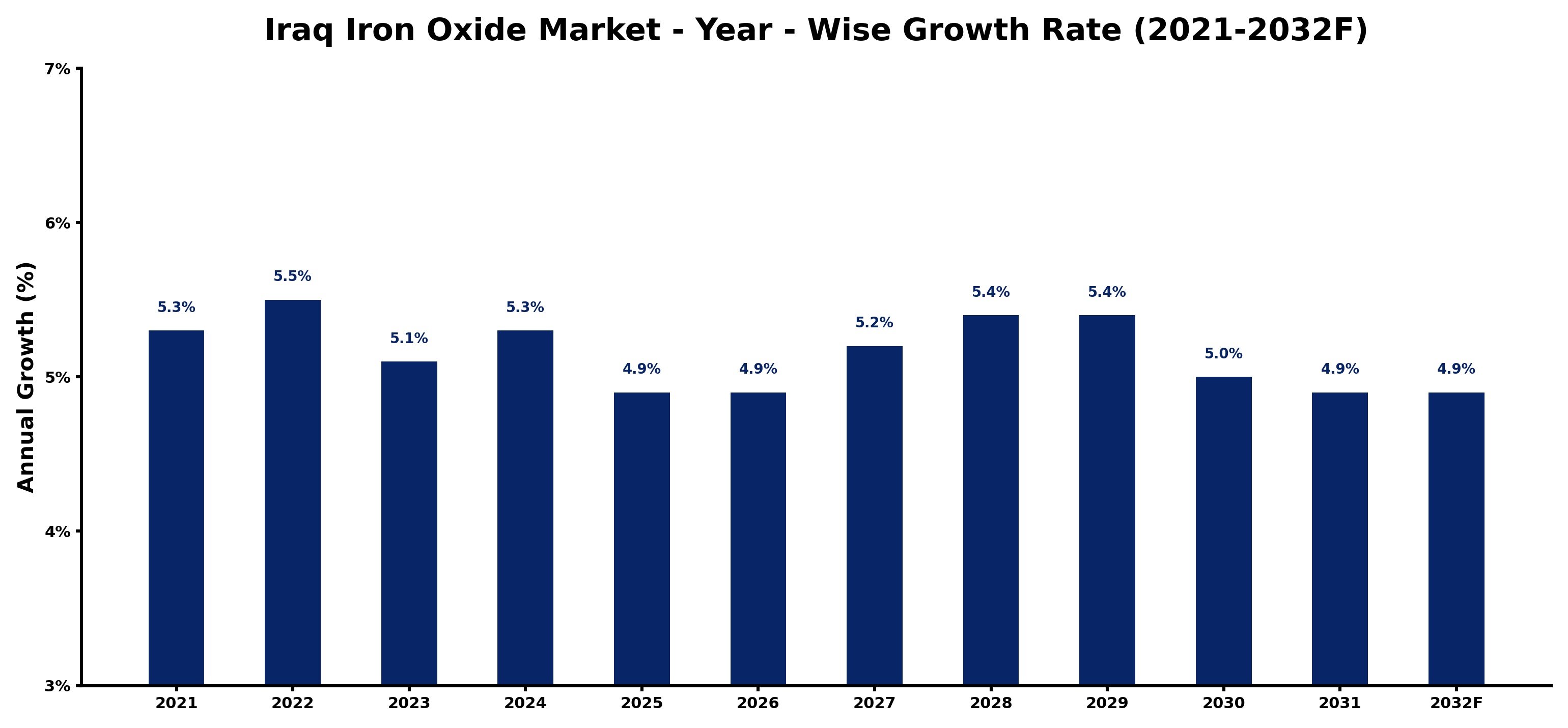
The table below presents the year‑wise growth rates along with the key drivers influencing the market
| Year | Growth Rate | Major Drivers |
| 2021 | 5.3% | Construction sector demand increased |
| 2022 | 5.5% | Manufacturing growth drove consumption |
| 2023 | 5.1% | Infrastructure projects expanded usage |
| 2024 | 5.3% | Export opportunities enhanced market |
| 2025 | 4.9% | Technological advancements improved production |
| 2026 | 4.9% | Environmental regulations supported sustainability |
| 2027 | 5.2% | Local sourcing initiatives gained traction |
| 2028 | 5.4% | Industrial applications broadened market reach |
| 2029 | 5.4% | R&D investments fostered innovation |
| 2030 | 5.0% | Market diversification opened new avenues |
| 2031 | 4.9% | Trade agreements facilitated exports |
| 2032 | 4.9% | Consumer awareness of quality improved |
Note - Market size estimations and growth projections presented in this report are based on 6Wresearch’s advanced forecasting approach, validated with industry datasets as of June 2026.
Iraq Iron Oxide Market Synopsis
The Iraqi market for iron oxide is characterized by its diverse applications, particularly in the pigments and coatings sector, where the need for durable and UV-resistant materials is paramount. This demand is further intensified by the ongoing investments in both public and private construction projects, indicating a robust supply chain to support these initiatives.
Furthermore, the local production of iron oxide compounds, including red, yellow, and black varieties, aligns with global sustainability trends, as manufacturers focus on creating environmentally friendly products. This adaptability is expected to enhance market competitiveness and ensure sustained growth in response to evolving consumer preferences.
Iraq Iron Oxide Market Key Takeaways
- The market is set to witness significant growth due to increased infrastructure investments.
- Iron oxide pigments are essential in construction, contributing to the market's stability.
- Government policies are fostering quality standards and sustainable production practices.
- Environmental regulations are shaping product development and market strategies.
- Emerging applications in the manufacturing sector are diversifying demand channels.
Evaluation of Restraints in Iraq Iron Oxide Market
Despite the promising growth prospects, the Iraq iron oxide market faces certain restraints that could hinder its full potential. Fluctuating demand stemming from global economic uncertainties can disrupt production schedules and inventory management for manufacturers. Additionally, supply chain disruptions, particularly those related to logistics and transportation in a post-conflict environment, may lead to delays in product delivery. Ensuring product quality and compliance with stringent environmental regulations adds another layer of complexity, requiring manufacturers to invest in continuous process improvements and quality assurance measures. Addressing these challenges is crucial for sustaining long-term market growth.
Iraq Iron Oxide Market Trends
The trend towards sustainability is increasingly shaping the Iraq iron oxide market, with manufacturers seeking to develop eco-friendly pigments that meet both local and international standards. Additionally, technological advancements in production processes are enabling the creation of higher-quality pigments with enhanced performance characteristics. The growing demand for colored construction materials, driven by urban aesthetics and branding, is also influencing product innovations and expansions within the market.
Iraq Iron Oxide Market Opportunities
There are substantial opportunities for growth within the Iraq iron oxide market, particularly through strategic partnerships and collaborations with local governments and construction firms. As urban development projects escalate, manufacturers can tap into the burgeoning demand for high-quality, specialized iron oxide pigments. Furthermore, expanding into niche applications such as renewable energy technologies presents exciting prospects for future investment and product diversification.
Government Initiatives in the Iraq Iron Oxide Market
The Iraqi government plays a pivotal role in regulating the iron oxide market, focusing on establishing quality standards and environmental compliance for manufacturers. Initiatives aimed at promoting research and development into sustainable production methods are essential for fostering a competitive market landscape. Public spending in infrastructure and construction continues to support the industry's growth, reflecting a commitment to advancing local manufacturing capabilities.
Future Insights of the Iraq Iron Oxide Market
Looking ahead to 2026-2032, the Iraq iron oxide market is poised for significant transformation. As construction and infrastructure development remain priorities, the demand for iron oxide products will likely increase, with manufacturers adapting to new technologies and sustainability practices. The continued diversification of applications, from coatings to ceramics, will also drive growth, presenting ample opportunities for both existing and new market entrants.
Iraq Iron Oxide Market Latest Developments (May 2025 - June 2026)
Recently, the Iraq iron oxide market has witnessed a surge in investments aimed at enhancing production capabilities and exploring new application areas. Industry stakeholders have begun collaborating on projects focused on sustainable product development, aligning with global market trends. Additionally, local manufacturers are investing in advanced technology to improve pigment quality and expand their product offerings to meet the rising demand across various sectors.
Iraq Iron Oxide Market - Key Attractiveness of the Report
- 10 Years of Market Numbers
- Historical Data Starting from 2022 to 2025
- Base Year: 2025
- Forecast Data until 2032
- Key Performance Indicators Impacting the Market
- Major Upcoming Developments and Projects
Key Highlights of the Report:
- Iraq Iron Oxide Market Outlook
- Market Size of Iraq Iron Oxide Market, 2025
- Forecast of Iraq Iron Oxide Market, 2032
- Historical Data and Forecast of Iraq Iron Oxide Revenues & Volume for the Period 2022-2032F
- Iraq Iron Oxide Market Trend Evolution
- Iraq Iron Oxide Market Drivers and Challenges
- Iraq Iron Oxide Price Trends
- Iraq Iron Oxide Porter's Five Forces
- Iraq Iron Oxide Industry Life Cycle
- Historical Data and Forecast of Iraq Iron Oxide Market Revenues & Volume By Product Type for the Period 2022-2032F
- Historical Data and Forecast of Iraq Iron Oxide Market Revenues & Volume By Red Iron Oxide for the Period 2022-2032F
- Historical Data and Forecast of Iraq Iron Oxide Market Revenues & Volume By Yellow Iron Oxide for the Period 2022-2032F
- Historical Data and Forecast of Iraq Iron Oxide Market Revenues & Volume By Black Iron Oxide for the Period 2022-2032F
- Historical Data and Forecast of Iraq Iron Oxide Market Revenues & Volume By Orange Iron Oxide for the Period 2022-2032F
- Historical Data and Forecast of Iraq Iron Oxide Market Revenues & Volume By Brown Iron Oxide for the Period 2022-2032F
- Historical Data and Forecast of Iraq Iron Oxide Market Revenues & Volume By Green Iron Oxide for the Period 2022-2032F
- Historical Data and Forecast of Iraq Iron Oxide Market Revenues & Volume By Other Blends for the Period 2022-2032F
- Historical Data and Forecast of Iraq Iron Oxide Market Revenues & Volume By Application for the Period 2022-2032F
- Historical Data and Forecast of Iraq Iron Oxide Market Revenues & Volume By Construction for the Period 2022-2032F
- Historical Data and Forecast of Iraq Iron Oxide Market Revenues & Volume By Paints & Coatings for the Period 2022-2032F
- Historical Data and Forecast of Iraq Iron Oxide Market Revenues & Volume By Plastics for the Period 2022-2032F
- Historical Data and Forecast of Iraq Iron Oxide Market Revenues & Volume By Paper & Pulp Manufacturing for the Period 2022-2032F
- Historical Data and Forecast of Iraq Iron Oxide Market Revenues & Volume By Textile for the Period 2022-2032F
- Historical Data and Forecast of Iraq Iron Oxide Market Revenues & Volume By Ceramics for the Period 2022-2032F
- Historical Data and Forecast of Iraq Iron Oxide Market Revenues & Volume By Leather for the Period 2022-2032F
- Historical Data and Forecast of Iraq Iron Oxide Market Revenues & Volume By Others (Fertilizers, Cosmetics, Rubber) for the Period 2022-2032F
- Iraq Iron Oxide Import Export Trade Statistics
- Market Opportunity Assessment By Product Type
- Market Opportunity Assessment By Application
- Iraq Iron Oxide Top Companies Market Share
- Iraq Iron Oxide Competitive Benchmarking By Technical and Operational Parameters
- Iraq Iron Oxide Company Profiles
- Iraq Iron Oxide Key Strategic Recommendations






































