Iraq Mineral Oil Market Size, Share & Growth Rate
The Iraq Mineral Oil Market was estimated at USD 240 Million in 2025 and is projected to reach USD 333 Million by 2032, growing at a CAGR of 4.8% from 2026 to 2032. This growth trajectory is driven by the increasing demand for mineral oil across automotive and industrial applications. As Iraq's economy diversifies, the expansion of manufacturing activities and rising vehicle ownership are further propelling the mineral oil sector's growth.
Iraq Mineral Oil Market Year-wise Growth Rate and Key Drivers
This graph highlights how the Iraq Mineral Oil Market has steadily grown over the years, supported by major growth factors.
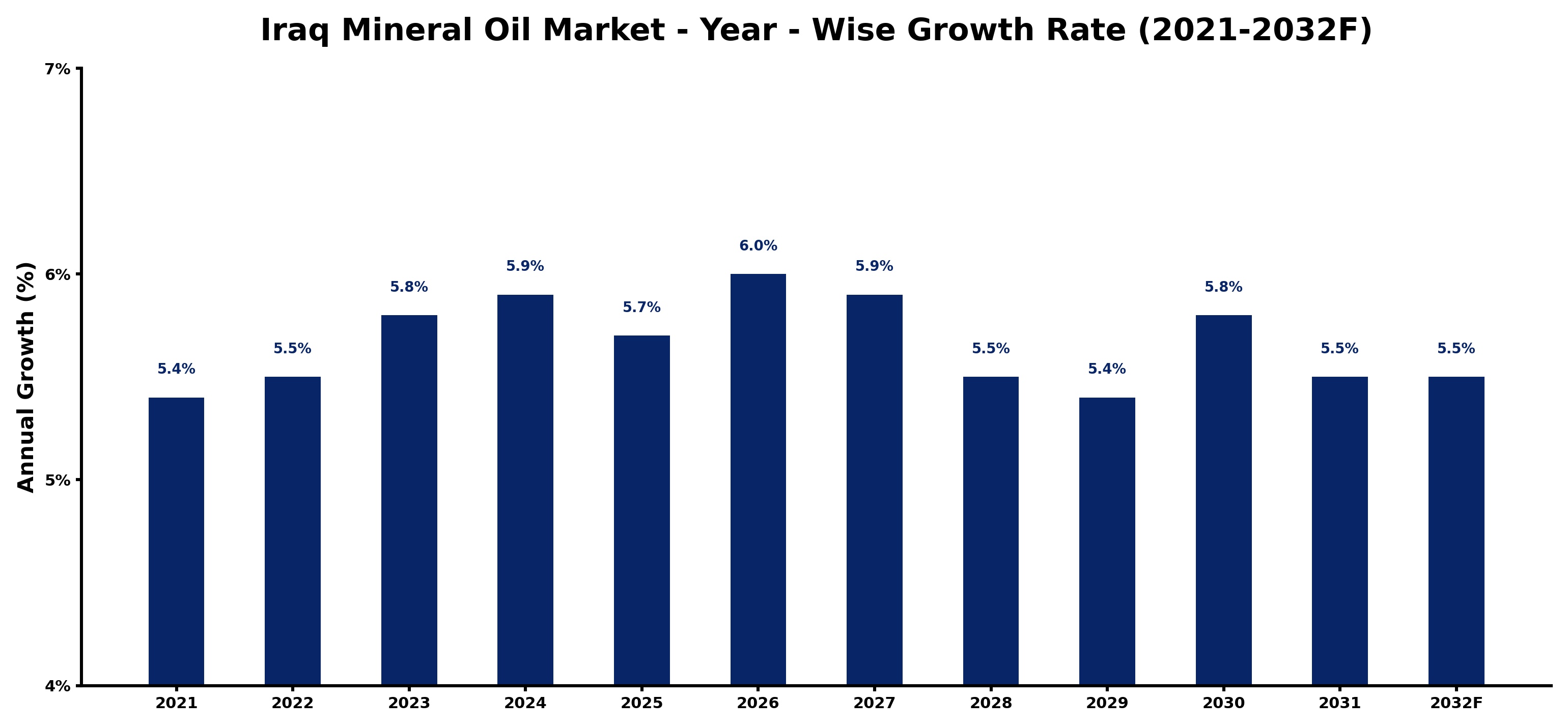
The table below presents the year‑wise growth rates along with the key drivers influencing the market
| Year | Growth Rate | Major Drivers |
| 2021 | 5.4% | Increasing industrial automation investments |
| 2022 | 5.5% | Growing renewable energy integration projects |
| 2023 | 5.8% | Expansion of manufacturing activities |
| 2024 | 5.9% | Government infrastructure modernization initiatives |
| 2025 | 5.7% | Expansion of manufacturing activities |
| 2026 | 6.0% | Expansion of commercial construction activities |
| 2027 | 5.9% | Increasing adoption of advanced technologies |
| 2028 | 5.5% | Increasing industrial automation investments |
| 2029 | 5.4% | Increasing industrial infrastructure investments |
| 2030 | 5.8% | Growing renewable energy integration projects |
| 2031 | 5.5% | Expansion of transportation and logistics networks |
| 2032 | 5.5% | Expansion of manufacturing activities |
Note - Market size estimations and growth projections presented in this report are based on 6Wresearch's advanced forecasting approach, validated with industry datasets as of June 2026.
Iraq Mineral Oil Market Synopsis
Recent trends in the Iraq Mineral Oil Market show a burgeoning demand for mineral oil as the economy progresses towards a more industrialized framework. Current market momentum is characterized by enhanced production capabilities and increased adoption in various sectors.
However, as the market evolves, it is heading towards a phase where eco-friendly alternatives and innovations in production processes are expected to shape future demand. The push towards sustainable practices signifies an important shift in how mineral oil products are perceived and utilized in Iraq.
Iraq Mineral Oil Market Key Takeaways
- The market is poised for steady growth driven by rising automotive ownership and industrial expansion.
- Government initiatives are fostering foreign investment, enhancing production efficiency.
- Increased awareness of environmental issues is boosting demand for eco-friendly mineral oil alternatives.
- The presence of abundant crude oil reserves ensures product availability and competitive pricing.
- Political stability and security improvements will be crucial for sustained market growth.
Evaluation of Restraints in Iraq Mineral Oil Market
While the Iraq Mineral Oil Market showcases considerable growth potential, it is not without its constraints. Geopolitical instability remains a significant concern, as ongoing tensions can disrupt supply chains and impact the operations of mineral oil producers. Additionally, fluctuations in global oil prices create a volatile environment that can affect profitability. As such, stakeholders in the market must devise comprehensive strategies to navigate these uncertainties and secure their operations against potential disruptions.
Iraq Mineral Oil Market Trends
Emerging trends in the Iraq Mineral Oil Market indicate a shift towards sustainability and innovation. Manufacturers are increasingly focusing on developing eco-friendly mineral oil alternatives, reflecting a broader global trend towards environmental responsibility. Furthermore, advancements in technology are enhancing production processes, leading to improved efficiency and reduced waste. These trends are likely to influence not only consumer preferences but also regulatory standards in the near future.
Iraq Mineral Oil Market Opportunities
Opportunities within the Iraq Mineral Oil Market are ripe for exploitation, particularly in the realm of eco-friendly products. As government policies increasingly support sustainable practices, companies that innovate in this area will likely gain a competitive edge. Additionally, the continued development of infrastructure will open new avenues for distribution and export, enabling firms to reach broader markets and enhance their product offerings. Strategic partnerships with foreign investors can further bolster technological advancements and resource management.
Government Initiatives in the Iraq Mineral Oil Market
The Iraqi government is actively pursuing initiatives to optimize the potential of its mineral oil resources. These initiatives include tax incentives for exploration and extraction activities, as well as production-sharing agreements aimed at attracting foreign investment. Furthermore, regulatory frameworks are being streamlined to facilitate the entry of new players and technology into the market. Infrastructure enhancements, such as improved transportation and storage facilities, are also being prioritized to bolster distribution capabilities and ensure efficient market operations.
Future Insights of the Iraq Mineral Oil Market
Looking ahead to 2026-2032, the Iraq Mineral Oil Market is positioned for progressive development. The anticipated economic diversification will likely bolster industrial and automotive growth, driving mineral oil demand. As environmental regulations tighten, companies that successfully adapt to these changes by integrating sustainable practices will be more resilient and competitive. The market is set to evolve, with innovation at its core, paving the way for a dynamic future in mineral oil applications.
Iraq Mineral Oil Market Latest Developments (May 2025 - June 2026)
Recent industry developments indicate a heightened focus on sustainability in the Iraq Mineral Oil Market, as companies begin to explore eco-friendly alternatives to traditional mineral oils. Additionally, investments in upgrading refinery capabilities are becoming more common, as firms aim to enhance production efficiency. Collaborations between local and international firms are also on the rise, reflecting a shared commitment to technological advancement and market expansion.
Iraq Mineral Oil Market - Key Attractiveness of the Report
- 10 Years of Market Numbers
- Historical Data Starting from 2022 to 2025
- Base Year: 2025
- Forecast Data until 2032
- Key Performance Indicators Impacting the Market
- Major Upcoming Developments and Projects
Key Highlights of the Report:
- Iraq Mineral Oil Market Outlook
- Market Size of Iraq Mineral Oil Market, 2025
- Forecast of Iraq Mineral Oil Market, 2032
- Historical Data and Forecast of Iraq Mineral Oil Revenues & Volume for the Period 2022-2032F
- Iraq Mineral Oil Market Trend Evolution
- Iraq Mineral Oil Market Drivers and Challenges
- Iraq Mineral Oil Price Trends
- Iraq Mineral Oil Porter's Five Forces
- Iraq Mineral Oil Industry Life Cycle
- Historical Data and Forecast of Iraq Mineral Oil Market Revenues & Volume By Grade for the Period 2022-2032F
- Historical Data and Forecast of Iraq Mineral Oil Market Revenues & Volume By Technical Oil for the Period 2022-2032F
- Historical Data and Forecast of Iraq Mineral Oil Market Revenues & Volume By White Oil for the Period 2022-2032F
- Historical Data and Forecast of Iraq Mineral Oil Market Revenues & Volume By Application for the Period 2022-2032F
- Historical Data and Forecast of Iraq Mineral Oil Market Revenues & Volume By Baby Oil for the Period 2022-2032F
- Historical Data and Forecast of Iraq Mineral Oil Market Revenues & Volume By Cosmetics for the Period 2022-2032F
- Historical Data and Forecast of Iraq Mineral Oil Market Revenues & Volume By Skin Care Products for the Period 2022-2032F
- Historical Data and Forecast of Iraq Mineral Oil Market Revenues & Volume By Hair Care Products for the Period 2022-2032F
- Historical Data and Forecast of Iraq Mineral Oil Market Revenues & Volume By Consumer Goods for the Period 2022-2032F
- Historical Data and Forecast of Iraq Mineral Oil Market Revenues & Volume By Others for the Period 2022-2032F
- Iraq Mineral Oil Import Export Trade Statistics
- Market Opportunity Assessment By Grade
- Market Opportunity Assessment By Application
- Iraq Mineral Oil Top Companies Market Share
- Iraq Mineral Oil Competitive Benchmarking By Technical and Operational Parameters
- Iraq Mineral Oil Company Profiles
- Iraq Mineral Oil Key Strategic Recommendations






































