Iraq Pigments Market Summary
The iraq pigments market was estimated at USD 151 Million in 2025 and is projected to reach USD 208 Million by 2032, growing at a CAGR of 5.3% from 2026 to 2032.
Iraq Pigments Market Year-wise Growth Rate and Key Drivers
This graph highlights how the Iraq Pigments Market has steadily grown over the past five years, supported by major growth factors.
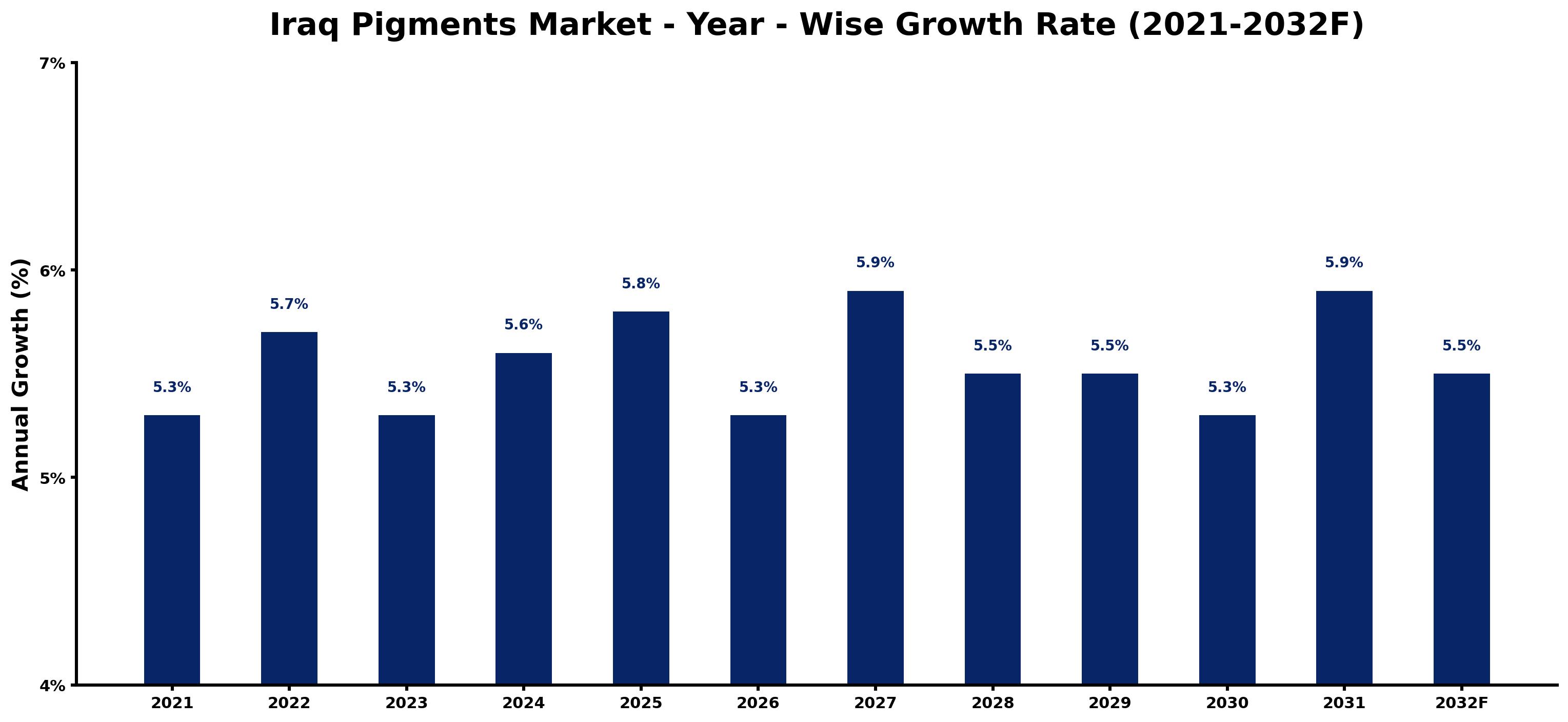
The table below presents the year wise growth rates along with the key drivers influencing the market
| Year | Growth Rate | Major Drivers |
| 2021 | 5.3% | Market recovery post-conflict begins as infrastructure projects gain momentum across Iraq. |
| 2022 | 5.7% | Increased construction activities highlight the need for high-quality pigments in various sectors. |
| 2023 | 5.3% | A push towards sustainable materials influences pigment manufacturing in the region significantly. |
| 2024 | 5.6% | Rising urbanization fuels demand for decorative paints and coatings across Iraqi cities. |
| 2025 | 5.8% | Local manufacturers innovate to meet specific color requirements for regional architectural styles. |
| 2026 | 5.3% | Investment in renewable energy projects increases demand for specialized industrial coatings. |
| 2027 | 5.9% | Artisans and craftspeople embrace vibrant hues, impacting local pigment preferences dramatically. |
| 2028 | 5.5% | Import tariffs on foreign pigments promote growth in domestic production capabilities significantly. |
| 2029 | 5.5% | Collaborations between artists and manufacturers drive unique pigment formulations in Iraq. |
| 2030 | 5.3% | Technological advancements enable local producers to enhance pigment durability and vibrancy. |
| 2031 | 5.9% | Export potential for Iraqi pigments expands as regional trade agreements take effect. |
| 2032 | 5.5% | Cultural heritage preservation projects emphasize the use of traditional pigments in renovations. |
Note - Market size estimations and growth projections presented in this report are based on 6Wresearch's advanced forecasting approach, validated with industry datasets as of June 2026.
Iraq Pigments Market Synopsis
The Iraq Pigments Market is projected to reach 5.3% and witness significant growth during the forecast period (2026-2032). This growth is primarily driven by the burgeoning demand for pigments across various sectors, including paints and coatings, plastics, printing inks, and textiles. The market is largely characterized by the dominance of inorganic pigments, notably titanium dioxide and iron oxide, which are favored for their exceptional properties and versatile applications.
Iraq Pigments Market Growth Drivers
Several factors contribute to the ongoing expansion of the Iraq Pigments Market. Key drivers include:
- Infrastructure development in Iraq is a significant catalyst, as increased construction activities elevate the demand for decorative paints and coatings.
- Rising disposable income levels lead consumers to invest in higher-quality and aesthetically pleasing products, further propelling the pigments sector.
- The global trend towards sustainability is fostering an increased interest in organic pigments, which are perceived as eco-friendly alternatives to traditional synthetic options.
- Increased production capacities and technological advancements are enabling manufacturers to offer innovative and diverse pigment solutions that cater to evolving industry needs.
- Growing health awareness among consumers is driving demand for non-toxic and environmentally safe pigment options in various applications.
Iraq Pigments Market Trends and Opportunities
The Iraq Pigments Market is evolving with notable trends that reflect global and local demands. An increasing shift towards organic pigments is evident, with manufacturers focusing on natural sourcing and sustainable production methods. The following opportunities are shaping the market:
- Developing high-performance pigments that boast improved color intensity, stability, and durability is becoming essential for various industrial applications.
- Investment in innovative research and development to create eco-friendly pigment solutions can capture the attention of environmentally conscious consumers.
- Emphasizing quality control processes can enhance product reliability, addressing concerns about inconsistent product quality in the market.
- Expansion of distribution networks to improve access to high-quality pigments is crucial for reaching a wider customer base.
- Collaboration with international companies to bring advanced technology and expertise into the local market can foster growth and innovation.
Iraq Pigments Market Challenges and Restraints
Despite its growth potential, the Iraq Pigments Market faces several challenges that could hinder expansion. These challenges include:
- Limited access to advanced production technologies constrains manufacturers' ability to innovate and enhance efficiency.
- Inconsistent quality of raw materials poses significant risks to the overall quality and reliability of pigments produced.
- Fluctuating pigment prices influenced by geopolitical instability can affect profitability and market stability.
- The presence of counterfeit products undermines consumer trust and affects market dynamics by creating unfair competition.
- Regulatory hurdles and bureaucratic processes for obtaining necessary permits can delay market entry for new players.
Iraq Pigments Market Investment Opportunities
The Iraq Pigments Market holds significant investment potential due to increasing demands across various sectors. The expanding construction industry, coupled with rising disposable incomes, drives the need for decorative and high-quality coatings. Investment opportunities encompass:
- Investment in local manufacturing facilities to capitalize on government initiatives aimed at reducing import dependency and fostering domestic production.
- Collaboration with government programs that support industrial growth and infrastructure initiatives, creating pathways for market entry.
- Fostering partnerships with research institutions to drive innovation in pigment technology and production methods.
- Establishing distribution networks to ensure consistent supply and availability of high-quality pigments in regional markets.
- Conducting comprehensive market research to identify emerging trends and consumer preferences that can guide product development.
Iraq Pigments Market Government Investment and Initiatives
Government policies regarding the Iraq Pigments Market focus on enhancing local production capabilities while regulating imports and exports. The Iraqi government has initiated several strategies aimed at supporting the pigment manufacturing sector, including:
- Encouraging investments in domestic manufacturing to decrease reliance on foreign imports, thus fostering local economic growth.
- Implementing stringent quality control measures to ensure that both domestically produced and imported pigments meet safety and environmental standards.
- Promoting environmentally friendly practices in the pigment production process to align with global sustainability goals.
- Establishing regulatory frameworks that support fair competition and prevent monopolistic behaviors within the industry.
- Investing in the development of infrastructure to facilitate efficient distribution networks across the country, enhancing market access.
Iraq Pigments Market Latest Developments (May 2025 - June 2026)
Recent developments in the Iraq Pigments Market indicate a proactive shift towards sustainability and innovation. Notable trends include a marked increase in investments in green pigment technologies that align with global environmental sustainability initiatives. Additionally, the landscape has seen improvements in local production capabilities, with advancements in manufacturing processes aimed at enhancing product quality. There has also been a rise in collaborations between local and international entities to boost knowledge transfer and technological advancements in pigment manufacturing.
Iraq Pigments Market - Key Attractiveness of the Report
- 10 Years of Market Numbers
- Historical Data Starting from 2022 to 2025
- Base Year: 2025
- Forecast Data until 2032
- Key Performance Indicators Impacting the Market
- Major Upcoming Developments and Projects
Key Highlights of the Report:
- Iraq Pigments Market Outlook
- Market Size of Iraq Pigments Market, 2025
- Forecast of Iraq Pigments Market, 2032
- Historical Data and Forecast of Iraq Pigments Revenues & Volume for the Period 2022-2032F
- Iraq Pigments Market Trend Evolution
- Iraq Pigments Market Drivers and Challenges
- Iraq Pigments Price Trends
- Iraq Pigments Porter's Five Forces
- Iraq Pigments Industry Life Cycle
- Historical Data and Forecast of Iraq Pigments Market Revenues & Volume By Product for the Period 2022-2032F
- Historical Data and Forecast of Iraq Pigments Market Revenues & Volume By Inorganic for the Period 2022-2032F
- Historical Data and Forecast of Iraq Pigments Market Revenues & Volume By Organic for the Period 2022-2032F
- Historical Data and Forecast of Iraq Pigments Market Revenues & Volume By Specialty for the Period 2022-2032F
- Historical Data and Forecast of Iraq Pigments Market Revenues & Volume By Application for the Period 2022-2032F
- Historical Data and Forecast of Iraq Pigments Market Revenues & Volume By Paints & coatings for the Period 2022-2032F
- Historical Data and Forecast of Iraq Pigments Market Revenues & Volume By Printing inks for the Period 2022-2032F
- Historical Data and Forecast of Iraq Pigments Market Revenues & Volume By Plastics for the Period 2022-2032F
- Historical Data and Forecast of Iraq Pigments Market Revenues & Volume By Construction materials for the Period 2022-2032F
- Historical Data and Forecast of Iraq Pigments Market Revenues & Volume By Others for the Period 2022-2032F
- Iraq Pigments Import Export Trade Statistics
- Market Opportunity Assessment By Product
- Market Opportunity Assessment By Application
- Iraq Pigments Top Companies Market Share
- Iraq Pigments Competitive Benchmarking By Technical and Operational Parameters
- Iraq Pigments Company Profiles
- Iraq Pigments Key Strategic Recommendations






































