Iraq Radioactive Waste Management Market Size, Share & Growth Rate
The Iraq Radioactive Waste Management Market was estimated at USD 1465 Million in 2025 and is projected to reach USD 2123 Million by 2032, growing at a CAGR of 5.4% from 2026 to 2032. This growth trajectory reflects a heightened recognition of the environmental and public health risks associated with radioactive waste, prompting the need for comprehensive management strategies. Moreover, the integration of international best practices and advancements in treatment technologies is driving investments across the sector, further solidifying Iraq's commitment to sustainable waste management solutions.
Iraq Radioactive Waste Management Market Year-wise Growth Rate and Key Drivers
This graph highlights how the Iraq Radioactive Waste Management Market has steadily grown over the years, supported by major growth factors.
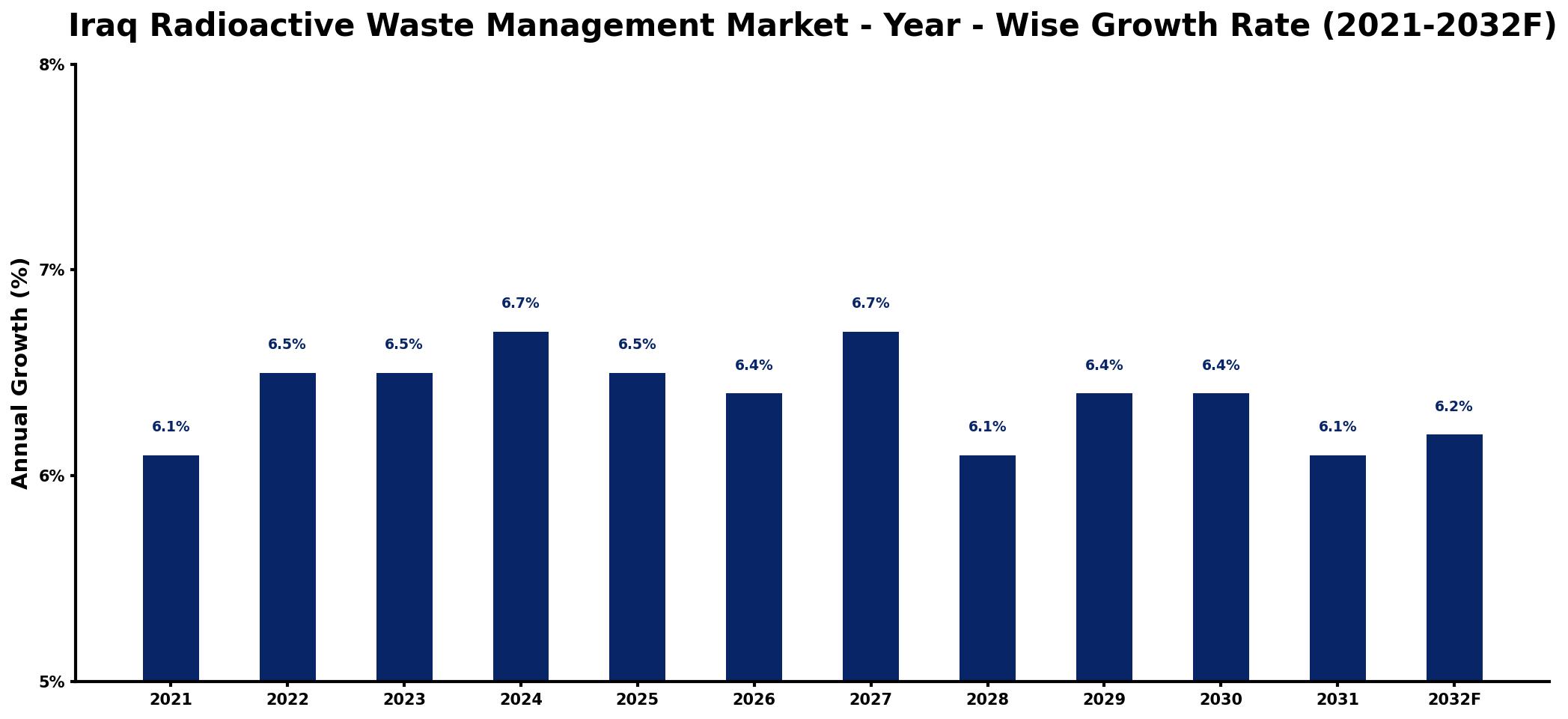
The table below presents the year‑wise growth rates along with the key drivers influencing the market
| Year | Growth Rate | Major Drivers |
| 2021 | 6.1% | increased regulatory compliance requirements |
| 2022 | 6.5% | growing public health awareness initiatives |
| 2023 | 6.5% | rising investments in infrastructure |
| 2024 | 6.7% | enhanced technology adoption rates |
| 2025 | 6.5% | expanding international partnerships formed |
| 2026 | 6.4% | increased focus on sustainability practices |
| 2027 | 6.7% | growing demand for safe disposal |
| 2028 | 6.1% | strengthened environmental protection policies |
| 2029 | 6.4% | higher funding for research projects |
| 2030 | 6.4% | increased collaboration with NGOs |
| 2031 | 6.1% | growing market for alternative solutions |
| 2032 | 6.2% | rising consumer awareness campaigns |
Note: Market size estimations and growth projections presented in this report are based on 6Wresearch's proprietary forecasting methodology, utilizing the latest available industry data, government publications, and primary research inputs.
Iraq Radioactive Waste Management Market Synopsis
In recent years, Iraq has increasingly recognized the imperative of effectively managing radioactive waste generated from various sectors including healthcare and energy. With ongoing regulatory developments, the nation is gradually establishing frameworks that align with international safety standards to address waste disposal challenges.
The confluence of growing industrial activities, particularly in oil and gas and nuclear power generation, has accentuated the urgency of reliable waste management systems. As stakeholders engage in initiatives aimed at public awareness, the importance of transparent and accountable practices is becoming more apparent, marking a pivotal shift towards improved operational standards.
Iraq Radioactive Waste Management Market Key Takeaways
- The market is poised for steady growth, driven by regulatory developments and investment in infrastructure.
- International best practices are being incorporated to enhance safety and efficiency in waste management.
- Public awareness initiatives are fostering a more informed community regarding radioactive waste management practices.
- The sector faces challenges due to existing regulatory gaps and public opposition, particularly against nuclear energy.
- Investment opportunities are emerging in waste treatment facilities and advanced disposal technologies.
Evaluation of Restraints in Iraq Radioactive Waste Management Market
Despite the promising growth trajectory, several constraints hinder the efficient management of radioactive waste in Iraq. A significant hurdle is the incomplete regulatory framework surrounding nuclear safety and waste disposal, which complicates the establishment of standardized practices. Additionally, limited financial resources have restricted the implementation of comprehensive waste management strategies, creating a reliance on outdated technologies. Public opposition to nuclear energy projects remains a critical challenge, as it can impede policy advancement and the necessary investment in waste management infrastructure.
Iraq Radioactive Waste Management Market Trends
Key trends are emerging in the Iraq Radioactive Waste Management Market, highlighting a shift towards the adoption of innovative waste treatment technologies. Growing collaboration with international entities is facilitating knowledge transfer and enhancing operational capacities. Furthermore, the increasing focus on environmental sustainability is driving demand for efficient waste disposal solutions that minimize ecological impact, shaping the future of the sector.
Iraq Radioactive Waste Management Market Opportunities
The landscape of the Iraq Radioactive Waste Management Market is ripe with opportunities for investment and development. Key areas include the establishment of advanced waste treatment facilities and the improvement of existing storage infrastructure. Additionally, as the regulatory framework strengthens, there is considerable potential for technology-driven solutions that enhance safety and efficiency in waste processing, providing avenues for both domestic and international investors.
Government Initiatives in the Iraq Radioactive Waste Management Market
The Iraqi government is actively developing policies aimed at the safe handling, storage, and disposal of radioactive waste. These initiatives are designed to align with international safety standards and ensure the protection of public health and the environment. The government is also prioritizing public engagement and awareness campaigns to improve transparency and foster stakeholder collaboration in radioactive waste management practices.
Future Insights of the Iraq Radioactive Waste Management Market
Looking ahead to the period between 2026 and 2032, the Iraq Radioactive Waste Management Market is expected to undergo significant transformation. The emphasis on aligning local regulations with international standards will catalyze further investments and advancements. As public awareness continues to grow and the understanding of nuclear waste management deepens, the market is poised to expand, with a stronger focus on sustainable and efficient waste disposal methodologies becoming the norm.
Iraq Radioactive Waste Management Market Latest Developments (2025 - 2026)
Recent developments in the Iraq Radioactive Waste Management Market reflect a commitment to enhancing safety and operational effectiveness. Efforts to bolster regulatory frameworks are ongoing, aiming for a more integrated approach towards waste management practices. In addition, initiatives promoting the adoption of cutting-edge technologies for waste treatment are gaining momentum, signaling a positive direction for the sector.
Iraq Radioactive Waste Management Market - Key Attractiveness of the Report
- 10 Years of Market Numbers
- Historical Data Starting from 2022 to 2025
- Base Year: 2025
- Forecast Data until 2032
- Key Performance Indicators Impacting the Market
- Major Upcoming Developments and Projects
Key Highlights of the Report:
- Iraq Radioactive Waste Management Market Outlook
- Market Size of Iraq Radioactive Waste Management Market, 2025
- Forecast of Iraq Radioactive Waste Management Market, 2032
- Historical Data and Forecast of Iraq Radioactive Waste Management Revenues & Volume for the Period 2022-2032F
- Iraq Radioactive Waste Management Market Trend Evolution
- Iraq Radioactive Waste Management Market Drivers and Challenges
- Iraq Radioactive Waste Management Price Trends
- Iraq Radioactive Waste Management Porter's Five Forces
- Iraq Radioactive Waste Management Industry Life Cycle
- Historical Data and Forecast of Iraq Radioactive Waste Management Market Revenues & Volume By Type for the Period 2022-2032F
- Historical Data and Forecast of Iraq Radioactive Waste Management Market Revenues & Volume By Exempt Waste and Very Low-Level Waste(VLLW) for the Period 2022-2032F
- Historical Data and Forecast of Iraq Radioactive Waste Management Market Revenues & Volume By Low-Level Waste(LLW) for the Period 2022-2032F
- Historical Data and Forecast of Iraq Radioactive Waste Management Market Revenues & Volume By Intermediate-Level Waste(ILW) for the Period 2022-2032F
- Historical Data and Forecast of Iraq Radioactive Waste Management Market Revenues & Volume By High-Level Waste(HLW) for the Period 2022-2032F
- Historical Data and Forecast of Iraq Radioactive Waste Management Market Revenues & Volume By Application for the Period 2022-2032F
- Historical Data and Forecast of Iraq Radioactive Waste Management Market Revenues & Volume By Industrial for the Period 2022-2032F
- Historical Data and Forecast of Iraq Radioactive Waste Management Market Revenues & Volume By Utility for the Period 2022-2032F
- Iraq Radioactive Waste Management Import Export Trade Statistics
- Market Opportunity Assessment By Type
- Market Opportunity Assessment By Application
- Iraq Radioactive Waste Management Top Companies Market Share
- Iraq Radioactive Waste Management Competitive Benchmarking By Technical and Operational Parameters
- Iraq Radioactive Waste Management Company Profiles
- Iraq Radioactive Waste Management Key Strategic Recommendations






































