Iraq Retail And Wholesale Market Size, Share & Growth Rate
The Iraq Retail And Wholesale Market was estimated at USD 1068 Million in 2025 and is projected to reach USD 1761 Million by 2032, growing at a CAGR of 7.4% from 2026 to 2032. This positive trajectory is largely fueled by a youthful population eager for diverse consumer goods, coupled with a gradual shift from traditional shopping formats to modern retail environments. Increasing disposable income levels and a burgeoning middle class are also contributing to the sector's growth.
Iraq Retail And Wholesale Market Year-wise Growth Rate and Key Drivers
This graph highlights how the Iraq Retail And Wholesale Market has steadily grown over the years, supported by major growth factors.
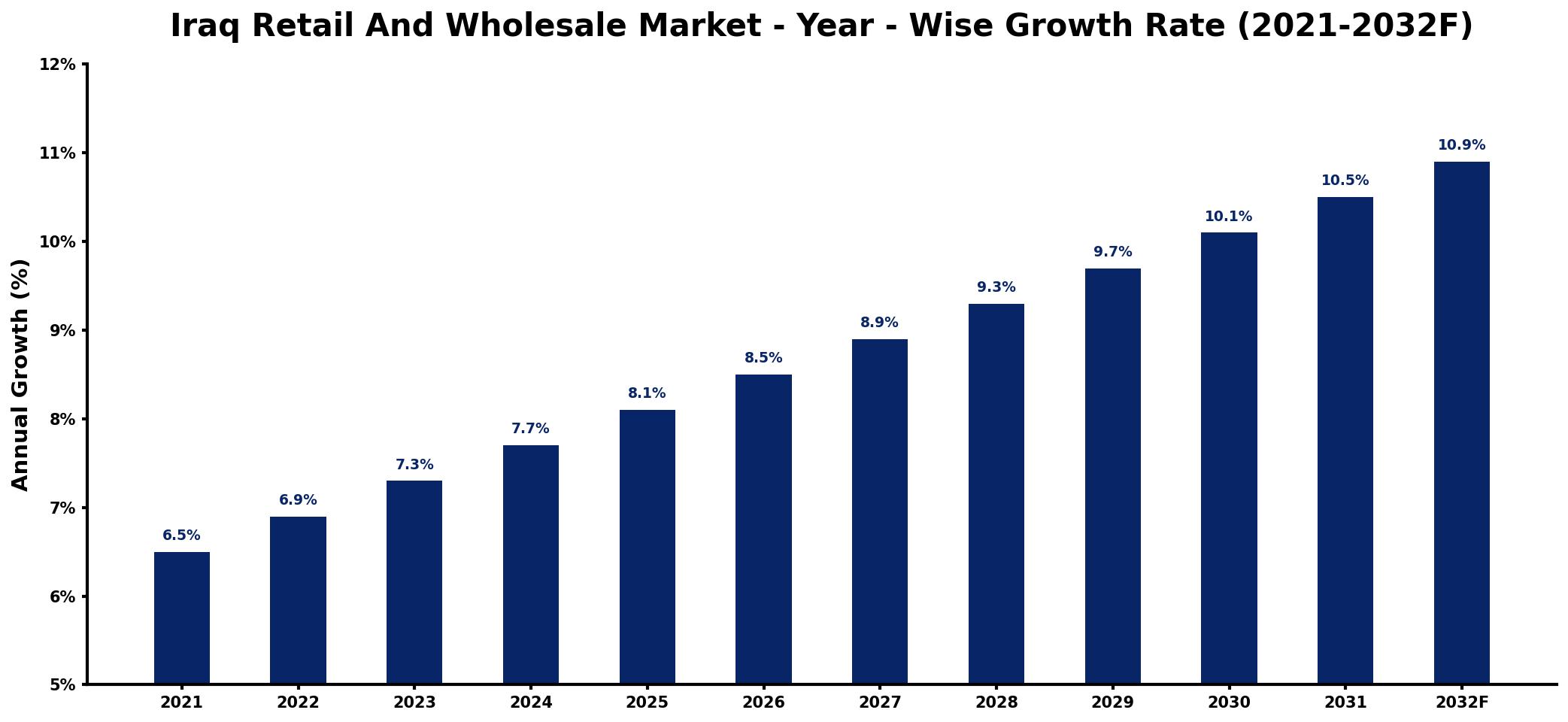
The table below presents the year‑wise growth rates along with the key drivers influencing the market
| Year | Growth Rate | Major Drivers |
| 2021 | 6.5% | rising consumer spending levels |
| 2022 | 6.9% | increased foreign investment influx |
| 2023 | 7.3% | expansion of digital payment systems |
| 2024 | 7.7% | growing urban population demand |
| 2025 | 8.1% | enhanced logistics and distribution networks |
| 2026 | 8.5% | development of local manufacturing capacity |
| 2027 | 8.9% | surge in e-commerce platforms |
| 2028 | 9.3% | improved infrastructure development projects |
| 2029 | 9.7% | increased product variety availability |
| 2030 | 10.1% | growing presence of international brands |
| 2031 | 10.5% | rising disposable income trends |
| 2032 | 10.9% | expanding healthcare application demand |
Note: Market size estimations and growth projections presented in this report are based on 6Wresearch's proprietary forecasting methodology, utilizing the latest available industry data, government publications, and primary research inputs.
Iraq Retail And Wholesale Market Synopsis
The Iraq Retail And Wholesale Market has seen notable momentum in recent years, characterized by a dynamic mix of traditional bazaars and emerging modern retail formats. With major urban centers like Baghdad and Erbil witnessing a surge in organized retail spaces, the market is poised for transformation.
As consumers increasingly gravitate towards convenience and quality, the sector is evolving to meet these demands. The retail environment is shifting, highlighted by the growing presence of international brands and a rising interest in sustainability, which aligns with changing consumer preferences across the region.
Iraq Retail And Wholesale Market Key Takeaways
- The retail sector is driven mainly by food and beverage demand.
- Modern retail formats are on the rise in urban areas.
- Technological advancements are enhancing supply chain efficiency.
- There is an increasing consumer preference for international brands.
- Sustainability initiatives are becoming more important in purchasing decisions.
Evaluation of Restraints in Iraq Retail And Wholesale Market
Political instability and security concerns remain significant constraints for the Iraq Retail And Wholesale Market. The ongoing conflicts can lead to unpredictable consumer confidence, affecting spending patterns. Infrastructure inadequacies, including poor transportation networks and limited electricity access, impede operational efficiency. Furthermore, corruption and bureaucratic hurdles continue to challenge both local and foreign businesses, complicating market entry and expansion efforts.
Iraq Retail And Wholesale Market Trends
A notable trend within the Iraq Retail And Wholesale Market is the acceleration of e-commerce adoption. Retailers and wholesalers increasingly utilize online platforms to enhance their reach and operational efficiencies. There is also a shift towards organized retail formats, indicating a growing consumer preference for convenience and specialty products.
In addition to these trends, sustainability practices are gaining traction, as consumers show a marked preference for ethically sourced products. This focus on quality and sustainability is reshaping the market landscape, positioning it for further growth.
Iraq Retail And Wholesale Market Opportunities
The Iraq Retail And Wholesale Market is ripe with investment opportunities, spurred by a young and growing population along with increasing disposable incomes. There is a burgeoning demand across various sectors, particularly in food and beverage, clothing, electronics, and home goods. The expanding e-commerce landscape further opens doors for innovative retail strategies, enabling businesses to connect with consumers more effectively.
Government Initiatives in the Iraq Retail And Wholesale Market
Government policies play a crucial role in shaping the Iraq Retail And Wholesale Market. Regulations related to foreign ownership, import/export duties, and licensing requirements are designed to protect local businesses while also attracting foreign investment. The government offers incentives to promote economic growth and support compliance with health, safety, and quality standards, creating an environment conducive to business development.
Future Insights of the Iraq Retail And Wholesale Market
Looking ahead to 2026-2032, the Iraq Retail And Wholesale Market is projected to experience substantial growth. Continued political stabilization is anticipated to boost consumer confidence, further increasing spending in retail sectors. The shift towards modern shopping experiences, including shopping malls and enhanced e-commerce platforms, will likely present significant opportunities for retailers. Addressing existing infrastructure challenges and regulatory barriers will be essential in fully unlocking the markets potential.
Iraq Retail And Wholesale Market Latest Developments (2025 - 2026)
In recent months, the Iraq Retail And Wholesale Market has seen ongoing developments that underscore its evolving landscape. Retailers are increasingly investing in technology to streamline operations and enhance customer experiences. Furthermore, international brands are making strategic entries into the market, reflecting a growing confidence in Iraqs retail potential. The trend towards sustainability continues to influence product offerings, with more consumers favoring environmentally friendly options.
Iraq Retail And Wholesale Market - Key Attractiveness of the Report
- 10 Years of Market Numbers
- Historical Data Starting from 2022 to 2025
- Base Year: 2025
- Forecast Data until 2032
- Key Performance Indicators Impacting the Market
- Major Upcoming Developments and Projects
Key Highlights of the Report:
- Iraq Retail And Wholesale Market Outlook
- Market Size of Iraq Retail And Wholesale Market, 2025
- Forecast of Iraq Retail And Wholesale Market, 2032
- Historical Data and Forecast of Iraq Retail And Wholesale Revenues & Volume for the Period 2022-2032F
- Iraq Retail And Wholesale Market Trend Evolution
- Iraq Retail And Wholesale Market Drivers and Challenges
- Iraq Retail And Wholesale Price Trends
- Iraq Retail And Wholesale Porter's Five Forces
- Iraq Retail And Wholesale Industry Life Cycle
- Historical Data and Forecast of Iraq Retail And Wholesale Market Revenues & Volume By Type for the Period 2022-2032F
- Historical Data and Forecast of Iraq Retail And Wholesale Market Revenues & Volume By Retail for the Period 2022-2032F
- Historical Data and Forecast of Iraq Retail And Wholesale Market Revenues & Volume By Wholesale for the Period 2022-2032F
- Historical Data and Forecast of Iraq Retail And Wholesale Market Revenues & Volume By Ownership for the Period 2022-2032F
- Historical Data and Forecast of Iraq Retail And Wholesale Market Revenues & Volume By Retail Chain/Wholesale Chain for the Period 2022-2032F
- Historical Data and Forecast of Iraq Retail And Wholesale Market Revenues & Volume By Independent Retailer/Independent Wholesalers for the Period 2022-2032F
- Historical Data and Forecast of Iraq Retail And Wholesale Market Revenues & Volume By Price Range for the Period 2022-2032F
- Historical Data and Forecast of Iraq Retail And Wholesale Market Revenues & Volume By Premium for the Period 2022-2032F
- Historical Data and Forecast of Iraq Retail And Wholesale Market Revenues & Volume By Mid-Range for the Period 2022-2032F
- Historical Data and Forecast of Iraq Retail And Wholesale Market Revenues & Volume By Economy for the Period 2022-2032F
- Historical Data and Forecast of Iraq Retail And Wholesale Market Revenues & Volume By Distribution Channel for the Period 2022-2032F
- Historical Data and Forecast of Iraq Retail And Wholesale Market Revenues & Volume By Supermarkets/Hypermarkets for the Period 2022-2032F
- Historical Data and Forecast of Iraq Retail And Wholesale Market Revenues & Volume By Convenience Stores for the Period 2022-2032F
- Historical Data and Forecast of Iraq Retail And Wholesale Market Revenues & Volume By Department Stores for the Period 2022-2032F
- Historical Data and Forecast of Iraq Retail And Wholesale Market Revenues & Volume By Specialty Stores for the Period 2022-2032F
- Iraq Retail And Wholesale Import Export Trade Statistics
- Market Opportunity Assessment By Type
- Market Opportunity Assessment By Ownership
- Market Opportunity Assessment By Price Range
- Market Opportunity Assessment By Distribution Channel
- Iraq Retail And Wholesale Top Companies Market Share
- Iraq Retail And Wholesale Competitive Benchmarking By Technical and Operational Parameters
- Iraq Retail And Wholesale Company Profiles
- Iraq Retail And Wholesale Key Strategic Recommendations






































