Iraq Soybean Oil Market Size, Share & Growth Rate
The Iraq Soybean Oil Market was estimated at USD 477 Million in 2025 and is projected to reach USD 660 Million by 2032, growing at a CAGR of 4.7% from 2026 to 2032. This growth trajectory is fueled by increasing health consciousness among consumers and a steady rise in the food processing sector. Additionally, government initiatives aimed at enhancing domestic soybean production further support market expansion.
Iraq Soybean Oil Market Year-wise Growth Rate and Key Drivers
This graph highlights how the Iraq Soybean Oil Market has steadily grown over the years, supported by major growth factors.
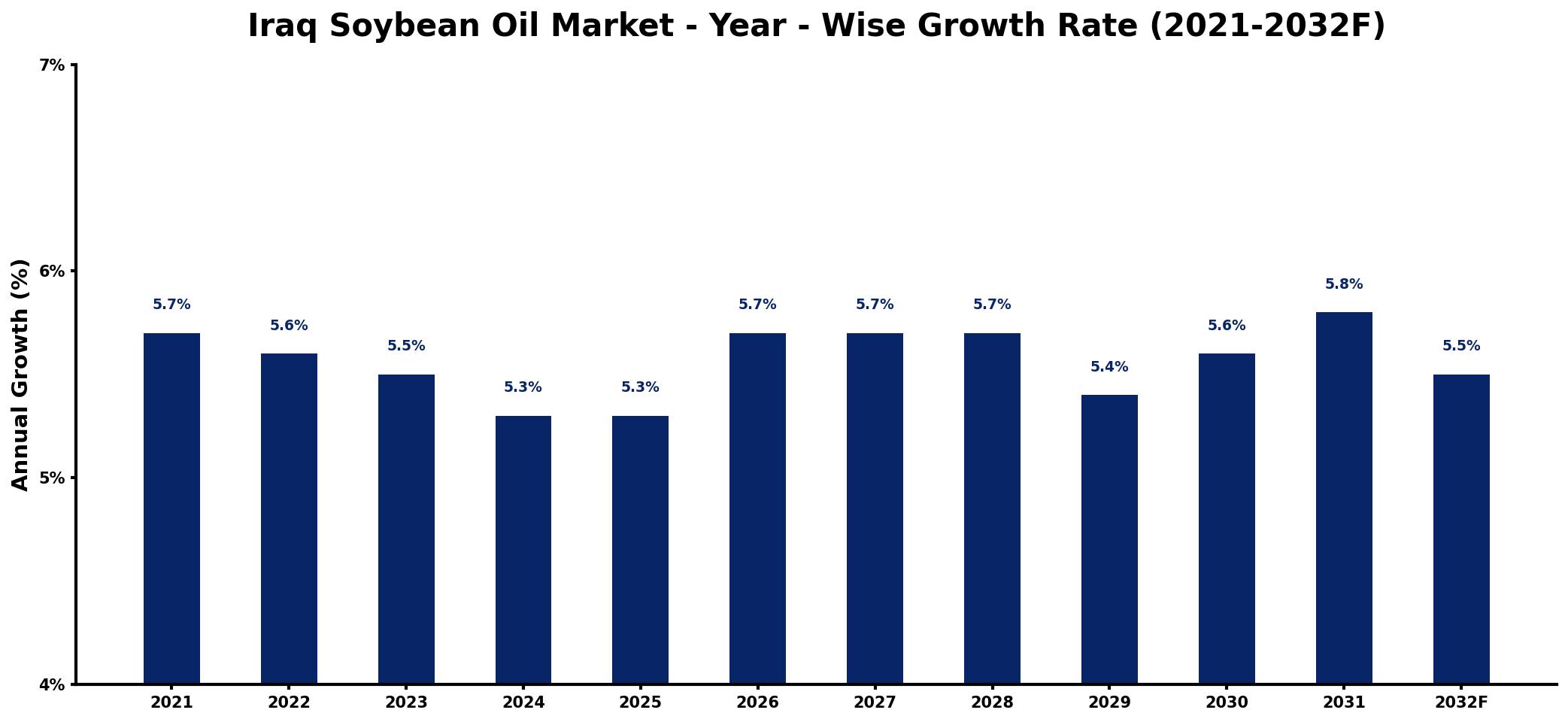
The table below presents the year‑wise growth rates along with the key drivers influencing the market
| Year | Growth Rate | Major Drivers |
| 2021 | 5.7% | Rising consumer health awareness |
| 2022 | 5.6% | Increased food industry demand |
| 2023 | 5.5% | Expansion of retail distribution channels |
| 2024 | 5.3% | Growth in culinary applications |
| 2025 | 5.3% | Surge in export opportunities |
| 2026 | 5.7% | Investment in processing facilities |
| 2027 | 5.7% | Development of premium product lines |
| 2028 | 5.7% | Technological advancements in production |
| 2029 | 5.4% | Strengthening of local partnerships |
| 2030 | 5.6% | Diversification of food product offerings |
| 2031 | 5.8% | Enhancement of marketing strategies |
| 2032 | 5.5% | Rising interest in sustainable sourcing |
Note: Market size estimations and growth projections presented in this report are based on 6Wresearch's proprietary forecasting methodology, utilizing the latest available industry data, government publications, and primary research inputs.
Iraq Soybean Oil Market Synopsis
The Iraq soybean oil market is currently thriving, driven by a shift towards healthier cooking oils. Consumers are increasingly choosing soybean oil due to its nutritional benefits, such as high unsaturated fat content and omega-3 fatty acids, which are becoming more recognized in food preparation.
As the food industry evolves, soybean oil is finding its way into diverse applications, ranging from snacks to ready-to-eat meals. The government's promotion of local soybean production is creating a favorable environment for both consumers and manufacturers, further solidifying its place in the market.
Iraq Soybean Oil Market Key Takeaways
- The market is on a growth trajectory driven by rising health awareness among consumers.
- Government efforts to enhance domestic soybean production are reducing reliance on imports.
- Key growth segments include the food processing industry, with soybean oil increasingly being used in various products.
- Quality concerns regarding imported oils pose a challenge but also offer opportunities for local producers.
- Infrastructure development is critical for improving market access and distribution efficiency.
Evaluation of Restraints in Iraq Soybean Oil Market
Despite the growth prospects, the Iraq soybean oil market faces several constraints. Fluctuating global soybean prices can create uncertainty, influencing local market stability. Moreover, heavy reliance on imports due to limited domestic production can affect market dynamics. Concerns over the quality of imported products can also deter consumers. Logistical challenges, such as inadequate transportation infrastructure, further complicate the distribution landscape, hindering the potential for robust market growth.
Iraq Soybean Oil Market Trends
A noticeable trend is the increasing consumer preference for healthy cooking oils, pushing soybean oil to the forefront. The food industry is rapidly adopting soybean oil as a primary ingredient in healthier alternatives to traditional cooking oils. Additionally, as more consumers seek out sustainable and nutritious options, the versatility of soybean oil in a range of applications—from cooking to food processing—positions it favorably in the market.
Iraq Soybean Oil Market Opportunities
The prospects for investment in the Iraq soybean oil market are compelling. With a growing population and rising disposable incomes, the demand for edible oils is set to climb. The governments focus on agricultural development, particularly in the soybean sector, opens avenues for investment, especially for those looking to integrate vertically from cultivation to distribution. Collaborations with local farmers could enhance production efficiency, addressing quality concerns and increasing market presence.
Government Initiatives in the Iraq Soybean Oil Market
Government policies are primarily aimed at bolstering domestic soybean oil production. Tariffs on imported soybean oil are implemented to protect local manufacturers and promote self-sufficiency. Moreover, quality standards and labeling regulations are enforced to ensure consumer safety and enhance the credibility of domestic products. The government also provides support and subsidies to local producers to encourage growth and competitive pricing in the market.
Future Insights of the Iraq Soybean Oil Market
Looking ahead to 2026-2032, the Iraq soybean oil market is expected to witness sustained growth, largely driven by the health-focused consumer movement and an expanding food sector. The increasing integration of soybean oil in various food products will play a crucial role. While challenges such as global pricing volatility and import dependency remain, the focus on domestic production and improved agricultural practices presents an optimistic outlook for the markets development.
Iraq Soybean Oil Market Latest Developments (2025 - 2026)
In recent months, the Iraq soybean oil market has seen initiatives aimed at improving local production capabilities. Efforts to enhance the distribution network have gained momentum, addressing logistical hurdles. Additionally, there are ongoing discussions regarding the establishment of quality assurance frameworks to bolster consumer trust in local products. The market dynamics are shifting towards more sustainable practices, reflecting changing consumer preferences.
Iraq Soybean Oil Market - Key Attractiveness of the Report
- 10 Years of Market Numbers
- Historical Data Starting from 2022 to 2025
- Base Year: 2025
- Forecast Data until 2032
- Key Performance Indicators Impacting the Market
- Major Upcoming Developments and Projects
Key Highlights of the Report:
- Iraq Soybean Oil Market Outlook
- Market Size of Iraq Soybean Oil Market, 2025
- Forecast of Iraq Soybean Oil Market, 2032
- Historical Data and Forecast of Iraq Soybean Oil Revenues & Volume for the Period 2022-2032F
- Iraq Soybean Oil Market Trend Evolution
- Iraq Soybean Oil Market Drivers and Challenges
- Iraq Soybean Oil Price Trends
- Iraq Soybean Oil Porter's Five Forces
- Iraq Soybean Oil Industry Life Cycle
- Historical Data and Forecast of Iraq Soybean Oil Market Revenues & Volume By End-Use for the Period 2022-2032F
- Historical Data and Forecast of Iraq Soybean Oil Market Revenues & Volume By Food for the Period 2022-2032F
- Historical Data and Forecast of Iraq Soybean Oil Market Revenues & Volume By Feed for the Period 2022-2032F
- Historical Data and Forecast of Iraq Soybean Oil Market Revenues & Volume By Industrial for the Period 2022-2032F
- Iraq Soybean Oil Import Export Trade Statistics
- Market Opportunity Assessment By End-Use
- Iraq Soybean Oil Top Companies Market Share
- Iraq Soybean Oil Competitive Benchmarking By Technical and Operational Parameters
- Iraq Soybean Oil Company Profiles
- Iraq Soybean Oil Key Strategic Recommendations






































