Iraq Tea Market Size, Share & Growth Rate
The Iraq Tea Market was estimated at USD 164 Million in 2025 and is projected to reach USD 229 Million by 2032, growing at a CAGR of 4.9% from 2026 to 2032. This positive trajectory can largely be attributed to the increasing consumer preference for tea, particularly among the younger population, who are driving demand for both traditional and innovative tea offerings. The market's expansion is also being fueled by rising disposable incomes and a greater awareness of the health benefits associated with tea consumption.
Iraq Tea Market Year-wise Growth Rate and Key Drivers
This graph highlights how the Iraq Tea Market has steadily grown over the years, supported by major growth factors.
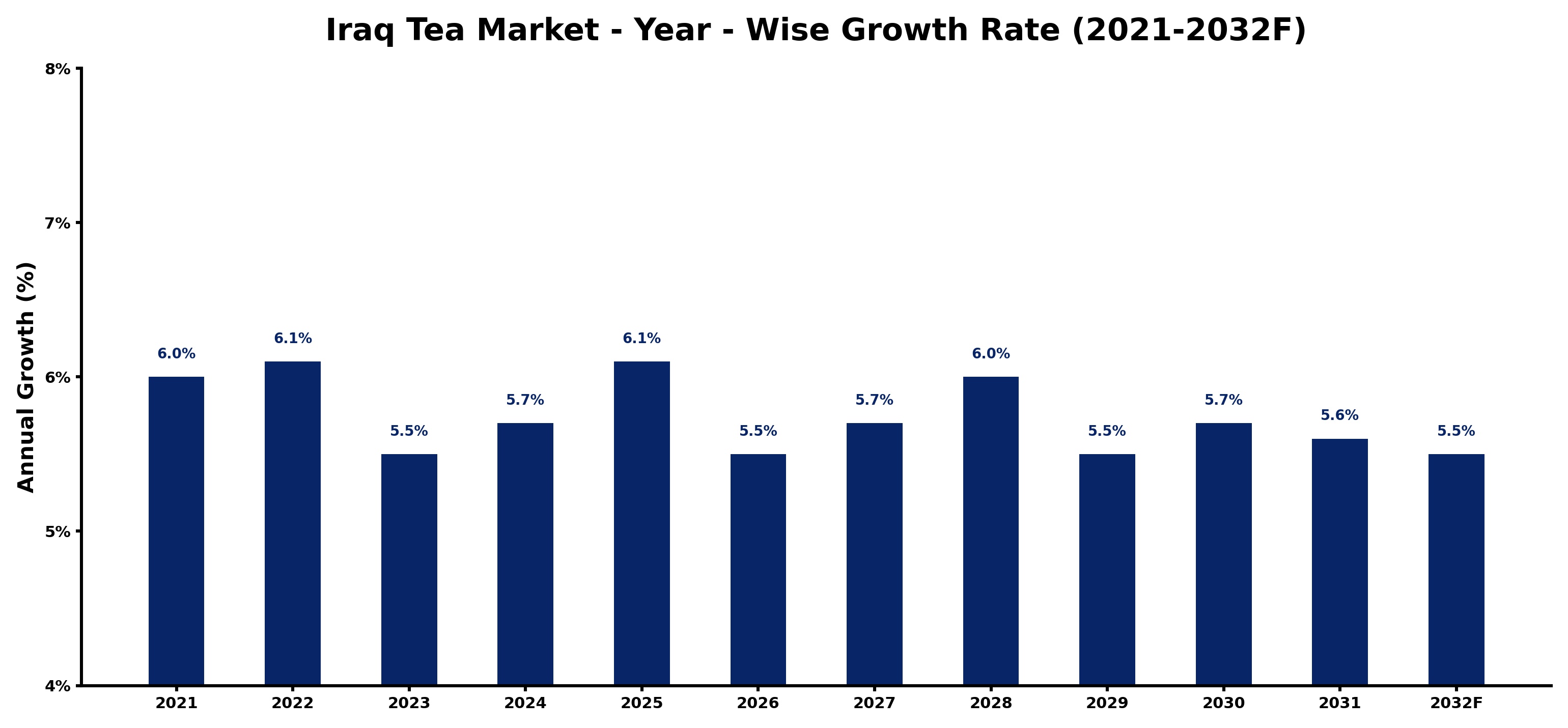
The table below presents the year‑wise growth rates along with the key drivers influencing the market
| Year | Growth Rate | Major Drivers |
| 2021 | 6.0% | Rising health consciousness among consumers |
| 2022 | 6.1% | Increased demand for premium blends |
| 2023 | 5.5% | Growth in specialty tea segment |
| 2024 | 5.7% | Expansion of local tea brands |
| 2025 | 6.1% | Innovative packaging attracted buyers |
| 2026 | 5.5% | Cultural tea consumption increased popularity |
| 2027 | 5.7% | E-commerce platforms enhanced accessibility |
| 2028 | 6.0% | Social media marketing drove awareness |
| 2029 | 5.5% | Sustainable sourcing gained consumer interest |
| 2030 | 5.7% | New flavor profiles attracted consumers |
| 2031 | 5.6% | Increased export opportunities for brands |
| 2032 | 5.5% | Collaborations with cafes boosted sales |
Note - Market size estimations and growth projections presented in this report are based on 6Wresearch’s advanced forecasting approach, validated with industry datasets as of June 2026.
Iraq Tea Market Synopsis
The Iraq tea market has experienced considerable momentum recently, owing to the growing popularity of tea as a staple beverage. However, as consumer preferences evolve, the market is set to transition towards more premium and specialty tea options, indicating a shift in purchasing behaviors.
While black tea remains a dominant player, green and herbal teas are quickly gaining traction, particularly among health-conscious consumers. The market's future will hinge on companies' ability to adapt and introduce products that cater to emerging trends in taste and health.
Iraq Tea Market Key Takeaways
- The market is experiencing a significant shift towards premium and specialty teas driven by health-conscious consumers.
- Retail channels such as supermarkets and online platforms are becoming increasingly important for tea distribution.
- Urbanization and the rise of the middle class are critical factors driving tea demand in Iraq.
- Innovative product offerings and flavors are emerging as key differentiators in this competitive landscape.
- Government policies supporting local production and import regulations are shaping market dynamics.
Evaluation of Restraints in Iraq Tea Market
The Iraq tea market faces several significant restraints that could hinder its growth potential. Political instability and security concerns in the region create an unpredictable environment for businesses and consumers alike, often leading to fluctuations in demand and supply. Additionally, the economic uncertainties that have persisted due to historical challenges can impact consumer purchasing power, making it difficult for tea brands to establish a stable foothold. Infrastructure issues, including inadequate transportation networks and power supply inconsistencies, further complicate distribution, posing logistical challenges for market players aiming to reach consumers effectively.
Iraq Tea Market Trends
Current trends in the Iraq tea market highlight a growing inclination towards health and wellness. Consumers are increasingly interested in organic and herbal tea varieties, reflecting a broader movement towards healthier lifestyle choices. Additionally, the rise of ready-to-drink tea products speaks to the demand for convenience in today's fast-paced world. The popularity of flavored teas is also on the rise, as consumers seek out unique taste experiences that set products apart from traditional offerings.
Iraq Tea Market Opportunities
With a strong tea-drinking culture and an expanding market, Iraq presents numerous investment opportunities. There is significant room for growth in both production and retail sectors. Domestic companies could benefit from investing in quality control and innovative product development, particularly in specialty and organic teas. Furthermore, international brands can find an advantageous position by introducing unique blends and flavors that resonate with Iraqi consumers seeking diversity in their tea choices.
Government Initiatives in the Iraq Tea Market
Government policies aimed at regulating the tea market in Iraq include import tariffs designed to protect domestic producers while ensuring quality control standards are met for all tea products. Licensing requirements for tea importers and exporters help maintain market order and prevent unfair competition. These initiatives are part of a broader strategy to enhance the tea market's growth and support local production, thereby benefiting consumers through improved quality and variety.
Future Insights of the Iraq Tea Market
Looking ahead to 2026-2032, the Iraq tea market is expected to maintain a positive growth trajectory. Factors such as a growing population, rising disposable incomes, and a shift towards healthier beverage options will continue to support demand. The market is poised for further expansion as companies innovate with new flavors and packaging formats, appealing to an increasingly sophisticated consumer base. While challenges remain, the overall outlook is favorable for both local and international players eager to capitalize on this evolving market.
Iraq Tea Market Latest Developments (May 2025 - June 2026)
In recent months, the Iraq tea market has seen a surge in interest surrounding specialty teas, reflecting consumers' desire for unique taste experiences. New product launches have emphasized health benefits, with several brands introducing herbal and organic varieties to capture this niche. Retailers are also enhancing their e-commerce platforms, responding to the growing preference for online shopping among consumers. These developments indicate an active market landscape that is adapting to consumer needs and preferences.
Iraq Tea Market - Key Attractiveness of the Report
- 10 Years of Market Numbers
- Historical Data Starting from 2022 to 2025
- Base Year: 2025
- Forecast Data until 2032
- Key Performance Indicators Impacting the Market
- Major Upcoming Developments and Projects
Key Highlights of the Report:
- Iraq Tea Market Outlook
- Market Size of Iraq Tea Market, 2025
- Forecast of Iraq Tea Market, 2032
- Historical Data and Forecast of Iraq Tea Revenues & Volume for the Period 2022-2032F
- Iraq Tea Market Trend Evolution
- Iraq Tea Market Drivers and Challenges
- Iraq Tea Price Trends
- Iraq Tea Porter's Five Forces
- Iraq Tea Industry Life Cycle
- Historical Data and Forecast of Iraq Tea Market Revenues & Volume By Type for the Period 2022-2032F
- Historical Data and Forecast of Iraq Tea Market Revenues & Volume By Green Tea for the Period 2022-2032F
- Historical Data and Forecast of Iraq Tea Market Revenues & Volume By Black Tea for the Period 2022-2032F
- Historical Data and Forecast of Iraq Tea Market Revenues & Volume By Oolong Tea for the Period 2022-2032F
- Historical Data and Forecast of Iraq Tea Market Revenues & Volume By Fruit/Herbal Tea for the Period 2022-2032F
- Historical Data and Forecast of Iraq Tea Market Revenues & Volume By Others for the Period 2022-2032F
- Historical Data and Forecast of Iraq Tea Market Revenues & Volume By Packaging for the Period 2022-2032F
- Historical Data and Forecast of Iraq Tea Market Revenues & Volume By Plastic Containers for the Period 2022-2032F
- Historical Data and Forecast of Iraq Tea Market Revenues & Volume By Loose Tea for the Period 2022-2032F
- Historical Data and Forecast of Iraq Tea Market Revenues & Volume By Paperboards for the Period 2022-2032F
- Historical Data and Forecast of Iraq Tea Market Revenues & Volume By Aluminum Tins for the Period 2022-2032F
- Historical Data and Forecast of Iraq Tea Market Revenues & Volume By Tea Bags for the Period 2022-2032F
- Historical Data and Forecast of Iraq Tea Market Revenues & Volume By Distribution Channel for the Period 2022-2032F
- Historical Data and Forecast of Iraq Tea Market Revenues & Volume By Supermarkets/Hypermarkets for the Period 2022-2032F
- Historical Data and Forecast of Iraq Tea Market Revenues & Volume By Specialty Stores for the Period 2022-2032F
- Historical Data and Forecast of Iraq Tea Market Revenues & Volume By Convenience Stores for the Period 2022-2032F
- Historical Data and Forecast of Iraq Tea Market Revenues & Volume By Online Stores for the Period 2022-2032F
- Historical Data and Forecast of Iraq Tea Market Revenues & Volume By Others for the Period 2022-2032F
- Historical Data and Forecast of Iraq Tea Market Revenues & Volume By Application for the Period 2022-2032F
- Historical Data and Forecast of Iraq Tea Market Revenues & Volume By Residential for the Period 2022-2032F
- Historical Data and Forecast of Iraq Tea Market Revenues & Volume By Commercial for the Period 2022-2032F
- Iraq Tea Import Export Trade Statistics
- Market Opportunity Assessment By Type
- Market Opportunity Assessment By Packaging
- Market Opportunity Assessment By Distribution Channel
- Market Opportunity Assessment By Application
- Iraq Tea Top Companies Market Share
- Iraq Tea Competitive Benchmarking By Technical and Operational Parameters
- Iraq Tea Company Profiles
- Iraq Tea Key Strategic Recommendations






































