Italy Infrared Imaging Market Size, Share & Growth Rate
The Italy Infrared Imaging Market was estimated at USD 112 Million in 2025 and is projected to reach USD 124 Million by 2032, growing at a CAGR of 1.5% from 2026 to 2032. This growth trajectory is largely propelled by the escalating demand for advanced thermal imaging solutions across diverse sectors such as healthcare, automotive, and industrial inspection. The emphasis on predictive maintenance and the increasing focus on safety and security measures further fuel the adoption of infrared imaging technologies throughout Italy.
Italy Infrared Imaging Market Year-wise Growth Rate and Key Drivers
This graph highlights how the Italy Infrared Imaging Market has steadily grown over the years, supported by major growth factors.
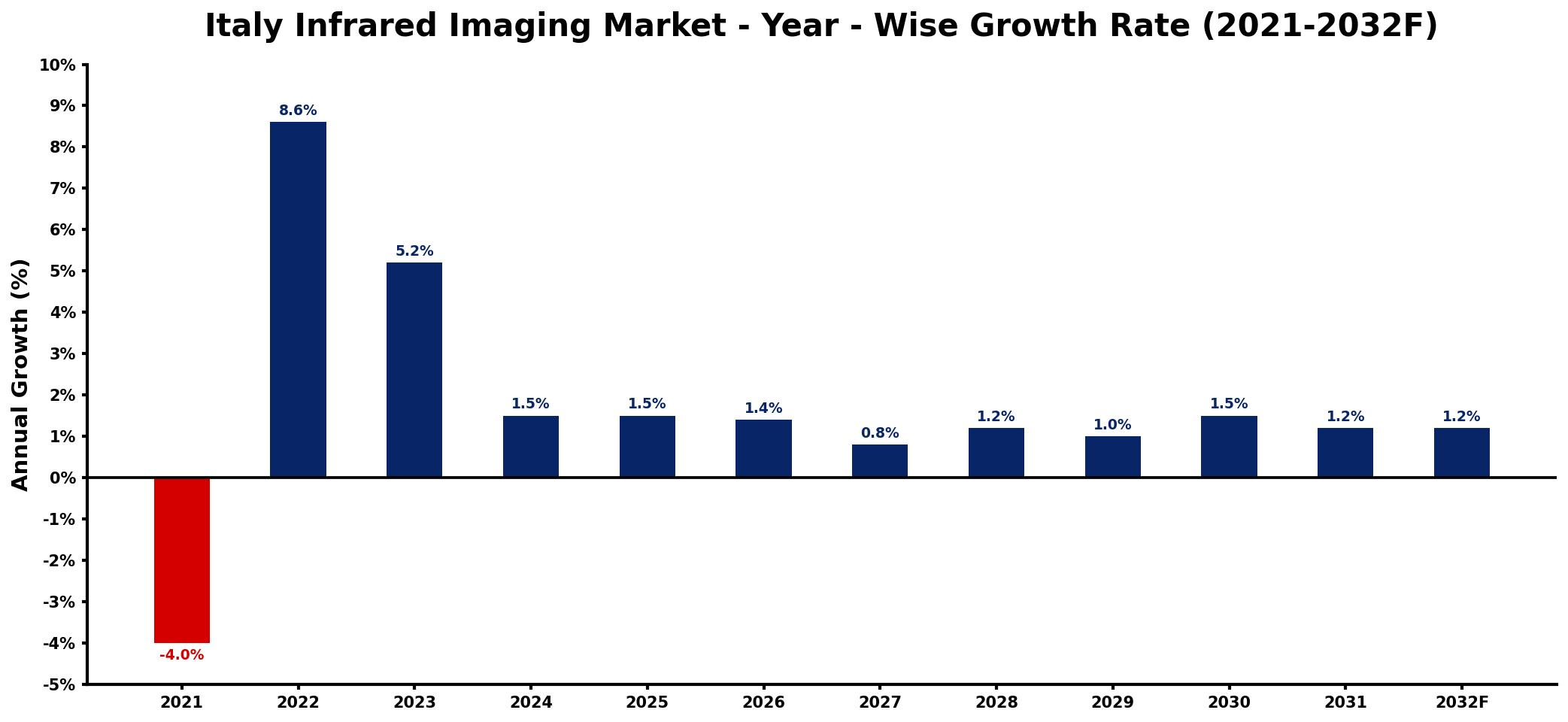
The table below presents the year‑wise growth rates along with the key drivers influencing the market
| Year | Growth Rate | Major Drivers |
| 2021 | -4.0% | decreased investment in technology |
| 2022 | 8.6% | growing demand in healthcare sector |
| 2023 | 5.2% | increased applications in construction |
| 2024 | 1.5% | expansion in energy efficiency projects |
| 2025 | 1.5% | rising interest in security solutions |
| 2026 | 1.4% | growing adoption in automotive industry |
| 2027 | 0.8% | increased funding for research initiatives |
| 2028 | 1.2% | expansion of smart building technologies |
| 2029 | 1.0% | growing use in environmental monitoring |
| 2030 | 1.5% | increased awareness of safety applications |
| 2031 | 1.2% | rising demand from agricultural sector |
| 2032 | 1.2% | improved raw material availability |
Note: Market size estimations and growth projections presented in this report are based on 6Wresearch's proprietary forecasting methodology, utilizing the latest available industry data, government publications, and primary research inputs.
Italy Infrared Imaging Market Synopsis
In Italy, the infrared imaging market is witnessing a significant transformation, driven by technological advancements and rising awareness of its multifaceted applications. From improving medical diagnostics to enhancing industrial quality control, infrared imaging is becoming integral in various sectors.
The market's strength lies in its versatility, offering non-invasive solutions for anomaly detection and temperature monitoring. As security concerns grow, infrared imaging systems are increasingly sought after for surveillance applications, further solidifying their essential role in modern technology.
Italy Infrared Imaging Market Key Takeaways
- Non-invasive infrared imaging solutions are transforming medical diagnostics and industrial quality assurance in Italy.
- Technological advancements are driving rapid adoption across various sectors, including healthcare, automotive, and security.
- The market is bolstered by government initiatives promoting innovation in imaging technologies.
- Challenges related to high costs and the complexity of technology must be navigated for sustained growth.
- Investment in predictive maintenance solutions is a key driver of demand within the market.
Evaluation of Restraints in Italy Infrared Imaging Market
Despite its promising growth potential, the Italy Infrared Imaging Market faces certain restraints that may impede its trajectory. The high cost of infrared imaging systems presents a significant barrier for small to medium-sized enterprises looking to invest in this technology. Additionally, the need for sophisticated technology to ensure accuracy creates a steep learning curve for users, often necessitating extensive training. As applications become more diverse, continual innovation is essential, adding pressure on manufacturers to keep pace with evolving market demands and technological advancements.
Italy Infrared Imaging Market Trends
Current trends in the Italy Infrared Imaging Market reflect a pronounced shift towards integrating artificial intelligence and machine learning technologies with traditional imaging systems. This integration enhances data analysis capabilities, improving diagnostic accuracy and operational efficiency. Furthermore, the growing acceptance of thermal cameras in smart city initiatives emphasizes their utility beyond traditional applications, promoting urban safety and infrastructure maintenance.
Italy Infrared Imaging Market Opportunities
There are ample opportunities for growth within the Italy Infrared Imaging Market, particularly in the healthcare sector where the demand for non-invasive diagnostic solutions continues to surge. Moreover, the automotive industry is exploring infrared imaging for advanced driver-assistance systems (ADAS), highlighting the technology's role in enhancing vehicle safety. With government incentives fostering research and development in imaging technologies, companies can capitalize on these opportunities to innovate and expand their market presence.
Government Initiatives in the Italy Infrared Imaging Market
The Italian government actively supports the infrared imaging market through a variety of initiatives aimed at fostering innovation and enhancing operational safety. Policies include financial incentives for companies investing in advanced imaging technologies, which not only improve efficiency but also contribute to public safety. Regulatory frameworks are in place to ensure the reliability and accuracy of infrared imaging systems, facilitating a conducive environment for market growth.
Future Insights of the Italy Infrared Imaging Market
Looking ahead to 2026-2032, the Italy Infrared Imaging Market is poised for substantial growth, driven by technological advancements and increased application across diverse sectors. Enhanced integration of artificial intelligence will likely transform data utilization in medical and industrial applications, while the urgency for safety and maintenance solutions continues to reinforce market demand. As innovative products and solutions emerge, stakeholders will need to focus on adapting to the changing technological landscape to maintain a competitive edge.
Italy Infrared Imaging Market Latest Developments (2025 - 2026)
Recent developments in the Italy Infrared Imaging Market indicate a shift towards the adoption of cutting-edge thermal imaging technologies that incorporate advanced sensor capabilities. Additionally, the market has seen an uptick in collaboration between technology firms and healthcare providers, aiming to enhance diagnostic processes through innovative imaging solutions. Increased investment in research and development is also expected to yield novel applications, particularly in automotive safety and industrial automation.
Italy Infrared Imaging Market - Key Attractiveness of the Report
- 10 Years of Market Numbers
- Historical Data Starting from 2022 to 2025
- Base Year: 2025
- Forecast Data until 2032
- Key Performance Indicators Impacting the Market
- Major Upcoming Developments and Projects
Key Highlights of the Report:
- Italy Infrared Imaging Market Outlook
- Market Size of Italy Infrared Imaging Market, 2025
- Forecast of Italy Infrared Imaging Market, 2032
- Historical Data and Forecast of Italy Infrared Imaging Revenues & Volume for the Period 2022-2032F
- Italy Infrared Imaging Market Trend Evolution
- Italy Infrared Imaging Market Drivers and Challenges
- Italy Infrared Imaging Price Trends
- Italy Infrared Imaging Porter's Five Forces
- Italy Infrared Imaging Industry Life Cycle
- Historical Data and Forecast of Italy Infrared Imaging Market Revenues & Volume By Technology for the Period 2022-2032F
- Historical Data and Forecast of Italy Infrared Imaging Market Revenues & Volume By Cooled Infrared Imaging for the Period 2022-2032F
- Historical Data and Forecast of Italy Infrared Imaging Market Revenues & Volume By Uncooled Infrared Imaging for the Period 2022-2032F
- Historical Data and Forecast of Italy Infrared Imaging Market Revenues & Volume By Wavelength for the Period 2022-2032F
- Historical Data and Forecast of Italy Infrared Imaging Market Revenues & Volume By Near Infrared for the Period 2022-2032F
- Historical Data and Forecast of Italy Infrared Imaging Market Revenues & Volume By Shortwave Infrared for the Period 2022-2032F
- Historical Data and Forecast of Italy Infrared Imaging Market Revenues & Volume By Mid-wave Infrared for the Period 2022-2032F
- Historical Data and Forecast of Italy Infrared Imaging Market Revenues & Volume By Long-wave Infrared for the Period 2022-2032F
- Historical Data and Forecast of Italy Infrared Imaging Market Revenues & Volume By Application for the Period 2022-2032F
- Historical Data and Forecast of Italy Infrared Imaging Market Revenues & Volume By Security & Surveillance for the Period 2022-2032F
- Historical Data and Forecast of Italy Infrared Imaging Market Revenues & Volume By Monitoring & Inspection for the Period 2022-2032F
- Historical Data and Forecast of Italy Infrared Imaging Market Revenues & Volume By Detection for the Period 2022-2032F
- Historical Data and Forecast of Italy Infrared Imaging Market Revenues & Volume By Vertical for the Period 2022-2032F
- Historical Data and Forecast of Italy Infrared Imaging Market Revenues & Volume By Industrial for the Period 2022-2032F
- Historical Data and Forecast of Italy Infrared Imaging Market Revenues & Volume By Nonindustrial for the Period 2022-2032F
- Italy Infrared Imaging Import Export Trade Statistics
- Market Opportunity Assessment By Technology
- Market Opportunity Assessment By Wavelength
- Market Opportunity Assessment By Application
- Market Opportunity Assessment By Vertical
- Italy Infrared Imaging Top Companies Market Share
- Italy Infrared Imaging Competitive Benchmarking By Technical and Operational Parameters
- Italy Infrared Imaging Company Profiles
- Italy Infrared Imaging Key Strategic Recommendations






































