Italy Public Cloud Market Size & Growth Rate (2026-2032)
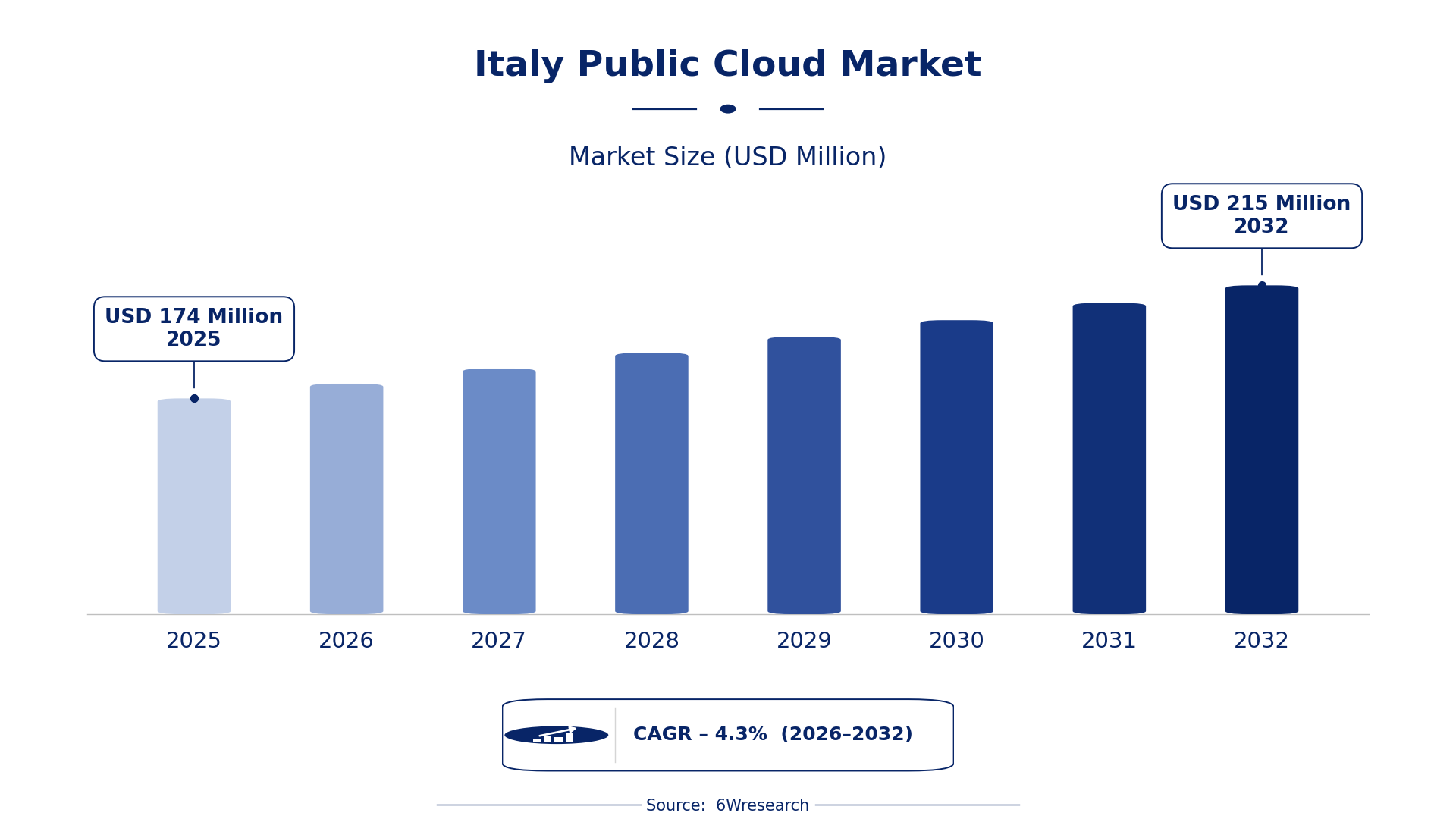
The Italy Public Cloud Market was estimated at USD 174 Million in 2025 and is projected to reach USD 215 Million by 2032, growing at a CAGR of 4.3% from 2026 to 2032.
Italy Public Cloud Market Synopsis
The Italian market for public cloud services is gaining momentum, driven by a wave of digital transformation initiatives across various sectors. Organizations are increasingly adopting cloud solutions to enhance operational efficiency, agility, and competitive advantage, signaling a fundamental shift in IT infrastructure priorities.
As enterprises grapple with the challenges of data security and regulatory compliance, they are turning to established public cloud providers that offer robust security frameworks and compliance certifications. This shift is not only about cost savings; it’s a strategic move towards innovation and scalability.
Italy Public Cloud Market Year-wise Growth Rate and Key Drivers
This graph illustrates the annual growth rates of the Italy Public Cloud Market from 2021 to 2032, highlighting a steady upward trajectory and projected expansion over the forecast period.
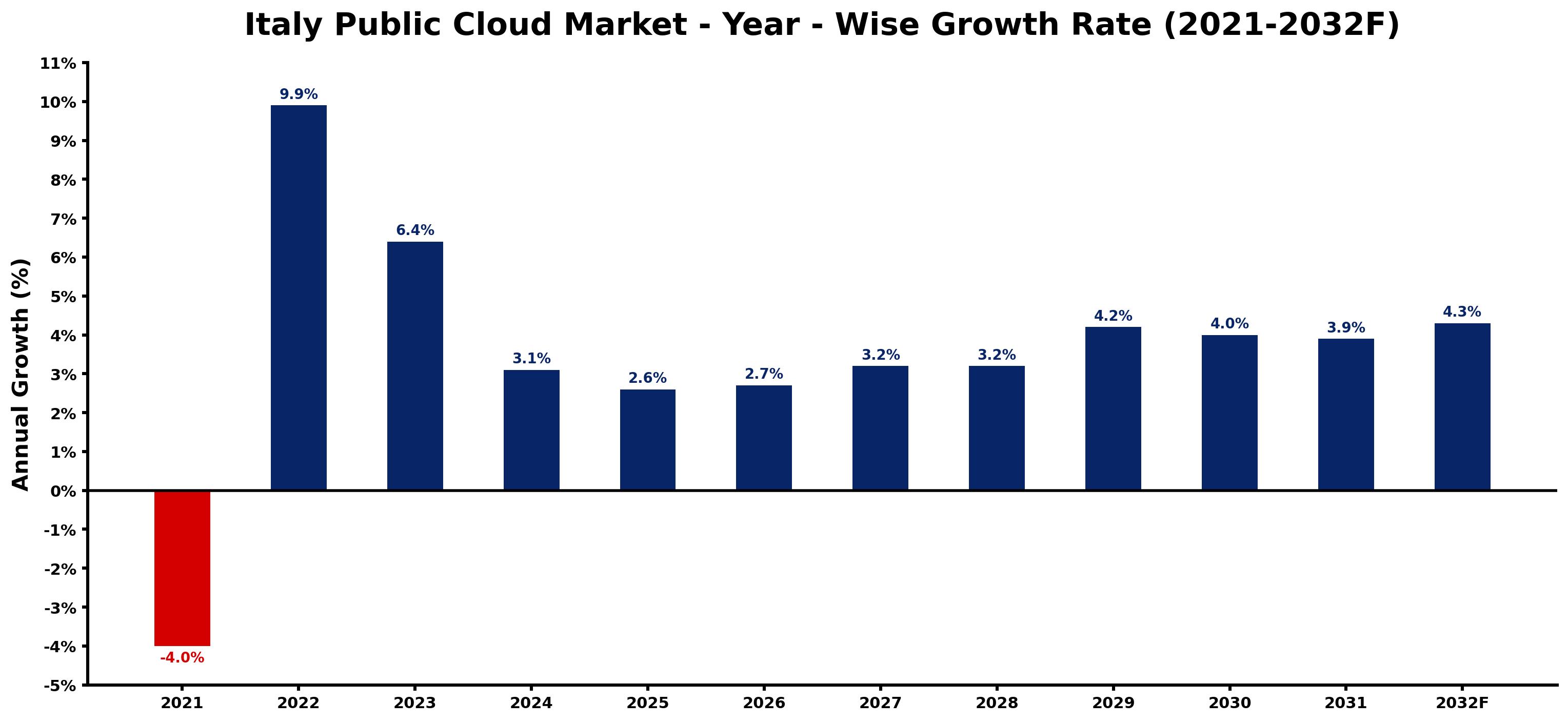
The table below presents the year‑wise growth rates along with the key drivers influencing the market
| Year | Growth Rate | Major Drivers |
| 2021 | -4.0% | Drag from GDPR compliance costs on local cloud adoption |
| 2022 | 9.9% | Increased investments driven by Italian Digital Agency initiatives |
| 2023 | 6.4% | Growth in remote work boosting cloud service adoption |
| 2024 | 3.1% | Strong demand for agile business solutions post-pandemic |
| 2025 | 2.6% | Italian SMEs increasing migration to cloud platforms |
| 2026 | 2.7% | Rising focus on sustainability in IT strategies |
| 2027 | 3.2% | Government support for digital innovation and transformation |
| 2028 | 3.2% | Adoption of 5G enhancing cloud service capabilities |
| 2029 | 4.2% | Expanding fintech sector driving cloud infrastructure needs |
| 2030 | 4.0% | Increased awareness of data privacy regulations strengthening cloud |
| 2031 | 3.9% | Healthcare sector digitalization requiring robust cloud solutions |
| 2032 | 4.3% | Educational institutions embracing cloud for digital learning |
Note: Market size estimations and growth projections presented in this report are based on 6Wresearch's proprietary forecasting methodology, utilizing the latest available industry data, government publications, and primary research inputs.
Italy Public Cloud Market Key Takeaways
Below are some of the specific key takeaways from the market, including:
- High demand for Software as a Service (SaaS) applications is shaping enterprise software procurement.
- Infrastructure as a Service (IaaS) is increasingly favored for its scalability and cost-effectiveness.
- Hybrid cloud solutions are emerging as a preferred strategy for balancing public and private cloud benefits.
- Investment in cybersecurity is accelerating as companies prioritize data protection measures.
- The government’s push for cloud adoption is creating a favorable environment for market growth.
Evaluation of Restraints in Italy Public Cloud Market
The Italy Public Cloud Market faces several limitations that could hinder its potential. Chief among these is the stringent regulatory framework surrounding data protection, particularly the General Data Protection Regulation (GDPR). Compliance with these regulations requires significant investment in security measures, which can be a deterrent for smaller businesses.
Additionally, concerns about data sovereignty are prevalent among Italian firms. The uncertainty regarding where data is stored and who can access it creates hesitation, especially in sectors with strict compliance requirements. The competitive environment, characterized by aggressive pricing from both global and local providers, further complicates the market dynamics.
Italy Public Cloud Market Trends
Several trends are shaping the Italy Public Cloud Market. There is a marked increase in the adoption of SaaS solutions as businesses look for flexible, subscription-based models to manage applications. IaaS continues to gain traction as organizations seek scalable resources to support fluctuating workloads.
A notable trend is the rise of hybrid cloud strategies. Companies are increasingly recognizing the need to combine public and private cloud resources to optimize their operations. This trend is bolstered by advancements in cloud management technologies that facilitate seamless integration and management.
Italy Public Cloud Market Opportunities
Investment opportunities abound within the Italy Public Cloud Market, particularly in specialized cloud services tailored for industries such as healthcare, finance, and manufacturing. The ongoing digital transformation initiatives in these sectors are driving demand for innovative cloud-based solutions.
on top of that, the increasing focus on cybersecurity presents a ripe area for investment. Companies are willing to invest in advanced security solutions to protect sensitive data, creating opportunities for cloud providers that can offer comprehensive security packages.
Government Initiatives in the Italy Public Cloud Market
The Italian government plays a crucial role in shaping the Public Cloud Market through various supportive policies aimed at promoting digital transformation. Recent initiatives focus on enhancing public sector efficiency and encouraging private sector adoption of cloud technologies. This proactive regulatory environment is critical for fostering innovation and ensuring data security.
- A recently completed National Cloud Strategy aims to improve public sector cloud adoption and efficiency.
- Currently ongoing is the Italian Cloud First approach, promoting the use of cloud services in government operations.
- Planned initiatives include a comprehensive regulatory framework expected to enhance billing transparency by 2027.
- The government is also investing in public-private partnerships to expand digital infrastructure access throughout Italy.
- Upcoming training programs are set to equip public sector employees with cloud-related skills, facilitating smoother transitions to cloud environments.
Future Insights of the Italy Public Cloud Market
Looking ahead, the Italy Public Cloud Market is set for robust growth from 2026 to 2032. Businesses are increasingly recognizing the strategic value of cloud technologies in driving innovation and operational efficiency. The trend towards remote work and the integration of data analytics will further fuel demand for cloud services.
As technological advancements continue, including artificial intelligence and edge computing, the market is likely to evolve rapidly. Companies will increasingly seek flexible solutions that can adapt to their changing needs, presenting ample opportunities for growth.
Italy Public Cloud Market Latest Developments
In the past year, the Italy Public Cloud Market has seen considerable activity as organizations push forward with cloud adoption. Key developments reflect a focus on enhancing service offerings and addressing emerging market needs. As cloud technologies mature, providers are adapting their strategies to better serve local businesses.
- A major technology vendor launched a new suite of cloud security solutions in Q1 2025 to address rising cybersecurity concerns.
- In mid-2025, a leading regional operator initiated an extensive upgrade of its cloud infrastructure to improve service reliability and performance.
- Upcoming partnerships are planned between cloud providers and industry leaders to create tailored solutions for the healthcare sector.
- A technology rollout aimed at expanding cloud service availability in rural areas is currently underway, initiated in early 2025.
- Several new product features designed for enhanced data analytics capabilities are expected to be introduced by late 2026.
Italy Public Cloud Market - Key Attractiveness of the Report
- 10 Years of Market Numbers
- Historical Data Starting from 2022 to 2025
- Base Year: 2025
- Forecast Data until 2032
- Key Performance Indicators Impacting the Market
- Major Upcoming Developments and Projects
Key Highlights of the Report:
- Italy Public Cloud Market Outlook
- Market Size of Italy Public Cloud Market, 2025
- Forecast of Italy Public Cloud Market, 2032
- Historical Data and Forecast of Italy Public Cloud Revenues & Volume for the Period 2022-2032F
- Italy Public Cloud Market Trend Evolution
- Italy Public Cloud Market Drivers and Challenges
- Italy Public Cloud Price Trends
- Italy Public Cloud Porter's Five Forces
- Italy Public Cloud Industry Life Cycle
- Historical Data and Forecast of Italy Public Cloud Market Revenues & Volume By Service Model for the Period 2022-2032F
- Historical Data and Forecast of Italy Public Cloud Market Revenues & Volume By Infrastructure as a Service for the Period 2022-2032F
- Historical Data and Forecast of Italy Public Cloud Market Revenues & Volume By Platform as a Service for the Period 2022-2032F
- Historical Data and Forecast of Italy Public Cloud Market Revenues & Volume By Software as a Service for the Period 2022-2032F
- Historical Data and Forecast of Italy Public Cloud Market Revenues & Volume By Organization Size Large enterprises for the Period 2022-2032F
- Historical Data and Forecast of Italy Public Cloud Market Revenues & Volume By Small for the Period 2022-2032F
- Historical Data and Forecast of Italy Public Cloud Market Revenues & Volume By Medium Enterprises SMEs for the Period 2022-2032F
- Historical Data and Forecast of Italy Public Cloud Market Revenues & Volume By Verticals for the Period 2022-2032F
- Historical Data and Forecast of Italy Public Cloud Market Revenues & Volume By BFSI for the Period 2022-2032F
- Historical Data and Forecast of Italy Public Cloud Market Revenues & Volume By Telecommunication for the Period 2022-2032F
- Historical Data and Forecast of Italy Public Cloud Market Revenues & Volume By IT & ITeS for the Period 2022-2032F
- Historical Data and Forecast of Italy Public Cloud Market Revenues & Volume By Government & Public Sector for the Period 2022-2032F
- Historical Data and Forecast of Italy Public Cloud Market Revenues & Volume By Retail & Consumer Goods for the Period 2022-2032F
- Historical Data and Forecast of Italy Public Cloud Market Revenues & Volume By Manufacturing for the Period 2022-2032F
- Historical Data and Forecast of Italy Public Cloud Market Revenues & Volume By Energy & Utility for the Period 2022-2032F
- Historical Data and Forecast of Italy Public Cloud Market Revenues & Volume By Media & Entertainment for the Period 2022-2032F
- Italy Public Cloud Import Export Trade Statistics
- Market Opportunity Assessment By Service Model
- Market Opportunity Assessment By Organization Size Large enterprises
- Market Opportunity Assessment By Verticals
- Italy Public Cloud Top Companies Market Share
- Italy Public Cloud Competitive Benchmarking By Technical and Operational Parameters
- Italy Public Cloud Company Profiles
- Italy Public Cloud Key Strategic Recommendations






































