Italy Publishing Market Summary
The italy publishing market was estimated at USD 218 Million in 2025 and is projected to reach USD 243 Million by 2032, growing at a CAGR of 1.5% from 2026 to 2032.
Italy Publishing Market Year-wise Growth Rate and Key Drivers
This graph highlights how the Italy Publishing Market has steadily grown over the past five years, supported by major growth factors.
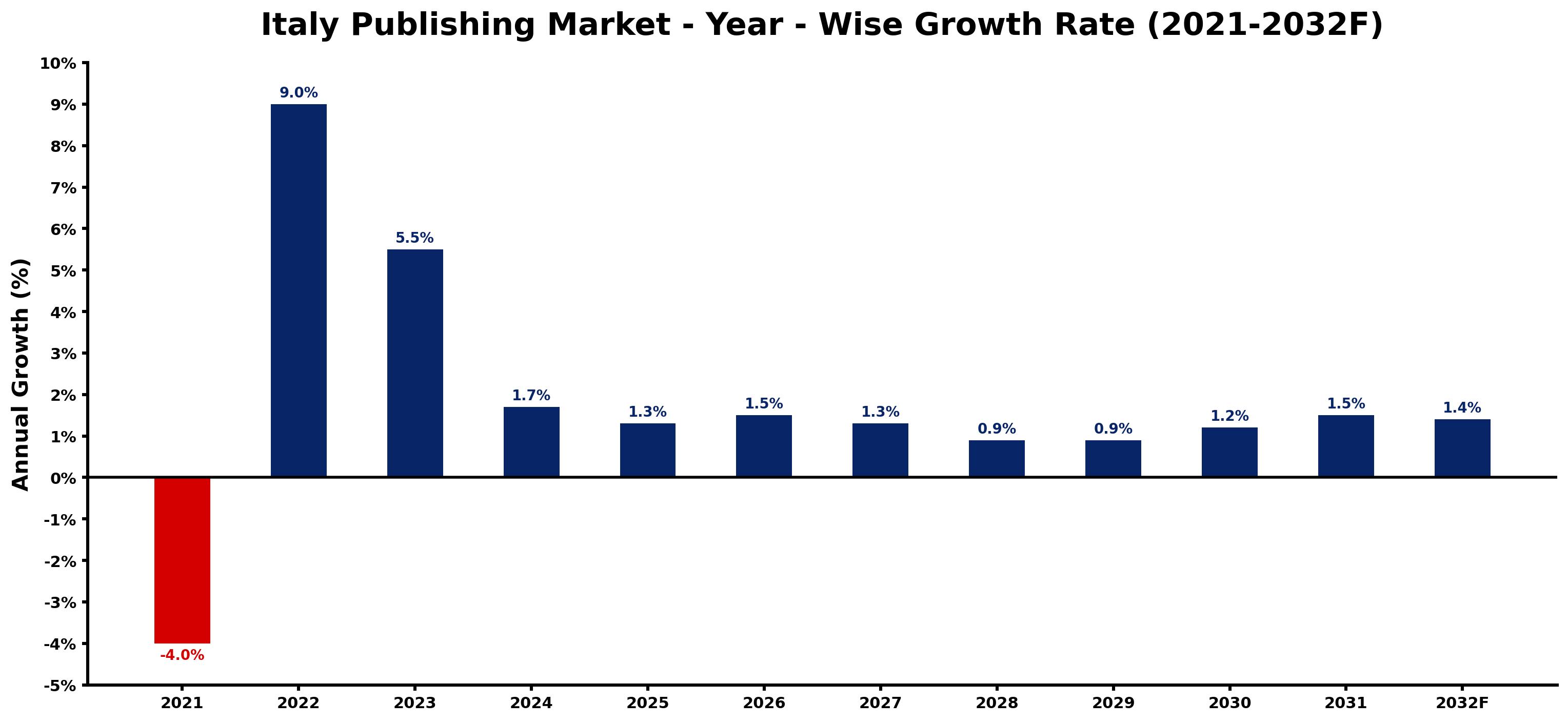
The table below presents the year wise growth rates along with the key drivers influencing the market
| Year | Growth Rate | Major Drivers |
| 2021 | -4.0% | The pandemicinduced shift to digital media diminished demand for traditional print publications in Italy. |
| 2022 | 9.0% | Emerging authors leveraged online platforms to reach broader audiences efficiently. |
| 2023 | 5.5% | E-books gained popularity, enhancing accessibility and convenience for readers nationwide. |
| 2024 | 1.7% | Print sales experienced a resurgence fueled by local interest in cultural heritage. |
| 2025 | 1.3% | Sustainability concerns prompted publishers to explore eco-friendly printing solutions. |
| 2026 | 1.5% | Audiobook consumption soared as commuters sought alternative entertainment during travels. |
| 2027 | 1.3% | Collaborative projects between authors and technology firms enriched content creation processes. |
| 2028 | 0.9% | International partnerships expanded, allowing Italian publishers to tap into global markets. |
| 2029 | 0.9% | Niche genres gained traction, attracting dedicated communities of passionate readers. |
| 2030 | 1.2% | Virtual reality storytelling began captivating younger demographics, influencing publishing techniques. |
| 2031 | 1.5% | Subscription services transformed customer loyalty dynamics, shifting revenue models significantly. |
| 2032 | 1.4% | Data analytics tools provided insights, enhancing targeted marketing strategies for publishers. |
Note - Market size estimations and growth projections presented in this report are based on 6Wresearch's advanced forecasting approach, validated with industry datasets as of June 2026.
Italy Publishing Market Synopsis
The Italy Publishing Market is projected to reach 1.5% and witness significant growth during the forecast period (2026-2032). This market encompasses the production and distribution of a wide range of content, including books, magazines, newspapers, and digital media. As reader consumption patterns evolve, both traditional print and digital formats play crucial roles in serving Italy's diverse audience. The market is not only characterized by conventional methods but also by a swift embrace of emerging digital platforms that cater to new consumer behaviors.
Italy Publishing Market Growth Drivers
Several key drivers are propelling the growth of the Italy Publishing Market. The rise of digital publishing is a significant factor, as consumer preferences shift toward accessible, mobile-friendly content. Readers are increasingly opting for e-books and online articles, which has led to a transformation in the publishing landscape. Additionally, technological advancements in printing and distribution methods are enhancing the efficiency of how content is produced and delivered. Following are some of the prominent drivers:
- The growth of e-books and digital content has fundamentally transformed how readers consume literature, increasing demand for digital formats.
- Changing reading habits, particularly among younger demographics, favor mobile devices and online platforms over traditional print media.
- Technological advancements are facilitating faster and more cost-effective publishing processes, thus reducing barriers to entry for new publishers.
- The rise of online retailing allows for greater distribution channels, enabling publishers to reach wider audiences.
- The emergence of self-publishing and print-on-demand services is empowering authors and contributing to a more dynamic market landscape.
Italy Publishing Market Challenges and Restraints
Despite the promising growth trajectory, the Italy Publishing Market faces various challenges that could impede its progress. Digital transformation poses a significant hurdle for traditional publishers, who must adapt to the rapidly changing technological environment. Furthermore, copyright issues are increasingly complex in the digital age, requiring vigilant efforts from stakeholders to protect intellectual property. Other challenges include:
- Traditional print publishers must contend with the declining sales of physical books as consumer preferences shift toward digital alternatives.
- Copyright enforcement in digital content remains a contentious issue, impacting the rights of authors and publishers.
- Market consolidation threatens the viability of independent publishing houses, which may struggle against larger, multinational entities.
- Maintaining sustainable business models in a competitive market landscape with fluctuating revenues is increasingly challenging.
- The rapid pace of technological change necessitates continual investment in new platforms and capabilities, straining financial resources for smaller players.
Italy Publishing Market Government Investment and Initiatives
The Italian government plays a pivotal role in fostering the publishing industry through various policies aimed at promoting freedom of expression and supporting cultural diversity. Recent initiatives include provisions for copyright protection, ensuring that the rights of authors and publishers are upheld in an increasingly digital environment. Public investments focus on enhancing literacy and promoting a reading culture across the nation:
- Funding programs are established to support independent publishers, helping to sustain a diverse range of voices in the market.
- Public libraries receive government backing to expand access to literature and educational resources for the community.
- Educational initiatives are implemented in schools and universities to cultivate a reading culture from an early age.
- Regulations are enforced to ensure fair competition, preventing monopolistic practices and promoting a level playing field for all publishers.
- Collaborations between the government and cultural organizations aim to encourage innovative publishing methods and new media forms.
Italy Publishing Market Latest Developments (May 2025 - June 2026)
Recent developments in the Italy Publishing Market indicate a period of significant transformation, characterized by rapid digital integration and evolving consumer expectations. During this timeframe, there has been a notable increase in the adoption of hybrid publishing models, which combine traditional and self-publishing approaches. Additionally, many publishers are investing in digital marketing strategies to enhance their visibility and reach amid growing online competition. The industry also witnessed increased collaborations between technology providers and publishing houses, aiming to develop innovative solutions that streamline operations and improve user experience.
Italy Publishing Market - Key Attractiveness of the Report
- 10 Years of Market Numbers
- Historical Data Starting from 2022 to 2025
- Base Year: 2025
- Forecast Data until 2032
- Key Performance Indicators Impacting the Market
- Major Upcoming Developments and Projects
Key Highlights of the Report:
- Italy Publishing Market Outlook
- Market Size of Italy Publishing Market, 2025
- Forecast of Italy Publishing Market, 2032
- Historical Data and Forecast of Italy Publishing Revenues & Volume for the Period 2022-2032F
- Italy Publishing Market Trend Evolution
- Italy Publishing Market Drivers and Challenges
- Italy Publishing Price Trends
- Italy Publishing Porter's Five Forces
- Italy Publishing Industry Life Cycle
- Historical Data and Forecast of Italy Publishing Market Revenues & Volume By Types for the Period 2022-2032F
- Historical Data and Forecast of Italy Publishing Market Revenues & Volume By Newspaper for the Period 2022-2032F
- Historical Data and Forecast of Italy Publishing Market Revenues & Volume By Journals for the Period 2022-2032F
- Historical Data and Forecast of Italy Publishing Market Revenues & Volume By Catalogues for the Period 2022-2032F
- Historical Data and Forecast of Italy Publishing Market Revenues & Volume By Magazine for the Period 2022-2032F
- Historical Data and Forecast of Italy Publishing Market Revenues & Volume By Books for the Period 2022-2032F
- Historical Data and Forecast of Italy Publishing Market Revenues & Volume By E-Books for the Period 2022-2032F
- Historical Data and Forecast of Italy Publishing Market Revenues & Volume By Platform for the Period 2022-2032F
- Historical Data and Forecast of Italy Publishing Market Revenues & Volume By Digital? for the Period 2022-2032F
- Historical Data and Forecast of Italy Publishing Market Revenues & Volume By Paper for the Period 2022-2032F
- Italy Publishing Import Export Trade Statistics
- Market Opportunity Assessment By Types
- Market Opportunity Assessment By Platform
- Italy Publishing Top Companies Market Share
- Italy Publishing Competitive Benchmarking By Technical and Operational Parameters
- Italy Publishing Company Profiles
- Italy Publishing Key Strategic Recommendations






































