Italy Retail And Wholesale Market Size, Share & Growth Rate
The Italy Retail And Wholesale Market was estimated at USD 491 Million in 2025 and is projected to reach USD 630 Million by 2032, growing at a CAGR of 3.6% from 2026 to 2032. This growth trajectory is propelled by the increasing adoption of e-commerce, driven by shifting consumer preferences for convenience and a wide product assortment. Moreover, the strong presence of Italys renowned fashion and luxury sectors continues to fuel retail sales, both domestically and globally.
Italy Retail And Wholesale Market Year-wise Growth Rate and Key Drivers
This graph highlights how the Italy Retail And Wholesale Market has steadily grown over the years, supported by major growth factors.
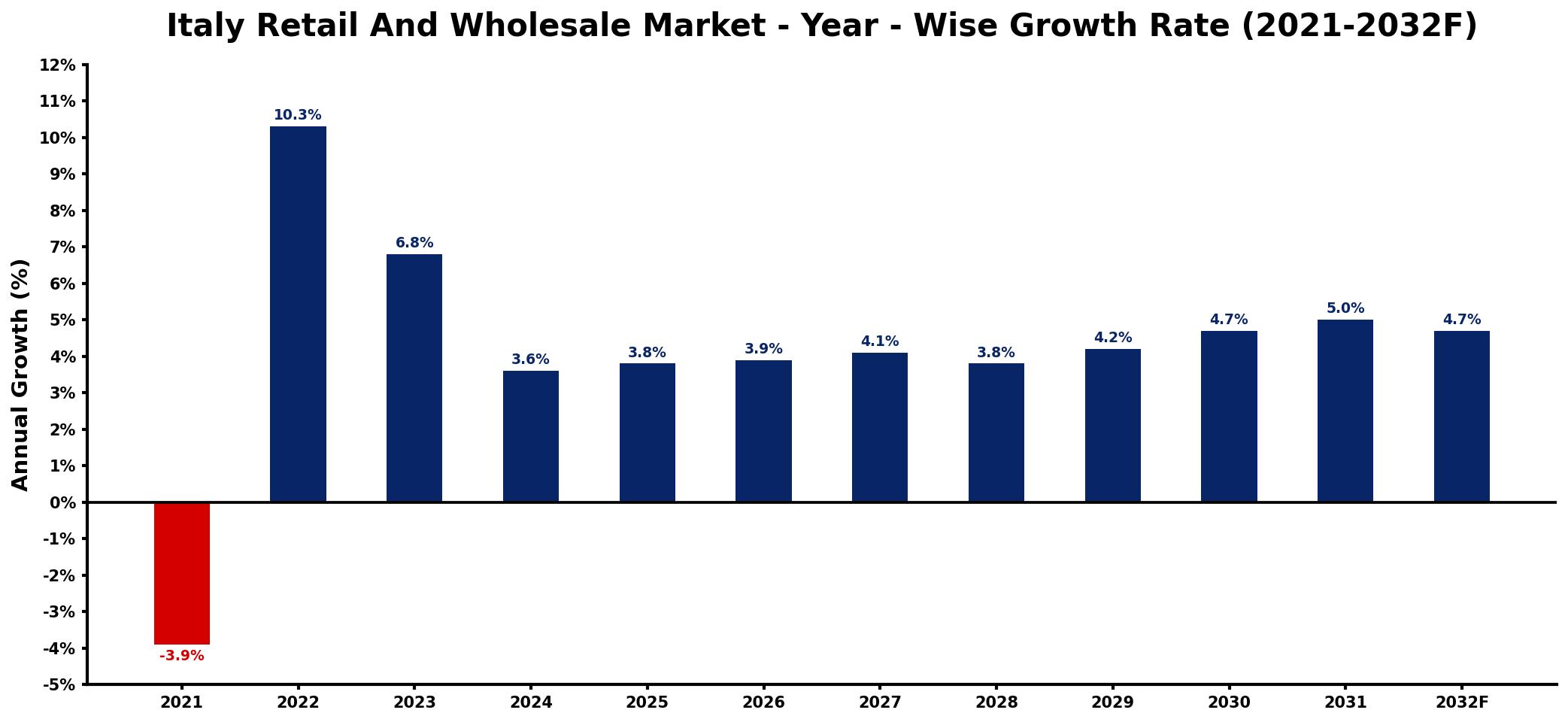
The table below presents the year‑wise growth rates along with the key drivers influencing the market
| Year | Growth Rate | Major Drivers |
| 2021 | -3.9% | decrease in consumer spending habits |
| 2022 | 10.3% | rise in online shopping popularity |
| 2023 | 6.8% | expansion of local brand offerings |
| 2024 | 3.6% | increased disposable income levels |
| 2025 | 3.8% | growth in e-commerce infrastructure |
| 2026 | 3.9% | enhanced supply chain efficiencies |
| 2027 | 4.1% | boost in tourism and hospitality |
| 2028 | 3.8% | development of sustainable practices |
| 2029 | 4.2% | growth of experiential shopping trends |
| 2030 | 4.7% | increase in digital payment adoption |
| 2031 | 5.0% | increased overall sector activity |
| 2032 | 4.7% | stronger distribution network expansion |
Note: Market size estimations and growth projections presented in this report are based on 6Wresearch's proprietary forecasting methodology, utilizing the latest available industry data, government publications, and primary research inputs.
Italy Retail And Wholesale Market Synopsis
The Italian retail and wholesale market is a kaleidoscope of vibrant industries, from fashion to electronics, underscoring its dynamic nature. While recent years have witnessed a surge in e-commerce, the future of retail in Italy is poised for an even more profound transformation, driven by advancements in technology and a growing emphasis on sustainability.
As the sector evolves, traditional shopping experiences are being augmented by innovative omnichannel strategies. Retailers are increasingly focusing on creating personalized and immersive shopping journeys that blend the digital and physical realms, ensuring they meet the evolving demands of Italian consumers.
Italy Retail And Wholesale Market Key Takeaways
- The Italy Retail And Wholesale Market is witnessing a pronounced shift towards e-commerce, with significant growth anticipated over the coming years.
- Italian consumers are increasingly prioritizing sustainability, driving demand for eco-friendly products and transparent supply chains.
- Technological innovations such as AI and augmented reality are being leveraged to enhance customer experiences across retail formats.
- Investment opportunities are prevalent in luxury goods, organic products, and e-commerce technologies.
- Government policies support fair competition and sustainability initiatives, providing a regulatory framework for market growth.
Evaluation of Restraints in Italy Retail And Wholesale Market
Despite the promising growth prospects, the Italian retail and wholesale market faces several real challenges. Heightened competition from online retailers is reshaping the landscape, compelling traditional players to rethink their strategies. Additionally, high operating costs, exacerbated by stringent regulations and taxation, continue to pressure profit margins. Furthermore, economic fluctuations and evolving consumer preferences necessitate agility from businesses to maintain relevance in this rapidly changing environment.
Italy Retail And Wholesale Market Trends
Current trends in the Italy Retail and Wholesale Market indicate a significant pivot towards digitalization and omnichannel retailing. The COVID-19 pandemic catalyzed a rapid adoption of online shopping, with more consumers valuing the convenience and safety that it offers. Furthermore, sustainability is no longer just a preference but a demand, as consumers increasingly seek out brands that prioritize ethical sourcing and eco-friendly practices. Retailers are responding by investing in technologies that enable personalized experiences and foster greater customer engagement.
Italy Retail And Wholesale Market Opportunities
Amidst the challenges, numerous investment opportunities are emerging within the Italy Retail and Wholesale Market. The ongoing growth in e-commerce represents a significant area for investment, particularly in enhancing technology and logistics to facilitate online sales. Additionally, the eco-conscious movement offers fertile ground for companies involved in organic food and sustainable fashion. As Italy remains a global fashion hub, there is also potential in high-end luxury retail, catering to both domestic and international clientele.
Government Initiatives in the Italy Retail And Wholesale Market
The Italian government has implemented various initiatives designed to foster a competitive retail and wholesale environment while ensuring consumer protection. Regulatory measures include restrictions on store opening hours aimed at supporting small businesses, alongside stringent guidelines on pricing transparency. To promote sustainability, the government actively encourages practices that align with eco-friendly values, reinforcing a commitment to both consumer welfare and environmental responsibility.
Future Insights of the Italy Retail And Wholesale Market
Looking ahead to the period from 2026 to 2032, the Italy Retail and Wholesale Market is set to undergo transformative changes. The e-commerce sector is anticipated to expand rapidly, with a growing number of consumers opting for online purchasing options. Sustainability will remain a critical influence on purchasing decisions, necessitating retailers to integrate ethical practices into their business models. As these trends unfold, businesses that leverage technology to improve customer engagement and streamline operations will likely be at the forefront of market growth.
Italy Retail And Wholesale Market Latest Developments (2025 - 2026)
Recent developments in the Italian retail and wholesale market reflect a strong commitment to evolving consumer needs. A noticeable increase in the integration of digital payment solutions has been observed, enhancing the online shopping experience. Furthermore, retailers are innovating their supply chain strategies to meet the growing demand for transparency and sustainability. The focus on personalized marketing techniques is becoming more prevalent, as companies strive to connect with consumers in a more meaningful way.
Italy Retail And Wholesale Market - Key Attractiveness of the Report
- 10 Years of Market Numbers
- Historical Data Starting from 2022 to 2025
- Base Year: 2025
- Forecast Data until 2032
- Key Performance Indicators Impacting the Market
- Major Upcoming Developments and Projects
Key Highlights of the Report:
- Italy Retail And Wholesale Market Outlook
- Market Size of Italy Retail And Wholesale Market, 2025
- Forecast of Italy Retail And Wholesale Market, 2032
- Historical Data and Forecast of Italy Retail And Wholesale Revenues & Volume for the Period 2022-2032F
- Italy Retail And Wholesale Market Trend Evolution
- Italy Retail And Wholesale Market Drivers and Challenges
- Italy Retail And Wholesale Price Trends
- Italy Retail And Wholesale Porter's Five Forces
- Italy Retail And Wholesale Industry Life Cycle
- Historical Data and Forecast of Italy Retail And Wholesale Market Revenues & Volume By Type for the Period 2022-2032F
- Historical Data and Forecast of Italy Retail And Wholesale Market Revenues & Volume By Retail for the Period 2022-2032F
- Historical Data and Forecast of Italy Retail And Wholesale Market Revenues & Volume By Wholesale for the Period 2022-2032F
- Historical Data and Forecast of Italy Retail And Wholesale Market Revenues & Volume By Ownership for the Period 2022-2032F
- Historical Data and Forecast of Italy Retail And Wholesale Market Revenues & Volume By Retail Chain/Wholesale Chain for the Period 2022-2032F
- Historical Data and Forecast of Italy Retail And Wholesale Market Revenues & Volume By Independent Retailer/Independent Wholesalers for the Period 2022-2032F
- Historical Data and Forecast of Italy Retail And Wholesale Market Revenues & Volume By Price Range for the Period 2022-2032F
- Historical Data and Forecast of Italy Retail And Wholesale Market Revenues & Volume By Premium for the Period 2022-2032F
- Historical Data and Forecast of Italy Retail And Wholesale Market Revenues & Volume By Mid-Range for the Period 2022-2032F
- Historical Data and Forecast of Italy Retail And Wholesale Market Revenues & Volume By Economy for the Period 2022-2032F
- Historical Data and Forecast of Italy Retail And Wholesale Market Revenues & Volume By Distribution Channel for the Period 2022-2032F
- Historical Data and Forecast of Italy Retail And Wholesale Market Revenues & Volume By Supermarkets/Hypermarkets for the Period 2022-2032F
- Historical Data and Forecast of Italy Retail And Wholesale Market Revenues & Volume By Convenience Stores for the Period 2022-2032F
- Historical Data and Forecast of Italy Retail And Wholesale Market Revenues & Volume By Department Stores for the Period 2022-2032F
- Historical Data and Forecast of Italy Retail And Wholesale Market Revenues & Volume By Specialty Stores for the Period 2022-2032F
- Italy Retail And Wholesale Import Export Trade Statistics
- Market Opportunity Assessment By Type
- Market Opportunity Assessment By Ownership
- Market Opportunity Assessment By Price Range
- Market Opportunity Assessment By Distribution Channel
- Italy Retail And Wholesale Top Companies Market Share
- Italy Retail And Wholesale Competitive Benchmarking By Technical and Operational Parameters
- Italy Retail And Wholesale Company Profiles
- Italy Retail And Wholesale Key Strategic Recommendations






































