Italy Smart Mirror Market Size, Share & Growth Rate
The Italy Smart Mirror Market was estimated at USD 172 Million in 2025 and is projected to reach USD 209 Million by 2032, growing at a CAGR of 2.8% from 2026 to 2032. This growth trajectory is largely attributed to an increasing consumer interest in integrating smart home technology into everyday life, as well as a rising demand for innovative solutions that enhance personal grooming and beauty routines. Additionally, the trend towards personalization and interactive experiences in both residential and commercial environments further fuels market expansion.
Italy Smart Mirror Market Year-wise Growth Rate and Key Drivers
This graph highlights how the Italy Smart Mirror Market has steadily grown over the years, supported by major growth factors.
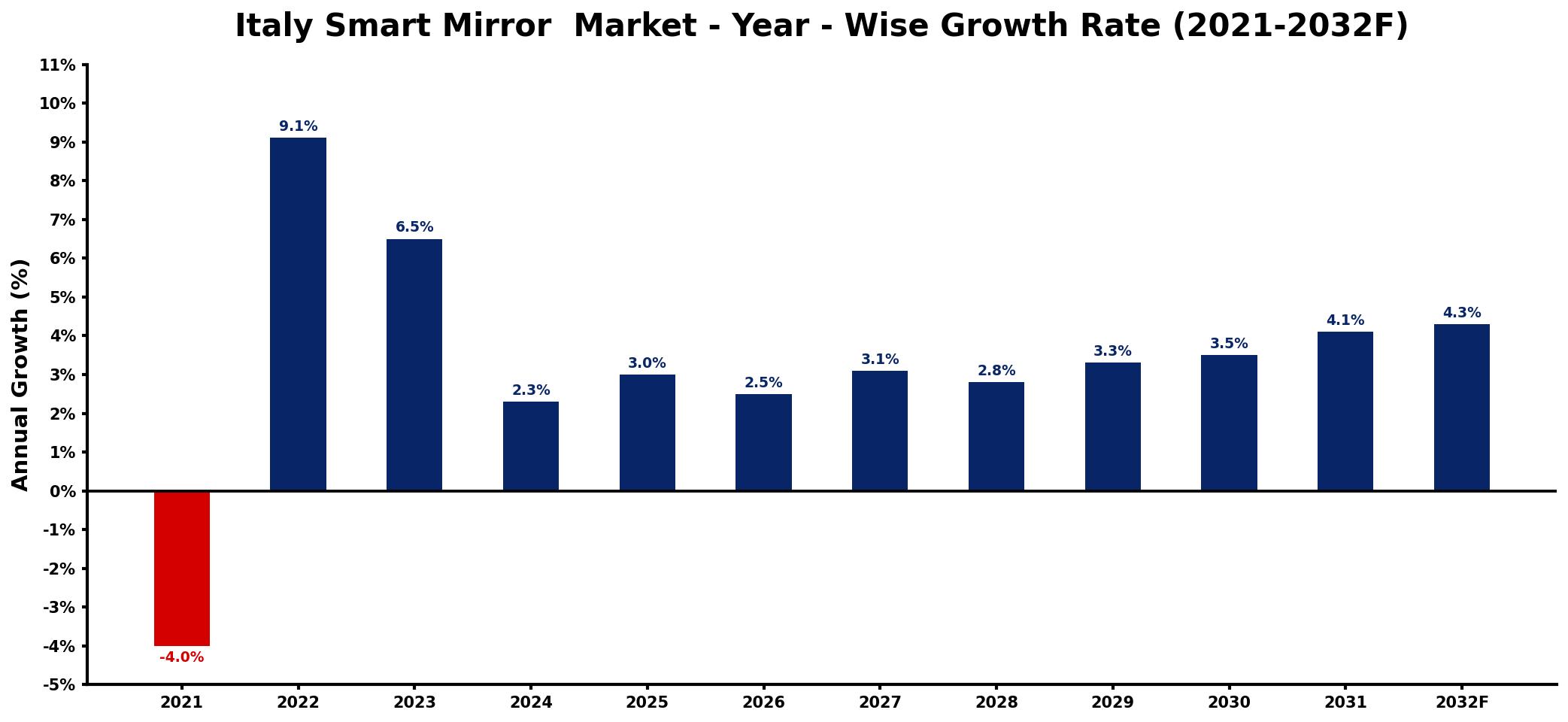
The table below presents the year‑wise growth rates along with the key drivers influencing the market
| Year | Growth Rate | Major Drivers |
| 2021 | -4.0% | decrease in consumer spending habits |
| 2022 | 9.1% | rising interest in home automation |
| 2023 | 6.5% | expansion of digital wellness trends |
| 2024 | 2.3% | growing automotive sector requirements |
| 2025 | 3.0% | growth in online retail channels |
| 2026 | 2.5% | rising demand for personalized experiences |
| 2027 | 3.1% | enhanced consumer awareness of technology |
| 2028 | 2.8% | introduction of innovative design features |
| 2029 | 3.3% | increased focus on energy efficiency |
| 2030 | 3.5% | growing popularity of connected devices |
| 2031 | 4.1% | stronger distribution network expansion |
| 2032 | 4.3% | increased integration with IoT platforms |
Note: Market size estimations and growth projections presented in this report are based on 6Wresearch's proprietary forecasting methodology, utilizing the latest available industry data, government publications, and primary research inputs.
Italy Smart Mirror Market Synopsis
In recent years, Italian consumers have increasingly gravitated toward smart mirrors that combine both functionality and style, indicating a clear shift in purchasing behavior. With features such as built-in LED lighting, touchscreen capabilities, and voice activation, these devices are finding their way into luxury homes, hotels, and retail spaces alike.
The rising trend of health and wellness has also played a significant role in this market's growth. Consumers are now more aware of personalized skincare regimens and are seeking smart mirrors equipped with health tracking features, further driving demand.
Italy Smart Mirror Market Key Takeaways
- The demand for innovative and aesthetically pleasing smart mirrors is surging in Italy.
- Smart mirrors are increasingly integrated with other smart home devices, enhancing their functionality.
- The luxury segment of the market is experiencing rapid growth, driven by high-end design and features.
- Technological advancements, such as AI integration, are enhancing user experiences.
- Consumer awareness and education about smart mirror capabilities are essential for future growth.
Evaluation of Restraints in Italy Smart Mirror Market
Despite the promising growth, several factors pose challenges to the Italy Smart Mirror market. One significant restraint is the high upfront cost associated with purchasing smart mirrors, which may deter average consumers from investing in such technologies. Furthermore, the integration of privacy concerns regarding data collection from these devices is a critical hurdle; many consumers remain wary of how their personal information is used and protected. Additionally, there exists a need for enhanced infrastructure to support the seamless integration of smart mirrors into existing home and commercial environments. A more educated consumer base regarding the advantages and features of smart mirrors would also catalyze broader adoption.
Italy Smart Mirror Market Trends
The market for smart mirrors in Italy is currently shaped by trends emphasizing personalized user experience and advanced technology integration. Features such as virtual try-ons for cosmetics and clothing are becoming increasingly popular, reflecting a broader shift towards experiential shopping. Additionally, there is a marked interest in smart mirrors that can interact with users through voice commands and offer personalized recommendations based on their individual beauty needs.
Another noteworthy trend is the incorporation of health and wellness functionalities, allowing users to track skincare routines and monitor personal health metrics. As the trend toward smart home technology continues to evolve, these features will likely become standard in the market, solidifying smart mirrors as essential tools for modern living.
Italy Smart Mirror Market Opportunities
The future looks promising for the Italy Smart Mirror market, presenting numerous investment opportunities for stakeholders. As consumer demand for innovative solutions grows, there is a significant potential for companies that specialize in smart mirror technology to diversify their offerings. Partnerships with cosmetic brands and health companies can further enhance product appeal and distribution channels. Investments in R&D to create next-generation smart mirrors, incorporating cutting-edge features such as augmented reality and improved AI algorithms, will be crucial. The hospitality and retail sectors present fertile ground for deploying smart mirrors to create interactive customer experiences, driving further market growth.
Government Initiatives in the Italy Smart Mirror Market
The Italian government is actively promoting innovation in technology sectors, including the smart mirror market. Policies designed to support research and development offer incentives that help businesses enhance their technological capabilities. Furthermore, regulations are being implemented to ensure consumer data privacy and security, which are critical for building trust in smart technology. Public funding initiatives encourage small to medium-sized enterprises to adopt smart technologies, further contributing to the growth of this sector. Overall, these efforts create a favorable environment for companies looking to enter or expand within the smart mirror market.
Future Insights of the Italy Smart Mirror Market
Looking ahead to the period from 2026 to 2032, the Italy Smart Mirror market is anticipated to witness substantial growth. This will largely stem from ongoing advancements in technology, such as enhanced voice control features and more sophisticated user interfaces. As the focus on health and wellness continues to rise, smart mirrors that offer health monitoring capabilities will likely attract a wider consumer base. The presence of smart mirrors in commercial spaces, including retail and hospitality, will also play a pivotal role in shaping future market dynamics, allowing for immersive and engaging customer interactions.
Italy Smart Mirror Market Latest Developments (2025 - 2026)
In recent months, the Italy Smart Mirror market has experienced dynamic developments, with companies unveiling new products that integrate cutting-edge technologies. Innovations include smart mirrors that offer seamless connectivity with various smart home devices, providing users with a more cohesive experience. Enhanced features like real-time skincare analysis and personalized beauty tutorials are becoming standard, reflecting consumer demand for tailored solutions. Additionally, collaborations between tech companies and fashion retailers are on the rise, aiming to leverage the power of smart mirrors for improved customer engagement.
Italy Smart Mirror Market - Key Attractiveness of the Report
- 10 Years of Market Numbers
- Historical Data Starting from 2022 to 2025
- Base Year: 2025
- Forecast Data until 2032
- Key Performance Indicators Impacting the Market
- Major Upcoming Developments and Projects
Key Highlights of the Report:
- Italy Smart Mirror Market Outlook
- Market Size of Italy Smart Mirror Market, 2025
- Forecast of Italy Smart Mirror Market, 2032
- Historical Data and Forecast of Italy Smart Mirror Revenues & Volume for the Period 2022-2032F
- Italy Smart Mirror Market Trend Evolution
- Italy Smart Mirror Market Drivers and Challenges
- Italy Smart Mirror Price Trends
- Italy Smart Mirror Porter's Five Forces
- Italy Smart Mirror Industry Life Cycle
- Historical Data and Forecast of Italy Smart Mirror Market Revenues & Volume By Component for the Period 2022-2032F
- Historical Data and Forecast of Italy Smart Mirror Market Revenues & Volume By Hardware for the Period 2022-2032F
- Historical Data and Forecast of Italy Smart Mirror Market Revenues & Volume By Software for the Period 2022-2032F
- Historical Data and Forecast of Italy Smart Mirror Market Revenues & Volume By Services for the Period 2022-2032F
- Historical Data and Forecast of Italy Smart Mirror Market Revenues & Volume By End User for the Period 2022-2032F
- Historical Data and Forecast of Italy Smart Mirror Market Revenues & Volume By Automotive for the Period 2022-2032F
- Historical Data and Forecast of Italy Smart Mirror Market Revenues & Volume By Healthcare for the Period 2022-2032F
- Historical Data and Forecast of Italy Smart Mirror Market Revenues & Volume By Residential for the Period 2022-2032F
- Historical Data and Forecast of Italy Smart Mirror Market Revenues & Volume By Others for the Period 2022-2032F
- Italy Smart Mirror Import Export Trade Statistics
- Market Opportunity Assessment By Component
- Market Opportunity Assessment By End User
- Italy Smart Mirror Top Companies Market Share
- Italy Smart Mirror Competitive Benchmarking By Technical and Operational Parameters
- Italy Smart Mirror Company Profiles
- Italy Smart Mirror Key Strategic Recommendations






































