Japan 3D Modeling Software Market Size & Growth Rate
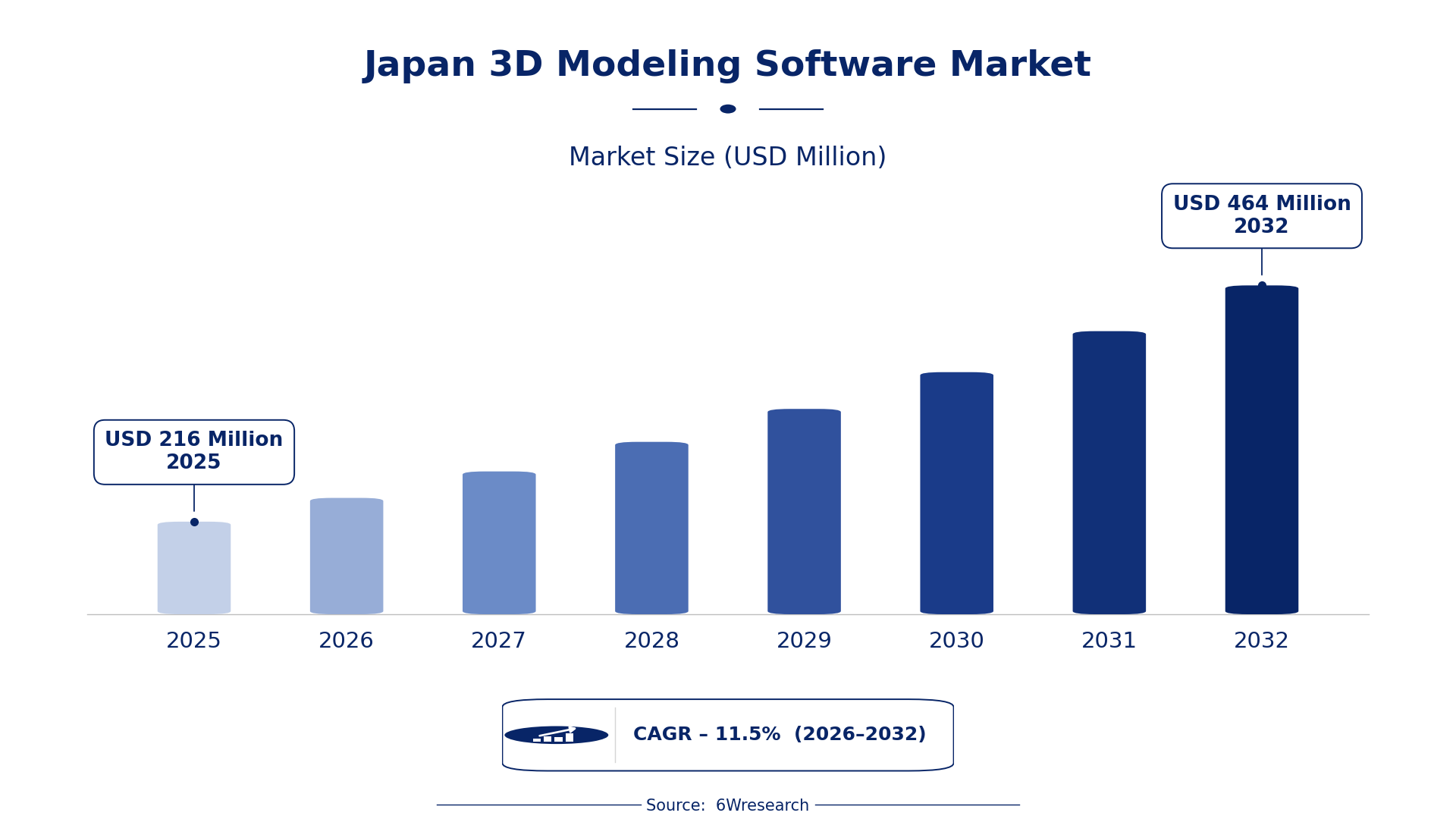
According to 6Wresearch internal database and industry insights, the Japan 3D Modeling Software Market was valued at USD 216 Million in 2025 and is projected to reach USD 464 Million by 2032, growing at a CAGR of approximately 11.5% during 2026–2032.
Japan 3D Modeling Software Market Highlights
| Report Metric | Details |
| Report Name | Japan 3D Modeling Software Market (2026-2032) |
| Market Size 2025 | USD 216 Million |
| Market Size 2032 | USD 464 Million |
| Absolute Growth 2025–2032 | USD 248 Million |
| CAGR 2026–2032 | 11.5% |
| Peak Annual Growth | 13.6% in 2030 |
| Forecast Period | 2026–2032 |
| Historical Data | 2022–2025 |
| Base Year | 2025 |
| Leading Software Type, 2025 | CAD Modeling (37% share) |
| Leading Deployment Mode, 2025 | Cloud-Based (40% share) |
| Leading Application Area, 2025 | Architectural Modeling (43% share) |
| Leading Distribution Channel, 2025 | Online Platforms (39% share) |
| Leading End User, 2025 | Construction Planners (42% share) |
| Fastest-Growing Software Type | BIM Tools (16.5% CAGR) |
| Fastest-Growing Deployment Mode | SaaS (16.8% CAGR) |
| Fastest-Growing Application Area | Engineering Analysis (13.7% CAGR) |
| Fastest-Growing End User | Mechanical Engineers (14.6% CAGR) |
| Growing Sector | Construction and Entertainment |
| Key End Users | Construction Planners, Animation Studios, Product Designers, Mechanical Engineers |
Japan 3D Modeling Software Market Year-wise Growth Rate and Key Drivers (2022–2032)
This graph illustrates the annual growth rates of the market from 2022 to 2032, highlighting a steady upward trajectory and projected market expansion over the forecast period.
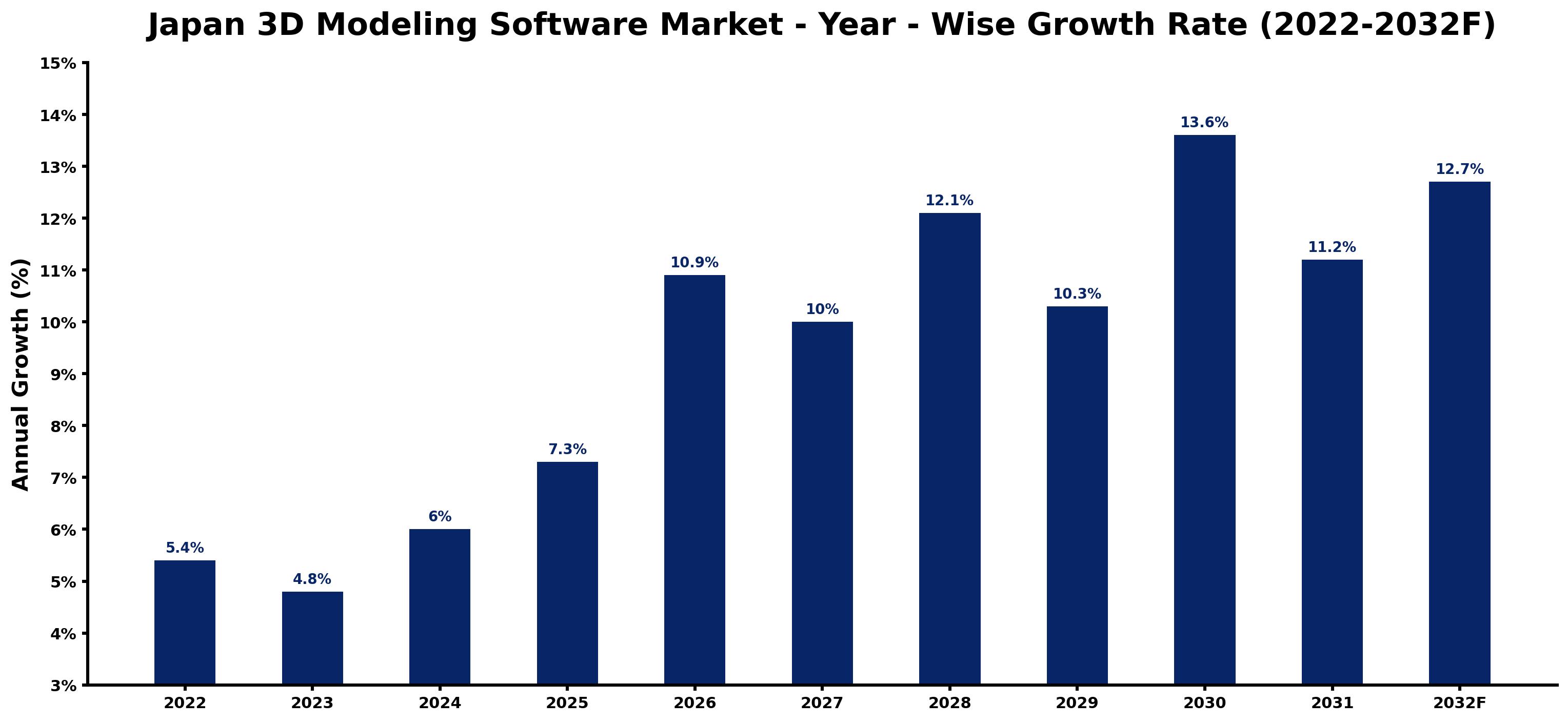
Below, each year's estimated growth is shown next to the factor that most influenced it.
| Year | Estimated Annual Growth (%) | Market Rationale |
| 2022 | 5.4 | The market experienced stable growth due to increasing adoption of digital design tools. |
| 2023 | 4.8 | Growth slowed as the market adjusted to heightened competition and evolving user needs. |
| 2024 | 6.0 | Demand picked up again as construction projects surged, driving software purchases. |
| 2025 | 7.3 | Growth accelerated with the rise of architectural modeling and BIM adoption. |
| 2026 | 10.9 | The market is expected to expand as more firms embrace cloud solutions. |
| 2027 | 10.0 | Growth is projected to slow slightly as market saturation begins to occur. |
| 2028 | 12.1 | Demand will rise as engineering analysis tools gain traction in various sectors. |
| 2029 | 10.3 | The market is anticipated to slow down due to increased competition among providers. |
| 2030 | 13.6 | Growth is expected to peak as BIM adoption reaches targeted levels in construction. |
| 2031 | 11.2 | A slight slowdown is projected as the market stabilizes after rapid expansion. |
| 2032 | 12.7 | Demand will rise again as mechanical engineers increasingly adopt advanced modeling tools. |
Note: Market size estimations and growth projections presented in this report are based on 6Wresearch's proprietary forecasting methodology, utilizing the latest available industry data, government publications, and primary research inputs.
Japan 3D Modeling Software Market Synopsis
3D modeling software enables the creation of three-dimensional representations of objects, primarily used in industrial design, architectural modeling, and character design in animation. The Japan 3D Modeling Software Market is growing due to a population exceeding 126 million and strong demand from construction planners and animation studios. Key drivers include the development of digital skills in construction and the adoption of BIM standards, with the architectural sector leading in software utilisation.
Market Dynamics Impact Analysis (2026–2032)
| Factor | Type | Impact | Primary Segment Affected |
| Increased demand for architectural modeling tools | Driver | High | Architectural Modeling |
| Growing adoption of cloud-based solutions for accessibility | Driver | High | Cloud-Based |
| Expansion of BIM adoption in construction projects | Opportunity | High | BIM Tools |
| Rising need for simulation-integrated tools in engineering | Opportunity | Medium | Simulation-Integrated |
| High competition among software providers | Restraint | High | CAD Modeling |
| Limited awareness of advanced modeling techniques | Restraint | Medium | Organic Modeling |
| Cost pressures from rising minimum wages | Challenge | High | SaaS |
| Capacity constraints in software development | Challenge | Medium | On-Premise |
Evaluation of Drivers in Japan 3D Modeling Software Market (2026–2032)
The following drivers explain most of the expected growth.
| Drivers | Primary Segment Affected | Why It Matters (Evidence) |
| Rising construction projects | Architectural Modeling | The construction industry, valued at approximately ¥60 trillion in 2023, drives demand for architectural modeling tools. |
| Increased remote work | Cloud-Based | The shift towards remote work has led to a 40% share of online platforms in software distribution. |
| Promotion of BIM standards | BIM Tools | The Architectural Institute of Japan's promotion of BIM standards supports the adoption of these tools. |
| Growing engineering workforce | Simulation-Integrated | With around 150,000 engineering graduates in 2022, there is a rising demand for simulation-integrated tools. |
| Demand from animation studios | Character Design | The presence of over 2,000 animation studios in Japan increases the need for character design software. |
The strongest pull on demand comes from the construction sector, valued at approximately ¥60 trillion in 2023, which drives increased purchases of architectural modeling software. The shift towards remote work has resulted in online platforms accounting for 40% of software distribution, prompting more firms to invest in cloud solutions. The push for BIM standards further increases demand for these tools. The engineering workforce, with around 150,000 graduates in 2022, fuels the need for simulation-integrated software. Lastly, the presence of numerous animation studios leads to a growing requirement for character design applications.
Evaluation of Restraints in Japan 3D Modeling Software Market
These are the pressures that could keep growth below its potential.
| Market Restraint | Primary Segment Affected | Why It Matters (Evidence) |
| Skills mismatch in 3D modeling software | BIM Tools | The gap in skills exists due to outdated educational curricula, causing project delays for construction buyers. |
| Intensifying competition among software developers | Cloud-Based | International firms entering the market force local producers to lower prices, reducing profit margins. |
| Supply chain disruptions for key software components | Simulation-Integrated | Delays in product launches impact buyers who rely on timely updates for their projects. |
| Rapid technological advancements | Architectural Modeling | Constant adaptation strains resources for producers and slows innovation cycles for buyers. |
| Limited market penetration in rural areas | Character Design | Urban-centric demand restricts access for potential buyers in less populated regions. |
Japan 3D Modeling Software Market Challenges
In 2022, Japan had around 150,000 engineering graduates, but a skills mismatch in 3D modeling hampers producers' ability to meet demand. This gap exists due to outdated educational curricula, resulting in delays in project completions for buyers in construction. Competition among software developers intensifies as international firms enter the market, forcing local producers to lower prices, which reduces their profit margins. Supply chain disruptions for key components lead to delays in product launches, impacting buyers who rely on timely updates for their projects.
Trends in the Japan 3D Modeling Software Market
Below are the shifts with the largest effect on the Japan 3D Modeling Software Market.
- Shift from On-Premise to Cloud-Based Solutions: Beginning in 2023, the transition to cloud-based solutions is accelerating as construction firms seek flexibility. With 40% of software distribution now online, suppliers must adapt to this demand shift.
- Increased Adoption of BIM Standards: Since 2023, the push for BIM standards has gained momentum, with the Japan Institute of Architects promoting guidelines. This shift improves collaboration among construction professionals, leading to better project outcomes.
- Growth of Simulation-Integrated Tools: In 2023, the rise of simulation-integrated tools has been marked by support from engineering associations. This trend is driven by the need for precise design validation, ensuring higher quality outputs.
- Expansion of Character Design Software: From 2023, character design software has seen increased demand, particularly from animation studios. With over 2,000 studios operating in Japan, this trend reflects a vibrant creative sector.
Investment Opportunities in the Japan 3D Modeling Software Market
The following opportunities in the Japan 3D Modeling Software Market pair current demand with a clear way in.
- Gap in Advanced 3D Modeling Training: With a significant skills gap in advanced 3D modeling, there is a need for training programs. Construction planners require skilled professionals, creating opportunities for educational institutions to develop targeted courses.
- Supply of Cloud-Based Solutions: As remote work rises, there is a growing demand for cloud-based solutions. Construction firms are seeking partnerships with tech providers to improve their digital capabilities and streamline workflows.
- Investment in Simulation-Integrated Software: The engineering sector is increasingly investing in simulation-integrated software. Collaborating with local universities can facilitate access to advanced technology and research, driving innovation.
- Development of Character Design Tools: With over 2,000 animation studios, there is a demand for advanced character design tools. Suppliers can enter the market by partnering with local studios to tailor solutions to specific needs.
Government Initiatives in the Japan 3D Modeling Software Market
The Industrial Standardization Act, established in 1949 and amended in 2019, governs product and test standards in Japan. This law ensures that 3D modeling software meets industry requirements, benefiting producers and buyers by improving product reliability and compliance with regulations.
The Digital Agency, formed in September 2021, leads government digital transformation efforts. It supports initiatives that promote the adoption of digital tools in construction, facilitating easier access for buyers and ensuring compliance with standards and regulations.
Future Insight of the Japan 3D Modeling Software Market
Construction firms will increasingly adopt BIM standards, supported by government initiatives and industry backing. By 2025, Japan aims for 50% BIM adoption, improving collaboration and efficiency for buyers in construction. The integration of advanced simulation tools will become standard, allowing suppliers to provide more sophisticated solutions. As remote work rises, SaaS solutions will gain traction, offering flexible options for users across various sectors.
Market Segmentation Analysis
Japan 3D Modeling Software Market report covers a detailed analysis of the following market segments:
By Software Type – CAD Modeling Leads, BIM Tools Expected to Grow Fastest
According to Vasu Joshi, Associate Consultant at 6Wresearch, the largest software type category in 2025 was CAD Modeling, at 37% of revenue. CAD modeling commands the largest share because it is extensively used in engineering and design industries, especially within the automotive sector. The automotive industry's reliance on CAD for design processes highlights its critical role in Japan's market. The quickest growth will come from BIM Tools, forecast to expand at a CAGR of 16.5% between 2026 and 2032. BIM tools are rapidly gaining traction as they are becoming indispensable for contemporary architectural and construction projects, particularly with the government's aim to boost BIM adoption to 50% by 2025. This focus on digital transformation in construction will contribute to CAD modeling's expanding lead. Suppliers should prioritise the development of BIM tools to align with the increasing demand in the market.
By Deployment Mode – Cloud-Based Leads, SaaS Expected to Grow Fastest
Cloud-Based held 40% of the Japan 3D Modeling Software Market by deployment mode in 2025. Cloud-based solutions dominate the market due to their accessibility and collaboration features, which are particularly beneficial for teams working remotely. The increasing popularity of cloud-based platforms among construction firms in urban areas like Tokyo contributes to this leadership. Over 2026–2032, SaaS are expected to post the fastest growth, at a CAGR of 16.8%. SaaS solutions are projected to grow rapidly as they offer subscription-based access and lower upfront costs, appealing to small and medium enterprises. The trend towards remote work further accelerates the adoption of SaaS in various sectors. Buyers will benefit from exploring SaaS options for cost-effective and flexible software access.
By Application Area – Architectural Modeling Leads, Engineering Analysis Expected to Grow Fastest
With 43% of application area revenue in 2025, Architectural Modeling was the largest category. Architectural modeling dominates the market as it is essential for architects and builders engaged in Japan's vibrant construction industry. The Architectural Institute of Japan's promotion of building information modelling standards highlights the significance of architectural modeling in the sector. Engineering Analysis is projected to grow fastest, at a CAGR of 13.7% during 2026–2032. Engineering analysis is witnessing swift growth as it is crucial for testing and validating designs, particularly in the manufacturing and construction industries. The rising complexity of engineering projects necessitates advanced analysis tools, propelling this segment's expansion. Suppliers should focus on enhancing engineering analysis tools to cater to the growing needs of engineers.
By Distribution Channel – Online Platforms Lead and Record the Fastest Growth
Online Platforms took 39% of distribution channel revenue in 2025, more than any other category. Online platforms are the leading distribution channel as they are increasingly used for software purchases and subscriptions, providing convenience to users. The shift towards digital transactions in Japan's tech-savvy population supports this trend. Online Platforms are also forecast to expand faster than any other category, at a CAGR of 15.2% over 2026–2032. Online platforms are also the fastest-growing channel, driven by the rising preference for digital purchases and the ease of access they provide. This trend is likely to continue as more users become accustomed to online shopping. Suppliers must optimise their online presence to capture the growing number of digital buyers.
By End User – Construction Planners Lead, Mechanical Engineers Expected to Grow Fastest
In 2025, Construction Planners led the end user split with a 42% share. Construction planners represent the largest end user group as they are essential for planning and executing construction projects, which are valued at approximately ¥60 trillion. Their reliance on advanced modeling software solidifies their dominant position in the market. The quickest growth will come from Mechanical Engineers, forecast to expand at a CAGR of 14.6% between 2026 and 2032. Mechanical engineers are the fastest-growing end user segment, utilising software for the design and analysis of mechanical systems in various industries. The increasing complexity of mechanical designs drives this rapid growth. Suppliers should tailor their products to meet the specific needs of mechanical engineers to seize this growth opportunity.
Key Attractiveness of the Report
- 10 Years of Market Numbers
- Historical Data Starting from 2022 to 2025
- Base Year 2025
- Forecast Data until 2032
- Key Performance Indicators Impacting the Market
- Major Upcoming Developments and Projects
Key Highlights of the Report:
- Japan 3D Modeling Software Market Outlook
- Market Size of Japan 3D Modeling Software Market, 2025
- Forecast of Japan 3D Modeling Software Market, 2032
- Historical Data and Forecast of Japan 3D Modeling Software Revenues & Volume for the Period 2022-2032F
- Japan 3D Modeling Software Market Trend Evolution
- Japan 3D Modeling Software Market Drivers and Challenges
- Japan 3D Modeling Software Price Trends
- Japan 3D Modeling Software Porter's Five Forces
- Japan 3D Modeling Software Industry Life Cycle
- Historical Data and Forecast of Japan 3D Modeling Software Market Revenues & Volume By Software Type for the Period 2022-2032F
- Historical Data and Forecast of Japan 3D Modeling Software Market Revenues & Volume By CAD Modeling for the Period 2022-2032F
- Historical Data and Forecast of Japan 3D Modeling Software Market Revenues & Volume By Organic Modeling for the Period 2022-2032F
- Historical Data and Forecast of Japan 3D Modeling Software Market Revenues & Volume By BIM Tools for the Period 2022-2032F
- Historical Data and Forecast of Japan 3D Modeling Software Market Revenues & Volume By Simulation-Integrated for the Period 2022-2032F
- Historical Data and Forecast of Japan 3D Modeling Software Market Revenues & Volume By Deployment Mode for the Period 2022-2032F
- Historical Data and Forecast of Japan 3D Modeling Software Market Revenues & Volume By Cloud-Based for the Period 2022-2032F
- Historical Data and Forecast of Japan 3D Modeling Software Market Revenues & Volume By On-Premise for the Period 2022-2032F
- Historical Data and Forecast of Japan 3D Modeling Software Market Revenues & Volume By Hybrid for the Period 2022-2032F
- Historical Data and Forecast of Japan 3D Modeling Software Market Revenues & Volume By SaaS for the Period 2022-2032F
- Historical Data and Forecast of Japan 3D Modeling Software Market Revenues & Volume By Application Area for the Period 2022-2032F
- Historical Data and Forecast of Japan 3D Modeling Software Market Revenues & Volume By Industrial Design for the Period 2022-2032F
- Historical Data and Forecast of Japan 3D Modeling Software Market Revenues & Volume By Character Design for the Period 2022-2032F
- Historical Data and Forecast of Japan 3D Modeling Software Market Revenues & Volume By Architectural Modeling for the Period 2022-2032F
- Historical Data and Forecast of Japan 3D Modeling Software Market Revenues & Volume By Engineering Analysis for the Period 2022-2032F
- Historical Data and Forecast of Japan 3D Modeling Software Market Revenues & Volume By Distribution Channel for the Period 2022-2032F
- Historical Data and Forecast of Japan 3D Modeling Software Market Revenues & Volume By Direct Sales for the Period 2022-2032F
- Historical Data and Forecast of Japan 3D Modeling Software Market Revenues & Volume By Online Platforms for the Period 2022-2032F
- Historical Data and Forecast of Japan 3D Modeling Software Market Revenues & Volume By Industrial Suppliers for the Period 2022-2032F
- Historical Data and Forecast of Japan 3D Modeling Software Market Revenues & Volume By Specialty Distributors for the Period 2022-2032F
- Historical Data and Forecast of Japan 3D Modeling Software Market Revenues & Volume By End User for the Period 2022-2032F
- Historical Data and Forecast of Japan 3D Modeling Software Market Revenues & Volume By Product Designers for the Period 2022-2032F
- Historical Data and Forecast of Japan 3D Modeling Software Market Revenues & Volume By Animation Studios for the Period 2022-2032F
- Historical Data and Forecast of Japan 3D Modeling Software Market Revenues & Volume By Construction Planners for the Period 2022-2032F
- Historical Data and Forecast of Japan 3D Modeling Software Market Revenues & Volume By Mechanical Engineers for the Period 2022-2032F
- Japan 3D Modeling Software Import Export Trade Statistics
- Market Opportunity Assessment By Software Type
- Market Opportunity Assessment By Deployment Mode
- Market Opportunity Assessment By Application Area
- Market Opportunity Assessment By Distribution Channel
- Market Opportunity Assessment By End User
- Japan 3D Modeling Software Top Companies Market Share
- Japan 3D Modeling Software Competitive Benchmarking By Technical and Operational Parameters
- Japan 3D Modeling Software Company Profiles
- Japan 3D Modeling Software Key Strategic Recommendations
Market Covered
The study includes the following segmentation.
By Software Type
- CAD Modeling
- Organic Modeling
- BIM Tools
- Simulation-Integrated
By Deployment Mode
- Cloud-Based
- On-Premise
- Hybrid
- SaaS
By Application Area
- Industrial Design
- Character Design
- Architectural Modeling
- Engineering Analysis
By Distribution Channel
- Direct Sales
- Online Platforms
- Industrial Suppliers
- Specialty Distributors
By End User
- Product Designers
- Animation Studios
- Construction Planners
- Mechanical Engineers































