Japan 3D Printed Eyewear Market (2026-2032) | Opportunities, Outlook, Companies, Forecast, Competitive, Growth, Value, Strategic Insights, Trends, Investment Trends, Size, Pricing Analysis, Competition, Analysis, Strategy, Challenges, Revenue, Drivers, Consumer Insights, Demand, Segments, Share, Segmentation, Industry, Supply, Restraints
Market Forecast By Material Type (Nylon, Metal, Resins, Others), By Technology (SLS, SLA, Multi Jet Fusion, DLP, FDM), By Application (Sunglasses, Optical Glasses, Sports Glasses, Safety glasses) And Competitive Landscape
| Product Code: ETC11536978 | Publication Date: Apr 2025 | Updated Date: Jul 2026 | Product Type: Market Research Report | |
| Publisher: 6Wresearch | Author: Bhawna Singh | No. of Pages: 70 | No. of Figures: 35 | No. of Tables: 5 |
Japan 3D Printed Eyewear Market Growth Rate
According to 6Wresearch internal database and industry insights, the Japan 3D Printed Eyewear Market is growing at a compound annual growth rate (CAGR) of 6.17% during the forecast period (2026-2032).
Japan 3D Printed Eyewear Market Year-wise Growth Rate and Key Drivers
This graph illustrates the annual growth rates of the Japan 3D Printed Eyewear Market from 2022 to 2032, highlighting a steady upward trajectory and projected market expansion over the forecast period.
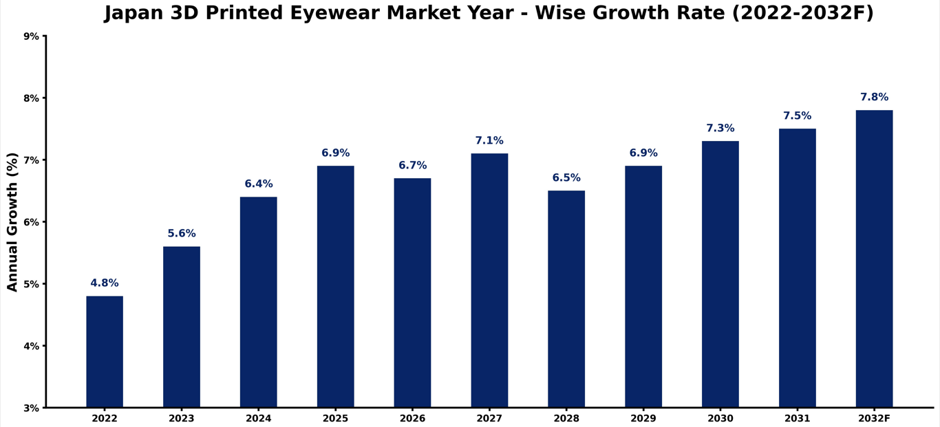
The table below provides a summary of the historical and forecasted growth rates of Japan 3D Printed Eyewear Market, and the rationale behind the performance of each year.
| Year | Estimated Growth (%) | Market Rationale |
| 2022 | 4.8% | Increasing adoption of customized eyewear and early integration of digital design technologies in optical retail. |
| 2023 | 5.6% | Rising use of 3D printing for rapid prototyping and personalized eyewear frame development. |
| 2024 | 6.4% | Growing demand for lightweight frames and improved 3D printing materials for optical applications. |
| 2025 | 6.9% | Expansion of online eyewear platforms and increasing acceptance of personalized frame solutions. |
| 2026 | 6.7% | Wider adoption of digital fitting technologies and increasing use of additive manufacturing in eyewear production. |
| 2027 | 7.1% | Growth supported by AI-based facial scanning and customized eyewear design platforms. |
| 2028 | 6.5% | Temporary moderation due to production cost challenges and limited large-scale adoption. |
| 2029 | 6.9% | Recovery driven by sustainable materials and increasing demand for personalized eyewear solutions. |
| 2030 | 7.3% | Increased automation and improved digital manufacturing capabilities enhance production efficiency. |
| 2031 | 7.5% | Growing adoption of advanced optical technologies and premium customized eyewear products. |
| 2032 | 7.8% | Expansion of mass customization models and stronger integration of digital eyewear manufacturing. |
Topics Covered in the Japan 3D Printed Eyewear Market Report
Japan 3D Printed Eyewear Market report thoroughly covers the market by material type, technology, and application. The market report provides an unbiased and detailed analysis of ongoing market trends, opportunities/high growth areas, and market drivers, which would help stakeholders devise and align their market strategies according to the current and future market dynamics.
Japan 3D Printed Eyewear Market Highlights
| Report Name | Japan 3D Printed Eyewear Market |
| Forecast period | 2026–2032 |
| CAGR | 6.17% |
| Growing Sector | Optical Glasses |
Japan 3D Printed Eyewear Market Synopsis
The Japan 3D Printed Eyewear Market is witnessing strong growth driven by rising demand for customized optical products and rapid adoption of additive manufacturing in the eyewear industry. The market is supported by Japan’s aging population requiring precision vision correction, increasing fashion-driven eyewear demand, and strong retail digitization. Government initiatives such as Japan’s Digital Agency smart retail transformation projects are accelerating adoption. In addition, AI-based facial scanning and cloud eyewear design platforms, are improving personalization, production efficiency, and environmental performance across optical retail and manufacturing ecosystems.
Evaluation of Growth Drivers in the Japan 3D Printed Eyewear Market (2026-2032)
Below mentioned are some major growth drivers and their influence on market dynamics:
| Drivers | Primary Segments Affected | Why It Matters |
| Rising Demand for Custom Eyewear | Optical Glasses, Retail Stores | Consumers increasingly prefer personalized frames for comfort, fit, and fashion improving satisfaction and repeat purchases significantly. |
| Aging Population & Vision Correction Needs | Optical Glasses, Hospitals/Clinics | Increasing elderly population results in the requirement for precise lightweight eyewear that supports better vision correction and daily usability needs. |
| Government Digital Manufacturing Initiatives | Manufacturing, Deployment Model | Promotes the adoption of additive manufacturing, accelerate smart production ecosystems and strengthen the competitiveness of Japan's advanced eyewear manufacturing. |
| AI-Based Facial Scanning & Fitting | Retail, Optical Chains | Augment frame fitting accuracy, decreases returns and refines customer experience with personalized frame recommendations. |
| Sustainable Manufacturing Push | Materials, Manufacturing Units | Encourages eco-friendly materials usage, reduces production waste, and supports long-term sustainability goals across eyewear manufacturing sector. |
Japan 3D Printed Eyewear Market is projected to grow significantly, with a CAGR of 6.17% during the forecast period of 2026-2032. The market growth is driven by increasing demand for personalized eyewear, rising fashion consciousness, and growing adoption of digital optical retail solutions. The advancement of AI-based facial scanning technologies and additive manufacturing systems is boosting the accuracy and customer satisfaction. Moreover, Japan’s focus on sustainable production practices and smart manufacturing ecosystems is also driving the growth of the market across the optical and fashion industries.
Evaluation of Restraints in the Japan 3D Printed Eyewear Market
Below mentioned are some major restraints and their influence on market dynamics:
| Restraints | Primary Segments Affected | What This Means |
| High Production and Equipment Costs | SMEs, Manufacturing Units | Limits adoption among small optical retailers due to high initial investment requirements and restricted scalability. |
| Material Limitations in Durability | Material Type (Resins, Polymers) | Restricts long-term usage of some 3D printed eyewear frames affecting product reliability and consumer trust levels. |
| Limited Consumer Awareness | Retail, End Users | Slows adoption in non-urban and price-sensitive segments due to low awareness of customization benefits. |
| Precision and Quality Control Issues | Manufacturing, Technology | Mass customization has still the challenge to keep a uniform quality, which affects the overall brand reliability and production efficiency. |
| Integration with Traditional Optical Retail Systems | Deployment Model, Retail Chains | Digital transformation of traditional eyewear stores is mainly hindered by system compatibility and operation shift. |
Japan 3D Printed Eyewear Market Challenges
In the Japan 3D Printed Eyewear Market, reliance on high-precision additive manufacturing equipment increases production costs, restricting the market to smaller optical retailers. However, the integration of AI-powered fitting systems into the current optical retail infrastructure is still complex, due to the fragmented adoption of digital solutions. The absence of standard materials for long-term durability also leads to inconsistencies in performance. In addition, Japan’s strict quality certification criteria for optical products can hold up the commercialisation of new 3D printed eyewear innovations.
Japan 3D Printed Eyewear Market Trends
Below are some major trends contributing to the Japan 3D Printed Eyewear Market Growth:
- AI-Powered Face Scanning and Virtual Try-On: AI-driven facial mapping improves frame fitting accuracy, reduces returns, and enhances online eyewear shopping experience significantly for customers.
- Sustainable and Bio-Based Materials Adoption: Increasing use of eco-friendly polymers reduces environmental impact, supports circular manufacturing practices, and aligns with sustainability-focused consumer preferences globally.
- Smart Retail Integration: Digital kiosks and cloud-based eyewear platforms improve customer experience, simplifying design customization and improve the retail operational efficiency.
Investment Opportunities in Japan 3D Printed Eyewear Market
Below mentioned are some investment opportunities in the Japan 3D Printed Eyewear Industry:
- Mass Customization Platforms: Development of digital eyewear design platforms to support scalable personalized production, improve customer interaction and increase repeat purchase rates.
- Sports and Performance Eyewear: There is a strong demand for lightweight, durable, ergonomic sports eyewear that drives a high adoption among professional athletes and active lifestyle consumers.
- Safety and Industrial Eyewear Solutions: Increasing industrial safety regulations are driving demand for customized protective eyewear that offers better compliance, comfort and workplace safety standards.
Key Players in the Japan 3D Printed Eyewear Market
Here are some top companies contributing to Japan 3D Printed Eyewear Market Share:
1. JINS Holdings Inc.
| Company Name | JINS Holdings Inc. |
|---|---|
| Established Year | 1988 |
| Headquarters | Tokyo, Japan |
| Official Website | Click Here |
JINS Holdings Inc. is a leading eyewear retailer in Japan actively investing in digital customization technologies and smart optical retail systems.
2. Materialise
| Company Name | Materialise |
|---|---|
| Established Year | 1990 |
| Headquarters | Leuven, Belgium |
| Official Website | Click Here |
Materialise specializes in advanced 3D printing software and medical-grade additive manufacturing solutions, enabling precision-driven customization in eyewear, healthcare, and industrial applications.
3. HOYA Vision Care
| Company Name | HOYA Vision Care |
|---|---|
| Established Year | 1941 |
| Headquarters | Tokyo, Japan |
| Official Website | Click Here |
HOYA Vision Care provides advanced optical lenses and eyewear solutions with strong focus on precision optics and customized lens technologies.
4. MYKITA GmbH
| Company Name | MYKITA GmbH |
|---|---|
| Established Year | 2003 |
| Headquarters | Berlin, Germany |
| Official Website | Click Here |
MYKITA GmbH specializes in high-end, minimalist eyewear design, including lightweight metal frames and innovative 3D-printed components for premium customized eyewear solutions.
5. Seiko Optical Products Co., Ltd.
| Company Name | Seiko Optical Products Co., Ltd. |
|---|---|
| Established Year | 1881 |
| Headquarters | Tokyo, Japan |
| Official Website | Click Here |
Seiko Optical Products focuses on precision optical lenses and eyewear systems with emphasis on high-performance vision correction solutions.
Government Regulations Introduced in the Japan 3D Printed Eyewear Market
According to Japanese government data, some regulatory and digital manufacturing initiatives supports the growth of the Japan 3D Printed Eyewear Market. The Ministry of Economy, Trade and Industry (METI) promotes “Digital Monozukuri” initiatives to strengthen additive production capabilities. Japan’s Society 5.0 framework supports integration of AI into consumer manufacturing industries, including eyewear. Japan Agency for Medical Research and Development (AMED) supports research into advanced optical materials. Additionally, the Digital Agency of Japan is driving nationwide digital transformation of retail ecosystems to enhance cloud-based customization platforms.
Future Insights of the Japan 3D Printed Eyewear Market
The Japan 3D Printed Eyewear Market perspective is very positive with more of the ongoing innovations in AI-enabled customization and additive manufacturing techniques further driving personalization and market growth over the next few years. Also, the cloud-based design systems and distributed manufacturing hubs will offer more efficiency and scalability. Furthermore, these ongoing government initiatives are to promote digital manufacturing and sustainability that will significantly strengthen future market expansion across optical and fashion industries.
Market Segmentation Analysis
The report offers a comprehensive study of the following market segments and their leading categories.
By Material Type – Market Dominated by Nylon, Resins Set for Expansion
According to Bhawna Singh, Senior Research Analyst, 6Wresearch, in 2025, Nylon accounted for a dominant share of 45.10%, owing to its lightweight nature, flexibility, and durability, making it ideal for eyewear frames. On the other hand, Resins is expected to drive the market growth at a CAGR of 6.30% during forecast period 2026-2032.
By Technology – Market Dominated by SLS, Multi Jet Fusion Set for Growth
SLS represented 38.60% of the market in 2025, owing to its capability to produce precise, lightweight, and durable frames without the need for support structures. However, Multi Jet is anticipated to grow at a CAGR of 6.75% during 2026–2032, due to increasing adoption in optical retail and demand for high-precision customized production of eyewear.
By Application – Market Dominated by Optical Glasses, Sunglasses Set for Growth
Optical Glasses dominated with 57.40% share in 2025 due to rising vision correction needs and aging population in Japan. Sunglasses is projected to rise at a CAGR of 6.10% during 2026–2032 forecast period, driven by AI-based fitting systems, increasing digital eye strain, and demand for tailored prescription eyewear solutions.
Note: Market size estimations and growth projections presented in this report are based on 6Wresearch’s advanced forecasting approach, validated with industry datasets as of June 2026.
Key attractiveness of the report
- 10 Years Market Numbers
- Historical Data Starting from 2022 to 2025
- Base Year: 2025
- Forecast Data until 2032
- Key Performance Indicators Impacting the Market
- Major Upcoming Developments and Projects
Key Highlights of the Report:
- Japan 3D Printed Eyewear Market Outlook
- Market Size of Japan 3D Printed Eyewear Market, 2025
- Forecast of Japan 3D Printed Eyewear Market, 2032
- Historical Data and Forecast of Japan 3D Printed Eyewear Revenues & Volume for the Period 2022-2032
- Japan 3D Printed Eyewear Market Trend Evolution
- Japan 3D Printed Eyewear Market Drivers and Challenges
- Japan 3D Printed Eyewear Price Trends
- Japan 3D Printed Eyewear Porter's Five Forces
- Japan 3D Printed Eyewear Industry Life Cycle
- Historical Data and Forecast of Japan 3D Printed Eyewear Market Revenues & Volume By Material Type for the Period 2022-2032
- Historical Data and Forecast of Japan 3D Printed Eyewear Market Revenues & Volume By Nylon for the Period 2022-2032
- Historical Data and Forecast of Japan 3D Printed Eyewear Market Revenues & Volume By Metal for the Period 2022-2032
- Historical Data and Forecast of Japan 3D Printed Eyewear Market Revenues & Volume By Resins for the Period 2022-2032
- Historical Data and Forecast of Japan 3D Printed Eyewear Market Revenues & Volume By Others for the Period 2022-2032
- Historical Data and Forecast of Japan 3D Printed Eyewear Market Revenues & Volume By Technology for the Period 2022-2032
- Historical Data and Forecast of Japan 3D Printed Eyewear Market Revenues & Volume By SLS for the Period 2022-2032
- Historical Data and Forecast of Japan 3D Printed Eyewear Market Revenues & Volume By SLA for the Period 2022-2032
- Historical Data and Forecast of Japan 3D Printed Eyewear Market Revenues & Volume By Multi Jet Fusion for the Period 2022-2032
- Historical Data and Forecast of Japan 3D Printed Eyewear Market Revenues & Volume By DLP for the Period 2022-2032
- Historical Data and Forecast of Japan 3D Printed Eyewear Market Revenues & Volume By FDM for the Period 2022-2032
- Historical Data and Forecast of Japan 3D Printed Eyewear Market Revenues & Volume By Application for the Period 2022-2032
- Historical Data and Forecast of Japan 3D Printed Eyewear Market Revenues & Volume By Sunglasses for the Period 2022-2032
- Historical Data and Forecast of Japan 3D Printed Eyewear Market Revenues & Volume By Optical Glasses for the Period 2022-2032
- Historical Data and Forecast of Japan 3D Printed Eyewear Market Revenues & Volume By Sports Glasses for the Period 2022-2032
- Historical Data and Forecast of Japan 3D Printed Eyewear Market Revenues & Volume By Safety glasses for the Period 2022-2032
- Japan 3D Printed Eyewear Import Export Trade Statistics
- Market Opportunity Assessment By Material Type
- Market Opportunity Assessment By Technology
- Market Opportunity Assessment By Application
- Japan 3D Printed Eyewear Top Companies Market Share
- Japan 3D Printed Eyewear Competitive Benchmarking By Technical and Operational Parameters
- Japan 3D Printed Eyewear Company Profiles
- Japan 3D Printed Eyewear Key Strategic Recommendations
Market covered
The report subsequently covers the market by following segments and subsegments.
By Material Type
- Nylon
- Metal
- Resins
- Others
By Technology
- SLS
- SLA
- Multi Jet Fusion
- DLP
- FDM
By Application
- Sunglasses
- Optical Glasses
- Sports Glasses
- Safety Glasses
Japan 3D Printed Eyewear Market (2026-2032): FAQs
The Japan 3D Printed Eyewear Market is projected to grow at a CAGR of 6.17% during the forecast period (2026-2032).
The regulatory infrastructures by Japan’s PMDA and Ministry of Economy, Trade and Industry (METI) ensure quality standards and innovation support for advanced optical and additive manufacturing systems.
Optical glasses and fashion eyewear frames are most widely adopted due to rising vision correction demand, while sports and safety eyewear are gaining momentum owing to custom-made needs.
High optical manufacturing ecosystem and a mix of AI-based design systems, supporting rapid deployment of 3D printed eyewear solutions globally.
6Wresearch actively monitors the Japan 3D Printed Eyewear Market and publishes its comprehensive annual report, highlighting emerging trends, growth drivers, revenue analysis, and forecast outlook. Our insights help businesses to make data-backed strategic decisions with ongoing market dynamics. Our analysts track relevent industries related to the Japan 3D Printed Eyewear Market, allowing our clients with actionable intelligence and reliable forecasts tailored to emerging regional needs.
Yes, we provide customisation as per your requirements. To learn more, feel free to contact us on sales@6wresearch.com
| 1 Executive Summary |
| 2 Introduction |
| 2.1 Key Highlights of the Report |
| 2.2 Report Description |
| 2.3 Market Scope & Segmentation |
| 2.4 Research Methodology |
| 2.5 Assumptions |
| 3 Japan 3D Printed Eyewear Market Overview |
| 3.1 Japan Country Macro Economic Indicators |
| 3.2 Japan 3D Printed Eyewear Market Revenues & Volume, 2022 & 2032F |
| 3.3 Japan 3D Printed Eyewear Market - Industry Life Cycle |
| 3.4 Japan 3D Printed Eyewear Market - Porter's Five Forces |
| 3.5 Japan 3D Printed Eyewear Market Revenues & Volume Share, By Material Type, 2022 & 2032F |
| 3.6 Japan 3D Printed Eyewear Market Revenues & Volume Share, By Technology, 2022 & 2032F |
| 3.7 Japan 3D Printed Eyewear Market Revenues & Volume Share, By Application, 2022 & 2032F |
| 4 Japan 3D Printed Eyewear Market Dynamics |
| 4.1 Impact Analysis |
| 4.2 Market Drivers |
| 4.2.1 Technological advancements in 3D printing technology |
| 4.2.2 Rising trend of customization and personalization in eyewear |
| 4.2.3 Growing demand for lightweight and comfortable eyewear options |
| 4.3 Market Restraints |
| 4.3.1 High initial investment in 3D printing equipment and materials |
| 4.3.2 Limited awareness and adoption of 3D printed eyewear among consumers |
| 4.3.3 Quality control challenges in ensuring consistent product quality |
| 5 Japan 3D Printed Eyewear Market Trends |
| 6 Japan 3D Printed Eyewear Market, By Types |
| 6.1 Japan 3D Printed Eyewear Market, By Material Type |
| 6.1.1 Overview and Analysis |
| 6.1.2 Japan 3D Printed Eyewear Market Revenues & Volume, By Material Type, 2022-2032F |
| 6.1.3 Japan 3D Printed Eyewear Market Revenues & Volume, By Nylon, 2022-2032F |
| 6.1.4 Japan 3D Printed Eyewear Market Revenues & Volume, By Metal, 2022-2032F |
| 6.1.5 Japan 3D Printed Eyewear Market Revenues & Volume, By Resins, 2022-2032F |
| 6.1.6 Japan 3D Printed Eyewear Market Revenues & Volume, By Others, 2022-2032F |
| 6.2 Japan 3D Printed Eyewear Market, By Technology |
| 6.2.1 Overview and Analysis |
| 6.2.2 Japan 3D Printed Eyewear Market Revenues & Volume, By SLS, 2022-2032F |
| 6.2.3 Japan 3D Printed Eyewear Market Revenues & Volume, By SLA, 2022-2032F |
| 6.2.4 Japan 3D Printed Eyewear Market Revenues & Volume, By Multi Jet Fusion, 2022-2032F |
| 6.2.5 Japan 3D Printed Eyewear Market Revenues & Volume, By DLP, 2022-2032F |
| 6.2.6 Japan 3D Printed Eyewear Market Revenues & Volume, By FDM, 2022-2032F |
| 6.3 Japan 3D Printed Eyewear Market, By Application |
| 6.3.1 Overview and Analysis |
| 6.3.2 Japan 3D Printed Eyewear Market Revenues & Volume, By Sunglasses, 2022-2032F |
| 6.3.3 Japan 3D Printed Eyewear Market Revenues & Volume, By Optical Glasses, 2022-2032F |
| 6.3.4 Japan 3D Printed Eyewear Market Revenues & Volume, By Sports Glasses, 2022-2032F |
| 6.3.5 Japan 3D Printed Eyewear Market Revenues & Volume, By Safety glasses, 2022-2032F |
| 7 Japan 3D Printed Eyewear Market Import-Export Trade Statistics |
| 7.1 Japan 3D Printed Eyewear Market Export to Major Countries |
| 7.2 Japan 3D Printed Eyewear Market Imports from Major Countries |
| 8 Japan 3D Printed Eyewear Market Key Performance Indicators |
| 8.1 Average production time per pair of 3D printed eyewear |
| 8.2 Percentage of repeat customers purchasing customized eyewear |
| 8.3 Number of collaborations with fashion designers or influencers to create exclusive 3D printed eyewear designs |
| 9 Japan 3D Printed Eyewear Market - Opportunity Assessment |
| 9.1 Japan 3D Printed Eyewear Market Opportunity Assessment, By Material Type, 2022 & 2032F |
| 9.2 Japan 3D Printed Eyewear Market Opportunity Assessment, By Technology, 2022 & 2032F |
| 9.3 Japan 3D Printed Eyewear Market Opportunity Assessment, By Application, 2022 & 2032F |
| 10 Japan 3D Printed Eyewear Market - Competitive Landscape |
| 10.1 Japan 3D Printed Eyewear Market Revenue Share, By Companies, 2025 |
| 10.2 Japan 3D Printed Eyewear Market Competitive Benchmarking, By Operating and Technical Parameters |
| 11 Company Profiles |
| 12 Recommendations |
| 13 Disclaimer |
Global Go To Market Strategy - 2030
Export potential enables firms to identify high-growth global markets with greater confidence by combining advanced trade intelligence with a structured quantitative methodology. The framework analyzes emerging demand trends and country-level import patterns while integrating macroeconomic and trade datasets such as GDP and population forecasts, bilateral import–export flows, tariff structures, elasticity differentials between developed and developing economies, geographic distance, and import demand projections. Using weighted trade values from 2020–2024 as the base period to project country-to-country export potential for 2030, these inputs are operationalized through calculated drivers such as gravity model parameters, tariff impact factors, and projected GDP per-capita growth. Through an analysis of hidden potentials, demand hotspots, and market conditions that are most favorable to success, this method enables firms to focus on target countries, maximize returns, and global expansion with data, backed by accuracy.
By factoring in the projected importer demand gap that is currently unmet and could be potential opportunity, it identifies the potential for the Exporter (Country) among 190 countries, against the general trade analysis, which identifies the biggest importer or exporter.
To discover high-growth global markets and optimize your business strategy:
Click Here
Pricing
- Single User License$ 1,995
- Department License$ 2,400
- Site License$ 3,120
- Global License$ 3,795

Leadership Perspectives from Industry Events
Search
Thought Leadership and Analyst Meet





Our Clients








6WResearch In News
- India Export Attractiveness Tracker 2026
- India Air Conditioner Market Set for Strong Rebound in 2026 After Weather-Led Correction and GST-Driven Recovery: 6Wresearch
- ADAS in India: How Automatic Emergency Braking, Blind Spot Detection & Driver Monitoring are Transforming Road Safety
- Doha a strategic location for EV manufacturing hub: IPA Qatar
- Demand for luxury TVs surging in the GCC, says Samsung
- Empowering Growth: The Thriving Journey of Bangladesh’s Cable Industry
Latest Reports
- Nicaragua RPG Gaming Market (2026-2032)
- New Zealand RPG Gaming Market (2026-2032)
- Netherlands RPG Gaming Market (2026-2032)
- Nauru RPG Gaming Market (2026-2032)
- Namibia RPG Gaming Market (2026-2032)
- Mozambique RPG Gaming Market (2026-2032)
- Montenegro RPG Gaming Market (2026-2032)
- Mongolia RPG Gaming Market (2026-2032)
- Monaco RPG Gaming Market (2026-2032)
- Micronesia RPG Gaming Market (2026-2032)
Industry Events and Analyst Meet

EV India Expo 2026

HIMTEX 2026

India Refining Summit 2026

India EV Show 2026

EV tech India Expo 2026
Whitepaper
- Middle East & Africa Commercial Security Market Click here to view more.
- Middle East & Africa Fire Safety Systems & Equipment Market Click here to view more.
- GCC Drone Market Click here to view more.
- Middle East Lighting Fixture Market Click here to view more.
- GCC Physical & Perimeter Security Market Click here to view more.


